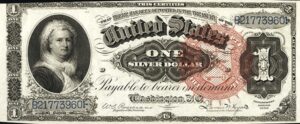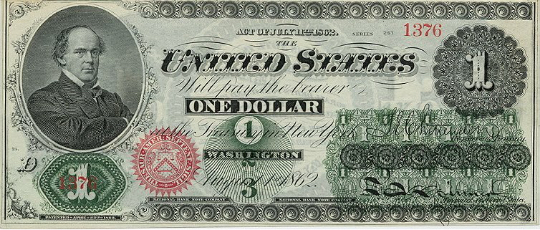
📷 Image source: AI generated. Images are selected by AI to represent the article topic and may not depict the exact note(s) described.
🎧 Listen to this article
Narrated by Algenib · 11,036 characters
Introduction: The Last of America’s Redeemable Paper Money
Silver Certificates hold a unique place in American monetary history. From their introduction in 1878 through their final printing in 1963, these notes promised the bearer a fixed quantity of silver on demand. The 1935 and 1957 series represent the final two major runs of the small-size Silver Certificate, and together they account for billions of notes printed over nearly three decades. For collectors today, this abundance is both a blessing and a challenge: most notes are common, but hidden within the vast printings are a handful of genuinely scarce varieties that reward the patient, knowledgeable collector.
Understanding Silver Certificates: A Brief Foundation
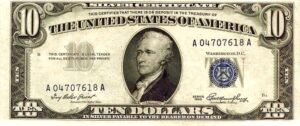
Silver Certificates were authorized by the Act of February 28, 1878, and the Act of August 4, 1886. They circulated alongside Federal Reserve Notes and United States Notes, distinguished by their blue Treasury seal and serial numbers. Holders could, in theory, walk into any Treasury facility and exchange the note for its face value in silver coin or silver bullion. This redemption right remained legally intact until the Silver Purchase Act repeal and the subsequent June 24, 1968, deadline set by Congress. After that date, Silver Certificates became simply collector items, no longer exchangeable for anything other than Federal Reserve Notes at face value.
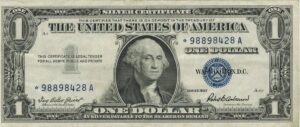
The small-size Silver Certificate was standardized in 1928 alongside all other U.S. paper currency. The face of the $1 denomination features a portrait of George Washington, the same basic design used to this day on the $1 Federal Reserve Note. The reverse carries the familiar ONE DOLLAR text framed by ornate engravings. What changed across the 1935 and 1957 series were the signature combinations, series letter suffixes, and minor design tweaks that make this field endlessly interesting.
The 1935 Series: Eight Varieties Over Two Decades
The 1935 series began production under Secretary of the Treasury Henry Morgenthau Jr. and Register of the Treasury Lauress Williams, and it ran through a remarkable eight alphabetical suffix designations: 1935, 1935A, 1935B, 1935C, 1935D, 1935E, 1935F, and 1935G, followed finally by 1935H. Each new suffix generally signaled a change in the signature combination of the Treasurer of the United States and the Secretary of the Treasury, though the 1935E suffix was so large it alone accounted for billions of notes.
1935 (No Suffix) – Friedberg 1606
The original 1935 issue carries the signatures of Secretary Morgenthau and Treasurer William A. Julian. Printed in relatively modest quantities compared to later suffixes, the 1935 no-suffix note is scarce in high grades. Circulated examples in Very Fine grade typically trade around $3 to $6, but a Gem Uncirculated (PMG 65 EPQ or better) example can bring $75 to $150 depending on centering and paper quality. Star notes from this issue are genuine rarities.
1935A – Friedberg 1607 and the Hawaii and North Africa Wartime Issues
The 1935A suffix is arguably the most historically significant stop in the entire series, because it produced three distinct notes rather than one. The standard 1935A (Friedberg 1607) was printed with Julian-Morgenthau signatures in large quantities and remains common in circulated grades. However, two emergency wartime overprint varieties also carry the 1935A designation.
The 1935A Hawaii Overprint (Friedberg 2300) was issued following the attack on Pearl Harbor. The word HAWAII was overprinted in large brown letters on the reverse, and the serial numbers and Treasury seal were printed in brown rather than blue. This was a security measure: if the Hawaiian Islands fell to Japanese forces, the government could declare these notes invalid, preventing the enemy from using standard U.S. currency. Star notes of the Hawaii overprint are among the most coveted small-size currency rarities, with print runs estimated at roughly 204,000 star notes. A Fine example of a Hawaii star regularly sells for $1,500 or more.
The 1935A North Africa Overprint (Friedberg 2306) carried a yellow Treasury seal and was issued for use by Allied forces in North Africa, again as a security measure. Regular issues are scarce; star notes are extremely rare. A PMG Very Fine 30 star note example sold at auction in 2022 for over $9,000.
When examining 1935A Hawaii or North Africa overprint notes, always verify the seal color and overprint ink under good lighting. Genuine Hawaii notes have brown serials and seal; North Africa notes have yellow seals. Counterfeits and altered notes do exist. Buying examples certified by PMG or PCGS Currency is strongly recommended for these high-value varieties.
1935B through 1935D
The 1935B (Friedberg 1608) carries Julian-Vinson signatures, reflecting the appointment of Fred M. Vinson as Treasury Secretary in 1945. The 1935C (Friedberg 1609) uses Julian-Snyder signatures, while the 1935D (Friedberg 1610) pairs Priest-Humphrey signatures. All three suffixes were printed in substantial quantities and are common in circulated grades. The 1935D is particularly notable because it represents a transitional moment: the switch from mottled blue-gray to a smoother paper finish was beginning, though this change is subtle and best evaluated in hand.
1935E: The Giant of the Series
The 1935E (Friedberg 1611) is the most commonly encountered Silver Certificate in existence. Printed with Priest-Anderson signatures under a booming postwar economy and massive Federal demand, the 1935E run totaled approximately 5.134 billion notes, not counting star note replacements. This makes circulated 1935E notes essentially face value items. That said, a perfectly centered, bright white Gem Uncirculated example graded PMG 67 EPQ can still bring $40 to $80 from condition-conscious collectors.
For common Silver Certificate issues like the 1935E and 1957, focusing on exceptional condition is the most practical collecting strategy. A note graded PMG 66 EPQ or PCGS 66 PPQ in a common series can be worth five to ten times a VF example of the same note, and finding true Gems with original paper and strong margins is harder than it sounds.
1935F, 1935G, and 1935H
The 1935F (Friedberg 1612) carries Smith-Dillon signatures and the 1935G (Friedberg 1613) pairs Smith-Dillon as well, with a subtle back plate change distinguishing the two in some references. The 1935H (Friedberg 1614), with Granahan-Dillon signatures, is among the scarcer suffix varieties of the 1935 series in strict Uncirculated condition, even though its total printing was not dramatically lower than 1935F. Star notes for the 1935H are notably scarce.
The 1957 Series: Simplification and the Final Years
By 1957, the Bureau of Engraving and Printing had modernized its printing process significantly. The 1957 series introduced dry printing (replacing the older wet printing method) across the board, which produced notes with sharper, higher-relief impressions and superior paper stability. Collectors can distinguish dry-printed notes from wet-printed examples by slight dimensional differences and a crisper overall appearance.
1957 (No Suffix) – Friedberg 1619
The original 1957 note carries Priest-Anderson signatures, the same pairing found on the 1935E. Printed in substantial numbers, these are common in all circulated grades. The design is effectively identical to late 1935-series notes at a glance, but the dry-print process gives them a slightly different feel. Uncirculated examples are plentiful, and even PMG 65 EPQ notes rarely exceed $20 to $30 in today’s market.
1957A – Friedberg 1620
Smith-Dillon signatures define the 1957A. This is one of the most frequently encountered Silver Certificates at coin shows and in dealer stocks. Total printings ran into the billions. Star notes, however, are another story: the 1957A star note in Uncirculated condition commands a modest premium, generally $15 to $35 in Gem, but remains accessible to beginning collectors.
1957B – Friedberg 1621
The 1957B, bearing Granahan-Dillon signatures, was the final Silver Certificate series produced before the denomination was discontinued. Production ended in 1963, and with redemption rights expiring in 1968, these notes quickly became collectibles. The 1957B is common in circulated grades; star notes in top condition are modestly scarce but not difficult to locate through major dealers.
Building a complete date-and-signature type set of 1935 and 1957 Silver Certificates, including the wartime overprint varieties, is an achievable and rewarding goal. Excluding the North Africa star note, a collector with a budget of $500 to $800 can assemble a solid VF to EF set covering all major Friedberg numbers. Adding the Hawaii overprint and North Africa regular issue will push the budget higher but is still manageable compared to many other currency series.
Star Notes Across Both Series
Star notes, those replacement notes with a star symbol in place of the last serial number digit, carry premiums in virtually every series. For 1935 and 1957 Silver Certificates, the relative rarity of star notes varies dramatically by suffix. The 1935A North Africa star, the 1935H star, and the 1935 no-suffix star are the most significant. Among the 1957 series, all three suffix stars are relatively common in circulated grades but can still be collected as a sub-specialty.
Grading Considerations for Silver Certificates
Silver Certificates from these series were heavily circulated, and finding original-paper, well-centered examples is genuinely difficult. Key grading factors include: paper quality and crispness, sharpness of the blue seal and serial numbers, margin evenness on all four sides, and the absence of folds, stains, or cleaning. Many Silver Certificates have been pressed or cleaned to simulate higher grades. Third-party grading by PMG (Paper Money Guaranty) or PCGS Currency is the best protection against overgraded or doctored notes, especially for the premium varieties like the Hawaii and North Africa overprints.
| Series / Suffix | Friedberg No. | Approx. Print Run | Rarity |
|---|---|---|---|
| 1935 (No Suffix) | F-1606 | ~653 million | Scarce in Gem |
| 1935A Hawaii Overprint | F-2300 | ~35.5 million reg. / 204,000 star | Key Date |
| 1935A North Africa Overprint | F-2306 | ~8.7 million (star: very limited) | Key Date |
| 1935E | F-1611 | ~5.134 billion | Common |
| 1935G | F-1613 | ~194 million | Scarce |
| 1935H | F-1614 | ~106 million | Scarce |
| 1935H Star Note | F-1614* | ~1.8 million | Rare in Gem |
| 1957 (No Suffix) | F-1619 | ~2.609 billion | Common |
| 1957A | F-1620 | ~1.594 billion | Common |
| 1957B | F-1621 | ~979 million | Common |
Conclusion: Why These Notes Still Matter to Collectors
The 1935 and 1957 Silver Certificate series offer something for every level of collector. A beginner can spend a few dollars and hold a piece of American monetary history in hand. An advanced collector can spend years hunting superb Gem examples, elusive star notes, and the extraordinary wartime overprint varieties. The series is fully cataloged, widely studied, and supported by excellent reference literature, including Arthur and Ira Friedberg’s standard catalog and the more detailed specialized works on wartime currency.
Perhaps most importantly, these notes represent the end of an era. When Silver Certificate redemption closed on June 24, 1968, the United States officially severed the last link between its paper currency and a physical precious metal. Every 1935 and 1957 Silver Certificate is a tangible artifact of a monetary system that no longer exists, and that alone makes them worth collecting with care and knowledge.