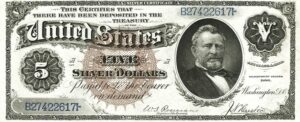
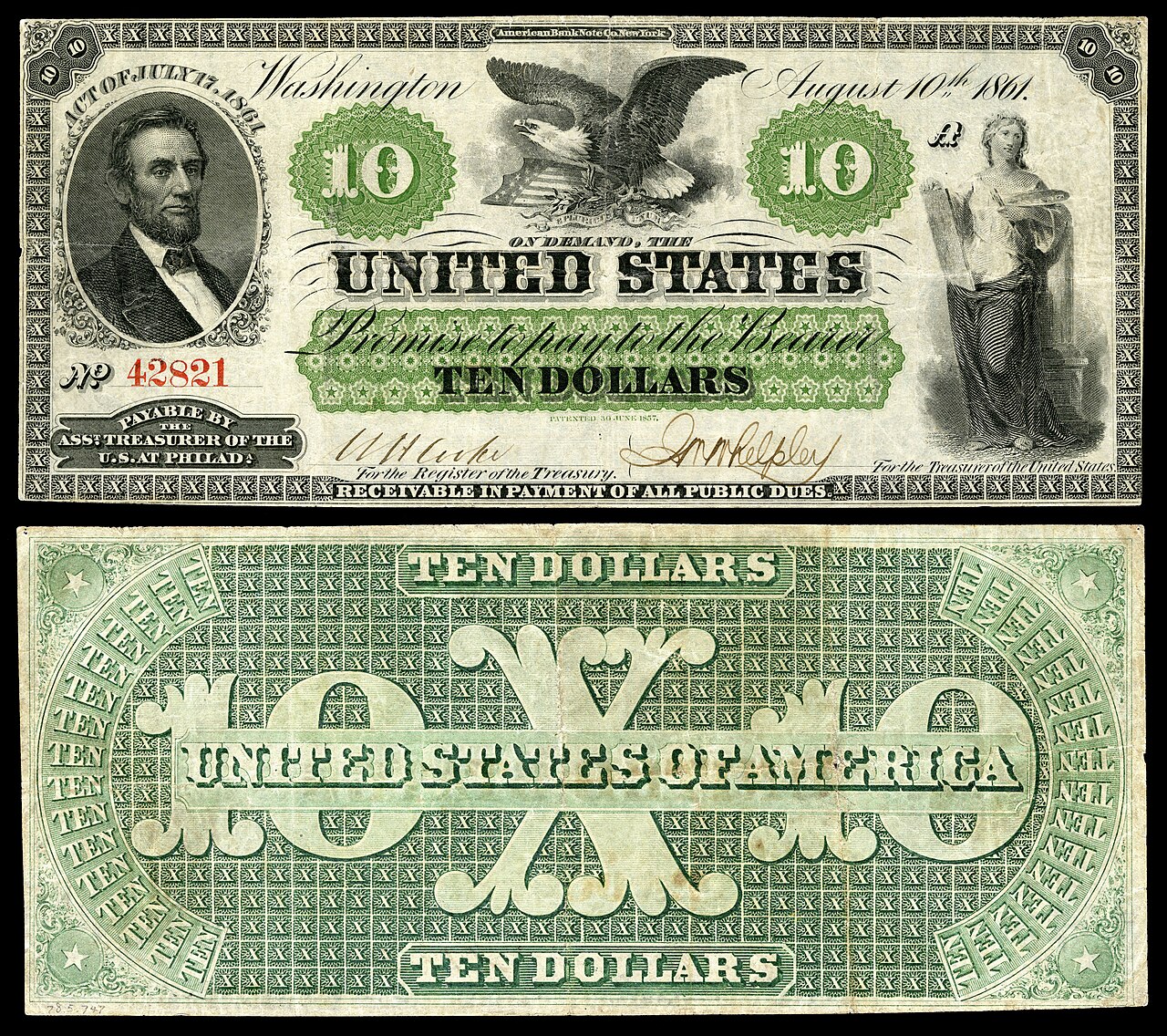
📷 Image source: National Numismatic Collection, National Museum of American History (via Wikimedia Commons). Images are selected by AI to represent the article topic and may not depict the exact note(s) described.
Pick up almost any worn $1 Federal Reserve Note from your change drawer, and you would toss it back without a second thought. Now imagine holding a piece of paper that is over 160 years old, that helped finance the bloodiest conflict ever fought on American soil, and that represents the very birth of federal paper currency in the United States. That is what you are holding when you examine a Demand Note of 1861, and the reason even a heavily circulated example with missing corners and heavy folds is considered a genuine trophy by collectors worldwide.
The Birth of Greenbacks: Historical Context Every Collector Must Know
When President Lincoln signed the Act of July 17, 1861, he authorized the Treasury Department to issue $50 million in demand notes as an emergency measure to fund the Union war effort. These were not the first paper instruments to circulate in America, but they were the first notes issued directly by the federal government and made payable by Treasury itself rather than by a state-chartered bank. The phrase printed on each note, “payable to bearer on demand,” was not marketing language. It was a legal commitment that holders could redeem these notes for gold or silver coin at any of the designated sub-treasuries.
The notes were printed by the American Bank Note Company and the National Bank Note Company, working in tandem under a Treasury contract. They were produced on a paper stock that, while considered adequate for the era, was never designed to survive 160 years of handling, humidity, folding, and the general indignities of circulation. The fact that any examples survive at all is remarkable. The fact that some survive in the upper grades is nothing short of astonishing.
Three denominations were issued: the $5 (featuring a portrait of Alexander Hamilton at left and an eagle at right), the $10 (with Abraham Lincoln at left and an eagle at center), and the $20 (with a Liberty figure). The back of each denomination was printed in green ink, which gave rise to the popular nickname “greenbacks” that Americans still use today for paper currency. These notes are, quite literally, where the term originated.
When examining a Demand Note, always check the payable city handstamp or printed city designation carefully. Notes payable at Cincinnati (Fr. 6, Fr. 9) and St. Louis (Fr. 7, Fr. 10) are considerably scarcer than their New York, Philadelphia, and Boston counterparts, and that city designation dramatically affects value even at the same grade level.
Why Standard Grading Logic Does Not Fully Apply
In virtually every other series of U.S. paper money, a note grading Good-4 by PCGS or PMG standards is considered a low-grade circulated example worth a fraction of its Fine or Extremely Fine counterparts. Collectors typically pursue the finest known specimens, and circulated examples at the Good level are often regarded as space-fillers at best. Demand Notes of 1861 operate under an entirely different collecting philosophy, one that seasoned numismatists understand instinctively but that trips up newer collectors constantly.
The reason is survival rate. Across all types and issuing cities, the total number of known Demand Notes is estimated at somewhere between 1,400 and 1,600 individual notes. Compare that to the tens of millions of 1861-era Confederate notes that survive, or even the thousands of examples known for common Large Size type notes from the 1880s and 1890s. For certain Demand Note varieties, such as the $10 payable at St. Louis (Fr. 10), the total known population may be fewer than ten examples. When fewer than ten of something exist on the entire planet, the concept of penalizing a note for wear becomes almost philosophically absurd.
Professional grading services, primarily PMG (Paper Money Guaranty) and PCGS Currency, apply their standard numerical grading scale to Demand Notes, but the market’s interpretation of those grades is radically compressed at the upper end relative to all other series. A Demand Note grading Very Fine-25 would be considered a genuinely exceptional piece. An example grading Extremely Fine-40 would be front-page news in the numismatic press. A note grading Choice Uncirculated-63 or above is, for most varieties, essentially hypothetical. The finest known $5 Demand Note (Fr. 1, New York) certified by PMG is graded VF-35, and it is regarded as one of the most significant pieces of U.S. currency ever certified.
The PMG and PCGS Grading Framework Applied to 1861 Notes
Both major grading services apply their standard 70-point Sheldon-derived scale to Demand Notes, but with important qualifications that appear as grading notations on the holder label. Understanding these notations is critical to properly evaluating any certified example you encounter at auction or in a dealer’s inventory.
At the Good-4 to Good-6 level, a Demand Note typically exhibits heavy circulation with significant folds, possible edge tears that do not extend into the design, some soiling or staining, and possibly a small amount of missing paper at the corners. Despite all of this wear, the design elements remain identifiable, the signatures (where present) are legible, and the overall structural integrity of the note is maintained. At this grade, you are holding a piece of paper that circulated in the months following Fort Sumter, perhaps paid a Union soldier’s wages or purchased supplies for a Northern household, and survived the entire span of American history since then. A Good-4 Demand Note typically sells at major auctions for $3,000 to $8,000 depending on denomination and issuing city.
The Very Good-8 to Very Good-10 range represents a note with somewhat lighter circulation, cleaner margins, and folds that are well-defined but not so heavy as to cause separation. Details in the vignettes remain clear. At this level, expect auction realization of $5,000 to $15,000 for common types such as the $5 New York or $10 Philadelphia.
Pay close attention to PMG and PCGS qualifier notations on Demand Note holders. Notations like “Splits,” “Repair,” “Stains,” or “Pinholes” can significantly affect market value even when the numerical grade appears respectable. A PMG Very Fine-25 with a “Repair” notation will trade at a substantial discount to a straight VF-25, sometimes 40 to 60 percent lower for this series.
Fine-12 to Fine-15 examples show moderate circulation with sharp folds and some evidence of handling throughout, but all design elements remain fully intact and the margins are reasonably preserved. These are genuinely desirable collector pieces and for several scarce varieties represent the finest known examples in existence. A Fine-15 $10 Cincinnati Demand Note (Fr. 9) is a legitimately important numismatic artifact.
Very Fine examples, grading from VF-20 through VF-35, are landmark pieces for any variety. Light to moderate folds, excellent color retention on both the face (black ink) and back (green ink), and clean margins characterize this grade range. For the more common New York and Philadelphia types, VF examples do appear at major auction houses with some regularity, typically bringing $20,000 to $60,000 or more at Heritage Auctions, Stack’s Bowers, or Lyn Knight sale venues.
Signatures, Handstamps, and the “For the” Varieties
One fascinating aspect of grading and authenticating Demand Notes involves the signature panels. Each note was supposed to be signed by Treasury officials, specifically the Register of the Treasury and the Treasurer of the United States. However, the enormous volume of notes required the use of clerks who signed “for the” Register or Treasurer. Notes bearing the full actual signatures of Lucius Chittenden (Register) or Francis Spinner (Treasurer) are known but rare. Most examples bear clerk-applied “for the” signatures, and some later issues had the “for the” language printed directly on the note rather than written by hand.
This creates distinct varieties catalogued separately in the Friedberg reference. The Fr. 1 through Fr. 4 (and their subvariants a and b) for the $5 denomination, Fr. 5 through Fr. 7 for the $10, and Fr. 8 through Fr. 10 for the $20 all have printed-versus-handwritten signature distinctions that affect both rarity and value. Graders examine these details carefully, and a misattributed variety can mean a significant difference in market value.
The Friedberg catalog designations for Demand Notes extend to “a” and “b” subvarieties based on whether the words “for the” appear in manuscript (handwritten) or are printed directly on the note. A note listed as Fr. 1a (handwritten “for the”) is considerably rarer than Fr. 1b (printed “for the”), and building a complete type set of all major varieties requires significant research and patience before acquisition.
Authentication Concerns and Altered Notes
Because genuine Demand Notes command substantial prices even in low grades, the numismatic community has long been aware of altered and counterfeit examples. The most common deception involves taking later-issue notes from 1862 or 1863 that share similar designs and attempting to alter them to appear as 1861 Demand Notes. Chemical washing to remove ink, the addition of false signatures, and the alteration of payable city designations have all been documented in the literature.
This is precisely why certification by PMG or PCGS is not merely recommended for Demand Notes. It is essentially mandatory for any serious collector. The grading services employ ultraviolet examination, paper fiber analysis under magnification, and comparison against known genuine examples from their reference archives. An uncertified Demand Note, regardless of how convincing it appears, carries authentication risk that no prudent buyer should accept at the prices these notes command.
| Friedberg No. | Denomination and City | Est. Notes Known | Rarity |
|---|---|---|---|
| Fr. 1 / Fr. 1a | $5, New York (handwritten “for the”) | Approx. 300-400 | Scarce |
| Fr. 1b | $5, New York (printed “for the”) | Approx. 500-600 | Common (for type) |
| Fr. 2 | $5, Philadelphia | Approx. 150-200 | Scarce |
| Fr. 3 | $5, Boston | Approx. 100-150 | Rare |
| Fr. 6 | $10, Cincinnati | Approx. 40-60 | Rare |
| Fr. 7 | $10, St. Louis | Fewer than 10 | Key Date |
| Fr. 9 | $20, Philadelphia | Approx. 80-120 | Rare |
| Fr. 10 | $20, Cincinnati | Approx. 20-30 | Key Date |
| Fr. 11 / Fr. 11b | $20, New York | Approx. 200-280 | Scarce |
Building a Collection: Practical Strategies
Most collectors who pursue Demand Notes do so with one of two goals: acquiring a single type example (usually the most affordable common type in the lowest acceptable grade) or attempting to build a complete denomination set. A complete set of all major Friedberg types is a multi-decade, multi-hundred-thousand-dollar endeavor that very few collectors have ever accomplished. The complete set assembled by the late Amon Carter Jr. remains one of the most celebrated collections in American numismatic history.
For collectors entering the series today, the $5 New York Fr. 1b in Good to Very Good condition represents the most accessible entry point, typically available through major auction houses or specialized dealers for $4,000 to $8,000 in genuine circulated grades. This gives you the iconic design, a historically significant issuing city, and an authentic connection to the birth of federal paper currency without requiring the budget of an institutional collector.
When budgeting for a Demand Note purchase, allocate funds for full auction fees and insurance costs upfront. Major auction houses typically charge buyer’s premiums of 17 to 20 percent on top of the hammer price for currency lots, and given the values involved, having the note professionally insured during transit and in your collection is strongly advisable. The total cost of ownership is meaningfully higher than the gavel price alone.
Conclusion: Rethinking What “Condition” Means
Grading Demand Notes of 1861 is ultimately an exercise in perspective. Every principle you learn about pursuing high-grade examples, about the premium that separates a Fine from a Very Fine, about the importance of originality and eye appeal, all of those principles still apply here. But they apply within a context that no other American series shares: an absolute scarcity so severe that every surviving example, regardless of grade, represents a meaningful piece of United States monetary history.
When you hold a Good-4 Demand Note with its heavy folds and slightly ragged edges, you are not looking at a damaged relic. You are looking at evidence of actual use, of a note that served the exact purpose for which the Lincoln administration created it, circulating hand to hand through a nation fighting for its survival. The wear is not a flaw. It is a biography. And that is why even the most circulated examples belong, without apology, in the finest company American numismatics has to offer.