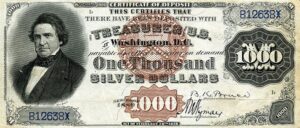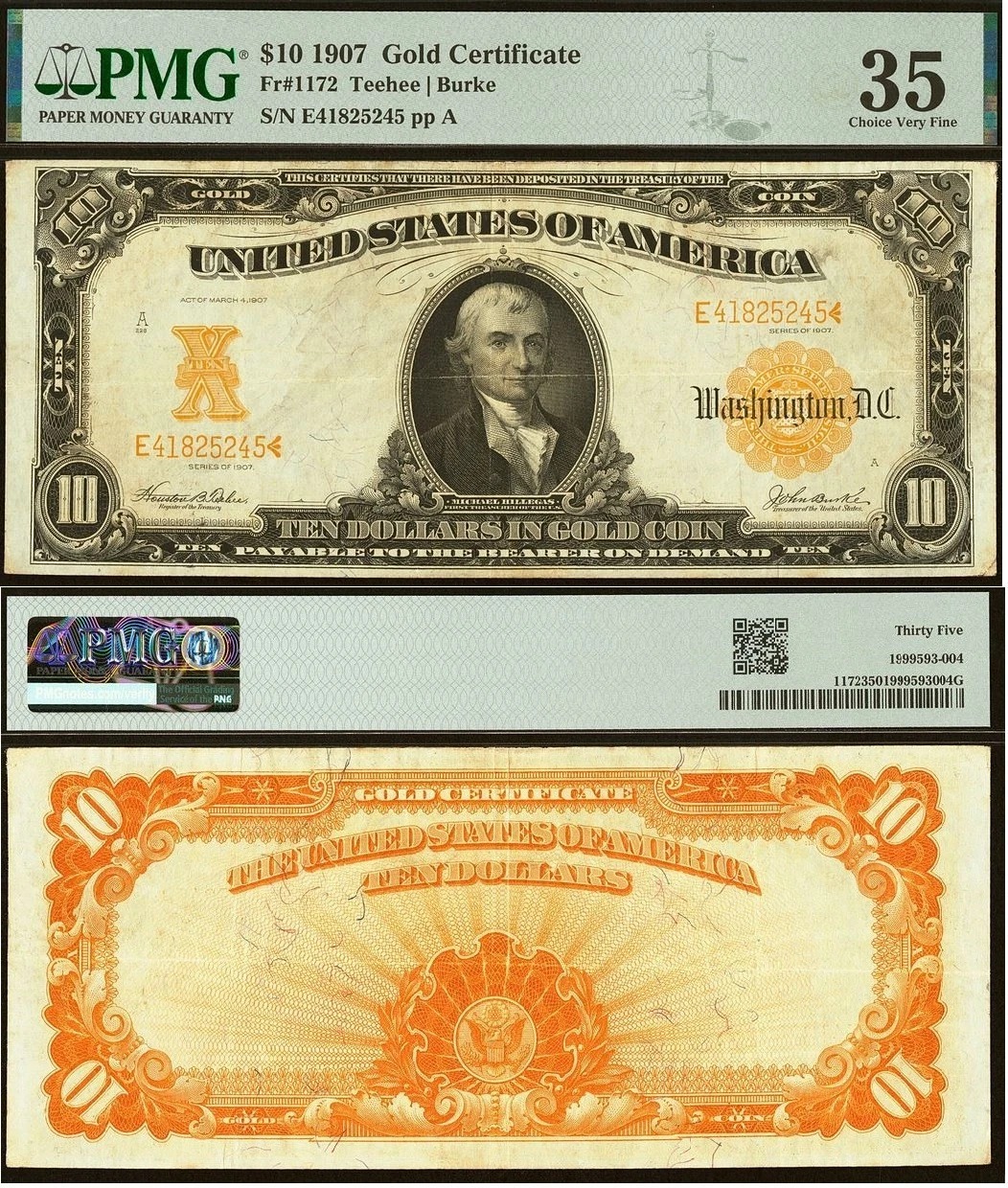
📷 Image source: Wikimedia Commons. Images are selected by AI to represent the article topic and may not depict the exact note(s) described.
Pick up a large-size National Bank Note from 1910 or a Gold Certificate from the Series of 1907, and you are holding a piece of paper that circulated during one of the most audacious experiments in American statecraft ever attempted. Between 1909 and 1913, the Taft administration formalized what became known as Dollar Diplomacy, a doctrine that explicitly substituted financial penetration for military occupation across Central America and the Caribbean. The policy shaped how the world perceived American currency, accelerated the push toward a centralized banking system that would produce the Federal Reserve Act of 1913, and left a paper trail, both diplomatic and monetary, that serious collectors can still trace today.
The Doctrine Explained: Money as a Substitute for Marines
Taft articulated the doctrine most clearly in his 1912 message to Congress, stating that the policy substituted dollars for bullets. The mechanism was straightforward in concept, if brutal in execution. American banking consortia, most prominently Brown Brothers and J. and W. Seligman, would refinance the debts of Central American and Caribbean nations that were dangerously overextended with European creditors, particularly British and German banks. Once American financiers held those debts, US diplomatic and sometimes military leverage ensured repayment. Customs houses, the primary revenue source for these governments, were placed under American supervision as collateral. The dollar, quite literally, became the instrument of sovereignty transfer.
Nicaragua offers the starkest example. By 1911, the country owed substantial sums to British bondholders. Knox negotiated the Knox-Castrillo Convention, which would have formalized American financial control, though the US Senate rejected it. The administration proceeded anyway through private arrangements, and Brown Brothers along with Seligman took control of the Nicaraguan National Bank and the Pacific Railway. American-supervised customs collection followed. When General Emiliano Chamorro’s government wavered, US Marines landed in 1912, remaining almost continuously until 1933. The dollar had arrived first; the rifles confirmed its authority.
Large-size National Bank Notes issued by New York City charter banks with close ties to the Seligman and Brown Brothers networks, particularly notes from the First National Bank of New York (Charter 29) dated between 1902 and 1913, are worth examining for provenance. While the notes themselves don’t carry diplomatic markings, their issuing institutions were direct instruments of Dollar Diplomacy. A Series 1902 Date Back $20 from Charter 29 in Fine to Very Fine condition catalogues in the $300 to $600 range but carries historical context most price guides simply cannot quantify.
The Currency Landscape of the Taft Years
To understand what Dollar Diplomacy meant for actual paper money, it helps to survey what was in American wallets and foreign treasuries during 1909 to 1913. The United States was still issuing large-size notes, measuring approximately 7.375 by 3.125 inches, across multiple currency types. Gold Certificates of Series 1907 featured the large orange-red treasury seal and bore the signatures of Register of the Treasury William T. Vernon and Treasurer Charles H. Treat through early 1909, then transitioning to James C. Napier and Treat, and subsequently to Napier and Carlin. Silver Certificates of the beloved Series 1899 were omnipresent, the $1 Black Eagle notes and $5 Onepapa notes circulating heavily. National Bank Notes under the Series 1902 Plain Back design formed the backbone of commercial credit.
These were the physical instruments that American banking representatives carried into Managua, Tegucigalpa, and Port-au-Prince. When Brown Brothers representatives sat across from Nicaraguan finance ministers, the tangible promise of dollar-denominated credit, backed by the full faith of US banking houses, was what they offered. The gold standard gave the dollar a credibility that no Central American currency could match. Nicaraguan cordobas, Honduran lempiras, and Haitian gourdes were all vulnerable to devaluation and European skepticism. The American dollar, redeemable in gold at $20.67 per troy ounce, was perceived as incorruptible. That perception was the entire leverage point.
The Dominican Republic Model and Its Currency Consequences
Theodore Roosevelt had actually pioneered the financial supervision model in the Dominican Republic in 1905, but Taft systematized and exported it aggressively. The Dominican customs receivership established under Roosevelt became the template Knox replicated across the region. By 1910, American-supervised customs revenues in Santo Domingo were remitting funds directly to American creditor banks, with the remainder passed to the Dominican government. Crucially, the receivership required that accounts be maintained in US dollars, effectively dollarizing portions of the Dominican economy decades before that term entered the financial lexicon.
For numismatists, this creates a fascinating documentary record. Dominican import-export firms, many of which maintained correspondent banking relationships with New York institutions, generated dollar-denominated commercial paper that occasionally surfaces in estate collections. While these are not US government currency issues, they represent the direct commercial shadow of Dollar Diplomacy and sometimes accompany collections of large-size US notes from the same period.
When building a thematic collection around the Dollar Diplomacy era, consider pairing Series 1902 National Bank Notes from major New York charter banks with contemporary photographs or documents from the 1909 to 1913 period. Heritage Auctions and Stack’s Bowers both maintain archive photograph lots that occasionally include images of American banking representatives in Central American capitals. A note and its historical context, professionally matted and documented, can command significant premiums at specialty auctions compared to the note alone.
The Road to the Federal Reserve: Dollar Diplomacy’s Domestic Legacy
There is a direct, underappreciated line between Dollar Diplomacy and the Federal Reserve Act of December 23, 1913. The Taft doctrine required something American banking actually could not reliably deliver in 1909: a unified, credible, internationally respected dollar. The embarrassing Panic of 1907, which had required J.P. Morgan to personally organize a private bank bailout, had exposed the fragility of the American monetary system. European creditors and Latin American governments alike understood that American currency lacked a central backstop. The dollar’s gold redeemability was its only reliable credential.
The Aldrich-Vreeland Act of 1908, passed in the immediate aftermath of the 1907 panic, created the National Monetary Commission, which ultimately produced the blueprint for the Federal Reserve. The commission’s work was deeply influenced by the diplomatic necessity of making the dollar genuinely competitive with sterling. British banks could offer consistent, centrally coordinated credit facilities because the Bank of England stood behind them. American banks operating in Nicaragua or Honduras could offer no such assurance. The Federal Reserve Act resolved this, and it is no coincidence that it passed just months after Taft left office and Wilson inherited a Latin America policy still enmeshed in dollar arrangements.
The first Federal Reserve Notes, Series 1914, bearing the signatures of Register Gabe Parker and Treasurer John Burke, or the more common Teehee-Burke combination, represent the direct institutional response to the credibility gap Dollar Diplomacy had exposed. Collectors who hold an early Red Seal Federal Reserve Note from 1914 are holding the monetary answer to the questions Dollar Diplomacy had raised.
Honduras and the Limits of Financial Coercion
Not every Dollar Diplomacy initiative succeeded. Honduras proved resistant. The country owed approximately $120 million to British bondholders, an enormous sum for a small economy, and Knox spent years attempting to negotiate an American refinancing arrangement. Multiple convention drafts failed in the US Senate, which was increasingly skeptical of arrangements that committed American prestige without formal treaty authorization. Honduras never came under the systematic financial supervision that Nicaragua or the Dominican Republic experienced, and its currency remained outside the dollar orbit. The failure illustrated an important limit: dollar diplomacy required Senate cooperation that was not always forthcoming, and it required that the target government be desperate enough to accept the terms.
Series 1902 Plain Back National Bank Notes graded by PCGS or PMG in the Very Fine 25 to Extremely Fine 40 range represent one of the best value propositions in large-size collecting for historically minded collectors. Notes from New York, Baltimore, and New Orleans charter banks active during 1909 to 1913 can often be acquired for $150 to $500, depending on denomination and charter. These are genuine artifacts of the financial system that Dollar Diplomacy was built upon, and they remain significantly undervalued relative to their historical importance.
Gold Certificates and the Gold Standard as Diplomatic Currency
The Gold Certificates circulating during the Taft years deserve special attention in this context. The Series 1907 $10 Gold Certificate, with its distinctive golden-orange treasury seal and the large ornate face design featuring Michael Hillegas, circulated alongside the Series 1906 $20 featuring George Washington. These notes were redeemable in gold coin on demand, a promise no Latin American government could match with its own paper. When American diplomats and bankers arrived in Central American capitals, the gold standard credibility of American paper was not an abstraction but a physical reality embodied in the notes they carried.
The $50 and $100 Gold Certificates of Series 1882, still circulating during the early Taft years with their large brown treasury seals, and the transition to Series 1913 issues, chart the evolution of America’s highest-denomination commercial instruments across exactly the Dollar Diplomacy period. A complete date run of Gold Certificate signatures from the Vernon-Treat combination of 1909 through the Parker-Burke combination of 1914 tells the monetary history of an era in physical form.
| Series / Type | Denomination and Variety | Estimated Surviving Examples | Rarity |
|---|---|---|---|
| Gold Certificate Series 1907 | $10, Vernon-Treat signatures | 800 to 1,200 circulated | Scarce |
| Gold Certificate Series 1906 | $20, Vernon-Treat signatures | 600 to 900 circulated | Scarce |
| Gold Certificate Series 1882 | $100, Lyons-Roberts signatures, late circulation | 200 to 400 known | Rare |
| Silver Certificate Series 1899 | $1 Black Eagle, Napier-Burke signatures | 15,000 plus | Common |
| National Bank Note Series 1902 Date Back | $10, Charter 29 (First National Bank NY) | 150 to 300 known | Rare |
| National Bank Note Series 1902 Plain Back | $20, major New York charters | 500 to 2,000 per charter | Scarce |
| Federal Reserve Note Series 1914 Red Seal | $5, all districts, Burke-McAdoo | 3,000 to 5,000 across districts | Scarce |
| Federal Reserve Note Series 1914 Red Seal | $50, Boston or Minneapolis district | Under 100 known across both | Key Date |
| United States Note Series 1901 | $10 Bison Note, Vernon-Treat signatures | 1,000 to 2,000 circulated | Scarce |
| Gold Certificate Series 1913 | $50, Parker-Burke signatures | 300 to 500 known | Rare |
What Dollar Diplomacy Reveals About Collecting This Era
The notes issued between 1909 and 1913 exist at a remarkable historical inflection point. They predate the Federal Reserve, meaning they represent the last years of a decentralized, bank-issued monetary system that Dollar Diplomacy had already begun to strain beyond its capacity. They circulated during years when the United States was consciously attempting to make its currency a global instrument of power, not merely a domestic medium of exchange. The signature combinations on these notes, Vernon and Treat giving way to Napier and Treat, then Napier and Burke, mark the transition through Treasury registrars and treasurers who were simultaneously managing a domestic currency system and watching their government use that currency’s credibility as a geopolitical weapon in Central America.
Building a collection around this theme does not require enormous capital. A Very Good to Fine Series 1902 Plain Back $5 from a Southern or Midwestern bank charter can be acquired for under $200. Add a circulated Series 1899 $1 Black Eagle, a worn but genuine Gold Certificate $10 from Series 1907, and a Blue Seal Federal Reserve Note from Series 1914, and you have assembled a physical narrative arc from the last days of uncoordinated American banking through the institutional response that Dollar Diplomacy’s ambitions had made necessary. The total investment might be $600 to $900 for mid-grade examples, yet the historical density of that small holding is extraordinary.
Conclusion: The Dollar’s First Global Audition
Dollar Diplomacy under Taft was, at its core, a bet that the prestige of American currency could accomplish what American military force would cost too much politically to achieve. It worked in Nicaragua and the Dominican Republic, stumbled in Honduras, and planted seeds of resentment across Latin America that would complicate US relations for decades. But it also forced a reckoning with the structural weaknesses of American money, a reckoning that produced the Federal Reserve and, eventually, the dollar’s genuine emergence as the world’s reserve currency after World War Two.
The large-size notes of 1909 to 1913 are among the most historically freighted artifacts in American numismatics. They circulated at the moment the United States decided its currency should be a tool of national power, not just a medium of domestic trade. Every collector who holds one of these notes holds a physical remnant of that audacious, flawed, transformative experiment. That context doesn’t appear in any price guide, but it is worth far more than a grade bump from Fine to Very Fine.