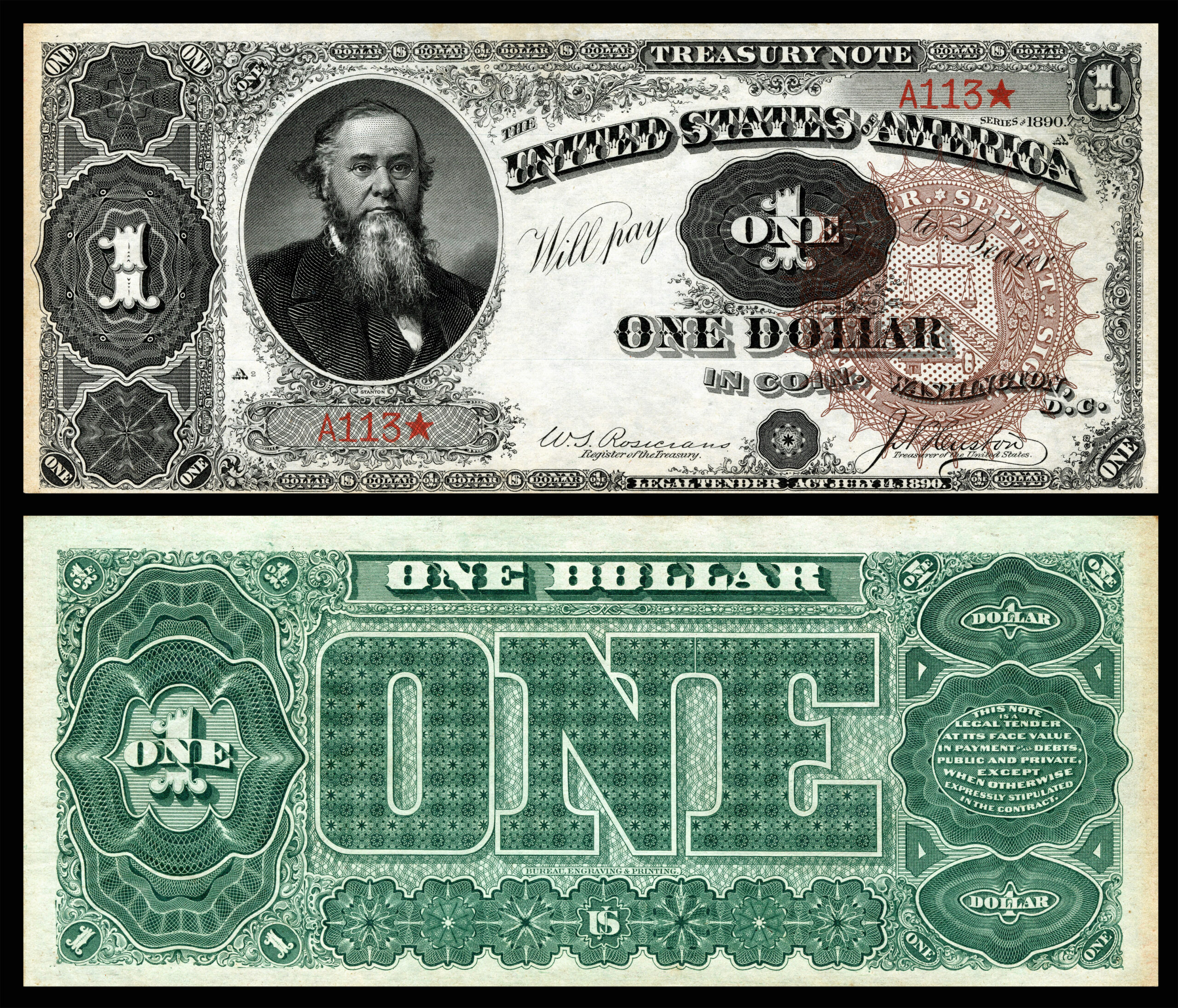
📷 Image source: U.S. Currency Education Program (uscurrency.gov). Images are selected by AI to represent the article topic and may not depict the exact note(s) described.
Pull out a high-grade 1890 Treasury Note and hold it under a loupe. What you see in those borders is not decoration. It is a deliberate, mathematically engineered fortress of interlocking geometric lathe-work, fine-line engraving, and overlapping rosette patterns that pushed the photomechanical counterfeiting technology of the 1890s to absolute failure. The Bureau of Engraving and Printing’s craftsmen spent months perfecting these designs, and the result was currency so visually complex that even today’s collectors find themselves lost in the detail. For numismatists, these notes represent a singular moment in American currency history: the point where artistic ambition and anti-counterfeiting necessity produced something genuinely beautiful.
The Sherman Silver Purchase Act and the Birth of the Coin Note
Before examining the borders themselves, some context is essential. The 1890 Treasury Notes, commonly called “Coin Notes” because they were redeemable in coin at the Treasury’s discretion, were authorized by the Sherman Silver Purchase Act of July 14, 1890. Congress required the Treasury to purchase 4.5 million ounces of silver monthly, paying for it with these new Treasury Notes. The political urgency behind their creation was immense: Western silver mining interests needed a market, and the currency had to project credibility and authority to an already skeptical public worried about silver-backed money.
That credibility had to be built into the paper itself. The Bureau of Engraving and Printing, then under the supervision of Chief Engraver Charles Burt and his talented staff, understood that a note’s security was only as good as its resistance to the best counterfeiting tools available. By 1890, photolithographic reproduction was becoming accessible. A skilled forger could photograph a note and transfer the image to a printing plate with alarming accuracy, provided the original design was simple enough. The BEP’s answer was to make the design anything but simple.
Geometric Lathe-Work: The Foundation of the Border Defense
The obverse borders of the 1890 Treasury Notes were produced using a geometric lathe, sometimes called a rose engine or guilloche machine. This device moved a cutting tool in complex, compound elliptical paths across a steel die, producing continuous interlocking curves that no human hand could replicate freehand and no photographic plate could cleanly transfer. The specific patterns on the 1890 series combined multiple passes of the lathe at different settings, creating what engravers called “engine-turned” backgrounds.
On the $1 note, for instance, the border features a series of interlocking oval rosettes connected by fine filigree chains, all produced at line weights below 0.01 inches. The critical anti-counterfeiting feature is not any single element but the relationship between elements: the precise spacing, the depth modulation of the engraved lines, and the way foreground portrait frames overlap with background lathe-work at mathematically exact intervals. A photographic reproduction flattened all of this into a uniform gray tone, immediately revealing the fake to any trained eye.
When examining an 1890 Treasury Note, tilt it at a 45-degree angle under a single-point light source. Authentic BEP intaglio printing will show distinct ink relief, and the lathe-work borders will produce a subtle optical shimmer as light catches the varying ink depths. A photomechanical counterfeit will appear flat and lifeless under the same test.
The Corner Medallions and Interlocking Rosette System
Each denomination of the 1890 series featured corner medallions of extraordinary complexity. These circular design elements at the four corners of the obverse were not simple round frames. They consisted of layered concentric rings, each ring carrying its own engine-turned pattern, with the rings themselves connected to the border by radiating spokes of fine-line engraving. The spaces between the spokes were filled with additional micro-patterns, often tiny repeating geometric forms that measured just fractions of a millimeter across.
On the $10 note, featuring General Philip Sheridan on the obverse, the corner medallions incorporate a pattern of interlocking “V” forms that reference the denomination while serving a security function. On the $50 note with William Seward, the corners deploy an eight-pointed star motif embedded within three concentric guilloche rings. These were not artistic choices made in isolation. Each pattern was selected partly for how poorly it would reproduce under contemporary counterfeiting methods.
The interlocking nature of the rosette system was the true masterstroke. Where the corner medallions met the top and bottom borders, the engravers used a technique called “pattern bridging,” where the geometric pattern of the medallion and the geometric pattern of the border were deliberately designed to interlock at the junction point. Attempting to paste or splice elements of a counterfeit note at these junctions would produce an obvious pattern break. Every junction on every denomination was a trap for the forger.
Portrait Frames and the Inner Border Architecture
Moving inward from the outer border, the 1890 notes presented a second layer of security in the portrait frame architecture. The oval frames surrounding each portrait were not plain engraved ovals. They were built from multiple concentric bands of differing engine-turned patterns, each band separated by a single engraved line of microscopic regularity. The transition from the frame’s inner edge to the portrait background was executed as a gradient of line density, moving from the dense cross-hatching of the frame into the open stippling of the portrait field.
This gradient technique, combined with the deep intaglio printing process, created a visual depth in person that photographs could not capture. The portrait of Edwin Stanton on the $50 note and the image of General George Meade on the $1,000 note both demonstrate this effect dramatically. Hold an example under magnification and the portrait seems to recede behind the frame, an optical illusion produced by the calculated transition between line densities.
The $1,000 denomination of the 1890 series is exceptionally rare in any grade. Only a handful of examples are known to exist, and most are in institutional collections. If you encounter one offered privately, demand third-party grading from PCGS Currency or PMG before any transaction, as reproductions and fantasies of this denomination do circulate in the market.
Why Counterfeiters Failed: The Compound Security Problem
Historians of American counterfeiting have documented that no successful large-scale counterfeit of an 1890 Treasury Note was prosecuted by the Secret Service during the notes’ circulation period. The Secret Service’s annual reports from 1891 through 1895 reference only crude hand-drawn or poorly lithographed attempts, none of which passed beyond casual examination. The reason comes down to what we might call the compound security problem.
Any single element of the 1890 border could theoretically be approximated. The outer lathe-work alone might have been replicated by a skilled craftsman with access to a rose engine. The portrait engraving alone was within reach of a talented forger with years of practice. But the 1890 design required defeating all elements simultaneously and correctly rendering the relationships between them. The corner medallion pattern had to bridge correctly into the border pattern, which had to nest correctly against the portrait frame, which had to transition correctly into the portrait field, all while maintaining the intaglio ink relief that gave authentic notes their tactile character. No counterfeiter of the era possessed all of these capabilities at once.
The photographic method, most promising for replicating fine detail, produced plates that printed in relief rather than intaglio, eliminating the tactile element. The hand-engraving method could produce intaglio prints but could not replicate the mathematical precision of the engine-turned elements. The 1890 design had essentially anticipated the fork in counterfeiting technology and made both paths impassable.
The 1891 Redesign: Security Versus Economics
The 1891 series Treasury Notes represent an interesting historical footnote to the border design story. Treasury officials, facing criticism that the backs of the 1890 notes were so densely covered with large numeral designs (earning the $1 and $2 notes their “Tombstone Notes” nickname from the massive back numerals) that they were expensive to print and wore poorly in circulation, authorized a redesign. The 1891 notes retained the obverse portrait designs but simplified both the back designs and, notably, lightened some of the more labor-intensive border elements.
This was not a security compromise so much as a cost and practicality adjustment. The 1891 borders remain highly complex by any modern standard, but the reduction in layering density means they are, marginally, less visually overwhelming than their 1890 counterparts. Collectors who study both series side by side consistently note the difference. The 1890 borders feel denser, more pressured, almost baroque in their refusal to leave any space unoccupied. The 1891 borders breathe slightly more. Both are magnificent, but the 1890 originals represent the artistic apex.
Building a complete type set of 1890 Treasury Notes by denomination is an achievable long-term collecting goal for most serious numismatists, with the exception of the $1,000. Focus first on acquiring the $1 (Rosecrans/Huston or Rosecrans/Nebeker signatures) and $2 denominations in Fine to Very Fine grades, where examples remain relatively affordable. The $50 and $100 denominations require significantly larger budgets even in circulated grades.
Signature Combinations and Their Collecting Significance
The 1890 and 1891 Treasury Notes were signed by three Register of the Treasury and Treasurer of the United States combinations, and these pairings create meaningful collecting distinctions. The Rosecrans/Huston combination (Register Rosecrans, Treasurer Huston) appears on 1890 notes and represents some of the scarcest signature pairings for certain denominations, as Huston’s tenure was brief. The Rosecrans/Nebeker combination also appears on 1890-dated notes and is generally more available. The Tillman/Morgan combination appears on the 1891 series and tends to be the most common signature pairing for that year’s issues.
For the 1890 $1 note, the Rosecrans/Huston signature combination with serial numbers in the lower ranges commands a premium of 25 to 40 percent over comparable Rosecrans/Nebeker examples in identical grades. This premium reflects genuine rarity, not collector sentiment, as Treasury records confirm shorter print runs for the Huston-signed notes before the treasurer’s replacement in April 1891.
| Series / Denomination | Signature Combination | Known or Est. Print Run | Rarity |
|---|---|---|---|
| 1890 $1 | Rosecrans / Huston | Est. 5.4 million | Scarce |
| 1890 $1 | Rosecrans / Nebeker | Est. 8.1 million | Common |
| 1890 $2 | Rosecrans / Huston | Est. 2.4 million | Scarce |
| 1890 $5 | Rosecrans / Huston | Est. 1.8 million | Scarce |
| 1890 $20 | Rosecrans / Nebeker | Est. 600,000 | Rare |
| 1890 $50 | Rosecrans / Huston | Est. 100,000 | Rare |
| 1890 $100 | Rosecrans / Nebeker | Est. 80,000 | Rare |
| 1890 $1,000 | Rosecrans / Huston | Fewer than 10 known | Key Date |
| 1891 $2 | Tillman / Morgan | Est. 3.5 million | Common |
| 1891 $1,000 | Tillman / Morgan | Fewer than 5 known | Key Date |
Grading Considerations Specific to the Border Designs
Grading 1890 Treasury Notes requires particular attention to the border regions precisely because of their complexity. The fine lathe-work lines in the outer borders are among the first areas to show wear, as the raised ink in these regions is thinner than in the portrait field or major design elements. A note that appears VF-30 in the portrait center can simultaneously show Fine-level wear in the border corners, a condition that grading services assess holistically but that collectors should understand when evaluating a note pre-submission.
Paper quality matters enormously for these issues. Original Treasury Note paper was a linen-cotton blend with a distinctive texture that complements the intaglio printing. Notes that have been cleaned, pressed, or chemically treated often show artificial brightness in the border fields that experienced dealers and graders can detect. The fine lines of the engine-turned borders are particularly unforgiving of pressing: any compression of the original paper surface reduces the tactile relief of the intaglio ink, producing a note that feels wrong even if it looks superficially appealing.
The Legacy of the 1890 Border Design Philosophy
The design philosophy that produced the 1890 Treasury Note borders did not disappear with the series. Elements of the geometric lathe-work approach persisted in American currency design well into the twentieth century, and the BEP continued to use rose engine machines for security border elements on Federal Reserve Notes through the mid-century designs. What changed was the balance between ornament and function: later designs used engine-turned elements more sparingly, integrating them as accent features rather than as the dominant visual architecture.
Modern American currency security has moved toward microprinting, color-shifting ink, security threads, and digital watermarks. These are effective technologies, but they lack the austere beauty of the 1890 approach, where the security mechanism and the aesthetic achievement were inseparable. You cannot remove the anti-counterfeiting function from an 1890 Treasury Note border without destroying the design entirely. The two are the same thing. That integration of purpose and beauty is why these notes continue to command respect, study, and significant collector premiums more than 130 years after their issue.
Whether you are a beginning collector encountering your first circulated $1 Coin Note or a veteran numismatist hunting a Gem example of the Rosecrans/Huston $5, the 1890 Treasury Notes reward careful attention. Spend time with the borders. Follow one interlocking pattern element as far as you can before it disappears into another. Consider what it meant to engrave these patterns by hand into hardened steel, and what it meant to a counterfeiter of 1891 to understand that he could not follow that same path. Then consider what it means to hold one of these notes today, in a world of digital printing and instant reproduction, and to recognize that this small piece of paper defeated every technology that tried to copy it.