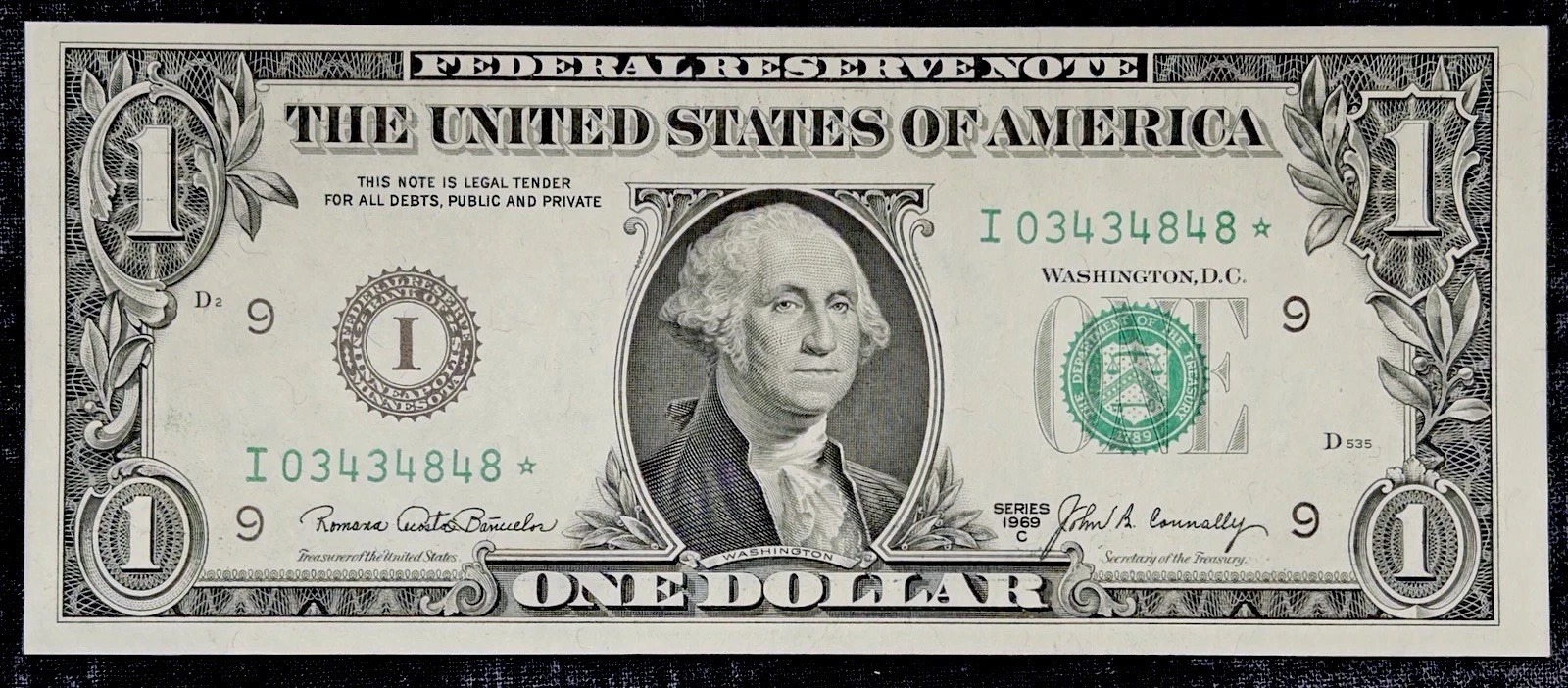
📷 Image source: Wikimedia Commons. Images are selected by AI to represent the article topic and may not depict the exact note(s) described.
There is a certain category of collectible that thrives on being ignored. The Series 1969C $1 Federal Reserve Note fits that description almost perfectly. Printed during a narrow window in the early 1970s under the signature combination of Treasurer Romana Acosta Bañuelos and Secretary of the Treasury John B. Connally, the 1969C occupies a peculiar place in the modern small-size dollar story. It is not as famous as the Series 1969D, which introduced the new Treasury seal design, and it is not as widely available as the 1969 or 1969A. What it is, for the patient collector, is a series full of subtle challenges and rewarding finds.
How the 1969 Series Designations Work
Before diving into the 1969C specifically, it helps to understand why the Bureau of Engraving and Printing used letter suffixes at all. A new series letter is assigned whenever the Treasurer of the United States changes, while an entirely new series year is assigned when the Secretary of the Treasury changes. The 1969 base series used signatures of Dorothy Andrews Elston and David M. Kennedy. When Elston was replaced by Francine Irving Neff, no change occurred yet because she served briefly. The signature chain that produced the lettered variants ran as follows: 1969A reflected Kabis/Kennedy, 1969B reflected Kabis/Connally, 1969C reflected Bañuelos/Connally, and 1969D reflected Bañuelos/Shultz.
Romana Acosta Bañuelos was sworn in as the 34th Treasurer of the United States on December 17, 1971, making her the first Mexican-American to hold the office. Her tenure lasted until February 1974. John B. Connally served as Secretary of the Treasury from February 1971 to June 1972, meaning the overlap window that produced 1969C notes was genuinely short, roughly the first half of 1972. That tight production window goes a long way toward explaining why certain Federal Reserve districts ended up with relatively modest print runs for this series.
Physical Characteristics and Design Notes
The 1969C $1 note is a green-seal Federal Reserve Note printed on the standard 75 percent cotton, 25 percent linen paper stock that the BEP used throughout this era. The face plate carries the familiar Gilbert Stuart-derived portrait of George Washington at center, framed by the ornate engine-turned border that dates to the 1963 redesign. The Treasury seal, positioned to the right of the portrait, is the large, slightly more open version used across the entire 1963-through-1969D run. Beginning with Series 1974, the seal was reduced in size and the design was modernized, which makes the 1969C one of the last series to carry the older, bolder seal style.
The Federal Reserve district letter and number appear twice on the face: once within the Federal Reserve seal on the left and once as a prefix letter in the serial number. Twelve districts means twelve collecting varieties for a complete district set, and the 1969C is demanding enough that assembling a full set in choice uncirculated grades takes genuine effort.
When attributing a 1969C note, always check both the district letter in the Federal Reserve Bank seal and the serial number prefix simultaneously. Mislabeled notes occasionally surface at shows and online auctions, particularly for the less common districts like Richmond (E) and Minneapolis (I).
Print Run Overview and District Variations
The Federal Reserve Bank of New York (B) predictably led all districts in 1969C production, as it does for virtually every modern series. However, the total combined print run across all twelve districts was notably smaller than both the 1969B and the 1969D series. The BEP printed 1969D notes in much larger quantities partly because the series straddled a period of heavy cash demand in late 1972 and into 1973. The 1969C essentially got squeezed by timing.
Minneapolis (I) and Kansas City (J) represent the most challenging districts to locate in problem-free, higher-grade condition. Dallas (K) and San Francisco (L) had more respectable runs, while Boston (A) and Chicago (G) occupy a comfortable middle ground. Richmond (E), St. Louis (H), and Minneapolis (I) star notes are considered genuinely scarce in grades above Fine, and in Gem Uncirculated (MS-65 or better by PMG standards), they are legitimately rare.
For the 1969C series, focus your grading attention on the corners and the embossing sharpness of the serial numbers. Notes from this era frequently suffered corner rounding in circulation even after brief handling, so finding a note with needle-sharp corners and no breaks in the paper is the real challenge.
Star Notes: The Heart of the Challenge
Star notes, those replacement notes bearing an asterisk at the end of the serial number, are where the 1969C becomes truly exciting for the advanced collector. The BEP issues star notes to replace defective notes destroyed during production, so their print runs are always a fraction of the regular issue. For the 1969C, the Atlanta Federal Reserve Bank (F) star note is the recognized standout rarity. Published research and BEP production records indicate that the Atlanta 1969C star run consisted of only 128,000 notes, a number small enough to make genuine Gem survivors exceptionally difficult to track down.
Richmond (E) and Minneapolis (I) star notes also command serious attention. Minneapolis 1969C stars had a production figure in the range of 640,000 notes, which sounds substantial until you factor in the decades of circulation attrition and the relatively small collector base that was actively saving these notes in the early 1970s. Most survivors found today come in grades of Very Fine or below.
By contrast, New York (B) and Chicago (G) star notes were printed in numbers large enough to keep collector demand satisfied. The Chicago 1969C star, for instance, is readily available in CU grades and serves as a good entry point for collectors new to the series.
When purchasing 1969C star notes in grades of VF or below, ask the seller for high-resolution scans of both faces under raking light. Pressed or cleaned notes are disproportionately common among lower-grade stars from this era, and the artificial crispness can fool even experienced buyers at a glance.
The 1969C in Context: Comparing Its Neighbors
Part of what makes the 1969C worth studying is understanding exactly how it fits between the 1969B and the 1969D. The Series 1969B, produced under Kabis and Connally, had a longer effective print window and more district coverage at higher volumes. The 1969D, produced under Bañuelos and Shultz, became the last series before the 1974 redesign introduced the smaller Treasury seal and other minor changes, giving it a kind of milestone status that drew collector attention early.
The 1969C got left out of both stories. It has no milestone attached to it, and its predecessor and successor are each easier to complete as district sets. That anonymity, paradoxically, has kept prices relatively modest compared to what the actual scarcity of key district stars would suggest in a more competitive market. The collecting community has been slow to recognize the 1969C as a standalone series worthy of systematic pursuit, and that gap between perceived and actual rarity is exactly where value hides.
Grading Considerations for the Modern Collector
Third-party grading services, principally PMG (Paper Money Guaranty) and PCGS Currency, have made it far easier to authenticate and grade 1969C notes with confidence. For regular issues, a PMG 65 EPQ (Exceptional Paper Quality) or better represents the realistic ceiling of ambition for most districts. For star notes from the scarce districts, even a PMG 63 EPQ is a strong note. The EPQ designation is particularly important here because it confirms original paper surfaces, ruling out the cleaned and pressed examples mentioned above.
Ungraded 1969C notes in CU condition occasionally surface at currency shows and through online dealers. If you are comfortable evaluating paper money yourself, these can represent good value. Look specifically for full, original embossing on the serial numbers and Treasury seal, no counting smears across the face, bright paper without any hint of the gray or yellowish cast that comes from handling, and absolutely crisp corners with no softness at the tips.
| Series | District / Variety | Print Run (approx.) | Rarity |
|---|---|---|---|
| 1969C | Atlanta, GA (F) Star | 128,000 | Key Date |
| 1969C | Richmond, VA (E) Star | 640,000 | Rare |
| 1969C | Minneapolis, MN (I) Star | 640,000 | Rare |
| 1969C | Minneapolis, MN (I) Regular | 3,840,000 | Scarce |
| 1969C | Kansas City, MO (J) Star | 1,280,000 | Scarce |
| 1969C | Richmond, VA (E) Regular | 7,680,000 | Scarce |
| 1969C | Dallas, TX (K) Regular | 19,200,000 | Common |
| 1969C | Chicago, IL (G) Star | 3,840,000 | Common |
| 1969C | New York, NY (B) Regular | 83,200,000 | Common |
| 1969C | San Francisco, CA (L) Regular | 32,000,000 | Common |
Building a 1969C Collection: Practical Strategies
A focused 1969C collection can take several forms. The most comprehensive approach is a full twelve-district set of regular issues in CU, supplemented by as many star notes as budget allows. A more targeted strategy would be to pursue only the star notes across all twelve districts, accepting lower grades for the genuinely scarce Atlanta, Richmond, and Minneapolis pieces while holding out for CU examples from New York, Chicago, and San Francisco.
Budget-conscious collectors might start with a type set: one high-grade regular issue and one star note, both from accessible districts like New York or Chicago, just to represent the series in their collection before tackling the harder pieces. This approach keeps initial outlay low while leaving room to upgrade and expand over time.
Currency auction archives from Heritage Auctions and Stack’s Bowers are invaluable research tools. Reviewing realized prices for 1969C lots over the past decade reveals just how infrequently the key-district stars come up for sale, and how strong the prices are when they do. That frequency data is arguably more useful than price guides alone because it tells you about liquidity, a factor that matters when you eventually decide to sell or trade.
Auction archives at Heritage Auctions are searchable by series and denomination with full lot images. Spend an evening reviewing every 1969C $1 lot sold in the past five years before making any significant purchases. You will quickly develop an intuitive sense of what problem-free examples look like and what prices are fair, saving you from overpaying or missing bargains.
Conclusion: The Quiet Rarity Worth Pursuing
The Series 1969C $1 Federal Reserve Note will never headline a major auction catalog the way a Colonial note or a high-denomination Gold Certificate might. But within the focused world of modern small-size collecting, it offers a genuinely rewarding challenge. The short production window created by the brief Bañuelos and Connally signature overlap produced a series where several districts are legitimately scarce and star notes from Atlanta, Richmond, and Minneapolis stand as full-blown rarities by any reasonable definition.
For collectors who have already assembled type sets of the major modern series and are looking for their next project, the 1969C district and star set is a natural step up in difficulty without requiring the budget of a truly esoteric specialty. The notes are still affordable enough that patient searching pays off, and the relative obscurity of the series means that undervalued examples still surface regularly. In short, the 1969C rewards exactly the kind of collector who takes the time to look past the obvious choices and study what everyone else is walking past.