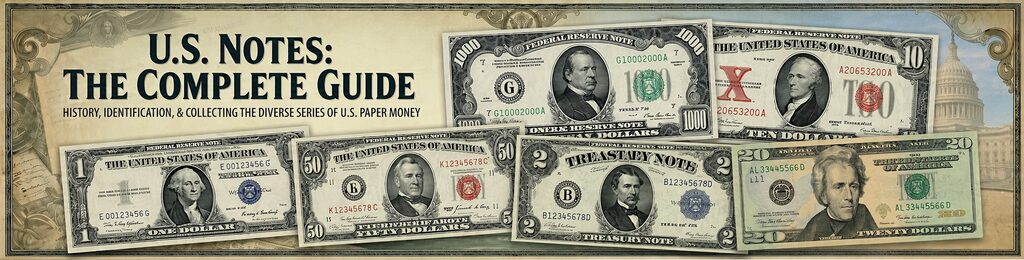
There is something quietly poignant about the Series 1993 Federal Reserve Notes. Printed and circulated in the mid-1990s, they carry the traditional small-portrait design that Americans had known for decades, completely unaware that the bills in their wallets were among the last of their kind. When the Bureau of Engraving and Printing rolled out the redesigned Series 1996 notes beginning with the $100 denomination in late 1996, an era ended. Series 1993 became, almost overnight, the final representative of old-guard American currency design. For collectors, that story transforms what might otherwise seem like ordinary modern notes into genuinely compelling historical artifacts.
Historical Context: Why 1993 Matters
To appreciate the Series 1993 notes, you need to understand the timeline leading up to them. Congress had been wrestling with counterfeiting concerns throughout the late 1980s and early 1990s. High-quality color photocopiers and desktop publishing software were becoming increasingly accessible, and the Secret Service documented a rising tide of technologically assisted counterfeiting. The Federal Reserve and the Treasury Department responded with a phased security upgrade program.
The first wave of modern security features actually appeared earlier, with the Series 1990 notes introducing the polyester security thread and microprinting to denominations of $50 and $100. Series 1993 extended microprinting to the $10 and $20 denominations, adding the text “USA TEN” or “USA TWENTY” repeated along the security thread, and “THE UNITED STATES OF AMERICA” printed in tiny letters along the left portrait border. The $1 and $5 notes in the 1993 series carried no microprinting, reflecting the lower counterfeiting risk associated with those denominations at the time.
But even with these incremental upgrades, Treasury planners knew a comprehensive redesign was coming. The Series 1996 overhaul would introduce dramatically enlarged off-center portraits, color-shifting ink, and refined watermarks, fundamentally transforming the visual identity of American currency for the first time since 1929. Series 1993 thus occupies a transitional role, carrying some modern security DNA while retaining the classic aesthetic that collectors now associate with pre-1996 small-portrait notes.
The Signature Combination and What It Tells You
Every Federal Reserve Note series is anchored by the signatures of the sitting Treasurer of the United States and the Secretary of the Treasury. For Series 1993, those signatures belong to Mary Ellen Withrow and Lloyd Bentsen. Withrow was appointed Treasurer by President Clinton in 1994 and served until 1999, making her signature appear on several subsequent series as well. Bentsen served as Treasury Secretary from January 1993 to December 1994, when he was succeeded by Robert Rubin. This relatively short window for Bentsen’s tenure is significant: it means that any Series 1993 notes printed after Rubin took office in January 1995 would have needed a new signature pairing, which gave rise to the Series 1995 designation rather than a mid-series signature change within the 1993 designation itself.
For collectors, the Withrow-Bentsen combination is the definitive signature pairing for 1993. Notes bearing this combination and verified via serial number prefix and Federal Reserve district can be pinpointed quite accurately to production windows in 1994 and early 1995, before printing transitioned to the Withrow-Rubin Series 1995 notes.
When buying Series 1993 notes in holders, always verify the signature combination reads Withrow-Bentsen. Some dealers loosely label mid-1990s FRNs without distinguishing series years, and a Withrow-Rubin note is actually a Series 1995, not 1993. The difference matters for registry sets and type collections.
Denominations, Districts, and Print Runs
Series 1993 notes were issued across all twelve Federal Reserve Districts, identified by the letter A through L and the corresponding district number printed on the face of each note. Washington DC (the BEP’s main facility) and the Fort Worth facility both produced 1993 series notes, with Fort Worth notes identifiable by a small “FW” printed to the right of the check letter and quadrant number on the face of the bill.
The $1 Federal Reserve Note in Series 1993 saw the largest print runs, as one would expect for the workhorse denomination of American commerce. Total production across all twelve districts ran into the billions of notes. The $100 denomination, by contrast, had comparatively modest runs and is the denomination most actively sought by collectors interested in the last pre-1996 large-denomination design.
Star notes, which the BEP produces as replacement notes when a standard note is damaged or misprinted during production, are the premier collectible variety within any FRN series. Series 1993 star notes are identified by a star symbol replacing the suffix letter in the serial number. Low-print-run star notes from specific districts, particularly the Atlanta (F*), Minneapolis (I*), and Dallas (K*) districts in higher denominations, are genuinely scarce and command strong premiums in the market.
Fort Worth-printed Series 1993 notes are distinguished by the “FW” plate position indicator. For competitive registry sets, building a matched district set of both Washington and Fort Worth printings for each denomination adds a satisfying layer of completeness to a 1993 type collection.
The $100 Note: Crown Jewel of the Series
Among Series 1993 denominations, the $100 Federal Reserve Note commands the most collector attention. This note retains the classic Benjamin Franklin portrait centered within the traditional oval vignette, the Independence Hall reverse, and the pre-1996 security thread reading “USA 100” embedded vertically to the left of the portrait. The microprinting “THE UNITED STATES OF AMERICA” appears in a thin line along the left edge of Franklin’s portrait.
In circulated grades, Series 1993 $100 notes are easily obtainable for modest premiums over face value. The real interest lies in gem uncirculated examples graded MS-65 or higher by PCGS Currency or PMG, and in high-grade star note replacements. A Series 1993 $100 star note from a low-print district in PMG 65 EPQ (Exceptional Paper Quality) can fetch $150 to $300 or more at auction, depending on the district and run size. Solid serial numbers, radar notes, and other fancy serial number varieties in the $100 1993 series also attract premium bids from the growing fancy serial number collector community.
The $1 Note: Accessible and Underrated
New collectors often overlook the Series 1993 $1 note because of its massive print runs, but there is genuine value hiding in this denomination for patient searchers. The $1 star notes from Minneapolis (I*) and San Francisco (L*) districts had notably smaller replacement runs compared to districts like New York (B*) or Chicago (G*). A Series 1993 $1 star from Minneapolis in crisp uncirculated condition is considerably harder to find than its face value suggests.
Additionally, the $1 Series 1993 from the Federal Reserve Bank of Minneapolis carries the distinction of being among the lower overall print figures for that denomination within this series. Collectors building a complete twelve-district set of Series 1993 $1 notes in PMG 64 or better will find Minneapolis and Richmond the most elusive districts to fill at that grade level.
CGA, PCGS Currency, and PMG all slab modern Federal Reserve Notes. For Series 1993 notes intended for long-term collections, PMG and PCGS Currency holders provide the most recognized third-party authentication and grading, which matters significantly if you ever decide to sell or trade. The EPQ and PPQ designations (Exceptional Paper Quality and Premium Paper Quality, respectively) indicate no chemical or physical restoration and are strongly preferred by advanced collectors.
Condition Grading Nuances for Series 1993
Because Series 1993 notes are relatively recent, the grading standards that apply differ in important ways from those used for nineteenth-century or early twentieth-century issues. Paper quality expectations are higher: collectors and grading services expect Series 1993 notes in the gem uncirculated range (PMG 65 and above) to show bright white paper with full original crispness, sharp corners, and absolutely no folds, presses, or counting smears. Even a single light handling fold drops a note from the uncirculated category entirely.
For circulated examples, the standard VF-20 to EF-45 range covers notes with light to moderate handling wear. Many Series 1993 notes encountered in collections today grade in the Fine-12 to Very Fine-30 range, having spent years in active circulation before being set aside. These circulated examples are primarily of interest to type collectors or those assembling denomination sets on a budget. The real collector premium begins at AU-55 and rises sharply through the gem grades.
One grading nuance specific to the 1993 series involves the security thread. Because the polyester thread was a relatively new feature, some notes show slight thread migration or minor delamination at the thread edges that is not necessarily the result of circulation but rather a production artifact. Grading services typically note this but do not automatically penalize the grade unless the delamination is severe. Collectors should examine the thread area under good lighting before purchasing slabbed examples.
The Bridge to 1996: Security Features in Transition
What makes Series 1993 technically fascinating is its hybrid security profile. The notes sit precisely at the inflection point of American currency security technology. The $10 and $20 notes gained microprinting for the first time in this series, yet the design architecture remained unchanged: centered portraits, traditional border scrollwork, and the familiar green Federal Reserve seal to the left of the portrait.
Compare a Series 1993 $20 to a Series 1996 $20 and the transformation is immediately visible. The 1996 note features a much larger Andrew Jackson portrait shifted to the right, a new watermark portrait embedded in the paper, color-shifting ink in the numeral, and a completely redesigned reverse with a larger White House vignette. The Series 1993 $20 looks almost austere by comparison, but that restraint is precisely what appeals to collectors who prefer the classic look of pre-1996 American currency.
| Denomination | District / Variety | Approx. Print Run | Rarity |
|---|---|---|---|
| $1 Star | Minneapolis (I*) | ~3,200,000 | Scarce |
| $1 Star | New York (B*) | ~64,000,000 | Common |
| $5 Star | Dallas (K*) | ~3,840,000 | Scarce |
| $10 Star | Atlanta (F*) | ~3,200,000 | Scarce |
| $20 Star | Minneapolis (I*) | ~640,000 | Rare |
| $50 Star | San Francisco (L*) | ~640,000 | Rare |
| $100 Star | Richmond (E*) | ~1,280,000 | Scarce |
| $100 Star | Minneapolis (I*) | ~640,000 | Key Date |
| $20 FW | Fort Worth Printing, all districts | Varied by district | Scarce |
| $100 Regular | Chicago (G), high grade gem | Large run | Common |
Building a Series 1993 Collection: Strategies by Budget
For collectors with modest budgets, a type set approach works beautifully with Series 1993 notes. Acquiring one circulated example of each denomination in the VF to EF range costs well under $100 total for the $1 through $20 notes, and perhaps $130 to $160 for the $50 and $100. This gives you a tangible, displayable set representing the last of the pre-1996 classic design era.
Intermediate collectors often pursue a complete district set of a single denomination, most commonly the $1 or $20. A twelve-district set of Series 1993 $1 notes in CU condition, sourced from original BEP packs or bank-fresh examples, is an achievable goal over the course of a year of patient searching. For the $20 in gem grades, budget $25 to $60 per note, more for the Minneapolis and Richmond districts.
Advanced collectors building registry-quality sets focus on star notes in the highest possible PMG or PCGS grades with EPQ designations. The Minneapolis $20 star and the Minneapolis $100 star in particular are legitimate condition rarities. Verified gem examples of these notes in PMG 66 EPQ or above appear at auction infrequently and should be pursued aggressively when they surface. Heritage Auctions, Stack’s Bowers, and Lyn Knight Currency Auctions are the primary venues where top-tier Series 1993 material appears.
Fancy Serial Numbers in the 1993 Series
The fancy serial number collecting segment has exploded in popularity since the early 2010s, and Series 1993 notes participate fully in this market. Low serial numbers (A00000001A through A00000100A on any district), solid serial numbers (all eight digits the same), radar notes (serial number reads the same forward and backward), ladder notes (12345678 or 87654321), and repeater notes are all sought regardless of series year.
For Series 1993 specifically, the most valuable fancy serial numbers are found in the $100 denomination, where collector demand for high-denomination fancy serials is strongest. A Series 1993 $100 with a solid serial number in gem condition could realistically auction for $5,000 or more. Low serials in the $1 to $10 range in gem condition regularly fetch $50 to $500 depending on the specific number.
Conclusion: A Series Worth Taking Seriously
Series 1993 Federal Reserve Notes deserve more attention than they typically receive in mainstream numismatic conversation. They are the last full series issued in the traditional small-portrait American currency format, carrying real historical weight as the final expression of a design philosophy that governed US paper money for over sixty years. The hybrid security features, the specific Withrow-Bentsen signature combination, the scarcity of certain district star notes, and the clear demarcation they represent before the 1996 redesign all combine to make them a compelling collecting target.
Whether you are assembling a budget type set, pursuing gem-grade district notes for a registry submission, or hunting for a key-date Minneapolis star note to anchor a high-end collection, Series 1993 offers entry points at every level. As the pre-1996 era recedes further into history, the collector premium on these transitional notes will only grow. Now is an excellent time to take a closer look at what may be the most historically significant series of modern Federal Reserve Notes ever issued.