📷 Image source: eBay. Images are selected by AI to represent the article topic and may not depict the exact note(s) described.
A Dollar Bill Unlike Any Other
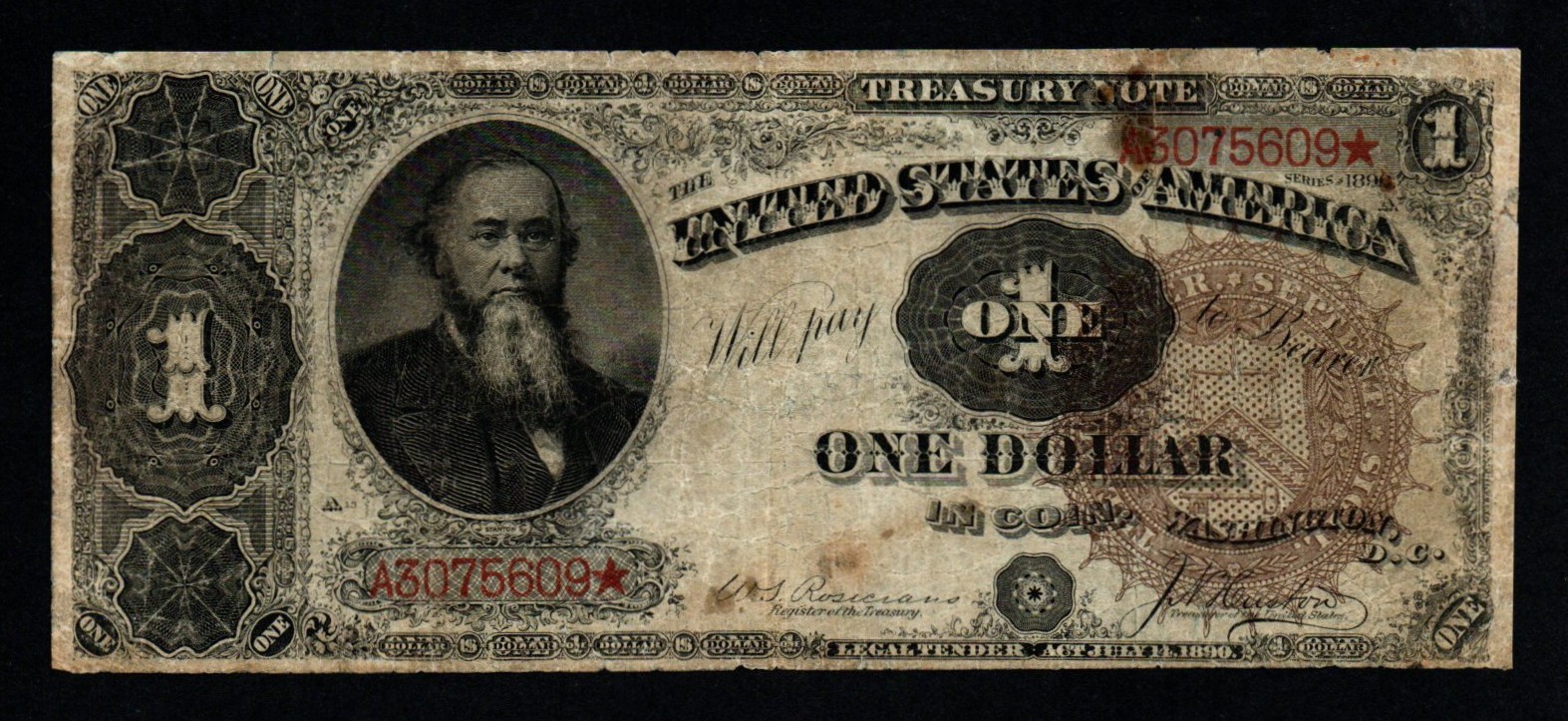
Pull up a photograph of the Series 1890 $1 Treasury Note and you will immediately understand why collectors have chased this issue for well over a century. The back of the note is dominated by enormous, tombstone-shaped numerals spelling out the denomination, surrounded by some of the most intricate engraving ever applied to American paper money. The front carries the portrait of Edwin M. Stanton, Abraham Lincoln’s Secretary of War, a figure whose face had not appeared on any earlier circulating note. This combination of bold design, historical significance, and genuine scarcity makes the 1890 $1 Treasury Note one of the crown jewels of nineteenth-century American currency collecting.
Treasury Notes and the Sherman Silver Purchase Act
To understand why the 1890 $1 Treasury Note exists at all, you need to step back into one of the most contentious monetary debates in American history. The Sherman Silver Purchase Act of July 14, 1890, required the federal government to purchase 4.5 million ounces of silver bullion every month. To pay for this silver, the Treasury was authorized to issue a new class of paper money: Treasury Notes of 1890, sometimes called Coin Notes because the reverse of each note carried the promise that it was “receivable for customs, taxes, and all public dues, and when so received may be reissued; and when held by any national banking association may be counted as part of its lawful reserve.” More significantly, each note was redeemable in either gold or silver coin at the discretion of the Secretary of the Treasury, making them a bridge instrument in the era’s fierce silver-versus-gold monetary battles.
The $1 denomination was the smallest issued under the act, and it was the workhorse note that ordinary Americans were most likely to encounter. Higher denominations in the Treasury Note series included $2, $5, $10, $20, $50, $100, $500, and $1,000, but the $1 and $2 notes circulated most heavily in everyday commerce.
Edwin M. Stanton: The Man Behind the Portrait
Edwin McMasters Stanton (1814-1869) was one of the most powerful and controversial cabinet officers of the nineteenth century. A Democratic attorney who had served as Attorney General under President James Buchanan, Stanton was appointed Secretary of War by Abraham Lincoln in January 1862 and proved to be an administrative genius of the first order. He reorganized the chaotic War Department, streamlined military logistics, and became one of Lincoln’s most trusted advisers despite a notoriously abrasive personality.
Stanton’s postwar career was equally dramatic. His conflict with President Andrew Johnson over Reconstruction policy led directly to the Tenure of Office Act crisis of 1868, when Johnson’s attempt to remove Stanton triggered the first presidential impeachment in American history. Stanton barricaded himself in his War Department office for months. When Johnson was acquitted by a single Senate vote, Stanton finally resigned. President Ulysses S. Grant nominated Stanton to the Supreme Court in December 1869, but Stanton died just four days after his Senate confirmation, before he could be sworn in.
His selection for the 1890 $1 Treasury Note was a deliberate honor from a Treasury Department still populated by men who remembered the Union war effort. The engraved portrait was executed from a photograph, rendered by the Bureau of Engraving and Printing with the fine cross-hatching and lathe-work detail that distinguished American banknote engraving of the era.
When examining the Stanton portrait on a Series 1890 $1 Treasury Note, look closely at the stippling in the beard and coat lapels under magnification. The quality and crispness of this engraving is one of the best indicators of genuine, high-grade examples versus cleaned or processed notes that have lost surface fiber detail.
The “Tombstone Note” Back Design
The back of the Series 1890 $1 Treasury Note is the feature that most dramatically separates it from every other dollar bill in American history. Designed by the Bureau of Engraving and Printing under the direction of Chief of the Engraving Division Charles Skinner, the reverse features the numeral “1” rendered in enormous, ornate gothic lettering that fills virtually the entire note. The thick, arched top of each numeral, combined with the dense surrounding filigree, gave the design its enduring nickname: the Tombstone Note.
The design intent was actually anti-counterfeiting. Treasury officials believed that the more intricate and complex the engraving, the more difficult the note would be to replicate by photographic or lithographic counterfeiting methods then emerging as a threat. In practice, the tombstone back is simply gorgeous, a masterpiece of the steel engraver’s art that would never be repeated in American currency design. When the series was revised to produce the Series 1891 Treasury Notes, the back design was simplified considerably, making the 1890 issues the only notes to carry the tombstone reverse.
Signature Combinations and Series Details
The Series 1890 $1 Treasury Notes were issued with two Register-Treasurer signature combinations. The first pairing was Rosecrans-Huston (William S. Rosecrans as Register of the Treasury and Enos H. Huston as Treasurer), and the second was Rosecrans-Nebeker (Rosecrans with Daniel N. Morgan having briefly served, then James W. Nebeker as Treasurer). Both combinations were produced with a brown Treasury seal, sometimes described as an orange-brown, applied to the left-center of the face.
The notes were printed in sheets of four subjects and bear serial numbers preceded by a single letter prefix and followed by a single letter suffix. Serial numbers for the $1 Series 1890 ran across both signature combinations, with Rosecrans-Huston examples generally bearing lower serial numbers. The face also carries the obligation text “The United States of America will pay to bearer ONE DOLLAR” along with the Coin Note redemption language that defines the series.
Both signature combinations of the Series 1890 $1 Treasury Note are genuinely scarce in grades above Very Fine. The Rosecrans-Nebeker combination is considerably rarer than Rosecrans-Huston in circulated grades, and both are genuinely difficult to find in Fine or better condition because the notes circulated heavily during the economically turbulent early 1890s. Budget accordingly and do not pass on a clean VF example waiting for an AU that may never appear at auction.
The Series 1891 Comparison
Collectors often ask how the 1890 and 1891 series differ, since both carry Stanton’s portrait on the face. The answer lies almost entirely on the reverse. The Series 1891 $1 Treasury Note replaced the elaborate tombstone back with a far simpler design featuring the numeral “1” in standard form flanked by scrollwork, with much more open, unprinted space. The face design remained largely unchanged, though the series date was updated. The 1891 was issued with multiple signature combinations, including Rosecrans-Nebeker (red seal), Tillman-Morgan, and Bruce-Roberts, giving collectors more variety but making the dramatic 1890 tombstone reverse even more special by comparison.
The red seal on certain Series 1891 notes versus the brown seal on all Series 1890 notes is another quick visual differentiator that even new collectors can use to sort the two issues.
Grading Considerations for the 1890 $1 Treasury Note
The condition landscape for Series 1890 $1 Treasury Notes skews heavily toward circulated grades. The notes entered commerce during a period of economic volatility, the Panic of 1893 was only three years away, and silver currency redemption was frequently demanded, meaning these notes passed through many hands. In terms of grading standards applied by PCGS Currency and PMG:
In grades of Very Good (VG-8 to VG-10), most examples show heavy folds, edge wear, and sometimes small tears or pinholes. The portrait and back engraving are still crisp enough to be appreciated. Fine (F-12 to F-15) examples show significant wear but retain clear design details throughout. Very Fine (VF-20 to VF-35) notes are genuinely desirable, showing only modest circulation evidence. Extremely Fine (EF-40 to EF-45) examples appear at major auction sales every few years and command strong premiums. Anything graded About Uncirculated or better is a trophy note, with only a handful of examples known in these grades across both signature combinations.
Series 1890 $1 Treasury Notes that have been lightly pressed or cleaned to improve apparent grade are encountered regularly in the marketplace. A genuine VF-25 note will display original paper body and some natural softness from circulation; a pressed note often feels stiff and may show subtle roller marks under side-lighting. Always examine unencapsulated examples under raking light before purchase, or insist on third-party graded examples from PMG or PCGS Currency for any note priced above $500.
Key Auction Records and Market Values
Heritage Auctions, Stack’s Bowers, and Lyn Knight Currency Auctions have all featured significant examples of Series 1890 $1 Treasury Notes over the past two decades. A PMG Very Fine 30 Rosecrans-Huston example realized over $1,800 at a Heritage Auctions sale in 2019. Higher-grade pieces push into the $4,000 to $8,000 range for EF examples, with the few certified AU notes having exceeded $15,000 at auction. Even honest Good-grade examples regularly trade between $400 and $700, reflecting the note’s broad collector appeal and genuine scarcity relative to demand.
The Rosecrans-Nebeker combination consistently commands a 20 to 40 percent premium over comparable Rosecrans-Huston pieces across all grades, reflecting its lower surviving population.
| Series / Date | Signature Combination | Seal Color | Rarity |
|---|---|---|---|
| 1890 | Rosecrans-Huston | Brown | Scarce |
| 1890 | Rosecrans-Nebeker | Brown | Rare |
| 1891 | Rosecrans-Nebeker | Red | Scarce |
| 1891 | Tillman-Morgan | Red | Common |
| 1891 | Bruce-Roberts | Red | Scarce |
| 1890 | Rosecrans-Huston (EF or better) | Brown | Rare |
| 1890 | Rosecrans-Nebeker (EF or better) | Brown | Key Date |
| 1891 | Bruce-Roberts (AU or better) | Red | Rare |
Where the 1890 $1 Fits in a Collection
The Series 1890 $1 Treasury Note occupies a unique position in American numismatics. It is old enough and scarce enough to be a serious challenge, yet it remains attainable in circulated grades for collectors who are willing to invest several hundred dollars. It fits naturally into several different collection themes: a type set of nineteenth-century paper money, a comprehensive Treasury Note collection by series and signature, a portrait collection featuring Civil War figures on currency, or a specialized study of the Sherman Silver Purchase Act issues.
For collectors building a type set of large-size U.S. currency, the 1890 tombstone design is non-negotiable. No other note looks remotely like it. The Series 1891 with its simplified back can serve as a budget alternative for the broader Treasury Note type, but it simply does not carry the same visual drama. Anyone who has held a crisp Very Fine 1890 $1 tombstone note understands immediately why this particular piece continues to command collector passion more than 130 years after it left the Bureau of Engraving and Printing.
If you are building a type set and can only afford one Series 1890 $1 Treasury Note, prioritize paper quality and originality over grade number. A raw, original Fine-15 note with bright paper and strong color is far more satisfying, and often more valuable long-term, than a processed or conserved note graded VF-20. Look for notes with four clear margins, no pinholes, and ink that has not faded to a dull gray.
Conclusion: A Tombstone Worth Chasing
The Series 1890 $1 Treasury Note is a note that rewards patience, study, and a genuine appreciation for the artistry of nineteenth-century American currency. Edwin Stanton’s portrait anchors a historical narrative stretching from the Civil War through the Reconstruction battles and the silver purchase debates of the Gilded Age. The tombstone back design stands as the boldest single piece of engraving ever placed on an American one-dollar bill. And the two signature combinations, both genuinely scarce in attractive grades, give collectors a meaningful set-building challenge that can occupy years of searching.
Whether you encounter your first example at a regional coin show, a major auction, or through a specialist currency dealer, the 1890 $1 Treasury Note has a way of stopping you cold and demanding your full attention. That reaction, consistent across generations of collectors, is the best evidence of what makes this note genuinely special in the long story of American paper money.