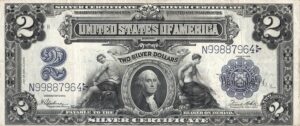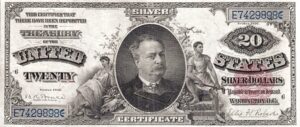
📷 Image source: eBay. Images are selected by AI to represent the article topic and may not depict the exact note(s) described.
A Denomination on Borrowed Time
By the early 1950s, the $2 United States Note had survived wars, economic upheaval, and repeated threats of abolition. It had circulated continuously since the Legal Tender Act of 1862, making it one of the most historically persistent denominations in American paper money. The Series 1953 issue would prove to be the last major production run before the denomination fell into its long dormancy, not returning in force until the Bicentennial Federal Reserve Note of 1976. That context alone makes the 1953 series worth serious attention, but the story gets considerably more interesting when you dig into the varieties, signature combinations, and production numbers.
Understanding United States Notes Versus Federal Reserve Notes
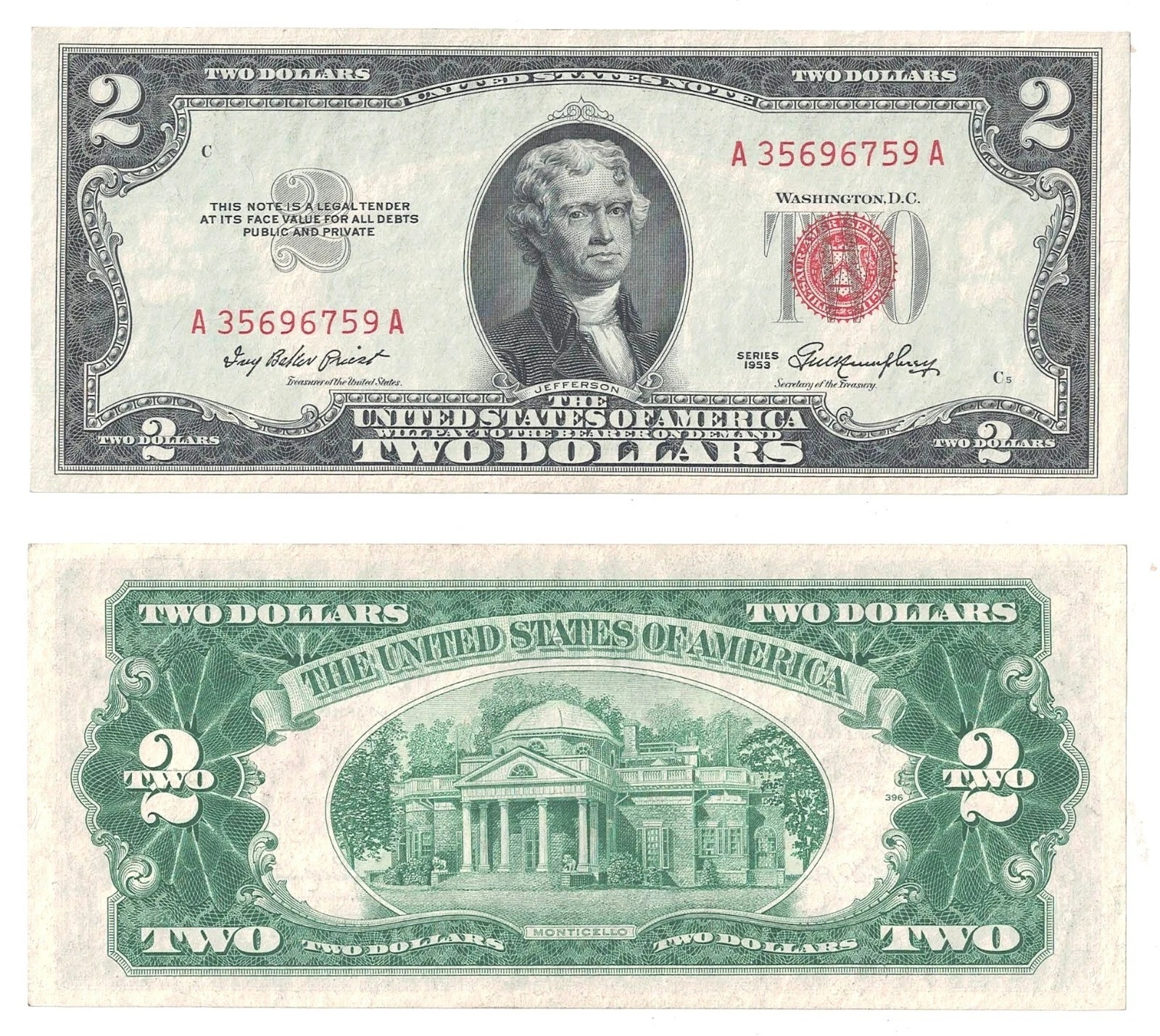
Before diving into the specifics of the 1953 series, it is worth grounding ourselves in what a United States Note actually is. Unlike Federal Reserve Notes, which are issued as liabilities of the Federal Reserve System and make up virtually all of the paper money in circulation today, United States Notes were obligations of the U.S. Treasury itself. They were authorized under the Legal Tender Acts and bore a distinctive red Treasury seal and red serial numbers rather than the green seal and serial numbers found on Federal Reserve Notes.
The government maintained United States Notes in circulation largely because federal law required a minimum of $300 million worth of Legal Tender Notes to remain outstanding at all times, a statutory holdover tied to post-Civil War monetary policy. The $2 denomination was one of the workhorses of this requirement. The red seal is therefore not merely a cosmetic feature. It is a fundamental identifier of the note’s legal and monetary status, and it is the first thing any collector should look for when picking up a suspected 1953 $2 note.
When examining any $2 note from this era, check both the seal color and the obligation text on the face. A genuine 1953 United States Note reads “This note is a legal tender at its face value for all debts, public and private” rather than the Federal Reserve obligation language. Counterfeit attribution errors are rare, but misidentification between note types is surprisingly common among newer collectors.
The Four Sub-Series: 1953, 1953A, 1953B, and 1953C
The Series 1953 $2 United States Note was produced in four distinct sub-series, each defined by a change in the signature combination of the Treasurer of the United States and the Secretary of the Treasury. Understanding these pairings is essential for accurate attribution and helps explain some of the dramatic rarity differences between sub-series.
Series 1953: Priest and Humphrey
The base 1953 series carries the signatures of Ivy Baker Priest as Treasurer and George M. Humphrey as Secretary of the Treasury. This is by far the most common of the four sub-series. The Bureau of Engraving and Printing (BEP) produced approximately 72 million notes in this configuration, enough to ensure that circulated examples are abundantly available today for just a few dollars above face value. Uncirculated examples in grades of MS-63 or better are still accessible for under $30, making this an excellent entry point for collectors new to United States Notes.
Series 1953A: Priest and Anderson
When Robert B. Anderson replaced Humphrey as Secretary of the Treasury in 1957, a new series designation was required. The 1953A notes bear signatures of Ivy Baker Priest and Robert B. Anderson. Production remained robust at roughly 55 million notes, and the 1953A is similarly common in circulated grades. Star note production for this sub-series, however, begins to tell a different story, as we will explore shortly.
Series 1953B: Smith and Dillon
Elizabeth Rudel Smith succeeded Priest as Treasurer in 1961, and C. Douglas Dillon became Secretary of the Treasury, creating the 1953B signature combination. Production dropped considerably, with roughly 15 million regular-issue notes printed. This reduced print run makes the 1953B meaningfully scarcer than the earlier sub-series in high grades, and collectors will pay a noticeable premium for CU examples.
The 1953B sub-series is where condition sensitivity really begins to matter in this set. A circulated Fine-20 example might cost $8 to $12, but a superb gem CU-65 EPQ example can command $75 to $150 from advanced collectors building high-grade type sets. Always prioritize original paper quality and sharp corners when selecting 1953B notes for investment-grade collections.
Series 1953C: Smith and Fowler
The 1953C sub-series represents the final chapter of this design family and is the most intriguing from a transitional standpoint. When Henry H. Fowler replaced Dillon as Secretary in 1965, the resulting signature pairing of Elizabeth Rudel Smith and Henry H. Fowler created a series with a very limited production window. Approximately 4 million regular-issue notes were printed, making this the key regular-issue sub-series of the set. The 1953C also marks a genuine transition point, as the $2 Legal Tender Note would not see another series issued after this point, leaving it as the closing note of an era that stretched back to Reconstruction.
Star Notes: The Real Prize for Specialists
Star notes, replacement notes printed by the BEP when a regular note is damaged or destroyed during production, are where the Series 1953 $2 set becomes genuinely exciting for advanced collectors. Star notes are identified by a star symbol preceding the serial number and represent a small fraction of any given print run.
For the base 1953 series, star note production was approximately 2.16 million notes. While not common, this figure is large enough that circulated examples appear regularly at coin shows and in dealer inventories at modest premiums. The 1953A star notes had a production of roughly 1.08 million, making them somewhat scarcer. The 1953B star notes, with a production of approximately 540,000, enter genuinely scarce territory, and the 1953C star notes are the rarest of the group with production estimated at around 216,000 notes.
That 1953C star note figure bears repeating: roughly 216,000 notes were produced. Given decades of circulation, attrition, and the tendency for low-denomination notes to see heavy use, the number of surviving high-grade examples is quite small. PCGS Currency and PMG population reports consistently show fewer than 100 graded examples across all grades for the 1953C star, with gem examples being genuinely rare.
When purchasing high-grade 1953C star notes, always insist on third-party graded examples from PMG or PCGS Currency. The premium for a PMG 65 EPQ versus an ungraded note claiming the same condition can seem steep, but the authentication and market liquidity benefits are substantial. Beware of cleaned or pressed notes that can fool the naked eye but will grade net or no-grade on submission.
Design Details and What to Look For
The face design of the Series 1953 $2 United States Note is essentially identical to the small-size $2 Legal Tender design introduced with the Series 1928 notes. The portrait of Thomas Jefferson is centered on the face, with the large red Treasury seal to the right and red serial numbers appearing twice. The obligation text runs across the lower face panel, and the series date appears near the lower left of the portrait.
The reverse carries the familiar Monticello vignette, Jefferson’s beloved Virginia home, rendered in fine intaglio engraving. The print quality on high-grade 1953 examples is exceptional, with crisp line definition in the architectural details of Monticello that can serve as a useful condition indicator. On heavily circulated notes, the fine crosshatching in the sky above Monticello is often the first area to show wear, followed by the high points of Jefferson’s portrait on the face.
One design note worth emphasizing for collectors: the 1953 series retains the small Treasury seal used on the 1928 and 1953 series Legal Tender Notes. This distinguishes them from later Federal Reserve Note designs and from the larger seal format used on some earlier series. The seal’s scalloped edge and fine interior detail should be sharp and well-defined on any note grading above Very Fine.
Grading Considerations Specific to This Issue
Because the Series 1953 $2 note circulated heavily as a low-denomination everyday note, truly high-grade examples were saved only by luck or by early collectors who set notes aside immediately upon receipt. When grading these notes, pay particular attention to the following: corner sharpness (the four corners of a CU note should be razor-sharp with no rounding), paper originality (avoid notes with any trace of cleaning, pressing, or artificial brightening), and centering (the BEP’s printing registration on 1953 series notes was generally good, but off-center examples with borders cut into the design are less desirable and will grade lower).
The EPQ (Exceptional Paper Quality) designation from PMG is especially meaningful for this series. An EPQ note confirms that the paper has not been chemically treated and retains its original surface texture and brightness. For the scarcer 1953B and 1953C sub-series, the EPQ premium is well justified and represents a meaningful distinction in the secondary market.
| Series | Type | Approx. Print Run | Rarity |
|---|---|---|---|
| 1953 | Regular Issue | 72,000,000 | Common |
| 1953 | Star Note | 2,160,000 | Common |
| 1953A | Regular Issue | 55,000,000 | Common |
| 1953A | Star Note | 1,080,000 | Scarce |
| 1953B | Regular Issue | 15,000,000 | Scarce |
| 1953B | Star Note | 540,000 | Rare |
| 1953C | Regular Issue | 4,000,000 | Scarce |
| 1953C | Star Note | 216,000 | Key Date |
Building the Complete Set
One of the most appealing aspects of the Series 1953 $2 United States Note for collectors is the attainability of a complete set. The full set in circulated grades, all four sub-series plus all four star notes, can be assembled for well under $500 if you are patient and willing to accept mid-grade circulated examples for the scarcer issues. A complete set in uncirculated grades with EPQ designations for the stars is a more serious undertaking, potentially running $1,000 to $2,500 depending on the grade level pursued, with the 1953C star note accounting for the majority of that budget.
Many collectors choose to build the set at a consistent grade level, acquiring all eight notes at roughly the same condition rather than mixing a gem 1953 regular issue with a heavily circulated 1953C star. This approach creates a visually cohesive collection and is the standard recommended by most United States paper money specialists.
The Transitional Significance of the 1953C
The 1953C deserves additional discussion beyond its rarity. By the time these notes were being printed in 1965 and 1966, the political and monetary environment was changing rapidly. The move toward eliminating silver certificates was already underway, and the broader rethinking of U.S. currency policy was in progress. The $2 denomination itself was seen by Treasury officials as an oddity that caused confusion in commerce and was disliked by the public for superstitious reasons. Its discontinuation after the 1953C series was not a surprise to monetary historians.
What is remarkable is that the denomination survived as long as it did in Legal Tender form, and that the Series 1953 family managed to span nearly 15 years of production across four signature combinations. The 1953C is therefore a genuine transitional issue in the strictest sense: it marks the end of continuous $2 Legal Tender Note production until the denomination was revived in Federal Reserve Note form for the 1976 Bicentennial issue. Collectors who understand this context appreciate the 1953C not merely as a key date but as a piece of American monetary history at a crossroads.
Conclusion: An Accessible Classic Worth Pursuing
The Series 1953 $2 United States Note offers something for virtually every level of collector. Beginners can pick up common circulated examples of the base 1953 and 1953A sub-series for just a few dollars and gain an immediate connection to mid-century American monetary history. Intermediate collectors will find the 1953B and the star note sub-series a satisfying challenge. And for advanced specialists, the hunt for a high-grade, EPQ-designated 1953C star note is a pursuit that can take years and reward patience handsomely. With red seals that catch the eye, a history that spans the final years of a long Legal Tender tradition, and a complete set that remains buildable without a museum-sized budget, the 1953 series remains one of the most rewarding collecting targets in all of small-size United States paper money.