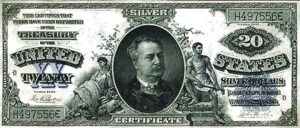
📷 Image source: eBay. Images are selected by AI to represent the article topic and may not depict the exact note(s) described.
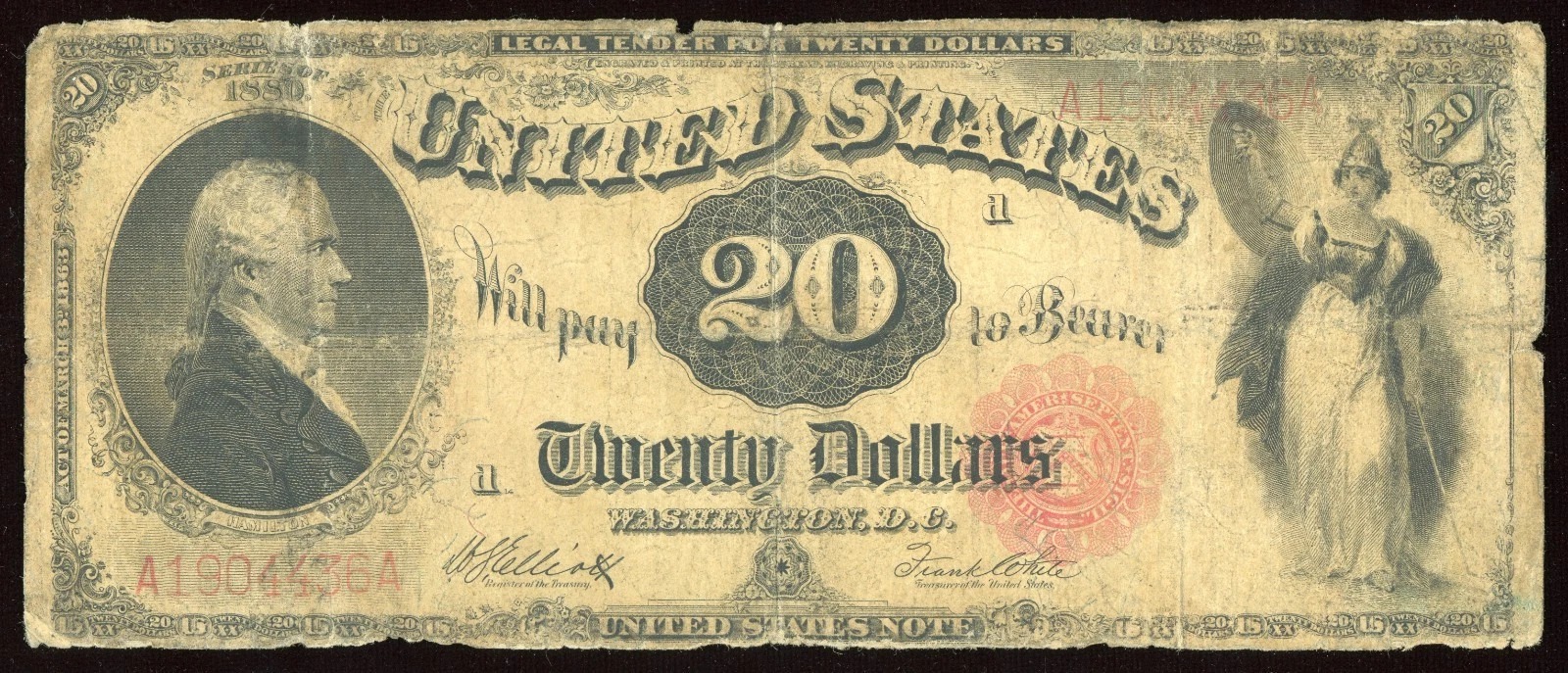
Pick up a Series 1880 $20 United States Note for the first time and the sheer physical presence of the thing stops you cold. At 7.42 by 3.13 inches, these large-size legal tender notes dwarf modern currency, and the engraving work on the face, dominated by a stately portrait of Alexander Hamilton at left and an intricate geometric lathe-work panel filling the center, represents Federal Bank Note Company and Bureau of Engraving and Printing craftsmanship at its confident peak. But size and artistry alone do not make a collectible series: what makes the 1880 $20 Legal Tender genuinely compelling is the layered complexity underneath that imposing exterior, specifically the interplay of signature combinations, Treasury seal varieties, and a surviving population that varies wildly from one variety to the next.
A Series Born From Post-War Monetary Ambiguity
The Series 1880 $20 United States Note did not emerge in a vacuum. It was a direct descendant of the Legal Tender notes first authorized by Congress in February 1862 to finance the Civil War, notes that critics called “fiat money” and defenders called financial salvation. By 1880, the legal tender question had been litigated all the way to the Supreme Court and settled, however uneasily, in favor of their continued validity. The notes carried the bold red legend “THIS NOTE IS A LEGAL TENDER AT ITS FACE VALUE FOR ALL DEBTS PUBLIC AND PRIVATE EXCEPT DUTIES ON IMPORTS AND INTEREST ON THE PUBLIC DEBT” on the reverse, a statement that was itself gradually simplified on later series.
The face design centered on Alexander Hamilton, the nation’s first Treasury Secretary, which carries an irony collectors often note: Hamilton was deeply skeptical of paper money unbacked by specie, yet his portrait graced one of the purest examples of fiat currency the government ever issued. The back featured an elaborate green geometric design, deeply engraved, that has aged beautifully on well-preserved examples. Serial numbers on the 1880 series appeared in red ink on most varieties, with the large red Treasury seal also printed directly on the face.
Mapping the Signature Combinations and Seal Varieties
Understanding the Series 1880 $20 requires treating it not as a single note but as a family of related varieties unified by design and separated by the administrative personnel who signed them. The Treasury Registrar and Treasurer of the United States both signed every note, and as administrations changed through the 1880s and into the 1890s, new combination pairs were issued under the same series date, since series dates reflected design freezes rather than calendar years of printing.
The earliest varieties, Fr. 127 and Fr. 128, carry the signatures of Scofield-Gilfillan and Bruce-Gilfillan respectively, paired with the large brown seal. These brown-seal examples are among the rarest of the entire run. The brown Treasury seal, used only briefly in the early 1880s before the BEP standardized on red, gives these notes an antique warmth that photographs poorly but is immediately arresting in hand.
When examining brown-seal 1880 $20 Legal Tenders (Fr. 127 and Fr. 128), be alert to notes where the seal color has faded or been altered. Genuine brown seals have a rich, slightly muted cocoa tone quite different from the oxidized appearance of a chemically treated red seal. Under UV light, authentic brown seals show a consistent organic fluorescence distinct from period red inks.
Moving through the series, the red-seal varieties split between two subtypes: those with spiked or “radiant” seals featuring pointed rays around the circumference, and later examples with scalloped edges. The ray-seal varieties (Fr. 129 through Fr. 132) cover the Bruce-Gilfillan, Bruce-Wyman, Rosecrans-Jordan, and Rosecrans-Hyatt signature combinations. The scalloped-seal notes (Fr. 133 through Fr. 137) then carry the Rosecrans-Huston, Rosecrans-Nebeker, and Tillman-Morgan combinations, the last of which, Fr. 137, is the single most available variety in the series by census count, printed into the mid-1890s in meaningful quantities.
What Survival Populations Actually Look Like
Population data for large-size legal tender notes is aggregated primarily through PCGS Currency and PMG grading records, supplemented by major auction appearances tracked in the Lyn Knight, Stack’s Bowers, and Heritage archives. The picture that emerges for the 1880 $20 series is one of extreme top-heaviness in the grade distribution: the vast majority of certified examples cluster in the Very Good (VG 8 to VG 10) through Very Fine (VF 20 to VF 35) range, reflecting a note that circulated actively for decades before being retired and saved as curiosities rather than as pristine specimens.
Fine-grade examples (F 12 to F 15) are the sweet spot for value-conscious collectors who want genuine eye appeal without paying the dramatic premiums that attach to Extremely Fine and better pieces. A solid Fine 1880 $20 in the Tillman-Morgan combination typically retails in the $350 to $600 range at auction, offering excellent design visibility and minimal serious damage, though folds and light soiling are expected and accepted at that grade. Step up to Extremely Fine (EF 40 to EF 45) on the same variety and prices climb to the $1,200 to $2,000 range, because examples with only two or three light folds and bright original color are genuinely uncommon even for the more available signatures.
For the Series 1880 $20, paper quality often matters as much as grade. Many examples graded VF 25 or VF 30 by PMG or PCGS exhibit original paper crispness at the margins despite heavy center folds, a trait described as “strong paper” in catalog notes. Prioritize notes where the engraving retains clear definition in the fine background lathe-work behind Hamilton’s portrait, because heavily circulated examples frequently show flattening in precisely those areas.
Uncirculated examples of any 1880 $20 variety are legitimately rare. PMG and PCGS combined census data, as of recent auction cycles, shows fewer than fifteen examples across all varieties graded MS 60 or better, and the majority of those are Tillman-Morgan notes. The brown-seal varieties (Fr. 127, Fr. 128) are essentially unknown in Uncirculated condition, and even a single VF example of Fr. 127 attracts serious competition at auction. When a PCGS VF 30 Scofield-Gilfillan brown-seal example appeared in a 2019 Stack’s Bowers sale, it realized just over $9,000 against an estimate of $6,000 to $8,000, illustrating the premium demand these notes command from advanced collectors.
The Rosecrans Varieties: Middle Ground and Hidden Scarcity
The Rosecrans signature combinations deserve particular attention because their rarity is not uniformly distributed as collectors sometimes assume. William Starke Rosecrans served as Register of the Treasury from 1881 to 1893, meaning his signature appeared on notes paired with four different Treasurers: Jordan, Hyatt, Huston, and Nebeker. The Rosecrans-Jordan pairing (Fr. 131) is especially scarce, with fewer than thirty certified examples across all grades in combined PMG and PCGS census data. Notes signed by Rosecrans and Hyatt (Fr. 132) are somewhat more available but still genuinely difficult to locate in grades above Fine.
The transition from the ray seal to the scalloped seal within the Rosecrans era creates an interesting collecting challenge: the Rosecrans-Huston combination (Fr. 133) appears in both seal types depending on printing date, and a small number of transitional examples with mismatched seal characteristics exist, though these are extremely rare and authentication requires expert examination. The Rosecrans-Nebeker pairing (Fr. 136) in the scalloped-seal format is more available than its ray-seal predecessors but still commands a significant premium over the Tillman-Morgan signature at comparable grades.
Building a complete signature set of the Series 1880 $20 is an attainable long-term goal for dedicated collectors, but budget accordingly for the Scofield-Gilfillan (Fr. 127) and Rosecrans-Jordan (Fr. 131) varieties. Consider acquiring the more available Tillman-Morgan examples first in higher grades to anchor your display, then work backward to the scarcer early signatures in grades you can realistically afford. A Fine-grade complete set is far more satisfying and educational than a partial set with a few gem examples.
Grading Considerations Specific to This Issue
Large-size legal tender notes from the 1880s present specific grading challenges that differ meaningfully from small-size currency. The paper stock used was a high-quality linen-cotton blend produced under government contract, and it ages with characteristic predictability: honest circulation wear shows as parallel diagonal folds across the face (the result of folding to fit into wallets and cash drawers), gradual softening of the paper body, and light soiling concentrated at the margins and fold intersections. What distinguishes problem-free notes from those with issues is the presence of tears, missing corners, pinholes (common from the practice of stringing notes together for counting), staining from ink or dampness, and evidence of cleaning or pressing.
Pressing is a particular concern with 1880 $20 Legal Tenders. The thick ink of the intaglio printing process creates a distinctive tactile relief on genuine notes that survives even moderate circulation, and an expertly pressed note will display artificially reduced fold visibility while retaining some of this surface texture. Graders at PMG and PCGS specifically examine ink relief in the portrait shading and in the serial numbers, both of which flatten noticeably under pressing. Notes with a “net” grade designation from either service, indicating a problem, typically trade at 30 to 50 percent below problem-free examples at equivalent technical grades.
| Friedberg No. | Signature Combination / Seal | Est. Known Examples | Rarity |
|---|---|---|---|
| Fr. 127 | Scofield-Gilfillan / Large Brown | Approx. 12-18 | Key Date |
| Fr. 128 | Bruce-Gilfillan / Large Brown | Approx. 20-30 | Key Date |
| Fr. 129 | Bruce-Gilfillan / Large Red (rays) | Approx. 40-60 | Rare |
| Fr. 130 | Bruce-Wyman / Large Red (rays) | Approx. 50-80 | Rare |
| Fr. 131 | Rosecrans-Jordan / Large Red (rays) | Approx. 25-35 | Key Date |
| Fr. 132 | Rosecrans-Hyatt / Large Red (rays) | Approx. 45-65 | Rare |
| Fr. 133 | Rosecrans-Huston / Large Red (scallops) | Approx. 80-120 | Scarce |
| Fr. 136 | Rosecrans-Nebeker / Large Red (scallops) | Approx. 100-150 | Scarce |
| Fr. 137 | Tillman-Morgan / Large Red (scallops) | Approx. 300-450 | Most Available |
Auction Records and Current Market Context
The market for Series 1880 $20 Legal Tenders has firmed consistently since the early 2000s, driven by a growing collector base for nineteenth-century large-size currency and by the finite, slowly declining supply of problem-free examples. Major auction results from the past decade illustrate the trajectory: a PMG Very Fine 30 Fr. 128 (Bruce-Gilfillan brown seal) sold for $14,100 at a 2022 Heritage auction against a pre-sale estimate of $9,000 to $12,000. A PMG Fine 15 Fr. 131 (Rosecrans-Jordan) realized $7,200 in a 2021 Stack’s Bowers sale. Even the most common variety, Fr. 137 in Fine condition, now reliably exceeds $400 at major auctions, up from the $250 range that was typical before 2010.
The key data point for prospective buyers is that these notes are not infinitely available even in circulated grades. Dealer stock turns over slowly, and the notes that do appear frequently carry problems. Patient collectors who set alerts through major auction house notification systems and cultivate relationships with large-size currency specialists will consistently find better material than those who rely solely on online marketplaces, where authentication concerns are higher and problem notes are more common.
Conclusion: The Case for Collecting the 1880 $20
The Series 1880 $20 United States Note rewards collectors at nearly every budget level while offering genuine numismatic depth. The Tillman-Morgan variety provides an accessible entry point into this historic series, and the progression toward the scarcer brown-seal and early red-seal varieties creates a collecting roadmap that can span years of enjoyable pursuit. Unlike some large-size series where a single note defines the collection, the 1880 $20 family encompasses enough variety in signatures, seals, and surviving condition to sustain serious engagement. These notes also carry genuine historical weight: they circulated through the Gilded Age, survived the economic panics of 1893 and 1907, and emerged as physical artifacts of a moment when the United States was still debating the fundamental nature of its own money. For collectors who care about that context as much as the physical object, the Series 1880 $20 Legal Tender offers both in exceptional measure.