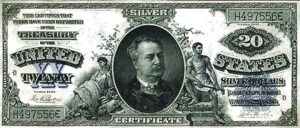
A Small-Size Classic: The Red Seal $2 Legal Tender Note
When the United States transitioned from large-size to small-size currency in 1929, the $2 denomination carried forward its long tradition as a Legal Tender Note, complete with a vivid red Treasury seal and red serial numbers. The result was one of the most visually distinctive pieces of twentieth-century American paper money: the Series 1928 $2 United States Note, popularly known among collectors as the “Red Seal Jefferson.” Over the next three decades, six sub-series were issued, each bearing a different combination of Treasury signatures and each carrying its own story in terms of mintage, survival rate, and collector demand.
Design and Layout: What You Are Actually Holding
Pick up any Series 1928 $2 United States Note and you immediately notice what sets it apart from a Federal Reserve Note of the same era. The obligation printed on the face reads “The United States of America will pay to the bearer on demand TWO DOLLARS” and the words “United States Note” appear prominently. The Treasury seal, positioned to the right of Jefferson’s portrait, is printed in a bright red ink, as are the two serial numbers flanking the design. On the back, Monticello, Jefferson’s Virginia estate, fills the central panel in rich green ink, essentially the same reverse design that would carry through to the modern $2 Federal Reserve Note introduced in 1976.
The front plate numbering system and the serial number format both follow the conventions established for all small-size currency at the time. Serials run from a letter prefix through eight digits and close with a star (for replacement notes) or a suffix letter. Condition survivors tend to show corner wear first, followed by center folds, because these notes actually circulated as pocket change in the 1930s and 1940s. Many Americans spent them without a second thought, which ironically makes high-grade examples today more valuable than one might expect for a series printed in the millions.
When examining a Series 1928 $2 United States Note under magnification, check the red seal for crispness and full ink saturation. Notes that circulated heavily often show a faded or abraded seal, which significantly reduces eye appeal and market value even in otherwise problem-free examples graded Fine to Very Fine.
The Six Sub-Series and Their Signature Combinations
A new sub-series letter was assigned whenever the Treasurer of the United States or the Secretary of the Treasury changed, because both signatures appear on every note. Understanding who signed what is the backbone of collecting this series.
Series 1928 (No Suffix Letter): Woods and Mellon
The base series, issued beginning in 1928, bears the signatures of Treasurer Walter O. Woods and Secretary Andrew W. Mellon. The print run totaled approximately 55,889,424 notes, making this the highest-production variety in the 1928 family. Despite that large number, circulated examples in Fine or better condition are genuinely pleasing, and a crisp Uncirculated specimen grades easily as PMG 64 or better. Star notes for this variety are available but carry a meaningful premium.
Series 1928A: Woods and Mellon (Revised)
The 1928A retained the Woods-Mellon signature pairing but was issued under a separate plate series. Production reached roughly 10,476,000 notes. Because circulation overlap with the parent 1928 series was heavy, many survivors come to market in well-worn grades. High-grade 1928A notes (PMG 65 EPQ or better) appear at major auction infrequently.
Series 1928B: Woods and Mills
When Ogden L. Mills replaced Andrew Mellon as Treasury Secretary in February 1932, a new sub-series was born. Woods-Mills notes had a print run of approximately 9,001,632. The 1928B is entirely collectible in circulated grades, but superb gem examples are genuinely hard to track down, and star note survivors are prized by specialists.
Series 1928C: Does Not Exist
Collectors new to the series are often puzzled by the apparent gap between 1928B and 1928D. There is no 1928C. The progression skipped that letter because the Treasury numbering conventions of the period left the “C” designation unissued for the $2 Legal Tender series. This is a legitimate and frequently asked question, so note it well before you find yourself bidding on a supposed “1928C” that is actually a counterfeit or a fraudulently altered note.
No Series 1928C $2 United States Note was ever officially printed or issued. If you encounter one offered for sale, treat it as a forgery or an altered note until proven otherwise by independent expert authentication. This gap in the series is well-documented in both the Friedberg catalog and the Standard Catalog of United States Paper Money.
Series 1928D: Julian and Woodin
By 1933, two new officials had taken their posts. William A. Julian became Treasurer and William H. Woodin served as Treasury Secretary under the newly inaugurated Franklin Roosevelt. The Julian-Woodin combination had an extremely brief window before Woodin’s ill health forced his resignation in late 1933. The result was a tiny print run: only 1,375,938 regular-issue notes were produced, along with a minuscule star note population. The 1928D is unquestionably the key date of the entire series in circulated grades, and even worn examples in Fine condition command multiples of the prices seen for the common 1928 base issue.
Series 1928E: Julian and Morgenthau
Henry Morgenthau Jr. replaced Woodin in January 1934 and would serve as Treasury Secretary for over eleven years. The Julian-Morgenthau pairing generated a 1928E print run of approximately 3,062,052 notes. The 1928E sits in the middle of the rarity spectrum: not as common as the base 1928, not as rare as the 1928D, but certainly underappreciated by newer collectors who tend to focus only on the obvious key date.
Series 1928F and 1928G: Clark and Snyder
Clark-Snyder (Series 1928F) and Clark-Snyder with a slightly modified plate specification (Series 1928G) round out the family. The 1928F had a print run of approximately 7,076,994 and the 1928G reached about 52,208,000, making the 1928G the second largest production run in the series. Both are readily available in circulated grades, and the 1928G in particular is a fine entry-level note for new collectors who want to hold a genuine piece of mid-century Legal Tender history without breaking the bank.
Star Notes Across the Series
Replacement notes, identified by a star symbol in place of the suffix letter, exist for all sub-series. The rarity levels vary dramatically. Star notes for the base 1928 issue are available with patience, while 1928D stars are among the most coveted small-size Legal Tender rarities in existence. Documented populations for 1928D stars run to only a few dozen confirmed survivors across all grades, and a single PMG 30 example can bring several thousand dollars at a major currency auction.
When building a type set of the 1928 $2 United States Note series, start with a high-grade 1928G for your foundation, then work backward toward the scarcer sub-series. Buying the 1928D last, once your budget is committed and your grading eye is sharp, is almost always the smarter approach than leading with the key date and settling for lesser examples of the common issues.
Grading Considerations Specific to This Series
The red ink on the seal and serial numbers is both the series’ greatest visual asset and its most common point of failure in grading. Ink smears from improper storage, “fox” staining along the borders, and paper folds that crack the red seal are all demerits that grading services penalize heavily. A note graded PMG 64 Choice Uncirculated with the EPQ (Exceptional Paper Quality) designation will consistently outperform a straight 65 without EPQ at auction because the market has learned to value original surfaces in Legal Tender notes.
Cleaning is another issue. Many red-seal notes were lightly pressed or washed by dealers in earlier generations of the hobby to improve their appearance. Modern grading services use ultraviolet examination and tactile assessment to detect cleaned notes, which are typically designated “NET” (net grade after problems) and carry reduced market premiums. Buy only third-party graded examples from PCGS Currency or PMG until your eye is trained well enough to detect cleaning on raw notes.
Catalog References and Friedberg Numbers
The standard reference for United States currency is the Friedberg catalog, formally titled “Paper Money of the United States” by Arthur and Ira Friedberg. The Friedberg numbers for the Series 1928 $2 United States Notes run from Fr. 1501 (base 1928) through Fr. 1507 (1928G). Star note variants carry the suffix asterisk in Friedberg notation. Serious collectors should own a current edition of the Friedberg catalog as well as the Standard Catalog of United States Paper Money edited by George Cuhaj, which provides additional population context and historical pricing data.
| Series / Friedberg No. | Signature Combination | Approx. Print Run | Rarity |
|---|---|---|---|
| 1928 / Fr. 1501 | Woods – Mellon | 55,889,424 | Common |
| 1928 Star / Fr. 1501* | Woods – Mellon (Star) | Est. 700,000+ | Scarce |
| 1928A / Fr. 1502 | Woods – Mellon | 10,476,000 | Common |
| 1928B / Fr. 1503 | Woods – Mills | 9,001,632 | Common |
| 1928D / Fr. 1504 | Julian – Woodin | 1,375,938 | Key Date |
| 1928D Star / Fr. 1504* | Julian – Woodin (Star) | Est. under 5,000 | Key Date |
| 1928E / Fr. 1505 | Julian – Morgenthau | 3,062,052 | Scarce |
| 1928F / Fr. 1506 | Clark – Snyder | 7,076,994 | Common |
| 1928G / Fr. 1507 | Clark – Snyder | 52,208,000 | Common |
Market Values and Where to Buy
As of recent auction data, a circulated Very Fine 1928 (base issue) typically sells in the $15 to $30 range, while the same grade in 1928D commands $300 to $600 or more depending on eye appeal. Gem Uncirculated examples with EPQ across any sub-series carry meaningful premiums: a PMG 65 EPQ 1928 base issue can fetch $150 to $250, and a PMG 65 EPQ 1928D would be a significant auction event likely to exceed $2,000. Heritage Auctions, Stack’s Bowers, and Lyn Knight Currency are the primary venues for high-grade or key-date examples. For circulated common issues, dealer tables at any major coin and currency show remain the most cost-effective source.
Building a complete 1928 $2 United States Note type set, one example of each sub-series in matching or near-matching grades, is a realistic and rewarding goal for intermediate collectors. The set has a defined endpoint, the notes are physically attractive, and the historical context spanning the Hoover and early Roosevelt administrations gives the collection a narrative arc that few other small-size series can match.
For a display-quality type set, aim for PMG or PCGS Currency graded examples in the VF 30 to EF 45 range for the scarcer sub-series (1928D, 1928E) and Choice Uncirculated 63 or better for the common issues (1928, 1928F, 1928G). This approach balances budget against visual consistency and ensures every note in the set can hold its own on the page.
Conclusion: A Series Worth Knowing Deeply
The Series 1928 $2 United States Note family rewards the collector who takes time to learn the details. Six sub-series, one notable gap, a true key date in the 1928D, and a wide range of star note rarities make this an endlessly interesting corner of the small-size Legal Tender universe. Whether you are drawn to the vibrant red seal, the historical sweep of signatures from the Hoover era through the early postwar years, or simply the challenge of completing a difficult registry set, the Red Seal Jefferson offers plenty of depth. Start with what you can afford, grade your way up, and never stop reading the catalog notes, because in paper money as in most things, knowledge is the sharpest tool in any collector’s kit.