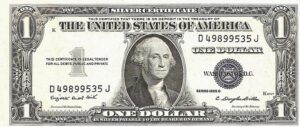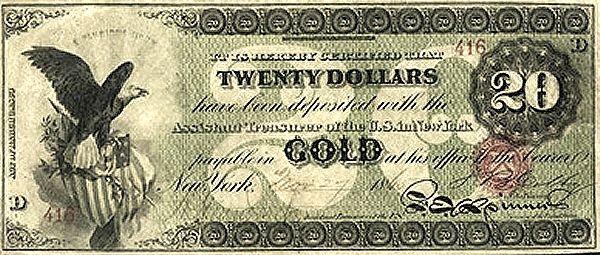
📷 Image source: banknote.ws (World Banknote Gallery). Images are selected by AI to represent the article topic and may not depict the exact note(s) described.
Pull a Series 1928 Gold Certificate from a dealer’s stock today and you are holding a note that the federal government once demanded back with the force of law. Issued beginning in 1928 as the first small-size gold-redeemable currency and recalled by executive order in 1933, these notes had a lifespan of barely five years in circulation. Yet in that brief window they became the definitive paper representation of the United States gold standard, bearing a brilliant golden-yellow Treasury seal that announced, unmistakably, that the holder had a legal claim on actual gold coin. That promise, of course, was revoked. The notes that survived government collection became collectibles almost overnight, and today they occupy a prized spot in any serious Federal Reserve or general type collection.
Background: Why Gold Certificates Existed
Gold Certificates in the United States date to the Civil War era, but the large-size issues that preceded 1928 were ornate, oversized notes that presented practical handling challenges. When Congress mandated a uniform small-size format for all U.S. currency with the act of 1928, every class of currency, including Gold Certificates, Silver Certificates, Federal Reserve Notes, and United States Notes, shrank to the familiar 6.14 x 2.61 inch dimension we still use today. The new small-size Gold Certificates were printed at the Bureau of Engraving and Printing starting in the summer of 1928, with deliveries to Federal Reserve Banks beginning in late 1928 and continuing through early 1929.
The legal basis for Gold Certificates rested on their explicit promise printed on the face of each note: “This certifies that there have been deposited in the Treasury of the United States of America [X dollars] in gold coin payable to the bearer on demand.” That language distinguished them from every other currency class and made them, technically, warehouse receipts for physical gold held in Treasury vaults. Banks used them heavily for interbank settlements, and they circulated among the public as ordinary currency, which is why so many found their way into wallets and cash drawers before the recall.
The Distinctive Design Elements
Every denomination in the Series 1928 Gold Certificate issue shares a family resemblance, but several design features set these notes apart from all other contemporaneous small-size currency.
The most immediately striking feature is the Treasury seal, printed in a rich golden-yellow ink that gives the notes their popular nickname, “Yellow Seals.” The serial numbers are also printed in the same golden-yellow ink, a detail that creates a visually cohesive face design unique to this class. Compare any 1928 Gold Certificate to a 1928 Federal Reserve Note or Silver Certificate side by side and the distinction is immediate and dramatic.
The backs of all denominations are printed in the standard green ink used across all small-size issues, a deliberate policy choice meant to make counterfeiting more difficult and to maintain visual continuity. The portraits follow Federal Reserve Note convention for the lower denominations: Alexander Hamilton on the $10, Andrew Jackson on the $20, Ulysses S. Grant on the $50, and Benjamin Franklin on the $100. The $500 bears William McKinley, the $1,000 bears Grover Cleveland, maintaining the same assignments used on contemporaneous Federal Reserve Notes of those denominations.
When examining a Series 1928 Gold Certificate, always check that both the Treasury seal and serial numbers are the same golden-yellow shade. Altered notes, sometimes created from Silver Certificates with yellow ink added, exist in the market. On genuine notes, the yellow ink has a characteristic warmth and slight texture that is difficult to replicate convincingly.
Signature Combinations and Series Varieties
All Series 1928 Gold Certificates carry the signatures of Register of the Treasury Walter O. Woods and Secretary of the Treasury Andrew W. Mellon, cataloged as the Woods-Mellon combination. This pairing is consistent across the $20, $50, $100, $500, and $1,000 denominations.
The $10 Gold Certificate presents a more nuanced situation that trips up newer collectors. The initial printings of the $10 note also carry Woods-Mellon signatures (Friedberg 2400), but a subsequent printing used the signatures of Woods and Ogden L. Mills, who replaced Mellon as Treasury Secretary in February 1932 (Friedberg 2400a, the Woods-Mills variety). Print runs on the Woods-Mills $10 are considerably smaller, and it commands a meaningful premium over its more common predecessor in equivalent grades. For a denomination-focused collection, owning both signature varieties of the $10 is a satisfying goal that many intermediate collectors pursue.
The 1933 Recall and Its Effect on Surviving Populations
Franklin D. Roosevelt signed Executive Order 6102 on April 5, 1933, requiring most Americans to surrender all gold coins, gold bullion, and gold certificates to Federal Reserve Banks by May 1, 1933. Violations carried penalties of up to $10,000 and ten years imprisonment, provisions that ensured a high compliance rate. The result was a massive reduction in the number of Gold Certificates remaining outside government control.
The notes that survived did so for various reasons. Some were held by foreign nationals or foreign central banks, who were initially exempt from the order. Others were held by numismatists who quietly retained examples under the collector exemption, which permitted holding gold coins and currency of recognized numismatic value. A significant number simply were not surrendered due to ignorance of the requirement, especially lower-denomination notes held in drawers, wallets, and household cash reserves. These “sleepers” have been appearing in family estates at a steady if declining rate ever since.
Interestingly, Gold Certificates were not formally remonetized for public holding until December 31, 1964, when the Treasury officially lifted restrictions on collecting them. Until that date, technically owning one outside of a recognized numismatic context was legally ambiguous at best. The 1964 liberalization opened the floodgates for widespread public collecting of these notes.
Many surviving Gold Certificates in circulated grades show evidence of folding consistent with regular use in commerce, including the telltale vertical center fold from time spent in a wallet. Notes that avoided heavy circulation and show minimal folds command strong premiums. The difference in retail value between a Fine-15 and a Very Fine-30 example on a common denomination like the $20 can be several hundred dollars, so grading precision matters greatly here.
Denomination-by-Denomination Collector Overview
The $10 Gold Certificate (Fr. 2400 and 2400a)
The $10 is the most accessible entry point into Gold Certificate collecting, with the Woods-Mellon variety (Fr. 2400) having a combined print run approaching 130 million notes across multiple deliveries. In circulated grades such as Fine to Very Fine, retail values typically run in the $150 to $300 range for problem-free examples, making this a genuine starter note. The Woods-Mills signature variety (Fr. 2400a) is meaningfully scarcer, with print runs totaling roughly 1.7 million notes, and even circulated examples can fetch $400 to $800 depending on grade and eye appeal.
The $20 Gold Certificate (Fr. 2402)
The $20 denomination saw a large print run of approximately 66 million notes and represents the most commonly encountered Gold Certificate in mid-grade condition. This is the “workhorse” denomination for type collectors who want a presentable example without paying a large premium. Uncirculated examples in PCGS or PMG holders grading 63 and above are readily available from major dealers and regularly appear at major currency auction houses.
The $50 and $100 Gold Certificates (Fr. 2404 and 2405)
Print runs drop sharply for these higher denominations. The $50 had approximately 5.5 million notes printed, and the $100 had roughly 3.5 million. Both denominations are noticeably less common in any grade and jump in price accordingly. The $100 in particular is a note that requires patience to find in attractive circulated condition, and gem uncirculated examples are genuinely scarce in the marketplace.
The $500 and $1,000 Gold Certificates (Fr. 2407 and 2408)
These are the true rarities of the series, with print runs measured in the low hundreds of thousands. The $500 McKinley and $1,000 Cleveland notes were primarily instruments of banking and large commercial transactions; relatively few entered ordinary public circulation, and the 1933 recall hit surviving populations hard. Today these notes appear infrequently even at major auction events, and when they do, prices for problem-free examples in Very Fine or better grades routinely reach five figures. A PMG 64 EPQ example of the $1,000 Gold Certificate sold at auction for over $60,000 in recent years.
Third-party grading from PMG or PCGS Currency is especially important for Series 1928 Gold Certificates above the $20 denomination. The combination of high values, the existence of altered or repaired notes, and the significance of color originality makes an authenticated, encapsulated note far easier to resell and significantly more trusted by advanced collectors and auction bidders alike.
Grading Nuances Specific to Gold Certificates
A few grading considerations apply specifically to this issue. First, paper color originality is paramount. Genuine Series 1928 Gold Certificates have a cream-white paper stock that darkens with age and handling to a light tan. Notes with very white, bright paper should be examined carefully, as washing or pressing, sometimes called “cleaning,” is not unknown on valuable currency. Grading services will note cleaning in their holder designations, and cleaned notes trade at substantial discounts.
Second, the golden-yellow ink of the seal and serial numbers is susceptible to fading and rubbing. On notes that circulated heavily, these elements can appear washed out rather than vibrant. Strong color in the yellow ink is a positive grade modifier and a strong predictor of eye appeal, which drives collector premiums beyond raw technical grade.
Third, pinholes are common on these notes because banks routinely used pin boards to organize stacks of currency. Even a single pinhole can reduce an otherwise choice note from a 64 to a 63 or lower in third-party grading, so examine surfaces carefully under a loupe against good light.
| Friedberg No. | Denomination / Variety | Approx. Print Run | Rarity |
|---|---|---|---|
| Fr. 2400 | $10, Woods-Mellon | ~130,000,000 | Common |
| Fr. 2400a | $10, Woods-Mills | ~1,700,000 | Scarce |
| Fr. 2402 | $20, Woods-Mellon | ~66,000,000 | Common |
| Fr. 2404 | $50, Woods-Mellon | ~5,500,000 | Scarce |
| Fr. 2405 | $100, Woods-Mellon | ~3,500,000 | Scarce |
| Fr. 2407 | $500, Woods-Mellon | ~420,000 | Rare |
| Fr. 2408 | $1,000, Woods-Mellon | ~288,000 | Rare |
| Fr. 2400a | $10 Star Note, Woods-Mills | Est. under 100,000 | Key Date |
Building a Collection: Strategies for Every Budget
For collectors with limited budgets, the obvious starting point is a circulated $10 Woods-Mellon or $20 example in Fine to Very Fine grade. Both denominations are genuinely affordable, historically significant, and attractive in hand. From there, adding a crisp uncirculated $10 or $20 in a PMG or PCGS holder gives a contrasting study in grade and eye appeal.
Intermediate collectors often work toward a complete denomination set, one note at each face value from $10 through $1,000. Completing that set in circulated grades is entirely feasible over several years of patient collecting, though the $500 and $1,000 notes will require a meaningful financial commitment. A complete circulated type set in Fine or better condition, acquired at reasonable prices, might represent a total investment in the $15,000 to $30,000 range depending on grades and market timing.
Advanced collectors focus on the finest known examples, pursuing notes with PMG or PCGS grades in the 65 EPQ or higher range, or completing both signature varieties of the $10. The competition for gem examples is real, and auction records for the highest graded notes are tracked avidly by specialists. The Standard Catalog of United States Paper Money and Friedberg’s Paper Money of the United States are the essential references, with updated valuations that reflect current market conditions.
Conclusion: A Short Life, A Long Legacy
The Series 1928 Gold Certificates existed in public hands for barely five years before a presidential order ended their story as currency. In that compressed lifetime they served as the last meaningful connection between American paper money and gold metal, a promise printed in yellow ink on paper that the government ultimately could not keep. That historical tension, a note that represented a monetary commitment America abandoned at a moment of national crisis, is precisely what makes these notes so compelling to collect and study today. Whether you are drawn to the vivid yellow seal of an affordable $10 note or the rarity and gravitas of a high-denomination example, the Series 1928 Gold Certificate issue offers one of the most rewarding collecting experiences in all of small-size paper money.