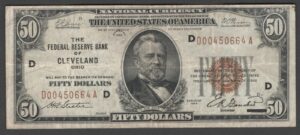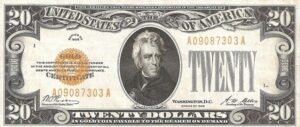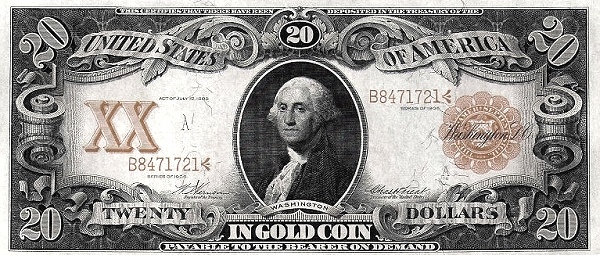
📷 Image source: banknote.ws (World Banknote Gallery). Images are selected by AI to represent the article topic and may not depict the exact note(s) described.
Pull up a photograph of the Series 1922 $100 Gold Certificate and the first thing that hits you is the sheer presence of the thing. Even on a screen, the large-size format commands attention, the golden-orange treasury seal blazing against the crisp face of the note, Abraham Lincoln gazing from the center left, and that magnificent spread eagle dominating the reverse in a way that smaller, modern notes simply cannot replicate. For collectors of large-size United States currency, this note occupies a special tier: it is the last of the large-size $100 Gold Certificates, the culmination of a design lineage that stretched back decades, and it carries with it the weight of an era that was about to end forever.
Historical Context: Gold Certificates in American Currency
Gold Certificates were a uniquely American institution, representing a promise that the federal government held an equivalent amount of gold coin in reserve for every note in circulation. The concept dated to 1865, when the first Gold Certificates were issued for bank-to-bank transactions only. By the 1880s and 1890s, the series had evolved into currency available to the general public, with the familiar gold-tinted seal and serial numbers that gave the notes their distinctive visual identity.
The Series 1922 $100 Gold Certificate emerged at the tail end of a long design evolution. It followed the Series 1905, 1906, and 1922 progression at the $100 denomination, and it carried the same large-size format that the Treasury had been using since the Civil War era. Just a decade later, the Emergency Banking Act of 1933 and subsequent Executive Order 6102 would require citizens to turn in their gold holdings, including Gold Certificates, effectively pulling these notes from circulation and making survivors genuinely scarce today.
The Design: Eagles, Lincoln, and That Unforgettable Seal
The face of the Series 1922 $100 Gold Certificate centers on a portrait of Abraham Lincoln, engraved with the fine detail that Bureau of Engraving and Printing craftsmen were renowned for during the large-size era. The portrait is flanked by ornate lathe-work borders, and the golden-orange Treasury seal is printed to the right of center. The serial numbers are also rendered in the same distinctive gold-orange ink, which collectors often call “goldenrod,” giving the face of the note a warmth and richness that is impossible to replicate on modern currency.
The reverse is where this note truly earns its reputation. A large spread eagle, wings fully extended, dominates the green-printed back of the note. The eagle vignette used here is a refined version of imagery the Treasury had employed across multiple series and denominations, but at the $100 large-size format it achieves a kind of monumental quality. The word “GOLD” is prominently printed, along with the redemption promise: “IN GOLD COIN PAYABLE TO THE BEARER ON DEMAND.” For collectors who appreciate the intersection of American artistic craft and monetary history, this reverse design is as good as it gets.
When examining a Series 1922 $100 Gold Certificate, inspect the goldenrod serial numbers and Treasury seal under good lighting. Fading or color shift in these elements can indicate improper storage or cleaning, both of which significantly impact grade and value. Original, unfaded gold-orange inks are a sign of a well-preserved example.
Friedberg Number and Catalog Classification
In the standard reference for large-size United States currency, “A Guide Book of United States Paper Money” by Arthur Friedberg and Ira Friedberg (commonly called the Friedberg catalog), the Series 1922 $100 Gold Certificate is assigned catalog number Fr. 1215. This is the only Friedberg number for the 1922 series at this denomination, reflecting the single signature combination issued: Speelman and White, corresponding to Register of the Treasury S. W. Speelman and Treasurer of the United States Frank White, who both served during the early 1920s.
Earlier large-size $100 Gold Certificates at the Fr. 1210 through Fr. 1214 range covered the Series 1905, 1906, and earlier varieties, many of which are considerably rarer than Fr. 1215. The 1922 series, benefiting from higher print runs typical of later large-size issues, is the most commonly encountered of the large-size $100 Gold Certificates, but “most commonly encountered” is a relative term: in strict VF or better condition, genuine examples are still quite scarce on the open market.
Print Runs and Survival Rates
The Bureau of Engraving and Printing produced approximately 4,348,500 notes for the Series 1922 $100 Gold Certificate. This figure sounds substantial, but context matters enormously. The vast majority of these notes were redeemed during the 1933 gold recall, many were simply worn out and destroyed through normal circulation, and a meaningful number were lost to fire, flood, and simple discard over the ensuing century. Population reports from PCGS Currency and PMG suggest that perhaps a few thousand examples survive today in all grades combined, with strictly uncirculated survivors numbering only in the hundreds.
Serial numbers for Fr. 1215 ran from A00000001A through the final issued serial, though tracking specific serial number ranges is complicated by incomplete historical records. Collectors who locate low serial numbers (below A00000100A) or notes with serial number curiosities such as solid digits, radar serials, or repeaters have found that premiums above catalog can be substantial.
Do not overlook circulated examples of Fr. 1215 if you are building a type collection. A solidly VF-25 or EF-40 example with original paper surfaces, no tears, and honest wear tells the full story of these notes as actual circulating currency. The price difference between a VF and an uncirculated example is dramatic, often $3,000 to $10,000 or more, making mid-grade pieces excellent value for the type collector.
Grading Challenges and What to Watch For
Grading large-size Gold Certificates presents challenges that do not arise with, say, a Federal Reserve Note from the 1950s. The age of the paper, the nature of large-size handling, and the unfortunate reality that some unscrupulous sellers have attempted to “improve” notes through pressing, washing, or chemical treatment all create pitfalls for buyers who are not well-informed.
The primary grading markers on Fr. 1215 are paper quality, corner integrity, and centering. Large-size notes were cut by hand from printed sheets, and off-center cutting was common. A well-centered example commands a significant premium. Folds are permanent on genuine old paper and cannot be pressed out without leaving evidence, so a note advertised as “crisp” or “uncirculated” that shows fold lines should raise immediate red flags. The goldenrod inks of the serial numbers and seal are also susceptible to fading: original bright coloring is a positive grading attribute, while washed-out or uneven color suggests either improper storage or deliberate alteration.
Third-party grading by PMG (Paper Money Guaranty) or PCGS Currency is strongly advisable for any example at the EF-40 level or above. The market for raw, ungraded examples of this note is active but carries meaningful risk for buyers who do not have extensive hands-on experience with large-size currency.
Market Values and Recent Auction Results
As of recent auction data, Fr. 1215 examples in Fine-12 to VF-25 grades have been selling in the $600 to $1,800 range depending on eye appeal, centering, and originality. Extremely Fine examples (EF-40 to EF-45) regularly cross $2,500 to $4,500. Mint-state survivors, graded PMG 63 or better, have brought $8,000 to $15,000 at major auction houses including Heritage Auctions and Stack’s Bowers. A PMG 65 EPQ (Exceptional Paper Quality) example would be considered a landmark coin-collection-quality rarity at this denomination and series.
For comparison, the earlier Fr. 1210 (Series 1905, $100 Gold Certificate, the famous “Technicolor” note with its multicolor design) routinely sells for $30,000 to $80,000 in mid grades, underscoring how the 1922 series, while expensive in high grade, remains relatively approachable within the Gold Certificate family.
Heritage Auctions and Stack’s Bowers both maintain fully searchable archives of past auction results, including realized prices and full scans of notes sold. Before bidding on or purchasing any example of Fr. 1215, spend time reviewing five to ten recent auction appearances of this note in comparable grades. This research will calibrate your price expectations and train your eye for what “original” and “problem-free” look like on this specific type.
Why Collectors Prize This Note Above Others
The appeal of the Series 1922 $100 Gold Certificate goes beyond simple rarity. It represents a convergence of several powerful collecting themes. First, it is a Gold Certificate, a class of currency that carries the mystique of the gold standard and the drama of the 1933 recall. Second, it is large-size, belonging to the era of American banknote design that most numismatists regard as the artistic peak of United States currency production. Third, the $100 denomination carries natural prestige. And fourth, the eagle reverse design resonates with the broader tradition of American numismatic imagery, creating an emotional connection that bridges coin and paper money collecting communities.
Collectors who specialize in type sets of large-size currency consider Fr. 1215 a cornerstone piece. Those who focus specifically on Gold Certificates find that the 1922 $100 is an essential part of any complete run. And general collectors who simply want to own a piece of American monetary history at the $100 denomination find the 1922 series the most attainable entry point in the large-size Gold Certificate family.
| Series / Fr. Number | Signature Combination | Approx. Print Run | Rarity |
|---|---|---|---|
| 1905 / Fr. 1210 | Lyons / Roberts | Approximately 200,000 | Key Date |
| 1906 / Fr. 1211 | Vernon / Treat | Approximately 400,000 | Rare |
| 1906 / Fr. 1212 | Vernon / McClung | Approximately 500,000 | Rare |
| 1906 / Fr. 1213 | Napier / McClung | Approximately 600,000 | Scarce |
| 1906 / Fr. 1213a | Napier / Thompson | Approximately 100,000 | Key Date |
| 1906 / Fr. 1214 | Parker / Burke | Approximately 900,000 | Scarce |
| 1906 / Fr. 1214a | Teehee / Burke | Approximately 700,000 | Scarce |
| 1922 / Fr. 1215 | Speelman / White | Approximately 4,348,500 | Most Available |
Buying Strategies for New and Experienced Collectors
If you are approaching the Series 1922 $100 Gold Certificate for the first time, the single most important piece of advice is to buy the note, not just the holder. A PMG or PCGS grade tells you about surface preservation, but it does not always capture the full story of eye appeal, centering, or the particular visual punch that a superb example delivers. When possible, examine high-resolution scans of both the face and reverse before purchasing, and compare margins on all four sides to assess centering.
For experienced collectors looking to upgrade within their collection, the jump from EF to Gem uncirculated is where the most dramatic quality differences and price jumps occur. Patience is a genuine virtue here: a mediocre uncirculated example is not preferable to a superb EF with original paper and vibrant colors. The market rewards quality over raw grade number in ways that are immediately apparent when you see two examples side by side.
Finally, consider the serial number. While the standard Fr. 1215 type is collected primarily for its design and condition, the fancy serial number market adds an additional dimension. A note with serial A00012321A (a radar), a solid number, or a serial under 100 will always find a premium buyer. If two otherwise comparable examples are priced similarly and one has a more interesting serial, the choice is clear.
The Society of Paper Money Collectors (SPMC) maintains an extensive library of resources and a membership community that includes specialists in large-size Gold Certificates. Joining the SPMC and participating in their forums or journal discussions is one of the fastest ways to develop genuine expertise in this area, and fellow members are often willing to share knowledge about specific notes, auction histories, and dealer reputations.
Conclusion: An Enduring Legacy in Green and Gold
The Series 1922 $100 Gold Certificate is not simply a collectible. It is a physical artifact from an era when American paper money was large, beautiful, and literally backed by gold reserves held in trust for its holder. The spread eagle on the reverse is not decorative flourish for its own sake: it is a statement of national confidence, printed at a moment when the United States had emerged from World War I as the world’s dominant creditor nation and the gold standard seemed as permanent as the continent itself. Eleven years later, that world was gone, and these notes became relics of it.
For collectors, that weight of history is precisely the point. Whether you acquire a circulated Fine example for your type set or patiently pursue a gem uncirculated survivor for a high-grade registry set, the Fr. 1215 rewards study, care, and appreciation. It is the kind of note that new collectors fall in love with and experienced numismatists never stop admiring.