
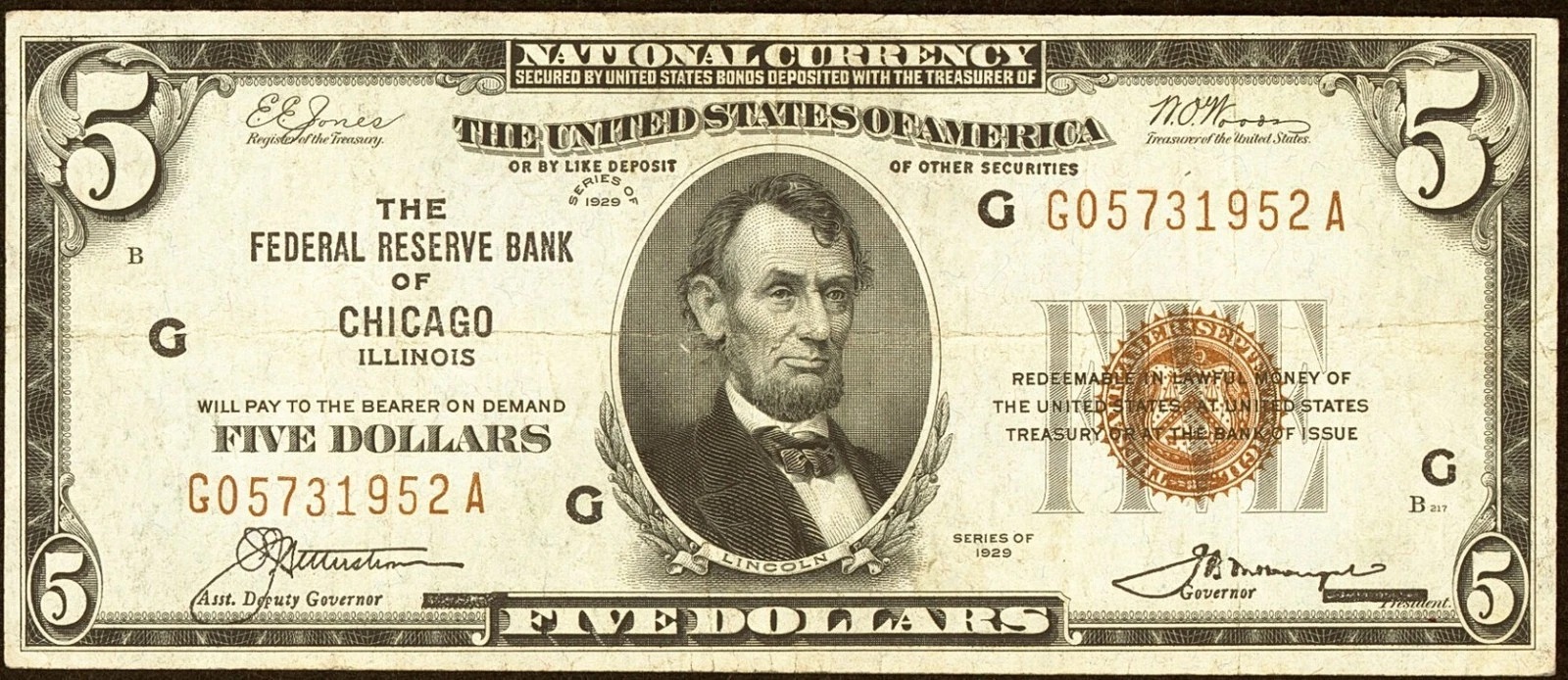
Walk into any serious currency auction and you will find at least a handful of Series 1929 Federal Reserve Bank Notes competing for bidder attention. These brown-seal notes occupy a unique corner of American numismatic history: issued during the darkest years of the Great Depression, they represent the last time the Federal Reserve Banks placed their own names, district letters, and officers’ signatures directly on United States paper money. For the $5 denomination specifically, the district-by-district rarity picture is genuinely dramatic. Some districts cranked out millions of notes that turn up in every dealer’s stock. Others produced numbers so modest that a Fine-grade example is a genuine trophy. Understanding those differences is the foundation of an intelligent collection.
Background: What Makes a Federal Reserve Bank Note Different?
Series 1929 Federal Reserve Bank Notes (FRBNs) are frequently confused with the Federal Reserve Notes issued during the same era, but they are legally and physically distinct. FRBNs were obligations of the individual Federal Reserve Banks, not of the United States government directly. Each note carries the name of the issuing bank printed prominently across the face, a district letter and number in the corner medallions, and two signatures unique to that bank: those of the bank’s own Governor (or President, after the Banking Act of 1935 changed the title) and Cashier. That localized identity is precisely what drives the collector appeal and the rarity differences from one district to the next.
The notes were printed by the Bureau of Engraving and Printing in two signature types. Type 1 notes carry the signatures of Treasurer Walter O. Woods and Secretary Andrew W. Mellon, while Type 2 notes carry Woods paired with Secretary Ogden L. Mills, who replaced Mellon in February 1932. Both types share the same Lincoln portrait and Lincoln Memorial reverse design that had debuted with the small-size series in 1928. The brown Treasury seal and brown serial numbers give the series its immediately recognizable appearance on the bourse floor.
How the Notes Were Ordered and Issued
Each Federal Reserve Bank submitted independent print orders to the Bureau of Engraving and Printing based on its own assessment of local currency demand. Districts serving large industrial populations with heavy retail and payroll activity, like New York and Chicago, ordered enormous quantities. Smaller, more agrarian districts serving fewer banks and lower transaction volumes ordered far less. The result is a print-run disparity of nearly ten-to-one between the most common and rarest districts at the $5 level. Those original order quantities, cross-referenced with known surviving populations in major collection surveys and auction records, form the backbone of any serious rarity guide.
When buying Series 1929 $5 FRBNs, always verify the district letter in the black seal on the left side of the face matches the bank name printed at the top. Mismatches indicate a damaged or altered note and will devastate grade and value.
The Twelve Districts: A Rarity Overview
Boston (A) and New York (B)
The Boston Federal Reserve Bank issued $5 FRBNs in solid but not spectacular numbers, with a combined Type 1 and Type 2 print run approaching 1.4 million notes. Circulated examples are readily available, though choice uncirculated specimens with strong brown seal color do carry a modest premium. New York is the unambiguous king of availability. The New York district printed well over 3.8 million $5 notes across both types, making it the single most common district in the series. Any dealer with a stock of 1929 FRBNs will almost certainly have a New York $5 in the tray. Gem examples still attract interest but the note is fundamentally a type piece, not a rarity play.
Philadelphia (C) and Cleveland (D)
Philadelphia printed approximately 1.5 million notes and sits comfortably in the common tier. Cleveland, serving the industrial Midwest, is similarly available at around 1.6 million notes combined. Neither district presents a challenge to the determined collector working at circulated grade levels. In gem uncirculated, both become modestly scarcer simply because heavily circulated industrial districts wore notes out quickly, but the underlying supply is deep enough that patient shopping will locate them.
Richmond (E) and Atlanta (F)
Richmond begins to inch toward the scarcer end of the spectrum. Print runs in the 900,000-note range for the $5 denomination mean that Fine and Very Fine examples appear regularly at shows but high-grade material takes longer to locate. Atlanta is meaningfully scarcer, with combined Type 1 and Type 2 production estimated at roughly 680,000 notes. An Atlanta $5 FRBN in Very Fine is a respectable holding; in Extremely Fine or better it becomes a note that advanced collectors actively pursue.
For the Series 1929 $5 FRBN set, consider targeting problem-free Very Fine examples for scarcer districts rather than holding out for Uncirculated. The jump in price from VF to EF on low-mintage districts like Minneapolis and Kansas City is steep, but the jump from EF to CU is even more dramatic and inventory is genuinely thin.
Chicago (G) and St. Louis (H)
Chicago rivals New York for sheer volume. As the financial hub of the Midwest and the center of the nation’s commodity and futures markets, the Chicago Fed required enormous quantities of small-denomination currency for daily commerce. Estimates place Chicago $5 FRBN production above 2.8 million notes. St. Louis printed considerably fewer at approximately 720,000 notes combined, putting it in the same general tier as Atlanta. St. Louis notes in high grade appear in auction several times a year but are never taken for granted by knowledgeable bidders.
Minneapolis (I) and Kansas City (J)
Here the rarity conversation changes character entirely. Minneapolis, serving a large geographic region but a relatively sparse population in the early 1930s, printed only around 252,000 $5 FRBNs across both types combined. That number places Minneapolis firmly in the key-date category. A Minneapolis $5 in any grade above Fine represents genuine scarcity, and uncirculated examples are legitimately rare. Kansas City is scarcely better, with an estimated combined print run near 348,000 notes. Both districts are primary targets for the collector pursuing a complete twelve-district set, and both will require patience and a willingness to pay strong prices.
Dallas (K) and San Francisco (L)
Dallas printed approximately 552,000 notes, a figure that puts it in the scarce-but-obtainable camp. The Texas economy was already suffering from agricultural distress before the broader Depression deepened, limiting demand for new currency. San Francisco, anchoring the Twelfth District across the Far West, produced around 1.1 million notes, making it comfortably available at most grade levels while still carrying a slight premium over the eastern giants.
Type 1 Versus Type 2: Does It Matter?
For the common districts, the Type 1 versus Type 2 distinction adds a layer of collecting interest without dramatically affecting affordability. Type 2 notes, bearing the Woods-Mills signature combination, were printed for a shorter window and generally in smaller quantities per district, meaning that for any given district the Type 2 is usually the scarcer of the two. In the case of Minneapolis, the Type 2 is exceptionally rare; documented examples in all grades number only in the dozens. Collectors assembling a comprehensive set by district, type, and condition will find the Minneapolis and Kansas City Type 2 notes to be the capstone pieces of the endeavor.
Third-party grading by PCGS Currency or PMG is strongly recommended for any Series 1929 $5 FRBN valued above $200. Brown seals are vulnerable to cleaning and chemical alteration that can be difficult to detect with the naked eye, and a genuine problem-free note commands a meaningful premium over a cleaned example at the same numerical grade.
Condition Considerations and Market Realities
The Series 1929 FRBNs were workhorse circulation currency issued during a period of economic crisis. Banks deployed them immediately and the public used them hard. The survival rate for high-grade examples is lower than print-run figures alone suggest, particularly for the industrial districts where the velocity of currency circulation was highest. A New York or Chicago $5 in PMG 64 or better is still a note that collectors notice, even though the overall print run was large. Conversely, the scarce districts sometimes survived better in higher grades because notes returned to bank vaults quickly in slow-moving rural economies.
When evaluating any Series 1929 $5 FRBN, pay close attention to seal color. The brown Treasury seal is prone to fading, particularly on notes that experienced any moisture exposure. A deep, rich brown seal against a crisp face design signals a note that has been well-preserved. Faded or washed-out seals knock a note down in eye appeal and consequently in market value regardless of paper quality.
| District (Letter) | Bank City | Est. Combined Print Run | Rarity |
|---|---|---|---|
| A (1) | Boston | ~1,400,000 | Common |
| B (2) | New York | ~3,800,000 | Common |
| C (3) | Philadelphia | ~1,500,000 | Common |
| D (4) | Cleveland | ~1,600,000 | Common |
| E (5) | Richmond | ~900,000 | Scarce |
| F (6) | Atlanta | ~680,000 | Scarce |
| G (7) | Chicago | ~2,800,000 | Common |
| H (8) | St. Louis | ~720,000 | Scarce |
| I (9) | Minneapolis | ~252,000 | Key Date |
| J (10) | Kansas City | ~348,000 | Rare |
| K (11) | Dallas | ~552,000 | Scarce |
| L (12) | San Francisco | ~1,100,000 | Common |
Building a Complete Set: Strategy and Patience
A full twelve-district set of Series 1929 $5 FRBNs is a genuinely achievable collecting goal that rewards both the historian and the bargain hunter. The four common districts, New York, Chicago, Philadelphia, and Cleveland, can typically be acquired in Very Fine for under $100 each from any well-stocked dealer. Boston, San Francisco, and Cleveland fill in the middle tier without major budget strain. Richmond, Atlanta, St. Louis, and Dallas will each require some searching and a somewhat higher investment, particularly above Very Fine.
The set-defining pieces are Minneapolis and Kansas City. Budget accordingly and do not be surprised if it takes a year or more of active searching to locate clean, problem-free examples at prices you consider fair. When they do appear, act decisively. Notes from these two districts in any grade above Very Fine appear in major currency auction archives only a handful of times per year. If your goal is to add Type 2 varieties for Minneapolis and Kansas City as well, expect an extended hunt and plan to pay collector-grade premiums when the notes surface.
The Series 1929 $5 FRBN set rewards those who learn the series deeply before spending money. Cross-reference the Friedberg catalog numbers, study the auction archives at Heritage and Stack’s Bowers, and connect with specialists in Depression-era small-size currency. The brown-seal $5 is a window into a specific moment of financial and institutional history in the United States, and building the set with knowledge and intention makes the finished collection something far more meaningful than the sum of its individual notes.