A Portrait Few Collectors Expect to Find
Walk into most advanced currency collections and you will find the classic staples: 1896 Educational Series notes, a few early Legal Tender rarities, perhaps a nice large-size National Bank note or two. What you almost never see is a Series 1891 $20 Silver Certificate in honest, collectible condition. This note, bearing the portrait of Daniel Manning on its face, is simultaneously one of the most historically significant Silver Certificates ever produced and one of the most genuinely difficult large-size notes to acquire at any grade. Its low survivor population is not a matter of collector hype. The numbers, when examined carefully, tell a sobering story about just how few of these notes made it to the twenty-first century intact.
Who Was Daniel Manning?
Before examining the note itself, it is worth understanding the man whose face graces it, because the choice of Manning was deliberate and politically charged. Daniel Manning served as Secretary of the Treasury under President Grover Cleveland from March 1885 until his resignation in April 1887 due to declining health. A New York banker and newspaper publisher by background, Manning was a staunch advocate for the gold standard and sound money principles at a time when the debate between gold and silver monetary policy was tearing American politics apart.
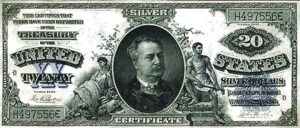
Manning’s appointment of his portrait to a Silver Certificate carries a rich irony that numismatic historians have noted for generations. Here was a man philosophically opposed to silver-backed currency, yet his likeness was chosen to grace a $20 Silver Certificate issued just a few years after his death in December 1887. The Treasury Department made the selection, and the engravers at the Bureau of Engraving and Printing produced a striking three-quarter portrait that captures Manning’s formal bearing and the gravitas of his office. The vignette is one of the finer portrait engravings of the era, with exceptional detail in the facial shading and coat lapel work.
When examining a Series 1891 $20 Silver Certificate, use a loupe to inspect the portrait engraving around Manning’s collar and the shading beneath his jawline. Crisp, unbroken engraved lines in these areas are a reliable indicator of a note that has been handled carefully and is likely to grade VF or better. Heavy wear in the portrait field is the first sign of a note that will disappoint on a third-party grading submission.
The Design and Printing History
The Series 1891 Silver Certificates represented a significant redesign from the large ornate reverses of the 1880 series. The $20 denomination features a relatively spare but elegant face design dominated by Manning’s portrait at center-left, with large denomination numerals flanking the design field. The reverse carries the obligation text and denomination in a more restrained layout than the elaborate geometric and allegorical designs of earlier issues. The Treasury seal on Series 1891 notes appears in red, a detail that immediately distinguishes them from later series and helps collectors authenticate notes at a glance.
Printing took place at the Bureau of Engraving and Printing in Washington, D.C., and the notes entered circulation during the late 1880s and 1890s. The $20 denomination saw relatively limited production compared to the $1 and $5 Silver Certificates of the same era, which circulated in enormous quantities. High-denomination notes of any type suffered from heavy commercial use and were rarely saved by the general public, who treated paper money as a utilitarian medium rather than a collectible artifact. This practical reality is the root cause of the note’s thin survivor population today.
Signature Combinations: The Three Friedberg Varieties
The Series 1891 $20 Silver Certificate was issued with three distinct signature combinations, each cataloged separately in the standard Friedberg reference. Understanding these varieties is essential for collectors because their rarity levels differ meaningfully, and buying or selling without knowing which variety you have can result in significant mispricing.
Fr. 319 carries the signatures of Register of the Treasury Rosecrans and Treasurer Huston. This is the scarcest of the three varieties and the one most likely to appear only in heavily circulated grades when it appears at all. Population reports from PCGS Currency and PMG combined show fewer than fifteen examples graded across all grades for this variety, making it a genuine condition rarity at any level above Fine.
Fr. 320 pairs Rosecrans as Register with Nebeker as Treasurer. This variety is marginally more available than Fr. 319 but remains extremely scarce in absolute terms. A PMG VF 25 example offered at a major Heritage auction in recent years realized over $14,000, illustrating the collector demand that exists when a presentable example comes to market.
Fr. 321, signed by Register Tillman and Treasurer Morgan, represents the most commonly encountered variety of the three, though “commonly encountered” is entirely relative. Even Fr. 321 in Good condition is a note that most collectors will never handle in person. This variety benefits from being the final signature combination used, meaning it likely saw production slightly later and some portion of its print run may have been handled with marginally more care before entering circulation.
Before purchasing any Series 1891 $20 Silver Certificate, cross-reference the signature combination against current PCGS Currency and PMG population reports. Population data for these notes is thin enough that a single new submission can meaningfully shift the rarity picture. Heritage Auctions, Stack’s Bowers, and Lyn Knight auction archives are also invaluable for establishing realistic price benchmarks, as dealer retail prices for these notes can vary widely.
Why So Few Survived?
The survival rate of any large-size note depends on a combination of original print volume, denomination, geographic distribution, and the collecting culture of the era. The Series 1891 $20 Silver Certificate fails on almost every count. The $20 face value in the 1890s represented roughly two to three days of wages for a skilled laborer, meaning these notes circulated actively in commercial transactions and were not casually set aside. Unlike the $1 and $2 denominations, where sentiment or novelty might prompt a working-class saver to tuck one away, $20 notes were spent and redeemed continuously.
Additionally, the Silver Certificate program itself was politically embattled throughout the 1890s. The Sherman Silver Purchase Act debates, the Panic of 1893, and the eventual triumph of the gold standard under the Gold Standard Act of 1900 all created uncertainty about silver-backed currency. Banks and businesses redeemed Silver Certificates for silver dollars or gold with some urgency during periods of monetary stress, and the Bureau of Engraving and Printing destroyed redeemed notes routinely. The combination of heavy commercial use and active government redemption and destruction programs created exactly the conditions needed to reduce a print run to a tiny surviving fraction within a few decades.
The note also predates organized large-scale currency collecting by a full generation. The hobby as we know it today, with its population reports, encapsulated grading, and specialist auction houses, did not exist when these notes were new. Collectors of the 1890s and early 1900s focused primarily on coins, and paper money was widely viewed as ephemeral commercial paper rather than a collectible artifact worthy of preservation.
Grading Challenges Specific to This Note
Even collectors experienced with large-size notes encounter specific challenges when grading or evaluating Series 1891 $20 Silver Certificates. The paper stock used for 1890s Silver Certificates is susceptible to a particular kind of fold weakening along diagonal lines, which often occurs at note corners and along the center folds that develop from wallet or register storage. A note that appears VF from a distance may reveal significant paper fiber separation along these fold lines under magnification, which will cause a third-party grading service to assign a net grade or a details grade indicating “paper issues.”
Ink oxidation is another concern. The red Treasury seal on these notes can exhibit color shifting toward a brown-orange hue when the note has experienced humidity exposure over its lifetime. Collectors should view any seal that appears muddy or brownish-orange with caution and consider whether the note has been improperly stored. Authentic seal color should be a clean, bright red, though some fading toward orange-red is acceptable and expected on circulated examples.
Finally, the Manning portrait itself is a demanding grading focal point. Because it is the design’s centerpiece, any wear, soil, or ink loss in the portrait field is immediately apparent to graders and will suppress the final grade. Notes that have been cleaned or pressed to simulate a higher grade almost always betray themselves under the portrait, where the engraved lines appear unnaturally bright or where fiber disruption from pressing is visible at the correct angle.
Submit Series 1891 $20 Silver Certificates to a reputable third-party grading service before purchasing at significant prices whenever the opportunity allows. PMG and PCGS Currency both maintain detailed population reports for these notes, and a graded holder protects the note while providing authentication that is especially valuable given the note’s high value in even modest grades. Unholdered raw examples at dealers or shows should be examined under strong light at oblique angles to detect pressing, cleaning, or hidden damage before committing to a purchase.
Auction Realizations and Current Market
The market for Series 1891 $20 Silver Certificates has strengthened considerably over the past two decades as collector awareness of large-size rarity has grown and population data has become more widely accessible. Heritage Auctions records from their currency sales document a consistent upward trajectory for presentable examples. An Fr. 321 in PMG Very Fine 30 brought approximately $16,800 at a 2019 Heritage sale, while an Fr. 319 in Fine 15 details (repaired) realized just over $5,500 in 2021, illustrating the meaningful premium that problem-free examples command over repaired or cleaned notes even at the same nominal grade level.
For collectors working within a budget, Fine to Very Fine examples of Fr. 321 represent the most achievable entry point into the series, with retail pricing typically ranging from $5,000 to $10,000 depending on eye appeal and whether the note is problem-free. Extremely Fine examples of any variety rarely come to market and should be considered investment-grade acquisitions when they do, as the combination of rarity and condition places them firmly in the category of notes that institutional and advanced collectors actively compete to acquire.
| Friedberg Number | Signature Combination | Est. Print Run | Rarity |
|---|---|---|---|
| Fr. 319 | Rosecrans / Huston | Unknown (very limited) | Key Date |
| Fr. 320 | Rosecrans / Nebeker | Unknown (limited) | Rare |
| Fr. 321 | Tillman / Morgan | Unknown (slightly more available) | Rare |
| Fr. 319 (Fine or better) | Rosecrans / Huston, problem-free | Fewer than 8 known | Key Date |
| Fr. 320 (VF or better) | Rosecrans / Nebeker, problem-free | Fewer than 10 known | Key Date |
| Fr. 321 (VF or better) | Tillman / Morgan, problem-free | Approximately 15-20 known | Rare |
| Fr. 321 (Good to Fine) | Tillman / Morgan, circulated | Approximately 30-40 total survivors | Scarce |
| Any Variety (XF or better) | All signature combinations | Fewer than 10 total across all varieties | Key Date |
Building Context in Your Collection
A Series 1891 $20 Silver Certificate does not exist in isolation. Collectors who pursue this note most successfully tend to approach it as part of a broader Silver Certificate type set or a focused large-size collection organized around the 1880s and 1890s production period. Pairing a Manning $20 with an 1886 $5 Silver Certificate (featuring Ulysses S. Grant), an 1886 $1 Martha Washington, and a complete set of 1896 Educational Series notes creates a thematic collection that tells the story of Silver Certificate design evolution across its most artistically ambitious period.
The note also contextualizes beautifully alongside the companion Series 1891 denominations. The $1 (Fr. 222-226), $2 (Fr. 245-247), $5 (Fr. 267-271), and $10 (Fr. 298-303) from the same series are considerably more available and provide accessible entry points that allow a collector to assemble the series type set before committing to the challenging $20. The $50 and $100 Silver Certificates from 1891 are equally or more rare than the $20 and represent the ultimate horizon for collectors who catch the series collecting bug.
Conclusion: A Note Worth Pursuing Seriously
The Series 1891 $20 Silver Certificate is the kind of note that rewards patient, informed collectors who take the time to understand its history and its market before committing to a purchase. Its combination of historical significance, portrait artistry, genuine rarity, and the compelling story of Daniel Manning’s ironic placement on a silver-backed note make it one of the most interesting individual issues in all of American paper money collecting. The thin survivor population means that opportunities to acquire presentable examples arise only a handful of times per year at major auctions, and dealers who have one in stock typically price accordingly.
For collectors at every level, the practical advice is consistent: study the signature varieties, monitor PCGS Currency and PMG population reports for shifts in the known census, and attend major currency auctions even as an observer to develop a sense of how these notes look in hand and how the bidding room responds when one appears. When your opportunity comes, having done the homework will make the difference between a confident acquisition and a missed chance. Notes this scarce rarely offer second chances at the same price.