When American Currency Reached Its Artistic Peak
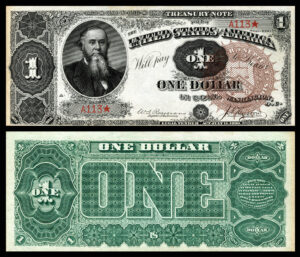
Pick up a well-preserved 1890 $1 Treasury Note and turn it over. What you are holding is arguably the most visually complex reverse ever produced by the Bureau of Engraving and Printing. The back of that note is so densely packed with lathe-work rosettes, intricate geometric patterns, and large ornate numeral counters that the Treasury Department itself grew alarmed. Counterfeiters, officials reasoned, would find all that white space too easy to replicate. The solution arrived in 1891, when a revised reverse design was introduced that opened up the composition considerably. That revision, paradoxically, transformed the 1890 series into a collecting legend. The original backs were gone almost before anyone noticed how remarkable they truly were.
What Are Treasury Notes, and Why Did They Exist?
Treasury Notes of 1890 and 1891 occupy a brief but fascinating chapter in American monetary history. They were authorized by the Sherman Silver Purchase Act of July 14, 1890, which required the federal government to purchase 4.5 million ounces of silver bullion per month and issue paper currency against those purchases. Unlike Silver Certificates, which were backed by silver dollars already coined, these Treasury Notes were redeemable in either gold or silver coin at the discretion of the Secretary of the Treasury. That dual-redemption feature made them technically the most powerful paper money the United States had ever issued, and the government dressed them accordingly.
The series ran in two distinct varieties: the 1890 notes with their famously dense reverses, and the 1891 notes with their revised, more open backs. Both used the same portrait assignments on the obverse, and both carry the Friedberg catalog numbers (from Robert Friedberg’s indispensable Paper Money of the United States) that collectors rely on today. The 1890 notes are cataloged as Fr. 347 through Fr. 376, depending on denomination and signature variety.
The Tombstone Back: Understanding the Design
The nickname “Tombstone Notes” derives directly from the large, arch-topped numeral panels on the reverse of each 1890 denomination. These counters, which display the note’s value in enormous outlined numerals, are framed by rounded tops that genuinely do resemble the profile of a Victorian-era grave marker. But the numeral panels are only the most obvious element of a reverse that rewards close examination at every scale.
The Bureau of Engraving and Printing’s geometric lathe work fills virtually every square centimeter of the background. Rosettes, engine-turned spirals, and interlocking guilloché patterns create a shimmering optical texture that shifts under different lighting angles. Around the central numerals, a series of ornate frame elements incorporate fine-line arabesque scrollwork and micro-engraved border details. The overall effect is one of almost suffocating richness. There is no breathing room, no deliberate negative space. Every part of the plate is doing something.
Chief engraver at the Bureau during this period was Charles Skinner, though multiple engravers contributed to the plate work. The lathe-work backgrounds were produced on geometric lathes, mechanical devices that could inscribe thousands of mathematically precise lines per inch, making exact reproduction by hand essentially impossible for a counterfeiter working in 1890. The irony is that Treasury officials still considered the design a security liability, primarily because large open areas printed in a single color were seen as easier to alter than a note with complex multi-element backgrounds.
When examining an 1890 Treasury Note reverse under magnification, look at the micro-detail inside the numeral counters themselves. Authentic notes will show crisp, unbroken guilloché lines throughout the background fill. Restorations, cleaning, or heavy circulation often show interruptions or blurring in these fine lines that the naked eye misses entirely. A 10x loupe is the minimum tool for serious authentication work on these notes.
Denomination by Denomination: What the Backs Look Like
While the general design philosophy is consistent across the 1890 series, each denomination features a slightly different arrangement of the central numeral elements and surrounding ornamentation. Understanding these differences helps collectors quickly identify denominations and spot altered notes.
The $1 Note (Fr. 347-348)
The $1 reverse centers on a large “1” counter flanked by the word “ONE” spelled out in matching ornate lettering. The surrounding lathe work is somewhat less dense than on higher denominations, but the detail remains extraordinary. Printed in green ink on the reverse, these $1 notes were issued in substantial quantities and represent the most available entry point into the 1890 series. Fine examples (PCGS or PMG graded VF-25 to EF-40) can be acquired in the $400 to $900 range, making them accessible to intermediate collectors.
The $2 Note (Fr. 352-353)
The $2 denomination features a paired “2” counter design. These notes are significantly scarcer than the $1 examples, and collector demand has pushed even circulated examples into strong price territory. A PMG Very Fine 30 example brought $2,400 at a Stack’s Bowers auction in 2022. The obverse carries a portrait of General James B. McPherson, making these notes doubly interesting from a historical portrait perspective.
The $5 Note (Fr. 355-356)
General George H. Thomas appears on the $5 obverse, while the reverse showcases one of the most balanced compositions in the series. The large “5” counters are surrounded by particularly elaborate scrollwork borders. Problem-free circulated examples trade between $800 and $2,500 depending on grade, while Uncirculated survivors are genuine rarities.
The $10 Note (Fr. 366-367)
The $10 denomination features a portrait of Philip Sheridan. Its reverse design incorporates the numeral “10” in a format that some collectors consider the most aesthetically successful in the entire 1890 series. The proportions of the counter relative to the surrounding ornamentation achieve a balance that the $1 and $2 notes, with their smaller primary numerals, do not quite reach.
The Higher Denominations
The $20 (Fr. 372-373), $50 (Fr. 374), and $100 (Fr. 375) notes are genuine rarities in any grade. The $50 carries a portrait of William H. Seward, while the $100 features Admiral David G. Farragut. These high denominations were redeemed for specie at high rates during the financial panics of the 1890s, and survival rates are correspondingly low. A PMG Very Fine 30 example of the $100 Fr. 375 sold for $129,250 at Heritage Auctions in 2019.
The $1,000 denomination (Fr. 376) is in a category by itself. Featuring a portrait of Major General George Gordon Meade, it is one of the rarest notes in all of American paper money. Only a handful of examples are confirmed to exist, and the last publicly auctioned specimen achieved over $2,585,000. Its reverse, while sharing the same artistic vocabulary as the rest of the series, has been examined by very few living collectors in person.
The two signature combinations found on 1890 Treasury Notes, Rosecrans-Huston and Rosecrans-Nebeker, can significantly affect value, particularly on the $1 and $2 denominations. The Rosecrans-Nebeker combination (Register Nebeker replaced Huston in April 1891) is the scarcer pairing on the 1890 series and commands a premium of roughly 20 to 40 percent over the Rosecrans-Huston combination in equivalent grades. Always confirm the signature combination before purchasing.
Why the Design Was Changed: The 1891 Revision
The Treasury Department’s stated concern about the 1890 reverses centered on the large, unbroken ink areas within the numeral counters. In practice, the Bureau of Engraving and Printing had actually engineered those areas with considerable security printing, but Treasury officials felt that an open counter displaying only a large digit presented an opportunity for alteration or washing. In early 1891, revised plates were prepared that reduced the size of the numeral counters, opened up the background composition to allow more white space, and softened the overall density of the design.
The result, the 1891 series reverses, is a perfectly attractive design by any normal standard. But comparing a 1890 back to a 1891 back side by side is a revealing exercise. The 1891 version looks almost sparse. The decision to revise was driven by bureaucratic caution rather than artistic judgment, and most numismatists who have studied both series agree that the Bureau’s engravers had achieved something genuinely extraordinary with the 1890 plates, something they were not permitted to build upon.
Grading Challenges Specific to the 1890 Series
The extraordinary density of the 1890 reverse creates specific grading complications that collectors should understand. Because the lathe-work backgrounds cover nearly the entire printed surface, any fold, crease, or abrasion is immediately visible against the complex pattern. A single diagonal fold across the face of a note will be accompanied by a corresponding break in the fine-line guilloché on the reverse, and grading services assess these breaks carefully. Notes that appear to grade EF-40 from the obverse can drop to VF-30 or lower when the reverse is properly examined.
Paper quality is equally critical. The 1890 notes were printed on banknote paper that was relatively durable for its era, but 130-plus years of storage have introduced foxing, toning, and brittleness to many survivors. PMG and PCGS Currency both use a net grading system for problem notes, and the fine-line backgrounds of the 1890 reverses make cleaning and pressing unusually easy to detect, as even light pressing disrupts the paper fiber alignment in ways that show against a guilloché background under side lighting.
Raw, ungraded 1890 Treasury Notes appear regularly at general antique auctions, estate sales, and non-specialist dealers who may not fully appreciate what they have. Before submitting any raw example to a grading service, compare it carefully against certified examples on auction archives at Heritage, Stack’s Bowers, and PCGS CoinFacts. Pay particular attention to paper brightness and the crispness of the fine reverse lines. A genuinely original VF or better example is worth the submission cost several times over.
The Printing Numbers: What Survived and What Did Not
Total printings for the 1890 series were relatively modest by later standards, but the real scarcity driver for most denominations is survival rate rather than original print run. The financial panics of 1893 and 1907 prompted massive redemptions of Treasury Notes, as holders converted them to gold or silver coin. Redeemed notes were destroyed at the Treasury. The Sherman Silver Purchase Act itself was repealed in November 1893 under President Grover Cleveland, which effectively ended new issuance and accelerated redemption of outstanding notes.
The $1 denomination had the largest print run by far, which explains its relative accessibility today. Higher denominations were issued in smaller quantities and were more likely to be redeemed rather than saved as curiosities, as ordinary people were far more inclined to preserve a $1 note as a novelty than to hold onto a $50 or $100 bill that represented substantial spending power in the 1890s.
| Friedberg No. | Denomination / Signatures | Approx. Known | Rarity |
|---|---|---|---|
| Fr. 347 | $1 Rosecrans-Huston | Several thousand | Common |
| Fr. 348 | $1 Rosecrans-Nebeker | Several hundred | Scarce |
| Fr. 352 | $2 Rosecrans-Huston | 100-200 est. | Scarce |
| Fr. 353 | $2 Rosecrans-Nebeker | Fewer than 75 est. | Rare |
| Fr. 366 | $10 Rosecrans-Huston | 50-100 est. | Rare |
| Fr. 372 | $20 Rosecrans-Huston | Fewer than 40 est. | Rare |
| Fr. 374 | $50 Rosecrans-Huston | Fewer than 25 est. | Key Date |
| Fr. 375 | $100 Rosecrans-Huston | Fewer than 20 est. | Key Date |
| Fr. 376 | $1,000 Rosecrans-Huston | 3-5 confirmed | Key Date |
Building a Collection Around the 1890 Series
For a collector approaching the 1890 Treasury Notes strategically, the most satisfying and achievable goal is a complete type set of the lower denominations in mid-grade circulated condition. A $1, $2, $5, and $10 in grades ranging from VF-20 to EF-45 represents a focused, historically coherent collection that can be assembled over several years with a budget in the $5,000 to $15,000 range, depending on patience and timing. Buying at specialist auctions rather than from fixed-price dealers generally produces better results, as general auction houses often do not attract the depth of bidding competition that specialist numismatic sales do.
Type collectors sometimes overlook the $2 denomination in favor of the more recognized $1 and $5 notes. This is a mistake. The $2 1890 Treasury Note is a legitimate rarity that has not yet achieved the auction profile of the $5 in collector consciousness, meaning it can occasionally be found at prices that do not fully reflect its scarcity. Astute collectors keep a standing want list with major dealers and regularly monitor Heritage and Stack’s Bowers pre-sale estimates for these notes.
For collectors with deeper resources, the $20 denomination represents a compelling target. It is genuinely rare, historically significant, and priced at a level, typically $15,000 to $45,000 for circulated examples, that places it within reach of serious but not ultra-wealthy collectors. The $50 and $100 are effectively in institutional territory, appearing at auction perhaps once every two to four years.
A Design That Outlived Its Era
The 1890 Treasury Note reverses represent a collision between an extraordinary artistic moment and an institution, the Bureau of Engraving and Printing in its late Victorian prime, that was simultaneously trying to prove the security value of its craft. The engravers succeeded beyond any reasonable standard. They created a printed artifact dense enough to defeat any contemporary counterfeiting attempt and beautiful enough to make modern collectors pay tens of thousands of dollars for a single well-preserved example.
That the design was withdrawn after less than a year of production, replaced by something deliberately less ambitious, gives the 1890 series a quality that transcends mere rarity. These notes feel like a missed turn, a path toward ornate, maximalist American paper money that was immediately abandoned in favor of the cleaner, more restrained aesthetic that would define US currency through the twentieth century. What the Bureau’s engravers built on those plates in 1890 stands as the high-water mark of American banknote art, and the Tombstone backs are the clearest proof of how high that water actually rose.