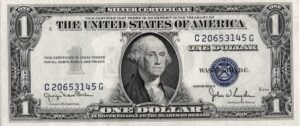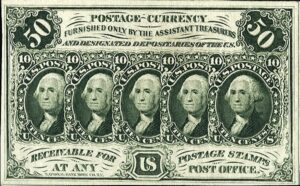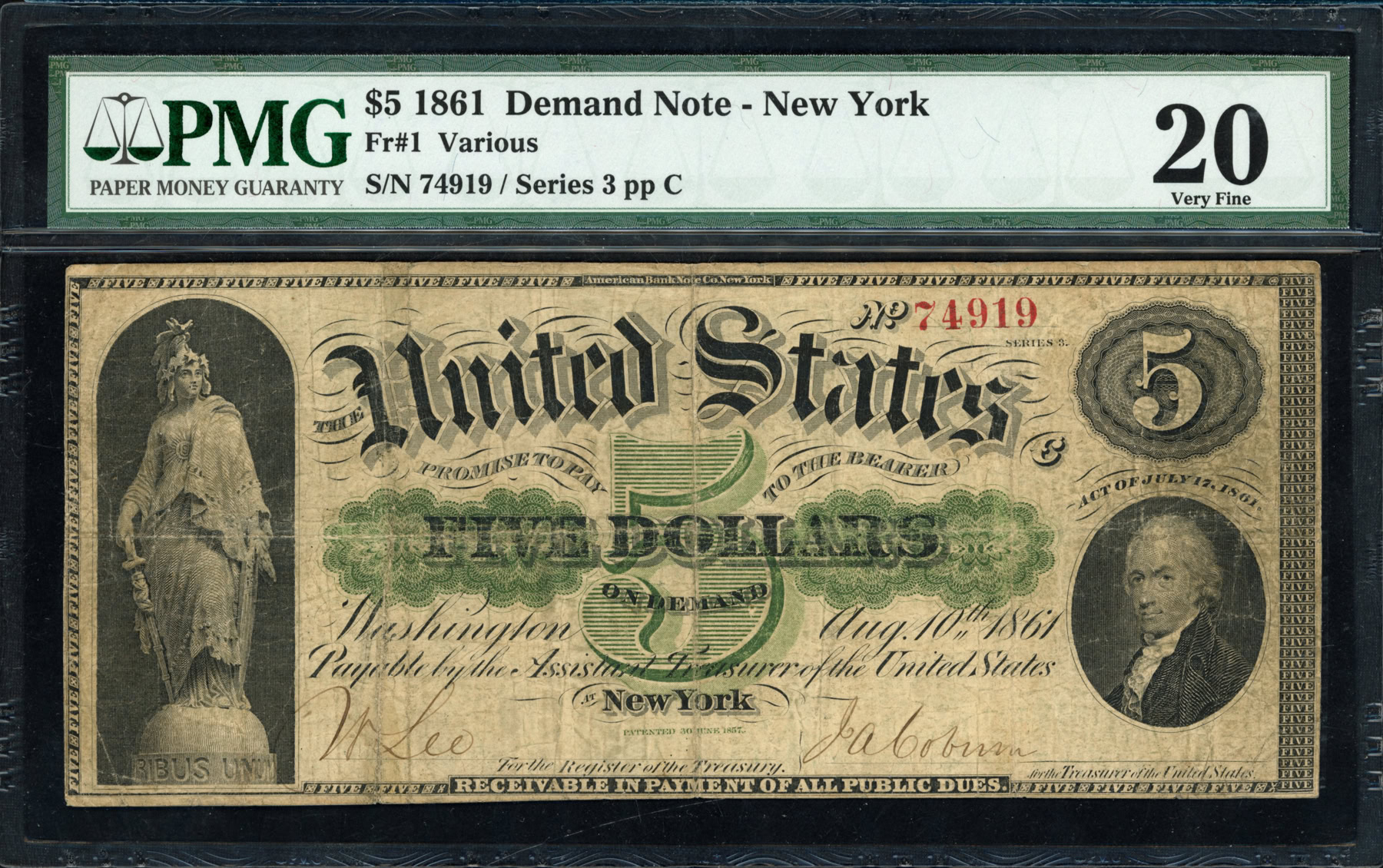
📷 Image source: GreatCollections. Images are selected by AI to represent the article topic and may not depict the exact note(s) described.
Pick up a Fine-12 Demand Note and hold it carefully by the edges. The paper is firm but supple, the folds softened by decades of handling, the portrait of Alexander Hamilton or Abraham Lincoln or Salmon P. Chase still clearly visible despite the honest wear. This note was printed in 1861, spent real time in real pockets during the Civil War, and survived roughly 160 years to reach your hands. In the world of 19th-century federal currency, that journey earns a kind of reverence that a crisp, stiff Uncirculated example, fascinating as it is, simply cannot replicate in the same way.
The Birth of Federal Paper Money: A Crisis Currency
The United States had never issued a general-circulation federal paper currency before the summer of 1861. The Independent Treasury system meant the government operated on specie, and private bank notes dominated everyday commerce. Then Fort Sumter fell, and everything changed. The Union needed to finance a war on a scale that no American government had previously contemplated, and the Treasury’s gold reserves were simply inadequate to the task.
Congress passed the Act of July 17, 1861, authorizing the issuance of Demand Notes in denominations of $5, $10, and $20. These notes were not legal tender in the strictest initial sense, but they were receivable for all public dues, and the Treasury committed to redeeming them in coin on demand at designated sub-treasury offices in Boston, New York, Philadelphia, Cincinnati, and St. Louis. The five paying cities were actually printed directly on each note, which is one of the distinguishing features collectors study today.
Approximately $33.4 million face value was authorized, though not all of it was printed or issued. Salmon P. Chase, Lincoln’s Treasury Secretary, shepherded these notes into existence. The American Bank Note Company and the National Bank Note Company produced them, using printing technology that blended engraved portraiture with intricate lathe-work backgrounds. They were, by the standards of any era, beautiful objects.
Why So Few Survived, and Why Those That Did Are Worn
Here is the central paradox that makes the Fine-12 grade so compelling for this series: the notes that circulated the most are often the notes that carry the greatest historical weight, yet heavy circulation is precisely what destroyed the majority of surviving examples.
Demand Notes were used intensively from late 1861 onward. When specie payments were suspended by banks in December 1861 and then by the government shortly after, Demand Notes became even more critical as a medium of exchange because they were among the only instruments the public trusted. They circulated hard. They passed through military paymaster offices, sutler stores, urban markets, and rural general stores. Many were lost, burned, or simply disintegrated from use.
By the time the Legal Tender Act of February 25, 1862 created United States Notes (the “greenbacks” that most people associate with Civil War currency), Demand Notes were being withdrawn from circulation and destroyed. Their window of active use was astonishingly brief, roughly six months to a year for most examples. Those that survived did so almost accidentally: tucked into a family Bible, saved as a curiosity, or forgotten in a tin box in an attic.
When examining a Demand Note, always check the paying city printed at the bottom. Notes payable at New York and Boston are more commonly encountered than those payable at St. Louis and Cincinnati. A Fine-12 example payable at Cincinnati on the $5 denomination is a genuinely scarce combination that commands a significant premium over catalog base values.
Understanding Fine-12: What the Grade Actually Means
The Sheldon numerical grading scale, adapted for paper money largely through the work of the Paper Money Guaranty (PMG) and Professional Coin Grading Service (PCGS Currency) grading services, defines Fine-12 with specific observable characteristics. A note grading F-12 will show:
- Multiple folds, typically three to six distinct fold lines, which have softened the paper but not caused fiber separation or tears at the intersections
- Moderate to moderately heavy circulation wear, with some reduction in surface detail on the highest relief areas of the engraving
- No significant holes, tears, or missing paper, though minor edge nicks at fold corners are acceptable
- All design elements, including serial numbers, Treasury signatures, and the paying city notation, clearly legible
- Paper that retains most of its original body, meaning it has not been reduced to a linen-like limpness
For Civil War era Demand Notes specifically, Fine-12 often represents the sweet spot between survivability and affordability. Very Fine examples (VF-20 through VF-35) command prices that push many $5 and $10 Demand Notes well above $5,000, and Extremely Fine or better examples are largely museum territory, appearing at major auction houses once or twice a decade. Fine-12 examples, by contrast, appear at major currency auctions with enough regularity that a serious collector has a realistic opportunity to acquire one.
The signatures on Demand Notes are hand-signed by Treasury Department clerks, not printed. There are two distinct signature varieties: those signed “for” the Register and Treasurer (earlier issues where clerks signed on behalf of officials), and later issues where the officials signed more directly. The “for” prefix variety is slightly scarcer and worth identifying before purchase. Both are clearly readable on a proper F-12 example.
The Three Denominations: A Collector’s Hierarchy
Not all Demand Notes are created equal in terms of survival rates, and the grade of Fine-12 plays out differently across the $5, $10, and $20 denominations.
The $5 Demand Note (Fr. 1)
The $5 note features a vignette of Alexander Hamilton at left and a spread eagle at center. It is the most frequently encountered Demand Note denomination in today’s market, partly because lower-denomination notes circulated more widely through everyday commerce and partly because they were produced in larger quantities. A Fine-12 example typically realizes between $2,500 and $4,500 at major auction depending on the paying city and signature variety, making it the most accessible entry point into the series.
The $10 Demand Note (Fr. 7)
The $10 features Abraham Lincoln at left, making it one of the earliest notes to bear Lincoln’s portrait and a touchstone piece for Lincoln collectors as well as currency specialists. In Fine-12, a $10 Demand Note typically commands $4,000 to $7,500. The Lincoln portrait is often the note that brings collectors to the Demand Note series in the first place, and it deserves that reputation.
The $20 Demand Note (Fr. 11)
The $20 is the great rarity of the series. Bearing a vignette of the Treasury Building and a Liberty figure, the $20 Demand Note was issued in far smaller quantities than the $5 or $10, and proportionally fewer have survived. A Fine-12 example of the $20, when one appears, can realize $15,000 to $30,000 or more. Finding a legitimate, properly graded Fine-12 $20 Demand Note at a reasonable price is one of the genuine achievements available to advanced collectors of 19th-century federal currency.
Always purchase Demand Notes encapsulated by PMG or PCGS Currency. The authentication question is significant for this series: altered notes, cleaned notes presented as original, and outright counterfeits do exist in the marketplace. A graded holder does not replace your own due diligence, but it provides a crucial baseline of authentication from professionals who examine these notes regularly.
Reading the Story in the Wear
One of the pleasures available to the historically minded collector is treating the wear pattern on a Fine-12 Demand Note as evidence rather than damage. The fold lines on these notes are not random. Currency folded for storage in a wallet or pocket tends to show a characteristic central horizontal fold combined with a vertical fold, producing a quartered appearance. Notes that were folded and kept in a breast pocket or tucked into a ledger show different wear patterns. Some examples show the kind of heavy horizontal fold and soft paper edges consistent with being rolled or stuffed into a trouser pocket repeatedly.
Consider what that means in context: this note was in someone’s pocket in 1861 or 1862. That someone might have been a Union soldier receiving pay, a merchant in a Northern city conducting trade, a government contractor, or a civilian navigating the economic upheaval of wartime. The note’s denomination suggests the economic level of its user: $5 represented roughly two weeks of wages for an unskilled laborer in 1861. This was not pocket change.
Condition Caveats: What to Watch For at F-12
Fine-12 is also a grade where problem notes can lurk if collectors are not careful. Several issues are worth watching for specifically on Civil War era material:
Cleaning and pressing: Notes that have been washed to remove grime or pressed to reduce the visual impact of folds can appear cleaner than their actual grade suggests. Grading services detect this through paper fiber analysis and the appearance of artificially bright surfaces, but self-educated collectors should learn to recognize the unnaturally smooth look of a pressed note versus the honest texture of original paper.
Tape repairs: Antique tape, particularly from the mid-20th century or earlier, is common on these notes. Even archival tape from a well-meaning owner 50 years ago affects grade. PMG and PCGS will note tape as a qualifier, producing designations like Fine-12 Net or simply marking the holder with a notation. A net-graded Fine-12 that would otherwise be Very Fine-25 is a different proposition than a straight Fine-12, and the price difference can be substantial.
Pinholes: Common on 19th-century currency, which was frequently strung on pins or spindles in business offices. Minor pinholes may be noted by grading services but do not always reduce the numerical grade dramatically. Their presence should be factored into your offer price.
| Fr. Number | Denomination / Paying City | Est. Fine or Better Survivors | Rarity |
|---|---|---|---|
| Fr. 1 | $5, New York | 250-350 | Scarce |
| Fr. 2 | $5, Philadelphia | 150-220 | Scarce |
| Fr. 3 | $5, Boston | 100-160 | Rare |
| Fr. 4 | $5, Cincinnati | 40-70 | Key Date |
| Fr. 5 | $5, St. Louis | 30-55 | Key Date |
| Fr. 7 | $10, New York | 120-180 | Rare |
| Fr. 9 | $10, Boston | 50-80 | Rare |
| Fr. 11 | $20, New York | 30-50 | Key Date |
| Fr. 11b | $20, Boston | 10-20 | Key Date |
Building a Strategy: Acquiring Your First Demand Note in Fine
For a collector approaching the Demand Note series for the first time, the $5 New York or Philadelphia example in Fine-12 is the recommended entry point. Heritage Auctions, Stack’s Bowers, and Lyn Knight Currency Auctions all handle these notes regularly, and price archives going back 20 years allow a buyer to calibrate expectations precisely. Set a budget, study recent auction results through the PMG Price Guide and PCGS CoinFacts currency equivalents, and be patient. Rushing into a purchase on an overpriced or problem example is the most common mistake new collectors make in this series.
Once you have held one Fine-12 Demand Note and understood what you are dealing with, the collecting imperative becomes clear. These notes are direct, tangible artifacts of the moment when the United States government created federal paper currency for the first time under conditions of national emergency. The wear on a Fine-12 example is not a defect. It is proof of purpose. It means this note did exactly what it was created to do, and it survived anyway.
Reference the Friedberg catalog number (Fr. 1 through Fr. 12b for Demand Notes) when communicating with dealers or bidding at auction. Different paying city varieties are assigned distinct Friedberg numbers, and knowing the specific Fr. number prevents confusion and ensures you are bidding on exactly the variety you intend to acquire. Robert Friedberg’s “Paper Money of the United States” remains the standard reference for this series.
Conclusion: Reframing What “Condition” Means for Historical Currency
Condition worship has its place in numismatics. A gem Uncirculated Federal Reserve Note from the mid-20th century is a legitimate collecting target, and the pursuit of the finest known example of any given type is a noble endeavor. But for Civil War era federal currency, and for Demand Notes in particular, the grading hierarchy asks to be read differently.
A Fine-12 Demand Note is not a consolation prize for collectors who cannot afford better. It is a historically authenticated artifact of the Civil War economy, a piece of paper that functioned as the United States government intended, that was held by Americans living through the most transformative crisis in their nation’s history, and that endured long enough for you to hold it now. In that context, the softened folds and honest wear of a Fine-12 grade are not flaws at all. They are credentials.