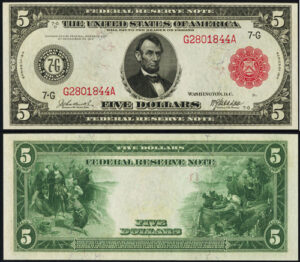
📷 Image source: Wikimedia Commons. Images are selected by AI to represent the article topic and may not depict the exact note(s) described.
Pick up a large-size Silver Certificate from the 1880s or 1890s and you are holding something that no modern Federal Reserve Note can rival in sheer visual ambition. The Bureau of Engraving and Printing employed master steel engravers whose work rivaled fine-art printmaking, and every major portrait, allegorical scene, and decorative border was chosen with deliberate symbolic purpose. For collectors, decoding these images is not mere academic exercise. It deepens appreciation for condition, raises awareness of which vignette varieties are scarce, and helps explain why certain notes command prices ten times higher than others at auction. This guide walks through the principal allegorical figures on large-size Silver Certificates, series by series, explaining their classical and political meanings alongside the numismatic details that matter most.
The Visual Language of the 19th Century: Why Allegory?
Before diving into specific notes, it is worth asking why the Treasury Department chose allegorical figures at all. The answer lies partly in practical security and partly in the cultural vocabulary of the era. Elaborate engraved vignettes were extraordinarily difficult to counterfeit with the photographic reproduction technology available before 1900. But symbolism also carried real weight for a Victorian audience steeped in classical education. A figure representing Liberty, Agriculture, or Justice communicated meaning instantly to citizens who had studied Latin and Greek mythology in school. The Bureau understood that currency was a public statement of national values, and these images were selected accordingly.
The allegorical tradition on American currency traces directly to continental European banknote design, filtered through the work of firms like the American Bank Note Company, which supplied engraved dies to the Treasury before the Bureau of Engraving and Printing took over exclusive production in 1877, just one year before the first Silver Certificates were authorized.
The 1878 and 1880 Series: Portraits and Early Allegory
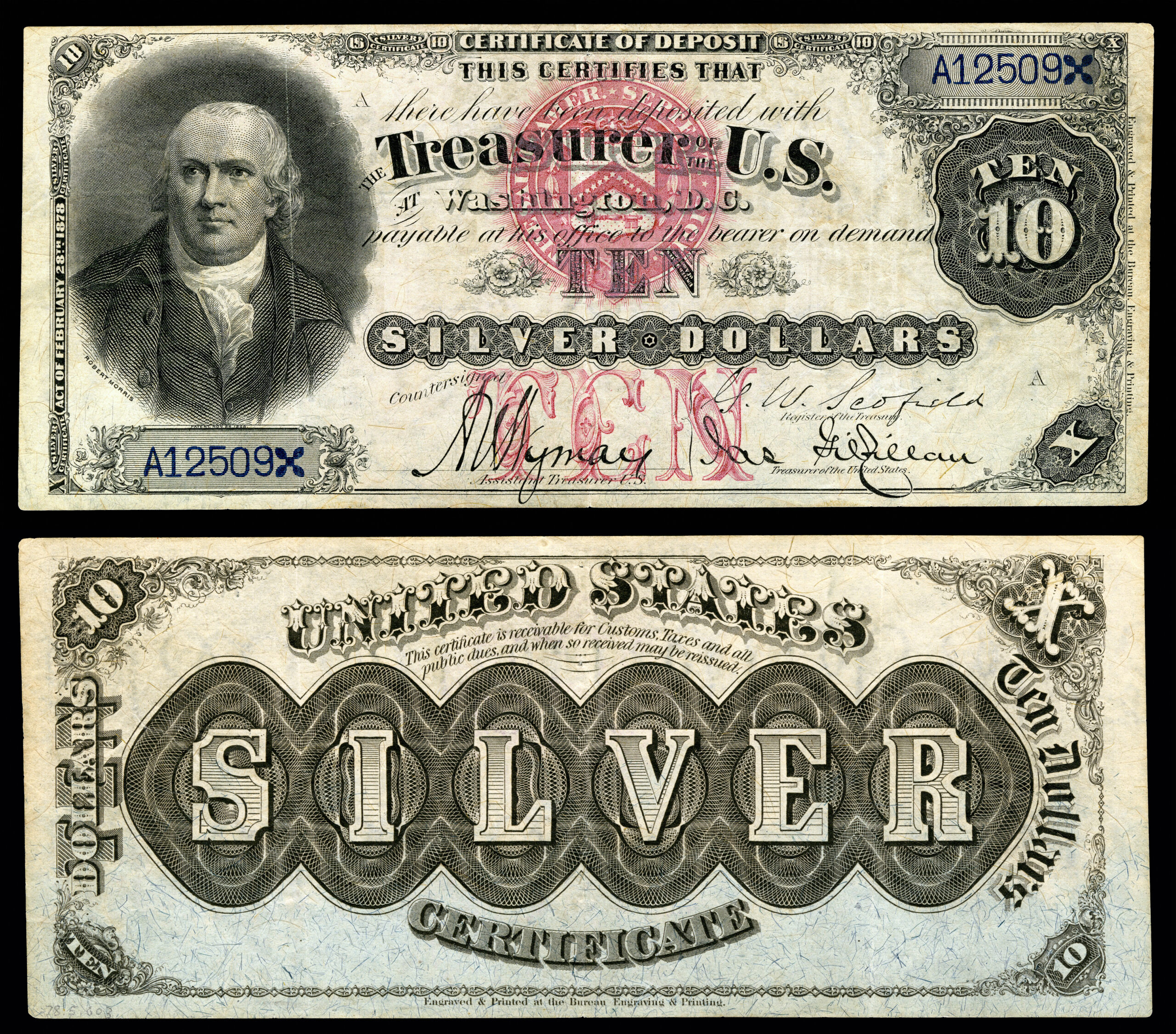
The first Silver Certificates, authorized by the Bland-Allison Act and issued beginning in 1878, appeared in denominations from $10 to $1,000. These early notes were countersigned by Assistant Treasurers and carry a distinct hand-signed character that makes them prized by specialists. The $10 of 1878 (Fr. 286) features a bust portrait of Robert Morris, the Revolutionary War financier, flanked by ornate lathe-work borders. Morris was a deliberate choice: he had literally funded the Continental Army, and his presence on a note backed by silver implied fiscal trustworthiness.
The 1880 series brought more elaborate imagery. The $50 (Fr. 325 through Fr. 331) introduced one of the most celebrated vignettes in large-size currency: an allegorical female figure representing Mechanics and Commerce, seated beside a cogwheel and a ship’s anchor. This image, engraved by Charles Burt from a design by Thomas F. Morris, synthesizes industrial and maritime prosperity in a single composition. Burt’s crosshatch technique gives the figure a sculptural depth that photographs rarely capture adequately; holding a high-grade example in hand under proper light reveals fine-line work invisible to casual examination.
When examining 1880-series Silver Certificates, use a 5x loupe to inspect the engraved vignette for sharpness of the crosshatch lines. A crisp, fully struck impression with no ink spread in the fine lines is a strong indicator of an early, well-printed sheet. Faded or soft line detail often correlates with later impressions from worn plates, and this distinction can affect desirability even within the same grade band.
“History” Instructing Youth: The $1 Educational Notes of 1896
No discussion of Silver Certificate allegory is complete without the 1896 Educational Series, the most visually ambitious currency the United States has ever produced. Designed by artist Will H. Low and engraved primarily by G.F.C. Smillie, Charles Schlecht, and Edwin Burnham, these three notes ($1, $2, and $5) function as a unified artistic program. They are cataloged as Fr. 224 through Fr. 271, and surviving high-grade examples regularly bring five to six figures at major auctions.
The $1 Educational Note (Fr. 224 to Fr. 226) depicts History Instructing Youth. A seated female figure representing History holds a scroll and gestures toward the Washington Monument and the Capitol, visible in the background. At her feet sits a young male figure, representing Youth or the Nation’s future, gazing attentively upward. To the right, the figure of an eagle spreads its wings above a shield. Art historian and numismatic scholar Gene Hessler identified the compositional source as influenced by Renaissance allegorical programs, specifically the tradition of depicting Minerva or Wisdom guiding heroic figures. The message for 1896 audiences was clear: America’s greatness derived from understanding its own history.
The portrait side of the $1 Educational is equally meaningful. Martha Washington occupies the right panel, the only time a woman’s portrait appeared on a circulating U.S. note until the 2016 redesign announcements. Her inclusion in 1896 was a quiet nod to suffragist sentiment, though Treasury officials publicly justified it on purely historical grounds.
The $2 Educational: Science Presenting Steam and Electricity
The $2 denomination (Fr. 247 to Fr. 249) carries the vignette titled Science Presenting Steam and Electricity to Commerce and Manufacture. A central female figure, Science, raises her arms to present two kneeling figures personifying Steam (holding a locomotive wheel) and Electricity (holding a lightning bolt). Commerce and Manufacture, also female, receive these gifts at the composition’s edges. For an 1896 audience living through the Second Industrial Revolution, this image was not abstract. Railroads had unified the continent. Edison’s electrical grid was spreading into American cities. The note literalized the era’s faith in technological progress as a democratic gift.
The reverse portrait panel of the $2 features Generals Robert Fulton and Samuel F.B. Morse, inventors of the steamboat and telegraph respectively. Their pairing with the obverse allegory creates a coherent thematic unity rare in any nation’s currency design.
The 1896 Educational Series $2 (Fr. 247) is significantly more available in circulated grades (VF to EF) than the $1 or $5, partly because the $2 denomination saw heavier day-to-day use. If your budget limits you to one circulated Educational note, the $2 in Fine-15 to Very Fine-25 offers excellent eye appeal at a fraction of the cost of an uncirculated example. Budget approximately $400 to $900 for problem-free VF specimens as of recent market data.
The $5 Educational: America Crowned by Fame
The $5 Educational (Fr. 268 to Fr. 271) is the grandest of the three and the scarcest. Engraver G.F.C. Smillie depicted a reclining female figure of America, surrounded by attributes of abundance: wheat sheaves, an eagle, and a globe. Above her, a winged figure of Fame descends with a laurel crown. The composition fills the entire face of the note in a manner that leaves almost no undecorated space, a deliberate choice by designer Will Low to push the boundaries of what engraved currency could achieve. The figure of America herself was modeled, according to contemporary accounts, on the Apollo Belvedere adapted to feminine form, an audacious classical reference that the educated Treasury officials approving the design would have recognized immediately.
The reverse of the $5 carries a portrait of Ulysses S. Grant on the left and Philip Sheridan on the right, two Union generals whose pairing emphasized national reunification and military strength. The contrast between the dreaming allegorical obverse and the martial portrait reverse creates a deliberate tension between idealism and power that few currency designs in any country have matched.
Later Series: Agriculture, Liberty, and the Transition to Simplicity
After the controversy that greeted the Educational Series (some critics found the allegorical figures immodest), Treasury designers retreated toward plainer portraiture for the 1899 and subsequent series. Yet allegory did not disappear entirely.
The 1899 $1 Silver Certificate (Fr. 226 through Fr. 238), nicknamed the “Black Eagle” note, places a large engraving of an eagle with spread wings at the center of the face, above small oval portraits of Presidents Lincoln and Grant. This eagle, engraved by Marcus Baldwin, was adapted from the Great Seal and carries the same symbolic weight: sovereignty, vigilance, and federal authority. Below the eagle, the silver certificate obligation text is set within an ornate frame that itself incorporates stylized wheat and oak leaves, referencing agricultural and civic strength.
The 1899 $5 (Fr. 269 through Fr. 282) features Running Antelope, the Uncpapa Sioux chief, in a vignette that represents the single most discussed portrait choice in large-size Silver Certificate history. Running Antelope wore a Pawnee war bonnet for the engraving session (his own bonnet was considered too tall for the oval format), a detail that has generated sustained commentary about the accuracy and respect of the representation. Numismatically, this note is actively collected both as a Silver Certificate and as a piece of Native American iconographic history.
The 1899 $5 Running Antelope note (Fr. 269 through Fr. 282) is frequently offered with repaired corners or edge tears because heavily circulated examples were retained as curiosities long before formal collecting became common. Always request a PMG or PCGS Currency certification for any example priced above $200, and review the certification label carefully for notations like “Repaired,” “Stained,” or “Apparent” that suppress value significantly compared to problem-free certified examples.
The $5 1886 and 1891 “Silver Dollar Back” Notes
One allegory type that newer collectors sometimes overlook appears on the reverse of the 1886 and 1891 five-dollar Silver Certificates. The 1886 $5 (Fr. 259 through Fr. 263) carries a reverse design dominated by five large Morgan silver dollars rendered in engraved detail so precise that individual design elements of the coin, including Liberty’s portrait and the eagle reverse, are clearly visible. This design was both decorative and functional: it reminded holders exactly what commodity backed the note. The 1891 $5 reverse (Fr. 264 through Fr. 267) simplified this to a single large silver dollar flanked by decorative work. Collectors who pursue “type” sets of large-size currency often target these reverse varieties specifically for their unusual design language.
| Series / Friedberg No. | Denomination and Vignette | Est. Known / Print Run | Rarity |
|---|---|---|---|
| 1878, Fr. 286 | $10, Robert Morris Portrait | Fewer than 50 known | Key Date |
| 1880, Fr. 325 | $50, Mechanics and Commerce | Fewer than 30 known | Key Date |
| 1896, Fr. 224 | $1 Educational, History Instructing Youth | Approx. 25,000 estimated surviving | Scarce |
| 1896, Fr. 247 | $2 Educational, Science Presenting Steam | Approx. 12,000 estimated surviving | Scarce |
| 1896, Fr. 268 | $5 Educational, America Crowned by Fame | Fewer than 4,000 estimated surviving | Rare |
| 1899, Fr. 226 | $1 Black Eagle, Marcus Baldwin Eagle | Very large print run, widely available | Common |
| 1899, Fr. 269 | $5 Running Antelope | Moderate surviving population | Scarce |
| 1886, Fr. 259 | $5 Silver Dollar Back, Large Rosettes | Fewer than 200 known high grade | Rare |
| 1891, Fr. 346 | $100, James Monroe Portrait | Fewer than 20 known | Key Date |
| 1908, Fr. 282 | $5 Running Antelope, Blue Serial | Moderate, but scarcer than earlier variants | Scarce |
Reading the Engravers: Why Attribution Matters
Knowing which engraver executed a specific vignette adds a layer of connoisseurship that serious collectors value. G.F.C. Smillie, who worked at the Bureau from 1894 to 1922, was considered the finest portrait engraver of his generation. His work on the 1896 $5 Educational is identifiable by the exceptionally fine parallel line work in the sky areas and the subtle modeling of the central figure’s drapery folds. Charles Burt, who preceded Smillie as the Bureau’s chief portrait engraver, used slightly heavier line weights, giving his figures a bolder, more sculptural appearance visible on the 1880-series high denomination notes.
Lorenzo Hatch specialized in the geometric lathe work, the engine-turned patterns that fill the borders of most large-size notes. These patterns were produced on a geometric lathe and were nearly impossible to reproduce by hand engraving, making them a primary anti-counterfeiting element. Collectors who take time to examine these border patterns under magnification discover extraordinary complexity: some 1880-series borders contain over forty distinct lathe-work bands, each with a unique undulating pattern.
Building a Vignette-Focused Collection
Collectors who approach large-size Silver Certificates through the lens of vignette subject matter, rather than purely by denomination or series, open up rewarding thematic possibilities. A collection tracing allegorical representations of Liberty across the full large-size period, from the 1880 issues through the final 1923 small-face design, tells a coherent story about how American self-image evolved over four decades. Similarly, a collection focused specifically on the three 1896 Educational notes, in matched grade within the same certification service, represents one of the most aesthetically satisfying sets in all of American paper money.
Budget-conscious collectors should note that circulated examples of the 1899 Black Eagle $1 (Fr. 226 through Fr. 238) are available in Fine condition for roughly $60 to $120, making them an excellent entry point for beginning a large-size Silver Certificate collection without significant financial risk. The visual impact of even a circulated Black Eagle note far exceeds its modest price point.
Conclusion: Art, Ideology, and the Case for Studying Vignettes
Large-size Silver Certificates are not simply monetary instruments frozen in time. They are engraved arguments about what America valued and what it aspired to become. The allegorical figures on these notes, History instructing Youth, Science presenting the gifts of industry, Fame crowning a reclining America, were not chosen arbitrarily. They represent a coherent visual program developed by artists, engravers, and Treasury officials who believed currency should educate and inspire as well as facilitate commerce.
For collectors, this means that a deep reading of these vignettes is inseparable from a deep understanding of the notes themselves. The engraving quality that gives a vignette its luminous depth, the political and classical references that gave it meaning in its own time, and the survival rates that determine its rarity today are all part of the same story. The collector who understands what History is pointing at, and why Running Antelope wears a borrowed headdress, collects with a richer perspective than one who sees only grades and catalog numbers. These notes reward exactly that kind of attention.