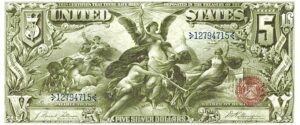
Spread a genuine 1863 Legal Tender note flat under a loupe and look closely at the background surrounding the portrait vignette. What you are seeing is not the work of a human hand. Those impossibly fine, interlocking rosettes, the spiraling guilloche bands, the micro-geometric basketweave fields that seem to shift and breathe as the note tilts in the light, all of it was produced by a remarkable piece of 19th century machinery called the geometric lathe, sometimes called a rose engine. It was arguably the single most effective anti-counterfeiting weapon the United States government possessed for nearly five decades, and today it is one of the most underappreciated elements of classic American currency design.
The Counterfeiting Crisis That Demanded a Solution
To understand why geometric lathe work mattered so profoundly, you need to appreciate just how catastrophic the counterfeiting situation in antebellum America had become. Before the Civil War, currency was issued by thousands of state-chartered banks, and estimates from the period suggest that as many as one-third of all notes in circulation were either counterfeit or issued by failed institutions. A traveling merchant in 1855 might carry a copy of Bicknell’s Counterfeit Detector and Bank Note List, a publication that ran to hundreds of pages and required monthly updates simply to keep pace with new forgeries entering the market.
Early engravers working for private bank note companies recognized that the vulnerability lay in the hand-transferable nature of simple line engraving. A skilled penman could reproduce a portrait or a simple border with enough fidelity to fool an unsuspecting shopkeeper. What no human hand could replicate with consistency was a mathematically generated, perfectly repeating geometric field containing thousands of intersecting curves calculated to tolerances of a fraction of a millimeter. That realization drove the adoption of geometric lathe technology by the major security printing firms of the era.
How the Rose Engine Actually Worked
The geometric lathe, in its security printing form, was a descendant of the ornamental turning lathes that European craftsmen had used since the 17th century to decorate ivory and precious metals. By the 1820s and 1830s, American bank note companies, most notably Perkins, Fairman and Heath and its successors, had adapted the principle to engraving on steel plates. The machine mounted a cutting or engraving tool on an arm driven simultaneously by two or more rotating cams of different diameters and offset angles. The result was a cutting path that described hypotrochoid and epitrochoid curves, the same mathematical family of shapes that a modern Spirograph toy produces, but executed in steel with absolute mechanical precision.
The operator could alter the ratio of the driving cams, the eccentricity of their offset, the pressure and angle of the cutting tool, and the feed rate of the plate beneath the arm. Each combination produced a visually distinct pattern. A single geometric lathe in the hands of a skilled operator might generate dozens of unique pattern families, and the exact settings used for any given note were treated as proprietary trade secrets by the printing companies. The American Bank Note Company, formed in 1858 through the merger of seven competing firms, consolidated much of this expertise under one roof and guarded it fiercely.
When examining a 19th century note for authenticity, bring a 5x to 10x loupe to the background lathe work, not the portrait. Genuine geometric lathe engraving will show lines of perfectly uniform width that maintain crisp, sharp edges to the very terminus of each curve. Photographic or lithographic counterfeits of the era invariably show line edges that are slightly fuzzy, broken, or vary in width under magnification.
Reading the Patterns on Actual Notes
Collectors who learn to identify specific lathe work patterns gain a significant advantage in detecting alterations and outright counterfeits. The major pattern types you will encounter on 19th century U.S. federal issues fall into several distinct categories.
Guilloche Bands
Guilloche is the term for the interlaced, rope-like spiral patterns most visible in the border areas of notes from the 1861 to 1880 period. On the Series 1869 Legal Tender notes, often called the “Rainbow” series, the guilloche bands in the upper and lower margins are particularly elaborate. The $1 denomination (Friedberg catalog number F-30) features a distinctive guilloche in a warm terra cotta color that printers produced by overprinting two separate lathe-engraved tint plates. Separating these colors perfectly under magnification confirms authentic printing registration that would have been essentially impossible to duplicate with period technology.
Rosette Fields
Rosette patterns, circular lathe-work designs resembling stylized flowers, appear most prominently in the oval and rectangular vignette backgrounds of Treasury notes from the 1870s and 1880s. The Series 1878 Silver Certificates are an excellent study piece for rosette work. The $10 denomination (F-284) places a dense rosette field in the background behind the agricultural vignette on the face, and the individual rosettes, each no larger than two millimeters across, nest together with no gap between them. Each rosette itself contains six to eight concentric rings of curved lines. Reproducing this by any means available to a 19th century counterfeiter was effectively impossible.
Cycloidal or Basketweave Fields
Perhaps the most visually complex lathe work appears as overall background tints that resemble fine woven fabric. These cycloidal fields, produced by the most complex cam arrangements, appear on notes including the Series 1875 National Bank Notes and the Series 1880 Legal Tender issues. On the $5 Series 1880 (F-67 through F-75, depending on signature combination), the green lathe work background on the reverse is a cycloidal field of such density that it appears almost as a solid color to the naked eye, resolving into distinct interlocking curves only under magnification.
The Series 1869 “Rainbow” Legal Tender notes are among the best teaching examples for geometric lathe study because they use multiple overprinted tint colors. Acquire a lower-grade circulated example in the VG to Fine range for your reference collection. These trade in the $150 to $400 range depending on denomination, making them accessible study pieces without the premium of uncirculated survivors.
The Printing Companies and Their Distinctive Signatures
Experienced collectors learn to distinguish the lathe work styles of different printing companies, because the pattern vocabulary of each firm was unique to its machinery. Before the Bureau of Engraving and Printing assumed full control of federal currency production in 1877, notes were printed by private contractors including the American Bank Note Company and the National Bank Note Company. Notes printed by the National Bank Note Company, which handled much of the 1863 to 1875 production, tend toward tighter, finer rosette clusters with sharper color separation between the lathe tint and the engraved portrait work. American Bank Note Company work of the same period shows slightly more generous spacing in the rosette fields and a characteristic softness in the transition zones between pattern elements.
By the time the BEP had fully internalized the geometric lathe capability in the late 1870s, the patterns on federal notes took on a somewhat more standardized character, though they lost none of their technical precision. The BEP invested heavily in geometric lathe equipment throughout the 1880s, and notes from the Series 1880 and Series 1886 Silver Certificates show some of the finest lathe work ever produced on American currency.
Why Counterfeiters Failed and How Authorities Knew
The Secret Service, established in 1865 specifically to combat currency counterfeiting, trained its agents to use lathe work as a primary authentication test. Period training documents preserved in the National Archives describe a systematic examination procedure: first check the lathe work background under magnification, then check the paper fiber, then examine the portrait engraving. The lathe work test came first because it was the fastest and most definitive.
Photographic counterfeits of the 1870s and 1880s, which represented the most sophisticated forgery technology of the era, failed specifically because halftone photographic processes could not resolve the fine lathe lines without introducing grain and edge blur. The finest lathe lines on genuine federal notes of this period measure approximately 0.08 to 0.12 millimeters in width. Wet collodion photographic processes of the 1870s could not capture lines this fine without distortion, and even when they could, transferring that image to a printing plate introduced additional degradation. The result was that photographic counterfeits examined under even a modest magnifying glass showed clearly degraded lathe work compared to genuine notes.
If you are considering a significant purchase of a scarce 19th century Legal Tender or Silver Certificate note, specifically ask whether the seller has examined the lathe work under magnification. A genuine note with problem-free lathe work, meaning no repairs, no in-painting, and consistent line quality throughout, is worth the premium. Restored notes sometimes show areas where lathe work lines have been hand-drawn to fill in damaged areas, and this is detectable under a 10x loupe even when invisible to the naked eye.
Collecting Focus: The Best Notes for Studying Lathe Work
Certain series stand out as particularly rewarding subjects for collectors interested in geometric lathe work as a specialty. The Series 1869 Legal Tender “Rainbow” notes across all denominations show exceptional multicolor lathe printing. The Series 1886 Silver Certificates, sometimes called the “Belly Button” series for the ornate counters on their reverse, combine dense lathe work backgrounds with elaborate engraved portraiture in ways that show both technologies at their peak. The $1 Series 1886 (F-215 through F-221) is especially accessible at the $200 to $800 range in Fine to Very Fine condition.
For collectors interested in the transition period when the BEP was perfecting its lathe work in the early 1880s, the Series 1880 Legal Tender notes in the $1 through $20 denominations offer a fascinating study in evolving pattern density and color application. The $2 Series 1880 (F-51 through F-56) in particular shows a transitional lathe work style that differs meaningfully from both the earlier contractor-printed notes and the mature BEP work of the late 1880s.
| Series / F-Number | Denomination and Type | Est. Known Examples | Rarity |
|---|---|---|---|
| 1869 / F-30 | $1 Rainbow Legal Tender | ~1,200 known | Scarce |
| 1869 / F-64 | $5 Rainbow Legal Tender | ~800 known | Scarce |
| 1869 / F-130 | $50 Rainbow Legal Tender | ~60 known | Rare |
| 1875 / F-18 | $1 National Bank Note (ABNC) | ~2,500+ known | Common |
| 1878 / F-284 | $10 Silver Certificate | ~150 known | Rare |
| 1880 / F-51 | $2 Legal Tender (Scofield-Gilfillan) | ~400 known | Scarce |
| 1886 / F-215 | $1 Silver Certificate (Rosecrans-Jordan) | ~500 known | Scarce |
| 1886 / F-347 | $5 Silver Certificate (Rosecrans-Hyatt) | ~90 known | Key Date |
| 1891 / F-350 | $5 Silver Certificate (Tillman-Morgan) | ~600 known | Scarce |
| 1863 / F-11 | $1 Legal Tender (First Charter) | ~1,800 known | Common |
The Legacy of Lathe Work in Modern Currency
Geometric lathe-derived patterns did not disappear when photographic and electronic reproduction technology eventually began to close the gap in the early 20th century. Instead, the principles evolved. The fine-line background printing visible on modern Federal Reserve Notes, particularly the intricate concentric patterns behind portraits on post-1990 redesigned notes, trace a direct intellectual lineage to the rose engine work of the 1860s. Modern currency bureaus use computer-controlled equivalents of the geometric lathe, software that generates mathematically precise guilloches specifically because the patterns defeat digital scanning and reproduction for the same fundamental reason they defeated photographic counterfeiting in 1875: the fine line spacing creates moire interference patterns in any reproduction that does not exactly match the original print resolution.
The collectors who study 19th century lathe work most closely are often the ones best equipped to understand and appreciate the security design of modern issues as well. The problem being solved is the same. Only the machinery generating the solution has changed.
Conclusion: Patterns Worth Pursuing
Geometric lathe work sits at the intersection of mechanical engineering, mathematical art, and the practical demands of a government trying to protect its currency in an era of inadequate law enforcement and primitive forensic science. For collectors, these patterns are not just background noise behind the portraits and vignettes that typically draw the eye. They are the primary evidence of authenticity on every 19th century federal note, a fingerprint of legitimate manufacture that no counterfeiter of the period could convincingly duplicate.
Building a reference collection specifically focused on lathe work quality across different series, signature combinations, and printing companies is a rewarding specialization that remains underexplored. A collector who can read the geometric lathe work on a Series 1869 Legal Tender note the way a sommelier reads a wine’s terroir has developed a skill that pays dividends in every corner of the large-size currency market. Start with a loupe, a good circulated example of the Series 1869 or 1880 issues, and the patience to look closely at what the machines of the 19th century left behind.