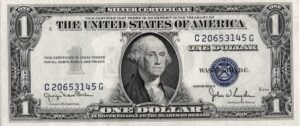
Pull a 1923 $1 Silver Certificate from an old dealer’s stock envelope and you might notice the paper has shifted from brilliant white to a soft, creamy ivory. The reverse printing carries a gentle amber warmth. The note hasn’t been cleaned, pressed, or messed with in any way. It simply sat in a drawer for a century, slowly absorbing the chemistry of its environment. Is that toning a problem? The answer, maddening as it sounds, is: it depends entirely on what kind of toning it is, how evenly it developed, and whether a professional grader interprets it as the honest result of age or the fingerprint of damage.
Toning is one of the most misunderstood and most consequential variables in paper money grading. New collectors often assume any color deviation from bright white is automatically bad. Veteran collectors know some toned notes command significant premiums. The truth lives somewhere in the nuanced middle, and mastering that nuance is what separates disciplined buyers from people who consistently overpay or pass up genuine bargains.
The Chemistry Behind Currency Toning
Before judging toning, it helps to understand what actually causes it. US currency paper from the late 19th century through the mid-20th century was made from rag-based cotton and linen fiber, sized with starch or gelatin. Both the paper substrate and the inks used in Bureau of Engraving and Printing (BEP) production are reactive to oxygen, humidity, light, and the acids that migrate from storage materials like wood pulp envelopes, leather wallets, and early cardboard albums.
The green inks used in Federal Reserve Note reverse printing contain organic pigments that oxidize predictably over decades. The red and blue security fibers embedded in paper from the Series 1928 era onward can bleed subtly when humidity cycles are extreme. The distinctive orange-red Treasury seals on Legal Tender Notes (United States Notes) from the 1862 through 1966 series were printed with pigments that can shift toward brown under prolonged UV exposure. Each of these processes produces toning with a different visual signature, and experienced graders learn to read those signatures like a language.
Original Skin: The Collector’s Holy Grail
The most desirable form of toning in paper money collecting is what dealers and grading services call “original skin” or “original surfaces.” This refers to paper that has aged uniformly and naturally without any human intervention. The note retains its original surface texture, the ink retains full depth and detail, and the color shift, if any, is even across the entire note rather than concentrated in spots or blotches.
A superb example of collectible original toning can be found in high-grade 1882 $5 Brown Back National Bank Notes (Friedberg catalog numbers 467-478, depending on bank charter and series). Many of these notes that have spent the last 140 years stored in bank vaults or private collections have developed a rich, warm amber tone across the entire face. When examined under a loupe, the engraving lines remain perfectly crisp, the fiber structure of the paper is intact, and there are no offsetting stains or concentrated dark areas. PMG and PCGS Currency frequently designate such notes with the qualifier “Original” and grade them without penalty, sometimes even noting the toning favorably in their remarks field.
When evaluating toning on an ungraded note, hold it at a 45-degree angle under a single incandescent light source. Original, even toning will show consistent color depth across the entire surface. Artificial toning from chemical treatment often reveals itself as a slightly greasy sheen or as color that sits “on top of” the paper rather than within the fiber.
When Toning Hurts: The Four Problem Categories
1. Fox Spots and Mold-Related Toning
Fox spots, the reddish-brown circular discolorations named for their resemblance to fox fur markings, are caused by microbiological activity, specifically mold or fungal growth that feeds on the organic sizing in the paper. Unlike uniform age toning, fox spots are localized, randomly distributed, and often appear on notes that were stored in high humidity environments. A 1901 $10 Bison Legal Tender Note (Fr. 122) with beautiful eye appeal can be knocked down two full grade points if the reverse carries multiple fox spots, even if the paper quality and embossing are otherwise VF to EF grade.
Grading services treat fox spots as damage rather than natural aging, and rightly so. They indicate a compromised paper structure and suggest the note may continue to deteriorate. PMG designates affected notes with a “Fox Spots” qualifier that accompanies whatever numeric grade is assigned, and the market applies a discount ranging from 20 to 50 percent depending on the severity and location of the spots.
2. Ink Migration and Bleed Staining
Some toning results not from external environmental factors but from instability within the note’s own inks. The overprinted serial numbers and Treasury seals on certain early Federal Reserve Bank Notes from the 1915 and 1918 series were applied with inks that, under high humidity conditions, can migrate outward from the printed area into the surrounding paper. The result is a diffuse halo of color around serial numbers, often brownish-red or greenish-gray depending on the ink color. This type of toning is considered a technical defect by all major grading services and always results in a grade qualifier or reduced numeric grade.
3. Chemical Brightening Residue
Here is where things get genuinely tricky for collectors buying ungraded notes. Many notes that circulated in the mid-20th century were “cleaned” with chemical brighteners, sometimes by well-meaning collectors who thought they were preserving the note, sometimes by dealers trying to improve eye appeal before sale. The most common culprit is hypochlorite bleach solution, but chemical brighteners used in laundry products were also applied to notes. Over time, the residue of these treatments oxidizes and creates an irregular yellowish or grayish toning that is visually distinct from natural aging.
The tell-tale signs include: toning that is heavier at the edges and corners than at the center (because cleaning solutions pool at borders), a slightly chalky or flat appearance to the paper surface, and printing that appears slightly washed out compared to an unaltered example of the same series. PMG and PCGS Currency will typically net-grade or detail-grade these notes and stamp them with notations like “Apparent” or “Previously Cleaned,” significantly reducing their market value.
Compare the paper color of an ungraded note to a graded example of the same series in a similar grade. Heritage Auctions and Stack’s Bowers maintain extensive online archives of past auction lots with high-resolution scans. If the ungraded note looks significantly whiter or brighter than comparable graded examples, that brightness may actually signal prior cleaning rather than superior preservation.
4. Solvent Damage Masquerading as Toning
Acetone and other organic solvents have been used by collectors attempting to remove tape residue or adhesive stains. When applied incorrectly or incompletely, these solvents leave behind a mottled, grayish-tan toning pattern that follows no logical aging logic, appearing heaviest exactly where the solvent was concentrated. Notes with solvent damage are almost always sent back by grading services as “Apparent” or “Damaged” regardless of their underlying paper quality.
The Gray Zone: Toning That Divides Expert Opinion
The most interesting, and financially significant, toning cases are the ones that fall into ambiguous territory. Consider a Series 1928B $20 Federal Reserve Note (Fr. 2052-G, Chicago district) that has spent decades in an original paper envelope alongside several gold coins. The acids and sulfur compounds off-gassing from the coins have imparted a light, even golden tone to the currency. The paper retains full crispness, the printing is sharp and detailed, and the toning is perfectly uniform. Is this original aging or contamination-induced toning?
Different grading services have reached different conclusions on notes with this type of “associated storage” toning. PMG tends to be more forgiving of uniform, low-intensity toning that does not impair the viewing of design details. PCGS Currency has historically applied slightly stricter standards to any toning that deviates from the expected color for a given series. This is one reason why submitting an ambiguous note to both services and accepting the higher of the two grades is a legitimate strategy employed by advanced collectors, though the double submission cost needs to factor into the economic calculation.
Large Size Legal Tender Notes from the 1869 “Rainbow Note” series (Fr. 64-75) present a special case. The vivid polychrome printing on these notes, featuring red, green, and black inks in complex geometric patterns, means that any uniform shift in paper color can be argued either as enhancing the warm antique appearance or as a technical reduction. Notes from this series with consistent light amber toning have sold in major auctions for prices within 10 percent of fully white examples, suggesting the market has reached a rough consensus that original toning on these early issues is not penalized by sophisticated buyers.
For ungraded Large Size notes, consult the Friedberg “Paper Money of the United States” reference values as a baseline, then cross-reference recent auction results on Heritage Auctions (ha.com) filtering specifically for “original” and “problem-free” notes in your target series. The price differential between graded and raw examples of the same type will tell you exactly what the market is currently paying for the uncertainty premium on ungraded toned notes.
Practical Examination Techniques Before Submission
If you are sitting with a collection of ungraded notes and trying to assess their toning before deciding whether to submit them for grading, here is the systematic approach used by professional currency dealers.
First, examine the note under UV (ultraviolet) light at 365nm wavelength. Original paper from notes printed before approximately 1970 will fluoresce with a dull, muted response because the rag paper lacks optical brighteners. Bright white fluorescence under UV is a strong indicator of either a modern reproduction or a note that has been treated with commercial brighteners. Conversely, dark or non-fluorescing patches within a note that otherwise has normal UV response can indicate areas of old water damage or chemical treatment.
Second, assess the toning directionality. Natural aging almost always produces toning that is heaviest at the edges and margins, where the paper is most exposed to air, and lightest in the center. This is the opposite pattern from cleaning residue, which tends to concentrate in corners and along the margins due to pooling. If the toning is heaviest at the center of the note, that warrants serious scrutiny.
Third, check for ink depth. A note with genuine original toning retains full ink depth: the intaglio printing on BEP-produced notes from the 19th and early 20th centuries has a tactile three-dimensionality you can feel with a fingertip. Notes that have been washed or chemically treated lose some of this depth, and the ink will appear slightly flat or washed-out under strong raking light even if the paper color looks acceptable.
Which Notes Benefit Most from Being Raw
Not every toned note is worth submitting for professional grading. The economics of grading depend on the expected value differential between a graded note and a raw one of equivalent apparent quality, minus submission fees that currently run from $20 to $65 per note at PMG depending on tier and declared value.
Notes that benefit most from grading despite toning include any Large Size note in the VF-25 to AU-55 range with catalog values above $500 in a reference guide such as Friedberg, any small size note with a star serial number or low print run variety, and any National Bank Note from a small-charter bank in a less populous state. For these categories, the credibility added by a PMG or PCGS Currency holder, with an explicit “Original” qualifier on the label, consistently adds 25 to 40 percent to realized auction prices compared to identical raw notes.
Notes that are probably not worth submitting despite interesting toning include common series Federal Reserve Notes in circulated grades, any note where the toning is clearly problematic enough to result in a Details/Apparent grade, and common small-size issues in grades below VF where the grading fee exceeds the incremental value added by the holder.
| Series / Catalog | Note Type / Denomination | Toning Type | Market Status |
|---|---|---|---|
| Fr. 64-75 (1869) | $1 Rainbow Legal Tender | Uniform amber age toning | Acceptable / Minor Discount |
| Fr. 467-478 (1882) | $5 Brown Back National | Even vault toning, original skin | No Discount / Often Premium |
| Fr. 122 (1901) | $10 Bison Legal Tender | Fox spots, mold toning | 20-50% Discount |
| Fr. 237-242 (1896) | $1 Educational Silver Cert. | Chemical brightener residue | Details Grade / Large Discount |
| Fr. 1173-1173a (1915-18) | $5 FRBN (various districts) | Ink migration / serial bleed | Apparent Grade / 30-60% Discount |
| Fr. 2052 series (1928B) | $20 FRN Small Size | Associated storage toning | Case-by-Case / Grader Dependent |
| Fr. 1500-1536 (1902) | $10 Date Back National | Uniform caramel toning | Generally Acceptable |
| Fr. 2155-F (1969C) | $100 FRN Atlanta Star | Edge toning from improper storage | Minor Discount if Uniform |
Storing Your Notes to Prevent Unwanted Future Toning
Prevention is easier than explanation. The notes in your collection that are ungraded today will be evaluated by future buyers or grading services based on how you treat them now. The enemies of stable paper money preservation are heat, humidity, UV light, and acid migration from improper holders.
Mylar D (archival polyester) holders are the gold standard for raw note storage. Original Mylar D is chemically inert and will not off-gas acids or plasticizers onto paper surfaces. PVC-based holders, still sold at some general office supply stores, will eventually leave a greasy residue that causes mottled toning and is very difficult to distinguish from chemical damage under professional examination.
Maintain storage conditions between 65 and 70 degrees Fahrenheit with relative humidity below 50 percent. Notes stored in bank safe deposit boxes are at particular risk from seasonal humidity fluctuations in vault environments, a fact that surprises many collectors who assume vault storage is automatically protective. If you store significant raw notes in a safe deposit box, include silica gel desiccant packets and replace them annually.
Conclusion: Read the Toning, Don’t Fear It
Toning is not the enemy of the currency collector. It is a communication from the note itself about how it has spent the past 50, 100, or 150 years. Your job as a collector is to learn to read that communication accurately: to distinguish the quiet dignity of original aging from the more urgent messages sent by fox spots, chemical residue, and mold damage.
The collector who develops a calibrated eye for toning evaluation gains a real market advantage. Toned notes that professional graders designate as original and problem-free are consistently undervalued by less experienced buyers who reflexively avoid any color deviation from brilliant white. Meanwhile, notes with problematic toning disguised by superficially attractive color can fool buyers who lack the examination skills to look beneath the surface. Study real examples, compare graded notes to ungraded ones, use UV light as a tool rather than a gimmick, and over time the toning on every note you pick up will start telling you its story clearly and honestly.