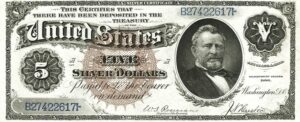
You pull a crisp-looking Large Size Legal Tender note from an old album. The paper has excellent body, the colors are vibrant, and the margins are nearly perfect. You are already mentally pricing it as a Fine 15 or better. Then you flip it over and spot three tiny pinholes in the upper left corner, a faint rust stain bleeding from an old paperclip, and a small brown water spot near the Treasury seal. Suddenly that note is not a Fine 15 anymore. Welcome to the world of net grading, where the final number on a certification holder rarely tells the whole story without understanding the note’s full condition narrative.
What Is Net Grading and Why Does It Exist?
Net grading is the practice of assigning a final grade that reflects both the inherent paper quality and circulation wear of a note AND any extrinsic defects that reduce its eye appeal or structural integrity. The concept exists because two notes can share identical paper quality, originality, and circulation characteristics, yet one might carry problems that significantly diminish collector desirability and market value.
Paper Money Guaranty (PMG) and PCGS Currency handle this in slightly different ways. PMG typically assigns a straight numerical grade when a note is problem-free and uses qualifier designations such as “NET” printed directly on the label when a defect warrants a grade reduction. PCGS Currency uses a similar approach, sometimes appending the specific problem to the grade description. An independent dealer working without a slab might simply say a note “grades Fine 15 net” and explain the reason verbally or in writing.
The Friedberg catalog numbers used throughout this article follow the standard Robert Friedberg reference, Paper Money of the United States, now in its 22nd edition. When discussing specific values, those reflect current retail market conditions for certified problem-free examples, against which net-graded notes are discounted.
The Mechanics of a Split Grade
Before a grader assigns a net grade, they first determine the “technical grade,” meaning the grade the note would receive if the defect were absent. Think of this as the baseline. A 1914 $10 Federal Reserve Note, Friedberg Fr. 915, issued from the Boston district, might have paper with enough body and crispness to technically grade Very Fine 25. If that same note carries a single small pinhole dead center, the grader might reduce the net grade by one full step to Fine 20, or even Fine 15 if the hole is in a visually prominent location like the center of a portrait.
This is the “split” in split grading: the technical grade and the net grade diverge. A note labeled “VF25 NET” on a PMG holder means the paper quality merits a VF25 baseline, but a problem pulls the assigned grade down. Collectors sometimes pay a premium for high-technical, low-net notes because the paper quality is genuine, even if the defect is real.
When evaluating a net-graded note, always ask: what is the technical grade versus the net grade? A PMG Fine 15 NET note with a technical grade of VF30 represents dramatically better paper quality than a straight Fine 15. For type collectors on a budget, these notes can be exceptional values if the defect is minor and non-distracting.
Pinholes: The Most Common Culprit
Pinholes are the single most frequently encountered defect in 19th and early 20th century paper money. Before modern storage methods, notes were routinely pinned to ledger pages, bundled with straight pins, or secured in receipt books with tacks. A single pinhole in a non-critical area of an 1880 $1 Legal Tender Note (Fr. 29, with red spiked seal and signatures of Scofield and Gilfillan) might reduce the grade by just one step. Two or three pinholes clustered near the portrait of Washington will reduce it by two to three steps.
The location matters enormously. Grading services consider the portrait area, central vignettes, and Treasury seal to be “critical zones.” A pinhole touching Lincoln’s portrait on a $5 United States Note Series 1880 (Fr. 67-Fr. 72 range) is penalized more heavily than the same hole in the blank margin area. The PCGS Currency grading standards document, available on their website, specifically references location as a determining factor in defect severity.
Multiple pinholes compound the problem. Three or more pinholes, regardless of location, will often push PMG to designate a note as having “multiple pinholes” on the label, and the grade reduction becomes more aggressive. A Large Size Silver Certificate Series 1891 $1 (Fr. 222-Fr. 226, Martha Washington portrait) that might otherwise grade Extremely Fine 40 with excellent paper and bright red-brown seal could net down to Very Fine 20 or lower if it carries four or five scattered pinholes.
Rust Stains: The Paperclip Legacy
Walk into any major currency auction and you will find that a significant percentage of pre-1935 notes carry some degree of paperclip rust. From roughly 1900 through the 1950s, bank tellers, merchants, and individuals routinely clipped notes together with steel paperclips that were not rust-resistant. The iron in those clips reacted with moisture over decades and transferred reddish-brown iron oxide stains directly into the paper fibers.
Rust stains are particularly damaging to graded value for two reasons. First, they are often large relative to pinholes, covering a centimeter or more of surface area. Second, they represent actual chemical degradation of the paper fiber, meaning the paper may be weakened in that area. A rust stain that has eaten partially through the paper is treated differently than a surface rust stain that has not compromised structural integrity.
On a Series 1928 $10 Federal Reserve Note (Fr. 2002-A through Fr. 2002-L, the first small-size series), a light paperclip rust stain in the upper margin might reduce a Gem Uncirculated 65 EPQ down to Choice Uncirculated 64 NET or even 63 NET, translating to a value reduction from roughly $250 for a problem-free CU63 to $80 to $120 for the net-graded equivalent, depending on district. Boston and Minneapolis issues from 1928 command premiums even in net grades due to lower print runs.
Rust stains sometimes continue to spread if a note is stored in humid conditions. If you acquire a net-graded note with rust staining outside a certified holder, have it professionally encapsulated promptly. The inert atmosphere inside a PMG or PCGS Currency holder slows further oxidation. Never attempt to treat rust stains at home with chemical solutions, as this almost always causes additional damage and creates an “altered or repaired” designation.
Water Stains, Fox Spots, and Brown Toning
Water staining can range from a nearly invisible tideline along one edge to large blotches that obscure portions of the design. The source is usually flooding, high humidity storage, or contact with a damp surface at some point in the note’s history. Water stains are particularly problematic on high-denomination Large Size notes, where collector demand is intense and condition sensitivity is extreme.
Fox spots, also called foxing, are small brown or reddish-brown spots caused by fungal or oxidative activity in the paper itself. They are common on notes printed on rag paper prior to the 1920s and appear as distinct circular or irregular spots separate from overall toning. A note with fox spots in the border area will receive a smaller grade reduction than one with foxing across the face design. A Series 1902 $10 National Bank Note (Fr. 616-Fr. 638 range, plain back variety) from a small-town bank in, say, Deadwood, South Dakota, already commands a premium as a rare charter. Fox spotting on such a note is especially heartbreaking to collectors because the rarity of the issuer is not diminished, but the value certainly is.
Brown toning is the most subjective of the stain-related defects. Some toning is considered “original” and acceptable, even attractive, on older notes. But uneven toning, edge darkening from acidic storage, or chemical toning from contact with newspaper or wood pulp sleeves can result in a net grade or at minimum an EPQ (Exceptional Paper Quality) designation being denied on an otherwise high-grade note.
Tears, Splits, and Edge Nicks
A tear is a physical separation of the paper fibers, ranging from a tiny edge nick of 1 to 2 millimeters to a catastrophic split running through the center of the note. Grading standards treat these on a sliding scale. PMG’s published guidelines indicate that a single edge nick of under 3mm on a note otherwise grading Very Fine may result in only a one-step net reduction. A split or tear extending into the design area from any edge, however, will result in a more significant reduction regardless of overall paper quality.
Center folds that have developed into splits along the fold line are particularly common on Series 1934 and 1934-A $500 and $1,000 Federal Reserve Notes, which were often folded and placed in envelopes or wallets for safekeeping during the mid-20th century. A 1934-A $1,000 FRN (Fr. 2212-B, New York district) in problem-free Very Fine 25 might retail for $1,800 to $2,200 in today’s market. The same note with a center split extending 15mm would net down significantly, perhaps to Fine 12 NET, bringing realized values into the $900 to $1,200 range at auction.
When examining a note for tears or splits, hold it up to a strong transmitted light source (a window or light box works well). Light passes through thinned areas and developing splits that are invisible under reflected light. This is especially important when evaluating Large Size notes folded along horizontal creases, where splits often begin along an existing fold line and extend inward from the edge.
Writing, Stamps, and Counting Machine Perforations
Ink writing on currency is a grade-destroying defect with almost no upside. Even a small endorsement signature, date notation, or merchant marking in pencil or ink in the margin of an otherwise high-grade note will result in a net grade and a PMG or PCGS label noting “writing.” Ink writing is penalized more severely than pencil, and writing on the face is treated more harshly than writing on the back.
Rubber stamp impressions, particularly bank cancellation stamps reading “CANCELLED” or “PAID,” are common on 19th century notes. A cancelled 1862 $1 United States Note (Fr. 16, first obligation reverse, with small red Treasury seal) might actually be more historically interesting with a contemporary bank stamp, but the market values it at a discount of 30 to 50 percent below a problem-free equivalent in the same grade.
Counting machine perforations deserve special mention. Major banks and the Federal Reserve system used mechanical counting machines from approximately the 1910s through the 1960s that punched small holes in groups of notes to count and void them. These perforations, often in patterns spelling “VOID” or simply in rows of small round holes, are considered a defect but also serve as historical documentation of a note’s banking life. On scarce star notes or low-serial notes, counting perforations are unfortunate but do not eliminate collector interest.
How Grading Services Document Net Grades
PMG uses a consistent label language. A net-graded note will show the numerical grade followed by “NET” in the grade designation field, with the specific problem listed in a separate comments field on the label. Examples from PMG holders in the market include designations such as “Fine 15 NET, Pinholes” or “Very Fine 20 NET, Stains” or “Extremely Fine 40 NET, Rust.” PCGS Currency uses a similar but slightly different format, sometimes combining the problem and grade in a single descriptor.
Neither service assigns EPQ (Exceptional Paper Quality) or PPQ (Premium Paper Quality) designations to net-graded notes. These quality suffixes are reserved exclusively for problem-free examples with above-average paper quality for the grade. A net-graded note, by definition, has a problem that disqualifies it from these premium designations regardless of how lovely the paper might otherwise be.
If you are assembling a type set on a budget, net-graded notes certified by PMG or PCGS Currency are an excellent strategy for expensive type notes. A PMG Very Fine 25 NET (pinholes) example of a rare Large Size type like the 1890 $1 Treasury Note (Fr. 347, large brown seal) can be acquired for 40 to 60 percent of what a straight VF25 commands, yet it still carries the authentication guarantee of a major grading service. For display purposes in an album or frame, the pinholes are often invisible to casual viewing.
The Compounding Effect of Multiple Defects
When a note carries more than one type of defect, the grade reduction compounds but does not simply add linearly. A note with both pinholes and a rust stain will not necessarily receive twice the reduction of a note with only one of those defects. Graders look at the overall eye appeal impact: if both defects are minor and located in unobtrusive areas, the combined reduction may be modest. If either defect is severe or centrally located, the dominant defect drives the reduction and the secondary defect adds a smaller additional step.
Where multiple defects become truly damaging is in the upper grades. A note that would otherwise grade Gem Uncirculated 65 EPQ is highly sensitive to any defect at all, because the premium for problem-free gem notes is enormous. A single faint counting machine perforation that might be overlooked on a Fine 12 will drop a gem note from a $500 plus value to a $150 net-graded result.
| Series / Friedberg No. | Defect Type | Technical Grade | Typical Net Grade Impact | Market Value vs. Problem-Free | Rarity |
|---|---|---|---|---|---|
| 1880 $1 LT, Fr. 29 | 2-3 Pinholes, margin | VF30 | Net to Fine 15 | 40-50% of problem-free VF30 | Common |
| 1891 $1 SC, Fr. 223 (Martha Washington) | 4-5 Scattered pinholes | EF40 | Net to VF20 | 35-45% of problem-free EF40 | Scarce |
| 1928 $10 FRN, Fr. 2002-B (NY) | Paperclip rust stain | CU65 | Net to CU63 | 50-65% of problem-free CU65 | Common |
| 1934-A $1,000 FRN, Fr. 2212-B | Center split, 15mm | VF25 | Net to Fine 12 | 55-65% of problem-free VF25 | Rare |
| 1902 $10 NBN, Fr. 626 (small charter) | Fox spotting, face | VF20 | Net to Fine 15 | 30-40% of problem-free VF20 | Key Date |
| 1890 $1 Treasury, Fr. 347 | Pinholes, single | VF25 | Net to Fine 20 | 45-55% of problem-free VF25 | Rare |
| 1862 $1 USN, Fr. 16 | Bank cancel stamp | Fine 15 | Net to VG10 | 35-50% of problem-free Fine 15 | Scarce |
| 1914 $10 FRN, Fr. 915 (Boston) | Water stain, margin | VF25 | Net to Fine 12 | 40-50% of problem-free VF25 | Scarce |
| 1928 $10 FRN, Fr. 2002-I (Minneapolis) | Single edge nick | CU64 | Net to CU63 | 60-70% of problem-free CU64 | Rare |
Practical Strategies for Buying and Selling Net-Graded Notes
For buyers, the key discipline is always asking what the technical grade is and whether the defect is visible at normal viewing distance. Many pinholes are invisible without magnification. Many rust stains are confined to a back margin. If the defect is minor and the technical grade is high, a net-graded note can represent the best value in the currency market. Always examine the actual note if possible, not just the certification label.
For sellers, full disclosure is not just ethical, it is market-smart. Collectors who feel deceived by an undisclosed defect will not return. Describing a note as “PMG Fine 15 NET, two small pinholes, both in upper right margin, not visible from normal viewing distance” will generate more confidence, more bids, and often a better final price than simply listing it as “Fine 15” without context.
For submitters considering whether to send a problem-note to PMG or PCGS Currency, the calculation depends on the note’s value and rarity. On a common type note worth $50 in problem-free Fine 15, the grading fee and shipping may not be justified for a net-graded example. On a rare charter National Bank Note potentially worth hundreds even with problems, or on any note above $300 in problem-free condition, certification provides authentication value that justifies the cost even with a net grade outcome.
Conclusion: Net Grading as a Tool, Not a Punishment
Net grading exists not to penalize collectors or artificially deflate values, but to give the market an honest, standardized language for describing notes that carry both strengths and weaknesses. A note labeled “VF30 NET” is not a bad note. It is a note with a genuine story: real paper quality, real circulation history, and a real defect that must be factored into value. For collectors who understand the system, net-graded notes represent some of the most accessible pathways into collecting rare types, scarce districts, and historically significant issues that would otherwise be out of reach at problem-free prices. The more fluently you speak the language of net grading, the better equipped you are to find genuine value in a market where condition nuance separates the knowledgeable collector from everyone else.