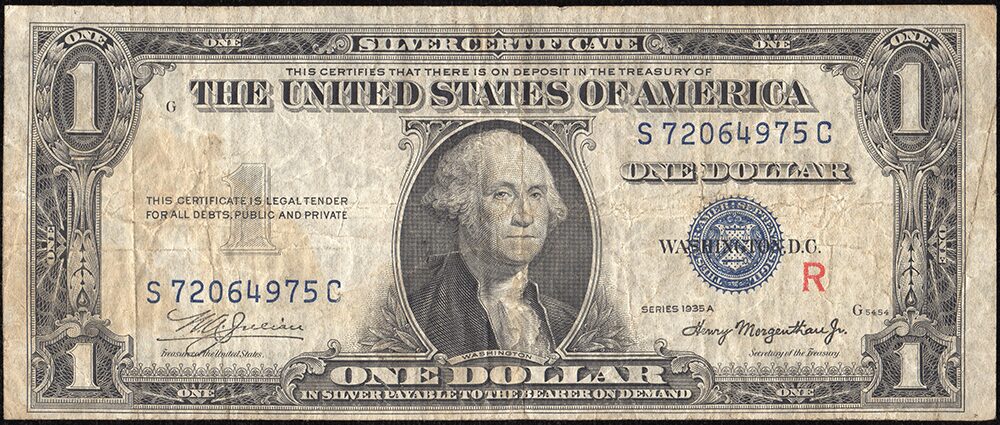
📷 Image source: U.S. Currency Education Program (uscurrency.gov). Images are selected by AI to represent the article topic and may not depict the exact note(s) described.
Walk through any major currency show and you will eventually spot a dealer’s case holding two nearly identical $1 Silver Certificates side by side, one bearing a bold red R and the other a bold red S stamped on the face. These are the Series 1935A Experimental notes, and their story touches on wartime paper shortages, bureaucratic innovation, and the kind of controlled government experiment that almost never makes it into public circulation. Almost.
The Wartime Context: Why an Experiment Was Needed
By 1944, the United States was deep into World War II, and the Bureau of Engraving and Printing (BEP) faced mounting pressure on its paper supply chain. Currency paper, produced exclusively by Crane and Company of Dalton, Massachusetts, had to meet strict specifications for durability, composition (75% cotton, 25% linen), and security. The BEP wanted to know whether a different paper formula, specifically one with a higher rag content and different sizing, could perform comparably in circulation. Rather than guessing, they ran a controlled, real-world test.
The experiment involved printing two batches of Series 1935A $1 Silver Certificates on two different paper stocks. To keep the batches identifiable, the BEP applied an overprinted red letter to the face of each note: R for the regular experimental paper and S for the special experimental paper. Both letters appear to the right of the portrait of George Washington, printed in a vivid red ink that stands out clearly against the note’s face.
Identifying the R and S Notes
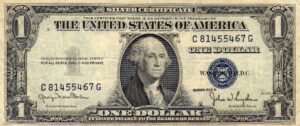
The base design of both varieties is identical to the standard Series 1935A $1 Silver Certificate. The blue Treasury seal sits to the right of center, the blue serial numbers are printed in the standard location, and the Julian/Morgenthau signature combination appears across the bottom. What distinguishes the experimental notes is, of course, that prominent red overprint.
The R note serial numbers run from S70884001C through S72068000C, a print run of approximately 1,184,000 notes. The S note serial numbers run from S73884001C through S75068000C, another print run of approximately 1,184,000 notes. Both batches were printed consecutively, and the serial number ranges are bookended precisely to allow the BEP to track each group independently.
When buying a 1935A R or S experimental note, always verify the serial number falls within the documented range. Fraudulent overprints do exist, and a note with a serial number outside the S70884001C-S72068000C (R) or S73884001C-S75068000C (S) windows is a red flag. Third-party grading by PCGS Currency or PMG is strongly recommended for any example above Fine condition.
Paper Stock Differences: What Were They Actually Testing?
The two paper types differed primarily in their sizing and surface treatment. The “special” paper used on the S notes was designed to have better resistance to folding and handling wear, with a slightly different fiber ratio intended to extend the note’s usable lifespan in circulation. The BEP and the Federal Reserve tracked the return rate and condition of recovered notes over subsequent years to determine which paper held up better.
From a purely tactile standpoint, the difference is subtle enough that most collectors cannot distinguish the two papers by feel alone, particularly on circulated examples. On high-grade, uncirculated specimens, some experts note a very slight difference in surface texture and ink absorption, but this is not a reliable identification method. The overprinted letter remains the definitive identifier.
Grading and Condition Considerations
Because these notes circulated normally alongside standard Series 1935A notes, finding them in high grades requires patience. Most examples encountered in the market today grade between Very Fine (VF-20 to VF-35) and Extremely Fine (EF-40 to EF-45), with worn circulated examples in Fine (F-12) condition being the most common entry point for new collectors.
Gem Uncirculated (MS-65 or CU-65 in PMG’s numerical scale) examples do exist but command significant premiums. A PMG 65 EPQ (Exceptional Paper Quality) R or S note can trade for five to ten times the value of a comparable VF example, depending on current market demand. The key grading considerations are:
- Crispness of the red overprint: Any fading, smearing, or mechanical damage to the R or S letter itself reduces grade and desirability significantly.
- Corner integrity: These notes were not set aside as collectibles by most recipients, so sharp, unfolded corners are a premium feature.
- Centering: Well-centered examples with equal margins on all four sides are preferred, as off-center printing was not uncommon in 1944 BEP production runs.
If you are assembling a type set of Silver Certificates, consider displaying the R and S notes together in a matched pair. Dealers sometimes offer them as a set at a modest discount compared to purchasing each individually, and the visual contrast between the two makes for a compelling exhibit page at currency shows.
The Outcome of the Experiment
The results of the 1944 paper experiment were inconclusive enough that neither paper formula was adopted as a wholesale replacement for the existing Crane specification. The BEP continued using the standard cotton-linen stock that had been in use since the Federal Reserve era, and the experimental paper test faded into administrative history. What survived, however, was roughly two million notes bearing testimony to the experiment, scattered into general circulation where most were spent without a second thought.
It is worth noting that the experiment represented one of the very few times in 20th-century U.S. currency history that an overprinted identifier was used to distinguish test groups in live circulation. Most BEP production experiments were conducted internally, never reaching the public. The decision to release these notes into actual commerce gives the R and S varieties a unique authenticity as historical artifacts: they are not proofs, specimens, or presentation pieces. They were meant to be used.
Relative Rarity: R vs. S
With essentially identical print runs of approximately 1,184,000 each, the R and S notes are theoretically equally scarce. In practice, however, the S note appears to survive in slightly higher quantities in collector-grade condition, a fact that some researchers attribute to early recognition by collectors who pulled S notes from circulation when the experiment became public knowledge in numismatic publications during the late 1940s. The difference is marginal, and for most practical purposes, both varieties carry the same market value at equivalent grades.
Do not overlook star note replacements within the R and S serial number ranges. While no confirmed star replacement notes from the experimental batches have been documented in published census data, the theoretical possibility makes any star note in the adjacent serial number ranges worth examining closely for signs of experimental paper characteristics.
Market Values and Where to Find Them
As of recent auction records, circulated examples in Fine to Very Fine condition typically trade in the $75 to $175 range for either variety. Extremely Fine examples step up to $200 to $350, while Choice Uncirculated (CU-63) notes regularly bring $400 to $600. Premium Gem examples with EPQ designations from PMG have realized $1,000 or more at major auction houses including Heritage Auctions and Stack’s Bowers.
The best sources for acquiring R and S experimental notes include major currency auction platforms, established dealers at the Memphis International Paper Money Show (IPMS) and the American Numismatic Association (ANA) conventions, and reputable online currency dealers. Always insist on third-party certification for any example priced above $200, and be wary of raw notes with suspiciously vivid red letters that might indicate a fraudulent overprint applied to an ordinary 1935A note.
| Variety | Serial Number Range | Print Run | Rarity |
|---|---|---|---|
| 1935A Standard (no letter) | Multiple blocks | ~6.1 billion (all 1935A) | Common |
| 1935A “R” Experimental | S70884001C – S72068000C | ~1,184,000 | Scarce |
| 1935A “S” Experimental | S73884001C – S75068000C | ~1,184,000 | Scarce |
| 1935A “R” in CU-65 EPQ | S70884001C – S72068000C | Survivors est. under 200 | Rare |
| 1935A “S” in CU-65 EPQ | S73884001C – S75068000C | Survivors est. under 250 | Rare |
| 1935A “R” Matched Pair with “S” | Consecutive or matched serials | Very few documented | Key Date |
| 1935A Standard Hawaii Overprint | Multiple ranges (brown seal) | ~35.5 million | Scarce |
| 1935A North Africa Yellow Seal | Multiple ranges (yellow seal) | ~25.0 million | Scarce |
Building Context: Related 1935A Varieties
Collectors who pursue the R and S experimentals often develop a broader interest in the full range of Series 1935A varieties, which is one of the richest series in all of small-size Silver Certificate collecting. The 1935A series also encompasses the Hawaii emergency overprint notes (brown seals, “HAWAII” overprinted front and back) and the North Africa yellow seal notes issued to military personnel during the North African campaign, both of which were designed as emergency measures allowing the government to demonetize specific currency stocks if captured by enemy forces. Together, the experimental, Hawaii, and North Africa varieties form a compelling wartime currency subset that tells a coherent story about mid-century monetary policy under pressure.
A focused collection built around Series 1935A wartime varieties, including the standard note, the Hawaii overprint, the North Africa yellow seal, and the R and S experimentals, can be completed on a modest budget at the Fine to VF level and represents exceptional historical depth for display purposes. Framing a complete set with period military photographs makes for a striking exhibit.
Conclusion
The Series 1935A R and S experimental notes occupy a genuinely special niche in U.S. currency collecting. They are not manufactured rarities or collector issues: they are the accidental survivors of a government efficiency study, pressed into everyday circulation with no expectation that anyone would notice or care. The fact that collectors did notice, and have preserved thousands of these notes over eight decades, is a tribute to the vigilance of the numismatic community. Whether you are completing a Silver Certificate type set, building a wartime currency collection, or simply want a conversation-starting note in your display, the 1935A R and S experimentals deliver history, scarcity, and visual impact in equal measure.