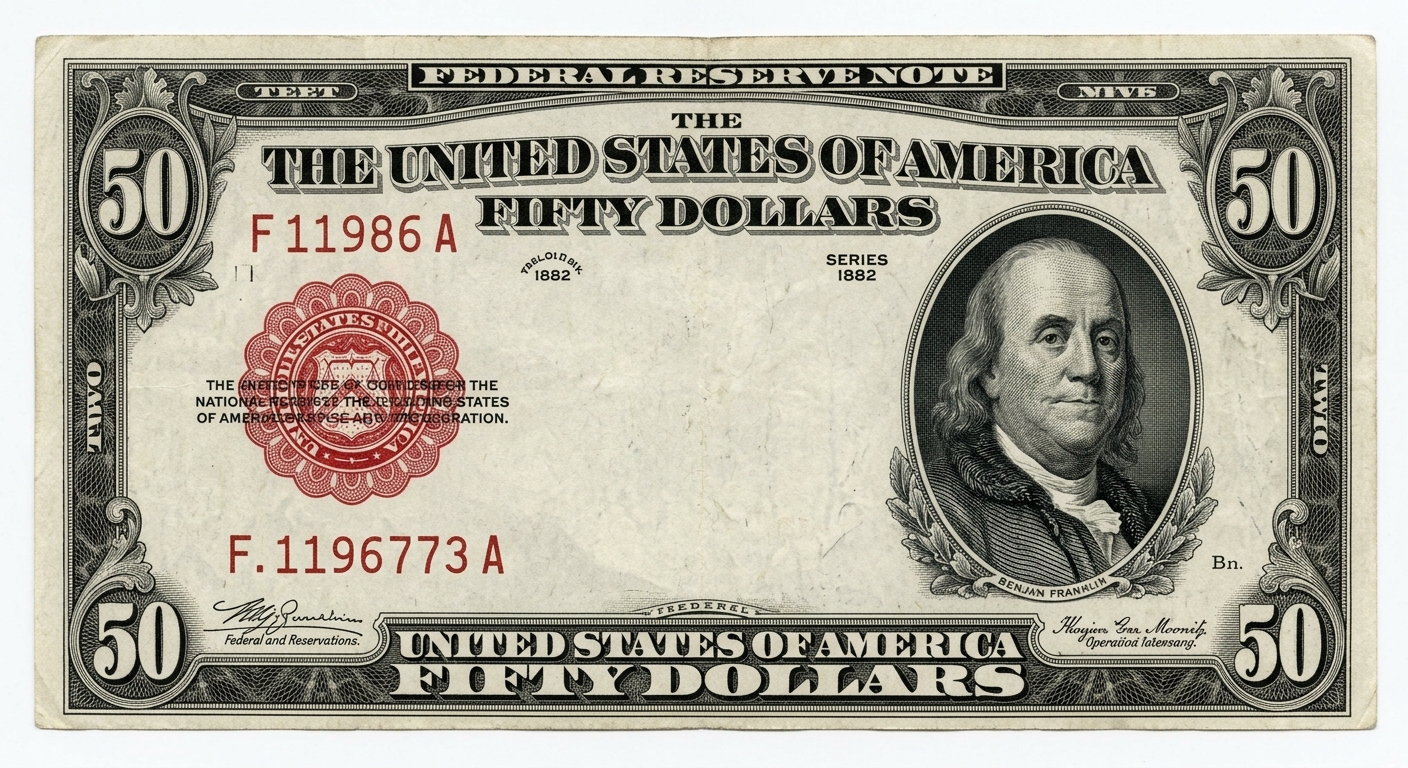
📷 Image source: AI generated. Images are selected by AI to represent the article topic and may not depict the exact note(s) described.
You have just acquired a spectacular original-skin 1928 Gold Certificate or perhaps a crisp Federal Reserve Note from a decades-old estate collection. The notes arrive bundled together, secured the old-fashioned way: a tight rubber band looped around the pack. Your stomach drops. You already know what that band may have done to the face and back of every note it touched. Rubber band damage is one of the most insidious forms of paper currency deterioration because it can be invisible at first glance, yet catastrophic to a grade. Understanding precisely how graders evaluate it, and what can reasonably be done before submission, can save you real money and heartbreak.
The Chemistry and Physics of What a Rubber Band Actually Does
Modern rubber bands are composed primarily of vulcanized natural latex or synthetic polymers blended with sulfur compounds, accelerants, and pigments. When a rubber band is stretched around a bundle of notes and left in place, several damaging processes begin simultaneously. The elastic pressure compresses the paper fibers along a narrow band, typically 3mm to 6mm wide depending on the band’s gauge. On a note stored for even six months in a warm environment, this compression is enough to create a visible crease or depression that graders call a compression line.
Beyond simple mechanical pressure, rubber compounds undergo a process called outgassing. As the rubber ages, it releases sulfur dioxide and peroxides that chemically react with the paper and printing inks. This is why you sometimes see a rust-colored or brown stain running exactly where the band sat, even on notes where the paper itself appears otherwise pristine. The sulfur compounds attack the silver and copper compounds present in certain printing inks used on nineteenth- and early twentieth-century currency, producing visible discoloration that no amount of surface cleaning can fully reverse.
On large-size notes (issued before 1929) the problem is compounded by the more porous, linen-heavy paper stock used prior to the Bureau of Engraving and Printing’s adoption of the standardized small-size format. A rubber band compression line on an 1882 Series Brown Back National Bank Note or a Series 1901 $10 Bison Legal Tender Note can penetrate far deeper into the fiber matrix than the same damage on a post-1950 small-size Federal Reserve Note.
When you acquire a note that has visible rubber band damage, hold it at a very low, raking angle under a single incandescent or LED light source before doing anything else. This oblique lighting technique, sometimes called raking light examination, will reveal the true depth of any compression channel and help you decide whether professional conservation is worth pursuing before grading submission.
How PMG Graders Evaluate Rubber Band Damage
PMG uses a structured internal evaluation protocol that separates rubber band damage into three severity tiers. Understanding these tiers helps collectors set realistic expectations before they pay submission fees.
Tier One: Surface Compression Lines Without Fiber Disruption
At this level, the rubber band has left a visible channel or depression in the paper surface, but the underlying cotton and linen fibers remain intact. Under magnification at 10x to 20x, the fibers are compressed but continuous. PMG graders typically penalize a note one full grade point for a single prominent compression line in this category, or up to two points if the line crosses the portrait or a key design element. A note that would otherwise present as PMG 65 Gem Uncirculated might come back as PMG 63 Choice Uncirculated with a qualifier noting the band line.
Tier Two: Surface Abrasion and Ink Disturbance
Here the rubber compound has abraded the surface of the note, lifting or smearing ink along the band’s contact zone. Under raking light you will see a slight sheen difference, and under magnification the ink layer shows micro-fracturing. This is particularly devastating on engraved notes because the fine ink ridges of intaglio printing are among the first casualties. A Series 1928 $20 Gold Certificate (Friedberg 2402) that grades AU-58 based on paper quality and folds might come back at EF-45 with a “Surface Abrasion” qualifier when band-related ink disruption is present along the upper or lower border.
Tier Three: Fiber Breaks and Through-Paper Damage
This is the most severe category. The rubber band has been tight enough, or present long enough, to actually break the paper fibers along the compression channel. Under magnification these breaks appear as discontinuities in the fiber network, sometimes accompanied by tiny associated tears or paper separations. Notes with fiber breaks from rubber bands will almost certainly receive a “Details” or “NET” grade from both PMG and PCGS Currency, meaning the grade reflects the damage and the note cannot be graded on the standard uncirculated or circulated scale. The value implications are severe: a Details-graded note typically trades at 10 to 30 percent of the value of a problem-free example at the same apparent grade.
If you suspect Tier Three fiber breaks, do not attempt any home conservation. Even gentle humidification to relax the paper can cause already-weakened fiber breaks to propagate, turning a single clean break into a partial tear. At this level, your only option is a professional conservator with specific paper currency experience, not a general document restorer.
How PCGS Currency Approaches the Same Problem
PCGS Currency’s grading philosophy aligns closely with PMG on the structural aspects of rubber band damage, but there are subtle differences in how qualifiers are worded on the holder insert. PCGS Currency uses “Stain” as a qualifier for chemical discoloration from rubber outgassing, while PMG may use “Rust” or “Toning” depending on the specific chemical signature of the discoloration. For compression lines without chemical staining, PCGS Currency’s graders apply a “Pressed” or “Crease” qualifier depending on whether the channel resembles a deliberate press attempt or an accidental compression. This distinction matters because a “Pressed” qualifier signals to buyers that someone may have attempted to improve the note, which carries its own market stigma beyond the physical damage itself.
Both services use a combination of transmitted light (holding the note over a light box) and reflective raking light to distinguish between compression lines that affect only the surface sizing of the paper versus those that penetrate into the fiber matrix. Transmitted light is especially useful for identifying rubber band channels on thicker large-size notes where surface examination alone can be misleading.
The Role of Conservation: What It Can and Cannot Do
Professional numismatic conservation for paper currency is a field that has matured significantly since the early 2000s. Both PMG and PCGS Currency explicitly permit the submission of conserved notes, and conservation that has been properly disclosed and executed does not automatically result in a Details grade. However, collectors need to understand precisely what conservation can accomplish with rubber band damage.
What Conservation Can Address
For Tier One compression lines, a skilled conservator can sometimes use controlled humidification and gentle flattening techniques under a book press with interleaving mylar to partially relax the compressed fibers. The key word is partially. Even the best conservation will not eliminate a compression line entirely from a note that has been banded for years, but it may reduce its visual impact sufficiently to recover one grade point. Chemical staining from rubber outgassing can occasionally be reduced through aqueous washing with deionized water, followed by controlled drying, but this works best when the staining has not yet penetrated into the ink layer. Surface abrasion in Tier Two is largely irreparable because displaced or abraded ink cannot be restored without crossing into restoration (which is explicitly prohibited by both grading services).
What Conservation Cannot Do
No legitimate conservation process can reverse fiber breaks, reattach separated paper layers along a compression channel, or reconstruct abraded intaglio ink ridges. Any service that claims it can make a fiber break invisible to a trained grader under magnification is either misrepresenting its capabilities or engaging in deceptive restoration, which will result in a “Restored” Details grade if detected. Graders at both major services are specifically trained to identify over-humidified paper, chemical washing residues, and the subtle fiber alignment changes that result from pressed-out compression lines.
Before hiring any conservation service, ask specifically whether they have experience with Bureau of Engraving and Printing paper stocks and whether their work is acceptable to PMG and PCGS Currency. Legitimate professional conservators in the numismatic space include those working through established auction houses like Heritage, Stack’s Bowers, and Lyn Knight, as well as independent specialists affiliated with the American Numismatic Association’s conservation referral network.
High-Value Notes Most Affected: Where the Stakes Are Highest
Rubber band damage on a circulated small-size $1 Federal Reserve Note is essentially a non-issue for most collectors. But the damage calculus changes dramatically on high-value material. Consider the Series 1882 $50 Gold Certificate (Friedberg 1196), which in PMG 63 Choice Uncirculated can realize $40,000 to $80,000 depending on the issuing bank and signature combination. A single rubber band compression line reducing that grade to PMG 58 Choice About Uncirculated could represent a $20,000 to $35,000 reduction in realized value at auction. On large-size National Bank Notes, where low-population survivors in high grade are often unique or near-unique, the damage is arguably even more consequential because there may be no comparable sale to establish the differential.
Gold Certificates as a class are particularly vulnerable because the distinctive golden-orange ink used for the backs of 1882 and 1922 series notes contains metallic pigment compounds that are highly reactive to the sulfur outgassing of rubber bands. The chemical staining on these backs often presents as a dark olive-brown band that is immediately visible against the note’s vivid orange ground color, making rubber band damage on Gold Certificates more visually obvious than on virtually any other currency type.
| Series / Friedberg No. | Type and Denomination | Approx. PMG Pop (VF30 and Above) | Value Sensitivity to Band Damage |
|---|---|---|---|
| 1882 / Fr. 1196 | $50 Gold Certificate | Under 25 examples | Key Date |
| 1901 / Fr. 122 | $10 Bison Legal Tender | Approx. 150 in all grades | Rare |
| 1922 / Fr. 1200 | $1,000 Gold Certificate | Under 15 examples known | Key Date |
| 1928 / Fr. 2402 | $20 Gold Certificate (Small-Size) | Several hundred graded | Scarce |
| 1863 / Fr. 167e | $100 Legal Tender, First Charter | Under 30 examples | Key Date |
| 1918 / Fr. 1131 | $500 Federal Reserve Note | Fewer than 40 graded examples | Rare |
| 1929 / Fr. 1800-series | $10 National Bank Notes (Type 1) | Varies by issuing bank | Scarce |
| 1934A / Fr. 2201 | $500 Federal Reserve Note | Approximately 150 graded | Scarce |
| 1935A / Fr. 1607 | $1 Silver Certificate (R-S Experimental) | Under 100 graded | Rare |
| Various / Fr. 2300-series | Small-Size $1 through $5 FRNs in Gem | High populations in most districts | Common |
Practical Steps for Collectors Who Inherit or Purchase Banded Notes
If you receive or purchase notes that have been stored with rubber bands, the priority is immediate removal of the band followed by careful, undisturbed examination. Do not slide the band off; instead, cut it with small scissors without touching the note’s surface. Place each note individually in a Mylar sleeve or between two pieces of acid-free interleaving tissue in a flat, clean environment. Allow the notes to rest undisturbed for 24 to 48 hours before examining them under raking light.
If you observe only subtle compression lines without any chemical staining or surface abrasion, you may choose to submit directly to a grading service, understanding that the graders will apply appropriate penalties. If you observe chemical staining or surface changes, consult a professional conservator before submission. Always get a written opinion and cost estimate from the conservator before proceeding, and ask specifically whether the conservation is likely to result in an improved numeric grade or simply a cleaner presentation within the same Details category.
Store your currency exclusively in Mylar D (polyester) holders or archival-quality currency sleeves. Never use rubber bands, paper clips, or PVC-based plastic sleeves for storage. If you are storing multiple notes together, use acid-free tissue interleaving between each note and secure the bundle with a cotton ribbon tie rather than any elastic material. This single storage practice will protect notes that might otherwise suffer thousands of dollars in grade-related value loss over a decade of improper storage.
Conclusion: Knowledge Protects Value
Rubber band damage sits in an uncomfortable middle zone of numismatic damage: it is common enough that graders see it on a substantial percentage of submitted notes from estate collections, yet specific enough in its mechanisms that many collectors still underestimate its impact until they see the returned holder. Understanding the three tiers of damage, the precise ways in which PMG and PCGS Currency evaluate and document band-related problems, and the realistic boundaries of what conservation can achieve puts you in a far stronger position whether you are evaluating a purchase, deciding whether to conserve before grading, or simply protecting the notes already in your collection. The rubber band is a small and ordinary object, but in the world of paper money collecting, it has damaged more potential Gem notes than almost any other single cause.