
📷 Image source: banknote.ws (World Banknote Gallery). Images are selected by AI to represent the article topic and may not depict the exact note(s) described.
On the night of March 1, 1932, Charles Lindbergh Jr., the twenty-month-old son of America’s most famous aviator, was taken from his nursery in Hopewell, New Jersey. What followed was a two-year currency hunt unlike anything American law enforcement had ever attempted. The FBI, the Treasury Department, and the Internal Revenue Service conspired to track a ransom payment through the serial numbers of Gold Certificates and Federal Reserve Notes, ultimately ensnaring Bruno Richard Hauptmann at a Bronx gas station in September 1934. For numismatists, the story is not just a true-crime footnote. It is a pivotal chapter in the history of how paper money was used as a law enforcement tool, and the specific notes involved remain among the most historically significant pieces of American currency ever to circulate.
The Ransom Payment: Denominations, Series, and the Currency Itself
The $50,000 ransom paid in the Lindbergh case was assembled by Lindbergh’s representatives under the direction of intermediary John Condon, who used the alias “Jafsie” in coded newspaper advertisements to communicate with the kidnapper. The ransom was handed over on the night of April 2, 1932, at St. Raymond’s Cemetery in the Bronx. The package was prepared by J.P. Morgan banker Henry Breckinridge and the Lindbergh family’s financial representatives, and it was deliberately composed of Gold Certificates because those were the most traceable notes in circulation at the time.
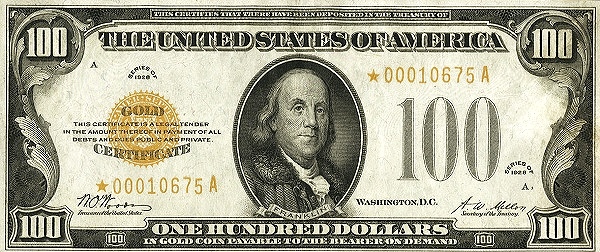
The bulk of the payment consisted of Series 1928 Gold Certificates in $20 denominations, with additional $5 and $10 Gold Certificates, and a smaller grouping of Federal Reserve Notes. The Series 1928 Gold Certificates are identifiable today by their distinctive golden-orange Treasury seal on the right obverse, the text “This certifies that there have been deposited in the Treasury of the United States of America X Dollars in Gold Coin payable to the bearer on demand” on the face, and the signatures of Treasurer Walter O. Woods and Secretary of the Treasury Andrew W. Mellon for the earliest printings, or Frank White as Treasurer paired with Ogden L. Mills for later 1928-B issues.
The critical investigative step taken before the handoff was the recording of serial numbers. Agents and bank staff photographed or manually copied the serial numbers of every note in the ransom package. This list, eventually comprising thousands of individual serial numbers, was distributed to banks, hotels, merchants, and gas stations across the northeastern United States. It was the most systematic currency tracking effort ever undertaken in an American criminal investigation up to that point.
Series 1928 Gold Certificates in any denomination are collectible today, but notes in circulated grades (Fine to Very Fine) still carry strong premiums. A 1928 $20 Gold Certificate in Fine-12 condition typically catalogs between $85 and $150 in retail, while an example in Extremely Fine-40 can reach $300 or more. Always verify the gold seal retains strong color, as faded seals significantly reduce value.
FDR’s Gold Recall: How History Accelerated the Hunt
By a remarkable coincidence of history, President Franklin D. Roosevelt signed Executive Order 6102 on April 5, 1933, exactly one year and three days after the ransom was paid. The order required all persons to surrender Gold Certificates to Federal Reserve Banks by May 1, 1933. This transformed the remaining Lindbergh ransom notes from ordinary circulating currency into legally conspicuous contraband. Anyone attempting to spend or deposit a Gold Certificate after the deadline was, by definition, breaking federal law, and banks were instructed to report any Gold Certificate deposits with particular scrutiny.
The Treasury and FBI recognized immediately that this gold recall could flush out the kidnapper. If the extortionist was sitting on a hoard of Gold Certificates, he would eventually need to spend them, and every Gold Certificate passed after May 1933 would be checked against the ransom list. This proved prescient. Between 1932 and 1934, Lindbergh ransom notes surfaced sporadically across upper Manhattan and the Bronx, almost always in small denominations, almost always passed at gas stations, grocery stores, and movie theaters. Investigators maintained a geographic plot of every bill recovered, and the cluster pointed unmistakably to a neighborhood in the East Bronx.
When examining Series 1928 Gold Certificates for your collection, pay close attention to the signature combination. The 1928 issue carries Woods-Mellon signatures, while 1928-A carries Woods-Mills. The 1928-B carries White-Mills. Each combination has a distinct print run and its own catalog value. The Friedberg catalog (Friedberg numbers 2400-2408 cover $10 and $20 Gold Certificates across these series) is the standard reference, and the 1928-B issues in higher grades are notably scarcer than the base 1928 issue.
The Gas Station Receipt: September 18, 1934
The break in the case came from a single $10 Gold Certificate. On September 18, 1934, a customer at the Warner-Quinlan gas station on Lexington Avenue in Manhattan paid for five gallons of gasoline with a $10 Gold Certificate. The attendant, Walter Lyle, had been following news reports of the Lindbergh ransom hunt and was aware that Gold Certificates were being flagged. Suspicious of a man paying with a gold note well over a year after the government recall, Lyle wrote the license plate number of the customer’s blue Dodge sedan in pencil on the bill: 4U-13-41, New York.
The plate came back registered to Bruno Richard Hauptmann, 1279 East 222nd Street, the Bronx. When agents searched Hauptmann’s garage on September 19, 1934, they found $14,590 in Lindbergh ransom notes concealed in the walls, wrapped in a cloth. Hauptmann was arrested the same day. The currency recovered from his garage became central evidence at trial, and the serial numbers were matched one by one against the original ransom list.
The Notes as Numismatic Artifacts
For currency collectors, the broader category of Series 1928 Gold Certificates encompasses some of the most beautiful American notes of the twentieth century. The $20 denomination (Friedberg 2402) features a portrait of President James Garfield on the face, printed by the Bureau of Engraving and Printing on distinctive paper with gold-colored treasury seal. The back carries a stately green-inked design. Total printings for the Series 1928 $20 Gold Certificate across all signature varieties reached approximately 66 million notes, making circulated examples accessible to most collectors, while high-grade uncirculated examples remain genuinely scarce.
The $10 Gold Certificate Series 1928 (Friedberg 2400) carries a portrait of Alexander Hamilton and was printed in somewhat smaller quantities relative to the $20. The $5 Gold Certificate (Friedberg 2399 series) depicts Abraham Lincoln and was the denomination most commonly used in small day-to-day transactions, meaning heavily circulated examples vastly outnumber well-preserved ones. A PCGS or PMG-graded $5 Gold Certificate in VF-25 catalogs around $175 to $250 in today’s market.
The higher denominations, $50 and $100, are considerably rarer in collector-grade condition. Series 1928 $50 Gold Certificates (Friedberg 2404) in Fine-15 or better command prices well north of $500, and pristine uncirculated examples have sold at Heritage and Stack’s Bowers auctions for $2,000 to $5,000 depending on grade and eye appeal.
Third-party grading is especially important for Gold Certificates because counterfeits and altered notes do exist in the marketplace. Both PCGS Currency and PMG have extensive experience with this series. When buying higher-denomination Gold Certificates ($50 and above) without a holder, insist on a third-party submission before completing the purchase. The cost of grading is negligible compared to the risk of acquiring a doctored example.
The Federal Reserve Notes in the Package
Not all of the ransom money was in Gold Certificates. A portion of the $50,000 payment was in Federal Reserve Notes, including Series 1928 and Series 1928-A issues from various districts. These notes, while not carrying the visual distinctiveness of Gold Certificates, were equally tracked by serial number. The Federal Reserve Notes from the ransom are less often discussed in numismatic literature but are equally significant historically. For collectors, original-series Federal Reserve Notes from 1928 with the distinctive Woods-Mellon signature combination carry their own collector following, particularly in the $5, $10, and $20 denominations from low-print-run districts such as Minneapolis (I) and Dallas (K).
What Collectors Can Own Today
Naturally, no verified Lindbergh ransom notes are available to collectors in the conventional marketplace. After serving as trial evidence, the recovered notes were retained by the government. Some were reportedly destroyed. The trial itself was held in Flemington, New Jersey, in January 1935, and Hauptmann was convicted and executed on April 3, 1936. But the broader category of Series 1928 Gold Certificates remains very much available and affordable, and owning any example from this series connects you directly to the monetary world that made the Lindbergh investigation possible. These are the same notes that circulated in the same years, from the same Bureau of Engraving and Printing print runs, with the same golden Treasury seal.
| Series / Friedberg No. | Denomination and Signatures | Approx. Print Run | Rarity |
|---|---|---|---|
| 1928 / Fr. 2399 | $5 Gold Cert., Woods-Mellon | ~25,600,000 | Common |
| 1928 / Fr. 2400 | $10 Gold Cert., Woods-Mellon | ~130,000,000 (combined) | Common |
| 1928 / Fr. 2402 | $20 Gold Cert., Woods-Mellon | ~66,200,000 | Common |
| 1928 / Fr. 2404 | $50 Gold Cert., Woods-Mellon | ~5,500,000 | Scarce |
| 1928 / Fr. 2405 | $100 Gold Cert., Woods-Mellon | ~3,240,000 | Scarce |
| 1928 / Fr. 2407 | $500 Gold Cert., Woods-Mellon | ~420,000 | Rare |
| 1928 / Fr. 2408 | $1,000 Gold Cert., Woods-Mellon | ~288,000 | Rare |
| 1928-B / Fr. 2402b | $20 Gold Cert., White-Mills | Significantly lower than 1928 | Scarce |
| 1928 Star Notes | $10 or $20, any district, star serial | Very small replacement runs | Key Date |
A Crime That Changed How America Tracked Its Currency
The Lindbergh case established a template for currency-based investigations that endures to this day. The systematic pre-distribution recording of serial numbers, the coordination between federal agencies and private banks, the public posting of ransom note lists in commercial establishments: all of these were innovations born from the desperation of the Lindbergh investigation. The Federal Bureau of Investigation and the Treasury Department formalized many of these procedures in the years following Hauptmann’s arrest, and serial number tracking became a standard component of ransom cases throughout the twentieth century.
For the numismatist, the deeper lesson is about the evidential power of paper money. A $10 Gold Certificate, serial number carefully noted by a suspicious gas station attendant, brought down one of the most wanted men in American history. Every Gold Certificate in your collection carries that same potential for historical weight: a piece of the monetary fabric of a specific moment, traceable, datable, and irreplaceable.
Building a thematic collection around the Lindbergh era does not require searching for actual ransom notes. Consider assembling a type set of Series 1928 Gold Certificates across denominations ($5, $10, $20, $50), paired with contemporary 1928 Federal Reserve Notes from the New York Federal Reserve district (which would have been the most likely source for a ransom package assembled in the New York area). Add a printed copy of the original ransom note serial number list, which is available in historical archives and has been reproduced in several numismatic publications, to give the collection its documentary grounding.