📷 Image source: banknote.ws (World Banknote Gallery). Images are selected by AI to represent the article topic and may not depict the exact note(s) described.
A Note That Stops Collectors in Their Tracks
Walk into any major currency show and set a Series 1923 $10 Silver Certificate on the dealer’s table. Watch what happens. Even seasoned collectors will pause, lean in, and take a second look. The note commands attention in a way that few pieces of American paper money can. Its oversized format, the deeply engraved portrait of Andrew Jackson centered in an ornate oval vignette, and the sheer scarcity of surviving examples combine to make it one of the true prize pieces of large-size note collecting.
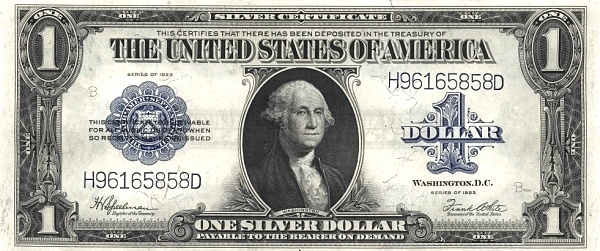
Most collectors are at least passingly familiar with the Series 1923 $1 Silver Certificate, the famous “Horse Blanket” note that circulated widely and survives in reasonably accessible quantities today. Many know the Series 1923 $5 Silver Certificate featuring Abraham Lincoln. But the $10 denomination from that same series is a different animal entirely. It was printed in far smaller numbers, circulated heavily when it was issued, and today exists in genuinely collectible condition in quantities that make even advanced collectors pause before building a complete set.
The Porthole Design: Where the Nickname Comes From
The “Porthole” nickname is immediately obvious the moment you lay eyes on one of these notes. The portrait of Andrew Jackson is set within a large, perfectly circular vignette that is in turn framed by an elaborate lathe-work geometric border. The overall effect is strikingly similar to looking through the round porthole window of a ship, with the portrait appearing almost three-dimensional against its ornate surround. The Bureau of Engraving and Printing executed the engraving work at the highest level of craft then available, and the result is a note that looks more like a piece of fine art than a circulating medium of exchange.
The back of the note is no less impressive. A large central counter shows the denomination in bold numerals, flanked by intricate scrollwork that fills the oversized note format. The blue Treasury seal and serial numbers stand out crisply against the face, identifying the note’s status as a Silver Certificate, meaning it was theoretically redeemable for its face value in silver coin or silver bullion at the Treasury. In practice, by 1923 most Americans simply spent these notes as ordinary currency, which is precisely why so few survive in problem-free high-grade condition today.
When examining a Series 1923 $10 Silver Certificate, pay close attention to the circular porthole border. The fine geometric lines in this area are extremely susceptible to fading, rubbing, and cleaning damage. A note that grades VF or better on overall eye appeal can still be downgraded significantly if the lathe-work border shows breaks or wears unevenly. Always examine this area under good lighting and slight magnification before purchasing.
Signature Varieties: Fr. 302 and Fr. 303
The Friedberg reference catalogs two distinct signature varieties for the Series 1923 $10 Silver Certificate, and understanding the difference between them matters significantly for collectors building a type set or a complete set of the issue.
The first variety, Fr. 302, carries the signatures of Treasurer Frank White and Secretary of the Treasury A.W. Mellon. White served as Treasurer from 1921 to 1928, and Mellon held the Secretary position from 1921 to 1932, so this combination represents the bulk of the production run for the series. Fr. 302 is the more commonly encountered of the two varieties, though “commonly encountered” is a highly relative term when discussing this note.
The second variety, Fr. 303, bears the signatures of Treasurer H.T. Tate and Secretary Mellon. Harley Tate succeeded White as Treasurer in 1928, giving this combination a narrower production window. Fr. 303 is considered meaningfully scarcer than Fr. 302 and commands a premium in all grades. In high grades such as Choice Extremely Fine (Ch. XF, 45) or better, the Tate-Mellon combination is genuinely rare and will attract serious competition at auction.
Serial numbers for both varieties fall within standard ranges for the period, with the prefix letter indicating the issuance block. Notes with low serial numbers, particularly those in the A00000001A through A01000000A range, carry a premium with collectors who specialize in fancy serials, though the overall population of the note is small enough that any example in respectable condition is desirable on its own merits.
Why the $10 Dwarfs the $5 in Rarity
This is the question that surprises many newer collectors, who might reasonably assume that the rarity relationship between denominations in the same series would be roughly proportional. In fact, the Series 1923 $5 Silver Certificate featuring Lincoln (Fr. 282 through Fr. 285) is considerably more obtainable than its $10 counterpart, and the reasons are instructive for understanding large-size note scarcity in general.
First and most fundamentally, the Treasury printed more $5 notes than $10 notes. The $5 denomination saw higher demand in everyday commerce, and the Bureau of Engraving and Printing responded with correspondingly larger production runs across multiple signature varieties. Second, the higher face value of the $10 note meant that notes coming out of circulation in worn condition were more likely to be redeemed and destroyed rather than saved as souvenirs or curiosities. A ten-dollar note in 1923 represented real purchasing power, roughly equivalent to well over $150 in today’s terms, and worn examples were more systematically retired.
Third, and perhaps most critically for condition rarity, the $10 note circulated in environments where it sustained heavy use. Bank tellers, merchants, and businesspeople handled these notes constantly, and the large format that makes them so visually impressive also made them physically vulnerable to folds, tears, and edge damage. The result is that while the $5 Silver Certificate of 1923 can be acquired in Very Fine condition with some patience at auction, finding a $10 example in the same grade is a genuinely meaningful achievement.
Do not let a lower grade deter you from acquiring a Series 1923 $10 Silver Certificate for a type set. A problem-free Fine 15 or Very Fine 20 example represents strong value compared to the same note with issues such as pinholes, tape repairs, or washing. The PCGS Currency and PMG grading services are both reliable for this issue, and their holders add a meaningful liquidity premium when reselling. Always prioritize originality over apparent grade.
Condition Census and Known Population
Population report data from the major grading services gives collectors a concrete sense of just how scarce the Series 1923 $10 Silver Certificate is in high grades. As of recent census data, the combined PCGS Currency and PMG populations for Fr. 302 and Fr. 303 in grades of Extremely Fine 40 and above number in the dozens rather than the hundreds. Notes grading Choice Uncirculated 63 or better are genuinely trophy pieces, with only a handful of examples certified at that level across both signature varieties combined.
The finest known examples have appeared at major auction houses including Heritage Auctions, Stack’s Bowers, and Lyn Knight Currency Auctions over the past two decades. A Gem Uncirculated example in a PMG 65 holder achieved a record price that underscored how seriously advanced collectors treat this issue. Even in Very Good to Fine grades, the note sells for multiples of what a comparably graded large-size $5 Silver Certificate would bring, reflecting the fundamental supply difference between the two denominations.
It is also worth noting that because these notes circulated so heavily and were so thoroughly used before being retired, the survival of even problem notes, those with repairs, pinholes, or significant staining, represents a real segment of the available market. Collectors on a budget who want to represent this issue in their collection need not hold out indefinitely for a pristine example; a problem-free Fine grade note without repairs or cleaning is a legitimate and respectable acquisition at a fraction of the cost of a higher-grade example.
Distinguishing Original Notes from Altered or Restored Pieces
The relative scarcity and high values associated with the Series 1923 $10 Silver Certificate make it a target for the kinds of problems that plague all scarce large-size notes. Washing and pressing to improve apparent grade is the most common issue, as a circulated note that has been chemically cleaned can display a false brightness and crispness that suggests a higher grade to the untrained eye. The lathe-work border on the porthole vignette is particularly telling in this regard: original ink will show a deep, rich quality even on worn notes, while a washed note will often display a flat, chalky appearance in the fine lines.
Pinholes are another pervasive problem on this issue. Notes were frequently pinned to boards or bundled in ways that left tiny punctures that are easy to miss under casual examination but are immediately visible when the note is held up to a strong backlight. Any note being considered for purchase at a significant price should be examined with transmitted light as a matter of course.
Buying only from reputable dealers or acquiring notes in PCGS Currency or PMG holders largely mitigates these risks, and for any example priced above a few hundred dollars the cost of third-party grading is minimal relative to the protection it provides.
If you are purchasing a raw (ungraded) Series 1923 $10 Silver Certificate, always negotiate the right to submit it to a third-party grading service before the sale is finalized, or buy on the explicit condition that the grade is as represented. Even experienced dealers occasionally miss subtle cleaning or restoration on this issue, and a grading service “details” designation can turn a $500 purchase into a $150 resale item almost instantly.
The Andrew Jackson Connection
There is a certain irony in Andrew Jackson’s portrait appearing on a Silver Certificate, a form of paper money he would almost certainly have opposed with considerable vigor. Jackson was famously hostile to both paper currency and central banking, having fought and won a bitter political battle to destroy the Second Bank of the United States during his presidency in the 1830s. He was a hard-money advocate who believed that only gold and silver coin constituted genuine currency.
Of course, the Silver Certificate’s explicit promise to pay in silver coin might have softened his objection slightly, since the obligation printed on the face of the note reads “This certifies that there have been deposited in the Treasury of the United States ten dollars in silver payable to the bearer on demand.” Whether Jackson would have found that sufficient comfort is a question historians enjoy debating. For collectors, the historical irony adds a layer of interest to an already compelling note.
Jackson’s portrait on currency was not new in 1923. He had appeared on various federal issues going back to the nineteenth century, and his image on the $20 Federal Reserve Note, which continues to this day despite periodic redesign discussions, has made him one of the most recognizable figures in American numismatics.
| Friedberg No. | Signatures | Est. Print Run / Notes Known | Rarity |
|---|---|---|---|
| Fr. 302 | White-Mellon ($10, 1923) | ~500,000 printed; ~150-200 known in VF+ | Rare |
| Fr. 303 | Tate-Mellon ($10, 1923) | ~150,000 printed; fewer than 75 known in VF+ | Key Date |
| Fr. 302 (CU) | White-Mellon, Gem CU 65+ | Fewer than 10 certified at 65 or above | Key Date |
| Fr. 303 (CU) | Tate-Mellon, any CU grade | Fewer than 5 certified Uncirculated | Key Date |
| Fr. 282 | Speelman-White ($5, 1923) | ~3,500,000+ printed; 400+ known in VF+ | Scarce |
| Fr. 285 | Tate-Mellon ($5, 1923) | ~800,000 printed; ~100 known in VF+ | Rare |
| Fr. 237 | Speelman-White ($1, 1923) | Multiple billions; widely available | Common |
| Fr. 238 | Woods-White ($1, 1923) | Large quantities; common in mid-grades | Common |
Current Market Values and Where to Find Examples
Market values for the Series 1923 $10 Silver Certificate reflect its scarcity in a straightforward way. In Good to Very Good condition (G-4 to VG-10), problem-free examples of Fr. 302 regularly sell in the $400 to $700 range at auction, with dealers asking somewhat more. Fine examples (F-12 to F-15) in original condition without repairs can bring $800 to $1,500. Very Fine notes (VF-20 to VF-35) jump substantially, with $1,500 to $3,500 being a realistic range depending on the quality of the specific example and whether it has been certified. Extremely Fine examples of Fr. 302 can bring $4,000 to $8,000, and anything approaching Uncirculated territory crosses into five figures reliably.
For Fr. 303 with the Tate-Mellon signatures, apply a 50 to 100 percent premium over Fr. 302 values at comparable grades, and more in the highest grades where the population is genuinely tiny.
The best venues for acquiring these notes are the major currency-focused auction houses, particularly Heritage Auctions and Stack’s Bowers, which offer the largest selection of certified large-size notes and maintain comprehensive auction archives that allow buyers to research historical realized prices before bidding. The major currency shows, including the Florida United Numismatists show in January and the ANA World’s Fair of Money in summer, also bring out substantial dealer inventories of large-size material.
Heritage Auctions maintains a free searchable archive of past realized prices at HA.com. Before bidding on any Series 1923 $10 Silver Certificate, search the archive for comparable certified examples from the past three to five years. This gives you a genuine market baseline and helps you avoid overbidding in competitive situations. PMG and PCGS Currency population reports are also freely available online and take only minutes to consult before any significant purchase.
Building a 1923 Silver Certificate Set: Realistic Goals and Strategy
For collectors who want to assemble a complete set of the 1923 Silver Certificate series across all three denominations, the $10 Porthole note is clearly the anchor piece that will define the difficulty and budget of the project. A realistic strategy is to secure the $10 note first, in the best grade your budget allows, and then build the more obtainable $1 and $5 denominations around it.
Type set collectors who simply want one representative example of the Porthole design would do well to target a problem-free Fr. 302 in Fine to Very Fine condition. This range offers genuine visual appeal, the note’s design characteristics are clearly visible, and it remains accessible relative to the upper-grade examples. A certified example in a PMG or PCGS Currency holder in the VF-20 to VF-30 range, purchased at auction, represents outstanding long-term value relative to the scarcity of the issue.
Advanced collectors who want both signature varieties face a more extended search, particularly for a presentable Fr. 303. Patience is the primary tool here. These notes do appear at major auctions two to four times a year in various grades, and setting up auction alerts with the major houses ensures you will not miss an opportunity when one comes to market.
A Piece of History Worth Pursuing
The Series 1923 $10 Silver Certificate is the kind of note that reminds collectors why large-size American paper money occupies a category of its own in world numismatics. The combination of physical size, engraving quality, historical subject matter, and genuine scarcity makes it a note that rewards careful study and patient acquisition. Its relative obscurity compared to the more widely recognized $1 Porthole note means that many collectors discover it late in their journey, often after years of focusing on more available issues.
That discovery moment, when a collector first holds a problem-free example of this note and takes in the full impact of Jackson’s portrait in its ornate oval frame, is one of the genuine pleasures of the hobby. The $10 Porthole is not the rarest large-size note ever produced. But it may be the most underappreciated combination of artistry, history, and scarcity that the large-size era has to offer.