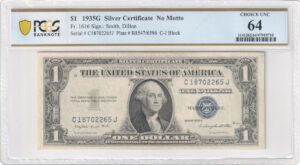
Flip a Series 1935F $1 Silver Certificate face-down on your desk and look carefully at the reverse engraving. If two notes from the same series look subtly but unmistakably different to you, you are not imagining things. The back design underwent a measurable change during the production run of the 1935F, splitting the issue into two collectible varieties that carry different catalog values and tell a fascinating story about mid-century Bureau of Engraving and Printing (BEP) operations. This guide breaks down everything a collector needs to know, from the mechanical origins of the change to how to authenticate each variety in hand today.
A Brief History of the Series 1935 $1 Silver Certificate Family
The Series 1935 $1 Silver Certificate is one of the longest-running note families in United States currency history. Beginning with the plain 1935 issue signed by Julian and Morgenthau, the BEP carried the basic design through eight suffix letters, ending with the 1935H. The face design remained essentially stable throughout: a blue Treasury seal to the right of Washington’s portrait, blue serial numbers, and the bold “SILVER CERTIFICATE” obligation across the top.
The 1935F falls roughly in the middle of that continuum. It bears the signatures of Ivy Baker Priest as Treasurer of the United States and H. Chapman Anderson as Secretary of the Treasury, a combination that places its printing squarely in 1955 through 1957. The total production run for the 1935F was substantial, in the range of 1.17 billion notes across all printings, making it one of the higher-volume issues in the series. But buried inside that enormous print run is the Narrow Back / Wide Back distinction that gives variety collectors something genuinely interesting to hunt.
What Exactly Is the “Back” and Why Did It Change?
The “back” in collector terminology simply refers to the reverse side of the note. On the $1 Silver Certificate, the reverse carries the familiar ONE dollar design that preceded the Federal Reserve Note reverse still in use today: an ornate green engraving with “THE UNITED STATES OF AMERICA” arched above and “ONE DOLLAR” prominent at center, flanked by decorative scrollwork.
The measurable difference between the Narrow Back and Wide Back varieties lies in the outer border of that reverse design. On the Wide Back notes, the green border design extends closer to the edges of the note, leaving a narrower margin of unprinted paper between the outermost green rule line and the physical edge of the note. On Narrow Back notes, that printed border is slightly more compressed inward, leaving a visibly wider unprinted margin all around. Put more precisely, collectors and catalogers have measured the difference in the width of the back plate design impression itself, hence the names Wide Back and Narrow Back.
The practical explanation for the change is rooted in BEP plate production. During the mid-1950s the Bureau periodically refurbished or replaced the steel intaglio printing plates used for note reverses. When a new plate generation was prepared, minor dimensional differences could result from the transfer and hardening process. The Narrow Back plates produced a design that was measurably reduced in overall printed width compared to the older Wide Back plates. This is not a miscut or trimming variation. It is a consistent, plate-level difference reproduced across every note printed from those particular plates.
When identifying Narrow vs. Wide Back varieties, use a loupe or magnifier and measure the unprinted margin between the outermost green border rule and the note edge. On Wide Back notes this margin is typically under 1.5 mm on well-centered examples. On Narrow Back notes the margin approaches 2 mm or slightly more. Compare two notes side by side for the fastest visual confirmation.
How to Identify Each Variety In Hand
Identifying these two varieties does not require expensive equipment, but it does require attention to detail. Here is a practical step-by-step approach for examining a 1935F Silver Certificate you have in hand:
Step 1: Confirm the Series and Signatures
Before worrying about back varieties, confirm you actually have a Series 1935F. The suffix letter appears after “SERIES” on the face of the note, just below Washington’s portrait. The signatures should read “Ivy Baker Priest” (lower left) and “H. Chapman Anderson” (lower right). Any other signature pair means you have a different series letter, and the Wide/Narrow distinction applies specifically to the 1935F and certain adjacent issues.
Step 2: Examine the Reverse Margins
Turn the note over and examine all four margins around the green border design. On a well-centered Wide Back note, the outer green rule of the border design sits noticeably close to the note edge, almost seeming to crowd the margins. On a Narrow Back note, there is a more generous, more even-looking white border. This is the single most useful visual diagnostic.
Step 3: Check Centering Before Drawing Conclusions
This is where many collectors make errors. A Wide Back note that is shifted in cutting can appear to have wide margins on two sides, mimicking a Narrow Back. Always examine all four sides and look for consistency. If three margins are tight and one is wide, you likely have a miscut Wide Back, not a true Narrow Back. Authentic Narrow Back notes show the compressed design on all four margins simultaneously.
Step 4: Use Reference Images
The Standard Catalog of United States Paper Money and Friedberg’s “Paper Money of the United States” both illustrate these varieties with notation. The Friedberg catalog lists both varieties under the 1935F entry. Cross-referencing a known Wide Back note from a reputable dealer scan against your example under consistent lighting will resolve most ambiguous cases.
Raw (ungraded) examples of the 1935F Narrow Back are frequently misidentified and sold as common Wide Back notes at common prices. If you are buying raw notes, take the time to authenticate the variety yourself or purchase only from sellers who explicitly guarantee the variety designation. A certified PCGS or PMG holder with the variety noted on the label eliminates all ambiguity.
Production Context: When Did the Back Change Occur?
Pinpointing the exact serial number range where the transition from Wide Back to Narrow Back plates occurred is one of the ongoing research challenges for 1935F specialists. Unlike some other production changes in BEP history, this plate transition was not a single clean cutover. Evidence from serial number surveys conducted by collectors over the decades suggests the Narrow Back notes appear in serial number ranges consistent with a later phase of the 1935F print run, likely in the 1956 to 1957 timeframe as older back plates were retired and new ones entered service.
Complicating the picture is the fact that the BEP ran multiple press lines simultaneously, meaning both plate types may have been in use concurrently during a transition window. This accounts for overlapping serial ranges that some collectors have documented. The practical takeaway is that you cannot use serial numbers alone to identify the variety. Physical examination of the note is always required.
Estimated production figures, while not officially separated by the BEP in surviving records at the level of back plate variety, suggest the Wide Back is significantly more common. Collector surveys and auction population data from the major grading services indicate the Narrow Back represents a distinctly smaller portion of surviving 1935F notes, likely somewhere between 10 and 20 percent of the total population in higher circulated and uncirculated grades.
Catalog Values and Market Performance
In well-worn circulated grades, the difference in catalog value between the two varieties is modest. A Fine-12 example of either variety typically trades in the $3 to $6 range at retail, since circulated Silver Certificates of this era are very common. The variety distinction becomes financially meaningful as grade rises.
In Extremely Fine-40 to About Uncirculated-55, a Wide Back 1935F might bring $12 to $18 at auction, while a Narrow Back in the same grade range can command $25 to $45 depending on centering and eye appeal. In true uncirculated grades, the spread widens further. PMG or PCGS graded Narrow Back examples in MS-63 to MS-65 have sold at major currency auctions in the $65 to $120 range, while equivalent Wide Back notes more typically settle between $20 and $40. The Narrow Back in a high-grade superb gem holder (MS-66 or better) is a legitimately scarce note that can exceed $200 in strong markets.
These are not dramatic collector premiums compared to major rarities in American paper money, but for a denomination that can be assembled in high grade on a modest budget, the Narrow Back variety adds meaningful numismatic depth to what might otherwise seem like a common series.
If you are building a type set of 1935 series Silver Certificates, including both the Wide Back and Narrow Back 1935F as separate entries adds a legitimate two-coin set opportunity within a single series letter. This is a recognized distinction in advanced type collecting and is acknowledged in major auction catalogs. Budget-minded collectors can find solid Narrow Back examples in the VF-30 to EF-40 range for under $20 if patient.
Comparison with the 1935A “R” and “S” Experimental Note Varieties
The 1935F Wide/Narrow Back distinction is sometimes compared by newer collectors to the famous 1935A “R” and “S” experimental varieties, but the two situations are quite different. The 1935A R and S notes were deliberately stamped with large red letters as part of an official BEP paper stock experiment, making them immediately visually distinct and intentionally documented. The 1935F Wide/Narrow Back difference, by contrast, was an unintentional byproduct of routine plate production, never officially labeled or separated by the BEP, and identified only through post-production collector research. This makes the 1935F varieties more analogous to the mule notes and transitional varieties found throughout American currency history, changes that happened on the production floor without fanfare but that numismatists have since elevated to genuine catalog status.
Star Notes in the 1935F: An Additional Collecting Dimension
The 1935F series also produced star notes, used as replacement notes when defective sheets were pulled from production. Star notes for this series carry an asterisk preceding the serial number and are scarcer than regular issues across both back varieties. A 1935F star note in Fine or better condition commands a meaningful premium over regular issues, and a 1935F star note confirmed as Narrow Back is among the more challenging single-note collecting targets in the entire 1935 series. Population data from the grading services shows certified 1935F Narrow Back star notes are genuinely rare in grades above EF-40.
| Series / Variety | Type | Est. Print Run / Population | Rarity |
|---|---|---|---|
| 1935F Wide Back | Regular Issue | Est. 1.0+ billion | Common |
| 1935F Wide Back Star | Replacement Note | Est. 3.2 million+ | Scarce |
| 1935F Narrow Back | Regular Issue | Est. 100-200 million | Scarce |
| 1935F Narrow Back (MS-65+) | Regular Issue, High Grade | Very limited certified pop | Rare |
| 1935F Narrow Back Star | Replacement Note | Est. under 500,000 | Rare |
| 1935F Narrow Back Star (EF+) | Replacement Note, Higher Grade | Fewer than 50 certified known | Key Date |
| 1935E Wide Back | Preceding Series (Granahan-Dillon) | Est. 1.5+ billion | Common |
| 1935G No Motto | Transitional, No “In God We Trust” | Est. 1.0 billion | Common |
| 1935G With Motto | “In God We Trust” added | Est. 31.3 million | Scarce |
| 1935H | Final 1935 Series Issue | Est. 30.2 million | Scarce |
Grading Considerations Specific to These Varieties
When submitting a 1935F for grading with a variety designation, it is worth noting on your submission form that you are requesting variety attribution. Both PCGS Currency and PMG are familiar with the Wide/Narrow Back distinction and will note the variety on the holder label when it is clearly attributable. Notes that fall in ambiguous centering territory may not receive a specific variety designation, which is one reason superb gem examples are especially prized: their consistent, even centering makes variety attribution unambiguous.
For the grading itself, the usual Silver Certificate condition points apply. Look for the typical circulation wear on Washington’s cheek and hair above the ear, corner folds that ghost into the design, and the characteristic fading of the blue serial numbers and Treasury seal that comes with handling. Uncirculated 1935F notes are not difficult to find in either variety, but paper quality matters significantly. Original paper brightness and absence of counting creases are the difference between a solid MS-63 and an MS-65 gem designation.
Silver Certificates of the 1935 era were frequently stored in wrapped bank packs for decades before entering the collector market. Notes from these original packs often show a diagonal counting crease from the wrapper band, which will suppress the grade even on a bright, crisp note. Examine any 1935F you are considering at a 45-degree angle under strong raking light before purchase to check for these “pack folds” that are invisible under flat lighting.
Conclusion: A Small Detail with Big Collecting Rewards
The Series 1935F $1 Silver Certificate Wide Back and Narrow Back varieties are a perfect example of the kind of production-level detail that separates a thoughtful currency collection from a casual accumulation. The notes look nearly identical at a glance, they come from the same series, share the same signatures, and carry the same face value. But the plate-level difference in their reverses is real, documented, cataloged, and reflected in the market. For a collector who takes the time to learn the diagnostic, the reward is a legitimate variety hunt hiding inside one of the most common denominations ever printed by the Bureau of Engraving and Printing. Whether you are assembling a comprehensive Silver Certificate type set, building a specialized 1935 series collection, or simply evaluating a shoebox lot of old currency, knowing the difference between a Wide Back and a Narrow Back 1935F is knowledge that pays for itself.