The Star Note Fraud That Collectors Don’t Talk About Enough
Walk through any major currency show and you’ll find dealers flipping through stacks of star notes with practiced efficiency, barely glancing at each one before pricing it. That confidence is earned through years of handling genuine replacement notes. But for newer collectors browsing eBay listings or estate sales, the star note market holds a quiet danger: altered bills where the star was never printed at the Bureau of Engraving and Printing (BEP) at all. Someone added it afterward, by hand or by stamp, to transform a $5 common note into something that looks like a $50 rarity.
Why Altered Star Notes Exist: The Economics of Replacement Note Collecting
To understand the fraud, you have to understand the premium. A standard 1995 Series $1 Federal Reserve Note from the Atlanta district in circulated condition might sell for face value or a dollar above it. The star note equivalent from that same district and series, however, had a print run of only 128,000 notes, and a crisp uncirculated example regularly brings $80 to $150 or more at auction. That price differential is the entire motive. A fraudster needs only a common 1995 Atlanta $1 note and some means of adding a convincing star to multiply the bill’s perceived collector value dramatically.
The same logic applies to large-size notes, where certain replacement stars on 1914 Federal Reserve Notes or 1923 Silver Certificates can command hundreds to thousands of dollars. The rarer the legitimate star, the greater the incentive to fake it.
The Four Main Alteration Methods
1. Rubber Stamp or Ink Stamp Addition
The crudest and most common method involves a pre-cut rubber stamp inked in a color the forger hopes will approximate the serial number green. The stamp is pressed over the space preceding the serial number. Under a loupe, stamped stars almost always show uneven ink distribution, feathering at the edges, and a star shape that does not match the precise five-pointed BEP design. The points on genuine BEP stars are sharp, symmetrical, and consistent across all denominations and series within a given printing era.
2. Pen or Fine-Brush Inking
More sophisticated fraudsters hand-draw the star using technical pens or fine brushes. This method can produce a surprisingly clean star to the naked eye, but it almost never survives loupe examination. Genuine BEP serial number ink is applied by a high-pressure intaglio or letterpress printing process, which forces ink into the paper fibers and creates a characteristic slight relief you can feel with a fingertip. Hand-drawn ink sits on top of the paper surface instead.
3. Chemical Alteration or Laser Printing Over Existing Notes
The most technically sophisticated alterations involve partially bleaching a note’s serial number area and reprinting it with a star included, or using laser toner applied over the existing serial number space. These fakes can fool the naked eye but fail under UV examination. Genuine BEP serial number ink fluoresces differently than toner or aftermarket inkjet and laser inks. A shortwave UV lamp (254nm) is particularly revealing here.
4. Transplanted Serial Number Panels
Rare but documented: forgers have cut the serial number panel from a genuine but low-value star note and carefully grafted it onto a higher-denomination or otherwise more valuable note. This type of alteration requires examining the paper texture at the seam line, checking for any residue or inconsistency in the background printing beneath the serial number, and confirming that the Federal Reserve district letter in the serial number matches the seal on the same note.
Before buying any unslabbed star note at a premium price, cross-reference the serial number against verified BEP production records. The BEP publishes print run data by series and district, and community databases like myriadcoin.com and the Star Note Production database maintained by collectors provide searchable lookups. If a note’s serial number falls outside the documented production range for that series and district, treat it as suspect regardless of how the star looks.
The Anatomy of a Genuine BEP Star
Knowing what a real star looks like is just as important as knowing what a fake looks like. On Federal Reserve Notes from the small-size era (1928 to present), the star precedes the serial number and matches the exact font weight, height, and green coloration of the eight digits that follow it. The star measures approximately 2.5mm point to point on most denominations. It has five sharply defined points with no rounded tips and no ink pooling at the center.
On large-size notes, the star’s position and style vary by issue. On 1899 Silver Certificate replacement notes, the star follows the serial number. On 1914 Federal Reserve Notes, placement conventions differ by bank. Collectors working in the large-size series should consult Friedberg’s Paper Money of the United States or the Standard Catalog of United States Paper Money for precise descriptions by Friedberg number.
Under a quality 10x loupe, genuine serial number printing shows clean, sharp edges with ink pushed slightly into the paper fibers. The star will sit at exactly the same baseline as the digits beside it, with consistent spacing. The color match between the star and the digits will be perfect, because they were printed simultaneously in the same pass.
Use the feel test as a first screen. Run your fingertip very lightly across the serial number and star on any star note you’re considering buying. Genuine intaglio-printed serial numbers have a tactile relief, a slight raised texture you can feel. If the star feels flat or has a different surface texture than the digits beside it, stop and examine further before proceeding.
Step-by-Step Authentication Protocol
Step 1: Verify the Serial Number Range
Every star note series has a documented production range. The 1995 Atlanta star notes, for example, ran from A00000001* through A00128000*. A note presenting as 1995 Atlanta with a serial number of A00200000* would be outside that range and therefore impossible if genuine. Look up the production data before you do anything else.
Step 2: Examine Color Match Under Daylight and UV
Hold the note under good natural or full-spectrum light and compare the star’s color to the digits. Even a very close match will often show a slight hue difference under these conditions. Then move to UV. Genuine BEP green serial ink has a characteristic dull response under longwave UV (365nm) and a more distinctive response under shortwave. Aftermarket inks almost always glow differently, either brighter or darker than the surrounding serial number.
Step 3: Loupe Examination of Star Geometry and Ink Deposit
A 10x loupe is the minimum. A 20x is better for suspicious notes. Look at the star’s five points for symmetry and sharpness. Examine the ink deposit at the star’s center and where the points meet, looking for any pooling, spreading, or inconsistency. Compare the ink penetration depth of the star versus the adjacent digits: they should be identical.
Step 4: Check Baseline Alignment
The bottom of the star should sit on exactly the same invisible baseline as the bottom of the digits. Hand-applied stars frequently sit slightly above or below this line. Even a fraction of a millimeter misalignment is a red flag.
Step 5: Confirm District Consistency
The letter prefix in the serial number identifies the Federal Reserve Bank district. On a genuine Federal Reserve Note, this letter must match the letter in the black Federal Reserve seal on the note’s face. If someone transplanted a star from a different note, or altered the serial number, the district letter may not match the seal. This mismatch is an immediate disqualifier.
When buying star notes online, always request additional photographs specifically showing the star and first two digits of the serial number under raking light (light source positioned at a low angle to the note’s surface). Raking light reveals surface texture differences and ink relief variations that flat, straight-on photography completely obscures. A legitimate seller will accommodate this request without hesitation.
Series and Denominations Most Frequently Targeted
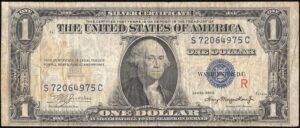
Not every star note is equally attractive to fraudsters. The targets cluster around issues where the star note carries a meaningful premium over the non-star equivalent. The 1969C $100 star notes are heavily targeted because certain Federal Reserve district varieties are genuinely scarce and bring strong premiums in high grade. The 1953 and 1957 $1 Silver Certificate star notes see alteration attempts because low-print examples in uncirculated condition bring several times the value of common non-star examples. Among large-size notes, the 1899 $1 Black Eagle Silver Certificate star notes are among the most faked, given that genuine examples in any grade sell for significant premiums.
Post-2000 series are targeted less frequently for alteration, partly because their security features are better understood and more difficult to replicate convincingly, and partly because the price premiums on modern star notes, while real, are generally more modest in circulated grades.
| Series / Date | Denomination and District | Documented Star Print Run | Rarity |
|---|---|---|---|
| 1995 | $1 Atlanta (F*) | 128,000 | Key Date |
| 2009 | $1 Minneapolis (I*) | 640,000 | Scarce |
| 1969C | $100 San Francisco (L*) | Approx. 512,000 | Scarce |
| 1953A | $1 Silver Certificate (*) | Approx. 7,200,000 | Common |
| 1957 | $1 Silver Certificate (*), low serial | Partial runs, under 1M for some batches | Scarce |
| 1899 | $1 Black Eagle Silver Certificate (*) | Unknown, estimated very low | Rare |
| 1914 | $5 Federal Reserve Note, select banks (*) | Unknown, bank-specific | Rare |
| 1928B | $1 Legal Tender / United States Note (*) | Not applicable, star follows serial | Scarce |
| 1963A | $100 Federal Reserve Note, select districts (*) | Varies by district, some under 640,000 | Scarce |
| 2003A | $1 Atlanta (F*) low print | 1,280,000 (unusually low for era) | Scarce |
The Role of Third-Party Grading in Protection
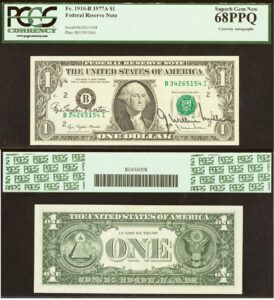
PMG (Paper Money Guaranty) and PCGS Currency both authenticate star notes as part of their grading process. An altered star note submitted to either service will receive a “no grade” or “details” designation with a notation indicating the alteration, and the note will be returned in a holder that clearly flags the problem. For any star note carrying a significant premium, submitting to a third-party grader before purchase, or insisting on buying only already-slabbed examples, is the single most reliable protection available to collectors.
That said, third-party holders are not infallible. Holders can be cracked open and notes swapped, though this is rarer with modern tamper-evident cases. Always verify that the serial number visible on the note inside the holder matches the information printed on the holder’s label. A mismatch is an immediate red flag.
If you’re building a collection of key-date star notes, budget for third-party grading costs from the start. The typical $30 to $75 submission fee is modest insurance against paying a $200 premium for a note that turns out to be a $2 altered common. The grading fee is also a deterrent, since forgers generally prefer to sell into markets where buyers do not send notes for authentication.
Reporting and Protecting the Hobby
When you identify an altered star note, reporting it matters. Document the note thoroughly with photographs, then report it to the dealer or platform where it was found. If the note was represented as genuine and sold at a premium, that potentially constitutes fraud, and the Secret Service maintains jurisdiction over currency alteration under 18 U.S.C. 484, which covers the alteration of genuine currency with intent to defraud. The SPMC (Society of Paper Money Collectors) maintains resources and contacts for collectors who encounter suspected fraud.
Sharing your findings, with photographs and documentation, on collector forums such as the PCGS Currency forum or the Paper Money Forum also helps educate other collectors and creates a documented record that may alert others to a specific fraudster’s technique or source.
Conclusion: Knowledge Is the Best Authentication Tool
The star note fraud problem is not new, and it will not disappear as long as replacement notes carry meaningful premiums over their common counterparts. What changes over time is the sophistication of the alterations and the sophistication of the collectors who detect them. The collectors who consistently avoid being victimized are not necessarily the ones with the most expensive authentication equipment. They are the ones who have handled enough genuine star notes to recognize immediately when something feels, looks, or measures wrong. Handle genuine examples whenever you can. Study the BEP’s printing characteristics. Use production databases. Trust your loupe over your first impression. The star note market rewards careful, educated collectors, and it punishes those who buy on excitement alone.