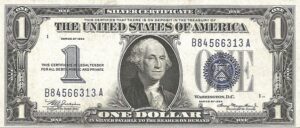
Pick up a Series 1977 $1 Federal Reserve Note and you know exactly what to expect: George Washington centered in his oval frame, the fine crosshatch engraving crisp and dark, every detail of the BEP’s intaglio work rendered in near-photographic precision. Now imagine that same note with a pale, ink-free void eating into Washington’s jaw, his collar, or obliterating the lower half of his portrait entirely. That is the obstruction foldover error, one of the most visually arresting mistake types in the entire spectrum of US error currency, and the Series 1977 print run produced some of the finest documented examples known to collectors today.
Understanding the Series 1977 Production Context
The Series 1977 Federal Reserve Notes were produced at the Bureau of Engraving and Printing’s Washington, DC facility during a transitional era in American currency manufacturing. The BEP was operating high-speed Giori presses and the newer Simultan presses, both of which printed face and back simultaneously or in closely sequenced passes. The signature combination of Treasurer Azie Taylor Morton and Secretary of the Treasury W. Michael Blumenthal places the bulk of 1977 production between late 1977 and 1981, with the later Series 1977A notes bearing the Morton/G. William Miller pairing running into 1979.
During this period, the BEP printed billions of notes annually across all twelve Federal Reserve districts. The sheer volume of production, combined with the high-speed nature of press operations, created conditions where sheet debris, torn paper fragments, folded paper corners, and other foreign material could enter the press path undetected. When that happened on the face printing pass, the results could be spectacular.
The Mechanics of an Obstruction Foldover Error
To understand why obstruction foldovers look the way they do, you need to picture the intaglio printing process. In intaglio printing, the engraved plate is inked, wiped, and then pressed against the paper under enormous pressure. The paper fibers are literally pushed into the recessed lines of the plate to pick up ink. For this to work correctly, the paper must make complete, unobstructed contact with the plate surface.
An obstruction foldover error begins when a piece of foreign material, most commonly a scrap of currency paper or a torn fragment from the sheet being fed, falls onto or folds across a portion of the substrate before or during the impression. The obstruction sits between the plate and the note’s surface, physically preventing ink transfer to the area it covers. When the obstruction is removed after printing (sometimes it stays attached, creating a related but distinct error type), it leaves behind a blank, unprinted zone surrounded by perfectly normal printing.
The term “foldover” in this context is slightly misleading to newcomers. It does not necessarily mean the note itself folded. Rather, it describes the action of the obstructing material having folded over onto the note. In many documented Series 1977 examples, the obstruction was a small triangle or irregular polygon of paper that adhered temporarily during the face printing pass, shielding a portion of the portrait area from contact with the intaglio plate.
When examining a suspected obstruction foldover on a Series 1977 note, look carefully at the boundary between the blank area and the printed zone under magnification. A genuine obstruction error will show a relatively crisp, irregular edge where normal intaglio printing stops abruptly. Fading or gradual thinning of ink along the edge can suggest a different error type, such as a paper fold or an ink starvation issue, which are less desirable to most collectors.
Why the Portrait Area Is the Critical Zone
Obstruction errors can occur anywhere on the note, but examples affecting the portrait area command the highest premiums and the greatest collector attention. The reasoning is both aesthetic and technical. Aesthetically, a blank void cutting through Washington’s face on a $1 note or Lincoln’s portrait on a $5 creates an immediate, startling visual impact that even non-collectors recognize as wrong. The portrait zone is the most densely engraved area of any Federal Reserve Note face, with hundreds of fine lines representing hair, facial features, and the oval frame. A blank section there is impossible to overlook.
Technically, because the portrait area receives the heaviest ink deposit during intaglio printing, it is also the area where the absence of ink is most sharply defined. Obstructions that fall in lightly printed areas like the lower margin or a corner might produce a subtle blank patch that looks almost like a press skip. In the portrait area, the contrast between rich black intaglio ink and bare paper is dramatic and unambiguous.
Documented Series 1977 examples include a $1 Federal Reserve Note from the Richmond district (E) showing a triangular blank area covering approximately 40 percent of Washington’s portrait, with the lower left quadrant of the face completely void of ink. Another well-publicized example is a 1977 $10 note from the Chicago district (G) where an obstruction piece covered Hamilton’s forehead and crown, leaving only the lower face and neck printed. This particular note realized $1,850 in a Heritage Auctions sale in 2019 in PMG VF 25 grade.
Series 1977 $1 notes are the most commonly encountered denomination for obstruction foldover errors simply because $1 notes were printed in the greatest quantities. However, do not overlook the $5 and $10 denominations. Higher-value notes circulated more slowly and were replaced less frequently, meaning a $5 or $10 obstruction error has a statistically better chance of surviving in a higher grade than a $1 note that passed through countless wallets before discovery.
District-by-District Considerations for Series 1977
All twelve Federal Reserve districts produced Series 1977 notes, but error frequency is not evenly distributed, partly because print runs varied significantly by district. The New York (B) and Chicago (G) districts consistently received the largest print orders throughout the 1970s, so the sheer volume of notes coming off those presses naturally produced more raw error notes. Boston (A) and Minneapolis (I) had comparatively smaller print runs, meaning errors from those districts are inherently scarcer.
For the Series 1977 $1 specifically, the Federal Reserve Bank of New York serial number blocks began with B and ran through enormous ranges. A B-block $1 obstruction foldover is relatively findable in the market, perhaps one or two appearing at major auction houses per year. A Minneapolis (I) obstruction foldover affecting the portrait would be genuinely rare, and if one were to surface in a certified holder above PMG Fine 15, it would likely exceed $2,500.
The San Francisco (L) district presents an interesting sub-specialty. Several Series 1977 $20 notes with obstruction errors affecting Jackson’s portrait have appeared in California-based numismatic auctions, suggesting that a batch of error notes may have been released into circulation through a specific regional Federal Reserve Bank routing. Collectors focusing on West Coast currency history often target L-district errors specifically.
Grading Obstruction Foldover Errors: A Different Calculus
Grading error notes requires a slightly different mindset than grading regular circulation currency. For standard notes, grade is almost entirely about wear, folds, and paper quality. For error notes, the severity and visual impact of the error itself becomes part of the valuation equation, even though the official PMG or PCGS grade reflects only the condition of the paper and printing.
A Series 1977 $1 obstruction foldover graded PMG Very Fine 30 will often sell for more than the same error type graded PMG Gem Uncirculated 65 if the VF-30 example has a dramatically larger blank area or a more visually centered obstruction. Collectors call this the “wow factor,” and for obstruction errors, a blank void covering 50 percent of the portrait is simply more impressive than one covering a corner of the note near the Treasury seal.
That said, a truly spectacular obstruction error in a high uncirculated grade is the gold standard. A Series 1977 $20 note with a large portrait-area obstruction in PMG 64 or better could realistically command $3,000 to $4,500 from a serious error note specialist, particularly if the note carries a low serial number or comes from a scarcer district.
Always submit Series 1977 obstruction foldover errors to PMG or PCGS Currency for certification before selling. Raw error notes, even spectacular ones, sell at a steep discount compared to certified examples because buyers cannot verify authenticity without expert examination. Certification also protects against the possibility of a chemically washed note being misrepresented as an error, a practice that unfortunately occurs in the error note market.
Authentication: Real Errors vs. Altered Notes
The obstruction foldover error is one of the more difficult error types to counterfeit convincingly, which is good news for collectors, but it is not impossible to fake. The most common fraudulent method involves chemically bleaching or abrading an area of a genuine note to simulate a blank zone. Under magnification, a genuine obstruction error will show the normal paper fiber texture in the blank area, with no mechanical disturbance of the surface. The ink stops abruptly because it was never deposited, not because it was removed. Chemical bleaching, by contrast, typically leaves a slight sheen, residual toning at the edges of the treated area, or subtle fiber disruption visible under a loupe at 10x magnification.
A second authentication consideration involves the back printing. On a genuine face-side obstruction error, the back of the note should be completely normal. The obstruction only interfered with the face printing pass, so the reverse should show the full, crisp green intaglio printing of the Series 1977 back design without anomaly. If you encounter a note with a blank area on the face and any corresponding irregularity on the back, treat it with significant skepticism and seek expert authentication before purchase.
| Denomination | Federal Reserve District | Est. Known Examples | Rarity |
|---|---|---|---|
| $1 Series 1977 | New York (B) | 12 to 18 certified | Scarce |
| $1 Series 1977 | Chicago (G) | 10 to 15 certified | Scarce |
| $1 Series 1977 | Atlanta (F) | 6 to 9 certified | Scarce |
| $1 Series 1977 | Minneapolis (I) | 2 to 4 certified | Rare |
| $5 Series 1977 | San Francisco (L) | 3 to 5 certified | Rare |
| $10 Series 1977 | Chicago (G) | 4 to 6 certified | Rare |
| $20 Series 1977 | San Francisco (L) | 3 to 5 certified | Rare |
| $20 Series 1977 | Boston (A) | 1 to 2 certified | Key Date |
| $1 Series 1977A | New York (B) | 8 to 12 certified | Scarce |
| $50 Series 1977 | Any District | Fewer than 3 known | Key Date |
Building a Series 1977 Error Note Collection
For collectors specifically targeting the Series 1977 era, obstruction foldover errors fit naturally into a broader error note collection organized by series. A focused collection might include one example each of the obstruction error, a misalignment error, a partial face print, and an inverted back print, all within the 1977 series. This type of thematic approach appeals to both advanced collectors and type collectors who want one representative example of each major error category.
Budget considerations matter here. Entry-level obstruction foldovers on Series 1977 $1 notes in circulated grades (PMG Fine 12 to Very Fine 30) are typically available in the $250 to $600 range at major error note dealers like Lyn Knight Currency Auctions, Stack’s Bowers, or Heritage Auctions. Moving up to uncirculated examples or notes with dramatic portrait-area blanking pushes prices into the $900 to $2,000 corridor for most denominations. The true top-tier pieces, large obstructions in PMG 64 or 65 grades, attract serious competition at auction and regularly exceed $3,000.
One practical strategy for new collectors is to focus initially on $1 denominations from major districts. The relative abundance of B-block and G-block $1 errors keeps prices accessible, and a well-chosen example in VF condition gives you a genuine, certified obstruction foldover for a manageable investment. As your budget and expertise grow, moving toward higher denominations, scarcer districts, and finer grades becomes a natural progression.
Cross-reference any Series 1977 obstruction foldover error you are considering against the PMG or PCGS population reports before buying. These reports list how many notes of a given type and grade have been certified, giving you a clearer picture of true scarcity. A dealer describing a note as “extremely rare” should be supported by a population of five or fewer certified examples. If the population report shows twenty-five certified examples, “scarce” is the more accurate descriptor, and pricing should reflect that.
Conclusion: A Window Into the Printing Floor
Every obstruction foldover error on a Series 1977 Federal Reserve Note is, in a very literal sense, a physical record of a moment on the BEP printing floor when something went wrong. A scrap of paper fell at the wrong time, a machine operator did not catch the anomaly before the sheet completed its press run, and the note made it through quality control, into a Federal Reserve vault, and eventually into circulation. The fact that a collector found it decades later and recognized it for what it is represents a small triumph of numismatic detective work.
For the Series 1977 series specifically, the combination of high production volumes, well-documented signature varieties, and a robust secondary market makes these error notes an ideal specialty for collectors at every level. Whether you are acquiring your first certified error note or adding a key-district example to a comprehensive collection, the obstruction foldover on a 1977 FRN offers historical depth, visual drama, and genuine scarcity in a single piece of currency paper.