
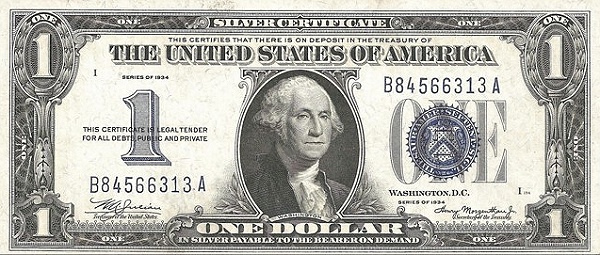
📷 Image source: banknote.ws (World Banknote Gallery). Images are selected by AI to represent the article topic and may not depict the exact note(s) described.
Walk into any major currency show and ask a dealer about the 1934A $1 Silver Certificate experimentals, and you will likely see their eyes light up. These notes occupy a peculiar and beloved corner of the hobby: government-issued currency that was deliberately used as a scientific test subject. The Bureau of Engraving and Printing (BEP) needed to know whether a new, more durable paper stock could hold up against its standard sulfite-based paper under real-world circulation conditions. To find out, they printed two carefully controlled batches of $1 Silver Certificates and sent them into the American economy. The experiment was simple in concept but rich in detail for today’s collectors, and serial numbers are the key to unlocking everything.
Background: Why Did the BEP Run This Experiment?
By the early 1940s, wartime pressures were straining every component of American manufacturing, including paper currency production. The BEP was actively exploring whether an experimental paper containing a higher rag content and different sizing could outlast the standard sulfite-blend paper used in regular Federal Reserve Notes and Silver Certificates. A more durable note would reduce replacement printing costs, ease the burden on the supply chain, and potentially extend the lifespan of currency in circulation. The test was authorized in 1944, and the $1 Silver Certificate was chosen as the test vehicle because of its enormous print runs and near-universal circulation, making it the ideal candidate for gathering statistically meaningful wear data.
The BEP printed 1,184,000 notes on the standard paper stock and designated them with a red capital R suffix appended to the serial number. An equal quantity, another 1,184,000 notes, was printed on the experimental “special” paper and received a red capital S suffix. Both groups carried the standard blue Treasury seal and serial numbers in blue ink that characterized all $1 Silver Certificates of the era, with the familiar Julian and Morgenthau signature combination that had graced Silver Certificates since 1934.
The red R and S suffix letters on these notes are printed in the same ink and style as the serial number itself, not stamped or overprinted separately. Under magnification, both the suffix letter and the numerals should show identical ink density and print quality. A faded, misaligned, or differently colored suffix letter is a red flag for a doctored note or a misidentified regular issue.
Decoding the Serial Number Ranges
The single most reliable way to authenticate and attribute an R or S experimental is by verifying the serial number falls within the documented ranges. Both varieties share the same prefix letter S and suffix letter C in their serial block, meaning all genuine experimentals follow the format: S########C with an additional red R or S appended after the C.
The R variety (standard paper) occupies serials S70884001C through S72068000C. This gives the R group a total print run of exactly 1,184,000 notes. The S variety (special experimental paper) covers serials S73884001C through S75068000C, again totaling 1,184,000 notes. Notice there is a deliberate gap between the two ranges, specifically serials S72068001C through S73884000C. That gap of 1,816,000 serial numbers represents regular 1934A $1 Silver Certificates printed on standard paper with no experimental designation at all. This structural gap was intentional: it prevented any accidental contamination of the experimental sample groups during distribution.
When examining a note you believe may be an experimental, follow this three-step verification process. First, confirm the series designation reads 1934A. Second, check that the prefix is S and the block suffix before the experimental letter is C. Third, confirm the numeral portion of the serial number falls within one of the two documented ranges above. All three conditions must be met simultaneously. A note showing an R or S suffix outside these ranges is not a genuine experimental issue.
When buying an R or S experimental at auction or from a dealer, always request the full serial number in writing before committing to a purchase. Third-party graded examples from PCGS Currency or PMG will typically note the experimental designation on the label, but even then, cross-referencing the serial against the documented ranges yourself is a best practice that has caught errors in the marketplace.
Physical Differences Between R and S Paper Stocks
For modern collectors, distinguishing the paper stocks visually is extremely difficult on circulated examples, and even on uncirculated notes it requires considerable experience. The experimental S paper was described at the time as having a slightly different texture and a marginally crisper feel compared to the standard sulfite-blend paper used for the R notes. Some longtime specialists in this area suggest that high-grade S variety notes exhibit a very slightly different sheen under raking light, but this is a subjective assessment rather than a reliable diagnostic tool.
The practical takeaway is this: do not attempt to attribute an R versus an S variety on paper feel alone. The serial number range is the definitive identifier. Paper characteristics degrade with handling, cleaning, and environmental exposure, making tactile assessment unreliable for anything below gem uncirculated condition. Professional grading services attribute these notes based on serial number ranges combined with visual examination of the suffix letter itself.
Relative Rarity and Market Values
Both the R and S varieties were printed in equal quantities of 1,184,000 notes each, suggesting they should appear with equal frequency in the collector market. In practice, however, the S variety (experimental paper) is consistently more sought after and commands a modest premium over the R variety at all grade levels. The conventional wisdom is that the S paper, being an experimental formulation, may have survived in slightly smaller numbers due to different wear characteristics, though this has never been conclusively documented. The more likely explanation is simply collector psychology: the word “experimental” attached to the S paper stock makes it feel more exotic, driving demand and therefore price.
In circulated grades such as Very Fine 20 to Extremely Fine 45, R variety notes typically trade in the $75 to $150 range, while S variety notes of equivalent grade often bring $100 to $200. In gem uncirculated condition graded MS-65 or higher by PMG or PCGS Currency, both varieties become genuinely scarce, with examples sometimes exceeding $500 to $800 at major auction houses. Star note equivalents within the experimental ranges do not exist as a documented category, since the experimental print runs were too controlled and limited to include replacement notes.
If you are building a type set of $1 Silver Certificates, acquiring both the R and the S variety as a matched pair from the same serial number block creates a compelling display piece that tells the full story of the experiment. Look for examples with sequential or near-sequential serials from the same print run for maximum exhibit appeal.
The Role of Julian and Morgenthau Signatures
All genuine 1934A $1 Silver Certificate experimentals bear the signature combination of Register of the Treasury William A. Julian and Secretary of the Treasury Henry Morgenthau Jr. This pairing appeared on Silver Certificates from 1934 through 1945, making it one of the longer-running signature combinations of the small-size era. Julian served as Register from 1942 to 1949, and Morgenthau’s tenure as Treasury Secretary ran from 1934 to 1945, meaning their signatures appear across the full run of Series 1934, 1934A, 1934B, and 1934C Silver Certificates. Collectors should be aware that the signature combination alone cannot narrow the series designation: you must confirm the series date printed on the note reads specifically 1934A.
Grading Considerations Specific to the Experimentals
Because these notes entered circulation as part of an experiment designed to measure wear, a significant portion of the surviving population shows circulated grades. The BEP intentionally distributed these notes into the normal banking system rather than holding them for controlled examination, meaning they passed through many hands before being retrieved and studied. Uncirculated examples exist because some were removed from bank bundles before release or were saved as novelties by individuals who noticed the unusual suffix letters. However, the overall availability of gem uncirculated examples is lower than for many other 1934A Silver Certificate varieties that were never specifically tracked for wear.
When grading these notes, pay particular attention to the corner folds, which on genuine circulated examples tend to show natural softening consistent with age. Artificially pressed examples occasionally appear in the market, particularly in the Very Fine to Extremely Fine range where the premium for an upgrade is most tempting. Both PMG and PCGS Currency will note any evidence of pressing or cleaning on their certification inserts, which is one strong argument for buying third-party certified examples of this specialty item.
The blue Treasury seal on all 1934A Silver Certificates should show crisp, even ink with no bleeding into the surrounding paper fibers on high-grade examples. On the experimentals specifically, compare the seal color and print quality to a known genuine 1934A regular issue: both should be indistinguishable in terms of printing, since the only difference is the paper stock and the suffix letter.
| Series / Variety | Suffix Letter | Print Run | Rarity |
|---|---|---|---|
| 1934A $1 SC Regular Issue | None | Hundreds of millions | Common |
| 1934A $1 SC Experimental R | Red R (standard paper) | 1,184,000 | Scarce |
| 1934A $1 SC Experimental S | Red S (special paper) | 1,184,000 | Scarce |
| 1934A $1 SC Experimental R, CU-65+ | Red R, Gem Uncirculated | Est. very few surviving | Rare |
| 1934A $1 SC Experimental S, CU-65+ | Red S, Gem Uncirculated | Est. very few surviving | Rare |
| 1934A $1 SC Experimental R, Matched Pair | R and S consecutive serials | Incidental survivors | Key Date |
| 1934A $1 SC Regular (outside gap range) | None | Large quantity | Common |
| 1934A $1 SC in PMG/PCGS holder, XF45+ | R or S, certified | Several hundred certified | Scarce |
Why These Notes Still Matter to Collectors Today
The 1934A experimental R and S Silver Certificates occupy a unique niche because they are simultaneously common enough to be attainable and rare enough to feel special. Unlike many key-date rarities that require a five-figure budget, a circulated example of either variety can be acquired for under $200, making these notes genuinely accessible to intermediate collectors. Yet they carry a documented historical story, a connection to wartime logistics, government experimentation, and the practical science of currency durability, that elevates them far above a standard type note.
For exhibitors, these notes are nearly perfect: they have a clear narrative, visual distinction from regular issues via the suffix letter, supporting documentary evidence from BEP production records, and enough market depth that both high and low grade examples appear regularly at major shows and auction sales. The Friedberg catalog designates these as Fr. 1609N (R variety) and Fr. 1609O (S variety), giving them official catalog status that anchors their place in the reference literature.
Whether you are assembling a complete type set of $1 Silver Certificates, building a thematic collection around BEP experimental issues, or simply hunting for an interesting conversation piece that most non-specialists will never recognize at face value, the 1934A R and S experimentals deliver extraordinary depth for a modest investment. Know your serial number ranges, verify your suffix letters, and let the history speak for itself.