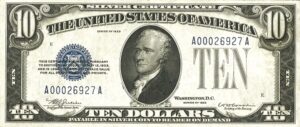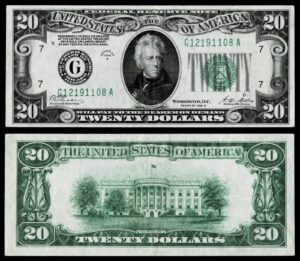
Pull a Series 1953A $5 Silver Certificate out of an old collection and it looks, at first glance, like just another mid-century blue-seal note. Abraham Lincoln stares back from the obverse, the Lincoln Memorial anchors the reverse, and the blue Treasury seal signals its silver redemption heritage. But spend more time with this series and a clearer picture emerges: the 1953A is quietly one of the more condition-sensitive and variety-rich issues of the entire 1950s silver certificate run, with star notes that rank among the scarcest small-size $5 silver certificates of the postwar era.
Historical Context: The Silver Certificate Twilight Years
By the time the Bureau of Engraving and Printing began producing Series 1953A notes, the silver certificate as a currency class was already living on borrowed time. Congress had authorized silver certificates under the Silver Purchase Act of 1934, and for two decades these blue-seal notes circulated alongside Federal Reserve Notes as a parallel currency backed by silver dollars on deposit with the U.S. Treasury. The 1953 base series and its 1953A, 1953B, and 1953C successors would become the final chapter of small-size $5 silver certificate production, with the last issue (1953C) delivered before silver certificates were finally phased out by executive order in 1964 and the redemption window closed in 1968.
The Series 1953A designation indicates a change in the Treasurer of the United States signature. The base 1953 series carried the signatures of Ivy Baker Priest as Treasurer and George M. Humphrey as Secretary of the Treasury. When Robert B. Anderson replaced Humphrey as Secretary in 1957, the signature combination changed and the 1953A designation was applied. This Priest-Anderson pairing is the defining characteristic of the 1953A and the starting point for any variety study.
The Priest-Anderson Signature Combination
Ivy Baker Priest served as Treasurer of the United States from January 1953 to April 1961, making her signature one of the most frequently seen on mid-1950s currency of all types. Robert B. Anderson served as Secretary of the Treasury from July 1957 to January 1961. Their combined tenure covers the production window for Series 1953A notes across all denominations. On the $5 silver certificate, the Priest-Anderson pairing appears to the left and right of the large portrait, printed in black ink as part of the engraved face plate.
Collectors should be aware that both signatures are engraved and thus appear with exceptional crispness on high-grade examples. On circulated notes, the fine lettering within the signatures is often the first detail to show wear, making it a useful diagnostic when assessing a note’s grade. An Extremely Fine (EF-40) 1953A will still show full signature clarity; a Very Fine (VF-20) example will typically show some softness in the finer engraving strokes.
When evaluating a 1953A $5 silver certificate, examine the signature lettering under a loupe at 5x magnification. Full, sharp letterforms in both the Priest and Anderson signatures are consistent with a Gem Uncirculated (MS-65 or higher) designation from PCGS Currency or PMG. Any softening or loss of fine detail typically places the note at EF-45 or below.
Regular Issue: Print Runs and Serial Number Ranges
The Bureau of Engraving and Printing printed approximately 90.0 million Series 1953A $5 silver certificates across multiple production runs. Serial numbers for regular issues begin at A00000001A and continue through the alphabet prefix system, reaching into the C-block prefix range. Notes are printed on 18-subject sheets (the standard for small-size currency at the time) using wet-ink intaglio printing for the face and letterpress for the back.
The face plate numbers and back plate numbers, visible as small numerals in the lower right corner of the face and the upper right corner of the back, are a useful reference for advanced collectors. Multiple face plate varieties exist for the 1953A, and while none are dramatically rare in circulated grades, certain low-numbered face plates command modest premiums in uncirculated condition among specialists. The standard catalog reference is the Friedberg numbering system, where the Series 1953A $5 silver certificate carries the catalog designation Friedberg 1656 for regular issues.
Star Notes: The Real Prize
Star notes, those replacement notes with a star suffix (or in earlier eras a star prefix) substituted for notes destroyed during production quality control, are the headline attraction for 1953A collectors. The Series 1953A $5 star note (Friedberg 1656*) was printed in a total of approximately 2.16 million notes, a figure that sounds substantial until you consider the attrition rate from circulation, improper storage, and the fact that the majority of surviving examples are well-worn.
The star notes carry serial numbers in the format A00000001* through A02160000*, using the single letter prefix and star suffix format standard for small-size silver certificates of the era. Finding a 1953A $5 star note in circulated grades is not especially difficult; a VF example might sell for $35 to $60 in today’s market. Finding one in Choice Uncirculated (CU-63) or better is a different matter entirely. PMG and PCGS Currency population reports consistently show fewer than 50 examples graded 64 or higher across both services combined, making a gem example genuinely scarce by any numismatic standard.
When searching for 1953A $5 star notes in dealer inventory or at currency shows, prioritize paper quality over superficial appearance. Many examples were lightly folded or corner-dipped but otherwise retain strong color, embossing, and bright inks. A note with one or two folds but exceptional paper quality and no stains will often grade higher and be more desirable than a flat example with dull, washed-out color.
Why This Series Is Scarcer Than It Appears
The 1953A suffers from what experienced collectors sometimes call the “common-looking trap.” Because the design is familiar, the blue seal is widely recognized, and circulated examples are genuinely easy to find, the series gets lumped in with the plentiful 1953 base issue and the 1953B in casual assessments of availability. The reality is more nuanced.
First, the 1953A’s production window was relatively brief. The series was produced primarily between late 1957 and 1959, a narrower window than either the base 1953 or the 1953B. Second, the 1953A was circulating at the tail end of the silver certificate era, meaning many notes entered the market during the redemption rush of the early 1960s and were subsequently redeemed for silver and destroyed. Third, the collector base for high-grade examples of this series has grown considerably since the early 2000s, outpacing the supply of certified gem examples and quietly driving prices upward at major auction houses.
For context: a Series 1953 base $5 silver certificate in PMG 65 EPQ (Exceptional Paper Quality) typically sells for $85 to $120. A comparable 1953A in the same grade can reach $150 to $225 at major auction, and a star note in PMG 65 EPQ has realized over $400 at Heritage Auctions in recent years. The price differential reflects real scarcity that casual survey of dealer stock does not capture.
Comparison With the Broader 1953 Silver Certificate Family
The $5 silver certificate of the 1953 era spans four series: 1953 (Friedberg 1654, signatures Priest-Humphrey), 1953A (Friedberg 1656, Priest-Anderson), 1953B (Friedberg 1657, Smith-Dillon), and 1953C (Friedberg 1658, Granahan-Dillon). Each has its own scarcity profile in high grade. The 1953C is frequently cited as the condition rarity of the group, with a relatively low print run and the latest production date, meaning it circulated during the most aggressive redemption period. But the 1953A sits firmly in second place for condition rarity, ahead of both the common 1953 base and the 1953B.
The 1953B, by contrast, had a substantially higher print run (roughly 133 million regular-issue notes) and correspondingly more survivors in all grades. A collector assembling a complete set of the four 1953 series $5 silver certificates in gem uncirculated condition will consistently find the 1953A the second most difficult note to source after the 1953C.
If you are building a type set of 1953-era $5 silver certificates, consider budgeting separately for the 1953A and 1953C in gem condition. These two notes routinely sell for two to three times what the 1953 base and 1953B command in equivalent grades. Purchasing them first, before completing the “easier” issues, ensures you do not exhaust your budget before addressing the true scarcities.
Grading Considerations and Common Problems
Several specific grading issues recur with 1953A $5 silver certificates. The blue seal, printed by letterpress over the engraved face, is prone to ink smearing and offsetting in lower-quality production runs. On high-grade examples, the seal should show clean, sharp edges with no ink bleeding into the surrounding engraved field. Smeared or uneven seal printing is a production flaw, not a post-print defect, and does not necessarily disqualify a note from a high numerical grade, but it can affect the EPQ designation from grading services.
Paper quality is another consistent concern. The 1953A notes used the standard cotton-linen BEP currency paper of the era, which is durable but susceptible to corner rounding and vertical fold lines from wallet or cash register storage. The most common circulation pattern produces a single center fold (the note folded in half for a wallet) plus light handling wear at the corners. A note with only the center fold and otherwise fresh paper will typically grade Fine-12 to Very Fine-20, which is respectable for a circulated example but well below the gem threshold that drives premium values.
Cleaning is a persistent problem in this series. Because lightly circulated examples can look quite attractive with their bold blue seals and crisp Lincoln portrait, the temptation to clean borderline notes has historically been high. Artificial brightening typically leaves a slightly glossy or “pressed” look to the paper surface that trained eyes and grading service experts identify readily. Always buy certified examples from PCGS Currency or PMG when paying above catalog value for grade, especially for star notes.
| Series / Friedberg No. | Signatures | Approx. Print Run | Rarity (Gem CU) |
|---|---|---|---|
| 1953 / Fr. 1654 | Priest-Humphrey | ~126.0 million | Common |
| 1953 Star / Fr. 1654* | Priest-Humphrey | ~3.24 million | Scarce |
| 1953A / Fr. 1656 | Priest-Anderson | ~90.0 million | Scarce |
| 1953A Star / Fr. 1656* | Priest-Anderson | ~2.16 million | Rare |
| 1953B / Fr. 1657 | Smith-Dillon | ~133.0 million | Common |
| 1953B Star / Fr. 1657* | Smith-Dillon | ~3.24 million | Scarce |
| 1953C / Fr. 1658 | Granahan-Dillon | ~47.2 million | Rare |
| 1953C Star / Fr. 1658* | Granahan-Dillon | ~1.08 million | Key Date |
Current Market Values and Where to Find Them
As of recent auction records, here is a practical value guide for the Series 1953A $5 silver certificate. Regular issues in Good-4 to Fine-15 condition typically trade between $7 and $18 in dealer and show inventory. Very Fine-20 to Extremely Fine-40 examples range from $20 to $45 depending on embossing, color vibrancy, and centering. Choice Uncirculated (CU-63) notes carry values of roughly $65 to $95. Gem examples graded PMG 65 EPQ or PCGS 65 PPQ have realized $150 to $225 in competitive auction settings. Star notes carry a premium at every grade level, with VF examples at $35 to $75, CU at $120 to $180, and gem examples potentially exceeding $400 when eye appeal is exceptional.
Heritage Auctions, Stack’s Bowers, and Lyn Knight Currency Auctions all handle 1953A examples regularly. For raw (uncertified) notes, the annual Memphis International Paper Money Show and regional currency club auctions remain excellent sources, particularly for moderately circulated examples where the premium for third-party grading may not be economically justified relative to the note’s value.
For 1953A $5 star notes valued above $100, third-party grading from PMG or PCGS Currency is strongly recommended before purchase. The population of certified examples is small enough that each graded note is a meaningful data point for pricing, and the certification protects against cleaned or repaired notes that can be difficult to detect in lower-powered examinations. Look specifically for the EPQ or PPQ qualifier, which confirms the paper has not been chemically treated or artificially pressed.
Conclusion: A Series Worth Taking Seriously
The Series 1953A $5 silver certificate occupies a sweet spot in the currency collecting market: affordable enough that building a quality set remains within reach for collectors at modest budgets, yet scarce enough in gem condition and star note form that serious upgrading requires genuine effort and knowledge. Its Priest-Anderson signature combination, blue Treasury seal, and position at the tail end of the silver certificate era give it real historical resonance beyond its face value and catalog number.
Whether you are a new collector picking up your first blue-seal $5 or an advanced numismatist rounding out a complete 1953-series type set, the 1953A rewards careful attention to grade, paper quality, and variety. The notes that look ordinary in a dealer’s stock can, with the right eye, reveal themselves as the scarcities they truly are.