A Date Stamped in History
Pick up a Series 1882 $20 National Bank Note Date Back and you are holding a relic of one of the most consequential transitional moments in American banking. The bold overprinted legend “1882-1908” on the reverse of these large-size notes is not decorative. It is a calendar of accountability, marking the precise window during which a national bank’s second charter was valid and its currency remained redeemable. For collectors, that date span transforms what might otherwise appear to be a generic territorial-era banknote into a precisely datable artifact with a rich institutional biography attached to every serial number.
The National Banking System and the Charter Framework
To appreciate why the Date Back exists at all, you need to understand the legislative scaffolding that produced it. The National Bank Act of 1863, revised and strengthened in 1864, allowed federally chartered banks to issue currency backed by US government bonds deposited with the Comptroller of the Currency. These charters were issued in 20-year increments. When a first-charter bank approached its expiration date, it had the option of renewing under a second charter. Congress set that second charter period to run from 1882 onward, and the legislation extended currency-issuing authority through 1908, hence the printed dates on the reverse.
The Series 1882 National Bank Notes appear in three distinct reverse types, and understanding which reverse you have is the first critical skill a collector must develop:
- Brown Backs (Fr. 519–547 for various denominations): The earliest second-charter notes, featuring the bank charter number printed in large brown numerals on the reverse. These were issued beginning in 1882.
- Date Backs (Fr. 548–565 for various denominations): Introduced around 1908–1909, these replaced the Brown Back design with the overprinted date span “1882-1908” centered on the reverse, flanked by green geometric lathe work.
- Value Backs (Fr. 566–578 for various denominations): The final second-charter reverse type, replacing the date legend with the denomination spelled out in large letters (e.g., “TWENTY DOLLARS”).
The $20 Date Back specifically carries Friedberg catalog numbers Fr. 554 through Fr. 565, with each number corresponding to a different Treasury signature combination found on the face of the note.
Anatomy of the $20 Date Back Note
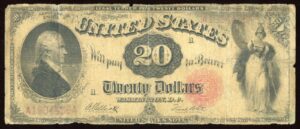
The face design of the Series 1882 $20 presents a portrait of James Garfield, the 20th President, at the left, alongside a vignette of the Allegorical figure of Columbia at the right. The brown Treasury seal appears to the right of center, and the charter number of the issuing bank is printed in large red numerals on the face. The issuing bank’s name, city, and state are also prominently displayed.
On the reverse, the Date Back’s defining feature is immediately visible: the brown overprinted text “1882-1908” arcs across the center of an intricate green engraved background. This reverse was designed at the Bureau of Engraving and Printing and replaced the Brown Back reverse when Congress extended second-charter banking authority beyond the original 1908 sunset date. The irony beloved by historians is that the “1908” end date was itself extended, meaning these notes were issued well past 1908, sometimes as late as the early 1920s, even as the printed date suggested otherwise.
When examining a Series 1882 $20 Date Back, always confirm which of the three reverse types you have before purchasing. Brown Backs and Value Backs are sometimes confused with Date Backs by newer collectors. The definitive identifier is the overprinted “1882-1908” legend on the reverse, printed in brown ink over the green geometric lathe-work background. No other second-charter type shares this exact feature.
Signature Combinations: The Key to Friedberg Numbering
The Fr. 554–565 range for the $20 Date Back is organized by the Treasury signature combinations printed on the face. These combinations reflect the Treasurer of the United States and the Register of the Treasury (or later the Secretary of the Treasury) who were in office when the note plates were certified. The major signature pairings for the $20 Date Back include:
- Fr. 554: Lyons-Roberts
- Fr. 555: Lyons-Treat
- Fr. 556: Vernon-Treat
- Fr. 557: Vernon-McClung
- Fr. 558: Napier-McClung
- Fr. 559: Napier-Thompson
- Fr. 560: Napier-Burke
- Fr. 561: Parker-Burke
- Fr. 562: Teehee-Burke
- Fr. 563: Elliott-Burke
- Fr. 564: Elliott-White
- Fr. 565: Speelman-White
Each of these pairings spans a specific window of time, allowing a knowledgeable collector to narrow the approximate printing date of any given note to within a few years purely by reading the signature combination. The Lyons-Roberts pairing, for example, was used from approximately 1898 to 1905, while Speelman-White notes date from 1921 to 1922, confirming that Date Back issuance continued long after the “1908” overprint might suggest.
Why the Issuing Bank Matters as Much as the Series
National Bank Notes are unique among US currency types in that every note is attributed to a specific chartered bank. The collector market for second-charter notes is therefore driven not just by series and signature but by the issuing institution, its state, and its charter number. A $20 Date Back from a small-town bank in Wyoming with a total issue of fewer than 100 notes of all types will command dramatically more than an identical-looking note from a large Chicago or New York bank that may have issued tens of thousands of sheets.
The Comptroller of the Currency’s records, preserved in the National Archives and extensively cataloged by researchers including Don C. Kelly (whose National Bank Notes reference volumes remain the standard), document the total note issuance by denomination and type for virtually every chartered bank. Collectors use these records to establish rarity rankings. A bank that issued only one or two sheets of $20 Date Back notes (each sheet containing four notes) may be represented today by a single known survivor. These “one-of-a-kind” territorial and small-state rarities routinely sell for five figures regardless of grade.
Before bidding on any Series 1882 $20 Date Back, research the issuing bank’s total reported circulation figures in Kelly’s National Bank Notes or the online resources at the Society of Paper Money Collectors (SPMC). A note graded VG-10 from a bank with fewer than 500 total notes outstanding may be worth more than a Fine-15 example from a major metropolitan institution with a heavy issuance history.
Geographic Rarity: Territories and Small States
The geographic dimension of Date Back collecting is one of its great pleasures. National banks were chartered across all 48 contiguous states and in several territories, including Arizona, New Mexico, Hawaii (then a territory), Indian Territory, and Oklahoma Territory. Notes from territorial banks carry a premium because the banking window in those regions was narrow and total issuances were small. A $20 Date Back from a bank in Indian Territory (pre-1907 Oklahoma statehood) is among the most sought-after notes in the entire National Bank Note series.
State-level rarity rankings also matter. Nevada, for instance, had very few active national banks during the second charter period, and surviving $20 Date Backs from Nevada institutions are genuinely rare. By contrast, Pennsylvania, Ohio, and New York had hundreds of chartered banks, and Date Back survivors from those states are far more accessible, though still not common by modern large-size standards.
Grading Considerations Specific to the 1882 Date Back
Like all large-size National Bank Notes, the Series 1882 $20 Date Back presents specific grading challenges. The brown ink of the date overprint on the reverse is particularly susceptible to fading and oxidation. On notes that circulated heavily, the “1882-1908” legend may appear faint or uneven. Grading services such as PMG and PCGS Currency evaluate this fading as part of the overall note condition, and a note with a weak or partially legible date overprint will typically receive a net grade or a qualifier such as “ink burn” or “staining” even if the paper body is otherwise strong.
Red fiber paper was used in BEP production during this era, and the presence or absence of visible red security fibers is a useful authentication point. Counterfeits of high-grade Date Backs do exist, though they are relatively uncommon compared to Federal Reserve Note counterfeiting. Certified holders from PMG or PCGS Currency provide meaningful protection against altered or cleaned notes, which were historically treated with chemicals to simulate higher grades.
When evaluating the reverse of a Series 1882 $20 Date Back in person, tilt the note under a single-source light at a low angle. This raking light technique will reveal paper folds, erasure marks, and surface cleaning that might be invisible under direct overhead illumination. The green lathe-work background on the Date Back reverse is especially revealing under raking light because any surface disturbance disrupts the fine line engraving.
Market Values: What Are These Notes Worth Today?
The Date Back $20 is not a note you will find in a dealer’s bargain bin. Even common-state examples in well-circulated grades represent meaningful collector investments. In VG condition (grades 8 to 10), a $20 Date Back from a large-state bank with a moderate issuance history might trade in the $400 to $800 range at major auction houses such as Heritage Auctions or Stack’s Bowers. Fine to Very Fine examples (grades 15 to 35) from the same bank category typically realize $900 to $2,500.
Rare-state and territorial examples operate in an entirely different market tier. A $20 Date Back from an Arizona Territory bank in any grade above Poor will routinely exceed $5,000 at auction, and exceptional examples have hammered above $15,000. The all-time auction records for specific bank rarities among Date Backs are held by single-survivor notes from small-town western banks, where documentation confirms that only a handful of sheets were ever printed.
Signature combinations also affect value independent of bank rarity. The Napier-Thompson pairing (Fr. 559) is one of the scarcest across all denominations because Thompson served only a very short tenure as Register, from November 1909 to March 1910. Fewer banks had their plates certified and notes issued during that narrow window, making Fr. 559 examples legitimately scarce in the marketplace.
| Friedberg No. | Signature Combination | Approx. Years Active | Rarity |
|---|---|---|---|
| Fr. 554 | Lyons-Roberts | 1898-1905 | Scarce |
| Fr. 555 | Lyons-Treat | 1905-1906 | Scarce |
| Fr. 556 | Vernon-Treat | 1906-1909 | Common |
| Fr. 557 | Vernon-McClung | 1909-1910 | Common |
| Fr. 558 | Napier-McClung | 1910-1912 | Common |
| Fr. 559 | Napier-Thompson | Nov 1909-Mar 1910 | Key Date |
| Fr. 560 | Napier-Burke | 1914-1915 | Scarce |
| Fr. 561 | Parker-Burke | 1915-1919 | Common |
| Fr. 562 | Teehee-Burke | 1917-1921 | Scarce |
| Fr. 563 | Elliott-Burke | 1919-1921 | Rare |
| Fr. 564 | Elliott-White | 1921-1922 | Rare |
| Fr. 565 | Speelman-White | 1921-1922 | Rare |
Building a Date Back Collection: Entry Points and Focus Areas
For a new collector drawn to this series, the most practical entry strategy is geographic focus. Choosing your home state or a state with personal significance allows you to develop deep knowledge of the specific banks, charter histories, and issuance figures within a manageable universe. State-focused collections of National Bank Notes have a long tradition in the hobby, and the annual conventions of the SPMC and the Professional Currency Dealers Association (PCDA) regularly feature dealers who specialize in specific states.
A second approach is to collect across denominations within a single signature combination, building a type set that illustrates how the Date Back design appeared on the $10, $20, $50, and $100 denominations under a single Treasury administration. This approach rewards patience more than deep pockets, since the larger denominations in rare signature combinations can be genuinely elusive.
For advanced collectors, assembling a complete set of all twelve Friedberg numbers in the $20 Date Back range (Fr. 554 through Fr. 565) represents a serious long-term project. The Fr. 563, Fr. 564, and Fr. 565 notes, with their late-era signature combinations and narrow issuance windows, may take years to locate in collectible grades. Population reports from PMG and PCGS Currency show that certified examples of Fr. 563 and Fr. 564 in grades above Fine are genuinely rare, with some signature-specific varieties having fewer than a dozen certified survivors across all issuing banks combined.
Register with the major auction house mailing lists at Heritage Auctions, Stack’s Bowers, and Lyn Knight Currency Auctions if you are pursuing scarce Friedberg numbers in the $20 Date Back series. Heritage in particular maintains a searchable online archive of realized prices going back many years, which is an invaluable free research tool for establishing fair market value before you bid or negotiate a private purchase.
The Legacy of the Date Back in Currency History
The Series 1882 $20 Date Back represents something genuinely unusual in the history of American currency: a note whose reverse was designed not to celebrate the nation or its institutions but to communicate a legal fact about charter duration to the public and to bank examiners. The date overprint was practical bureaucracy, converted by time and scarcity into one of the most collectible large-size note categories in existence.
The transition from Brown Back to Date Back to Value Back within the second charter period also illustrates how the Bureau of Engraving and Printing responded to evolving legislative realities. When Congress extended the second-charter window, the BEP could not simply leave the old Brown Back design in circulation without modification. The Date Back overprint was an economical solution, using existing note stocks and adding a new reverse element that communicated the extended authority without requiring an entirely new engraved plate. This kind of adaptive design decision, made under the pressures of congressional deadlines and banking regulations, is exactly what makes the study of National Bank Notes so rewarding for collectors who appreciate the intersection of history, law, and art.
Whether you are examining your first Series 1882 $20 or completing the final Fr. 565 to finish a twelve-note signature set, these notes repay close attention. The “1882-1908” overprint is never just a date. It is a compressed biography of the institution that printed it, the administration that authorized it, and the community that spent it.