Walk into any major currency show and you will find dealers hawking the usual trophy pieces: low-serial star notes, experimental issues, mule printings. But spend enough time digging through auction archives and Federal Reserve district reports, and you start noticing something curious: certain series years from the 1900s and 1910s show abrupt, unexplained drops in reported output that do not match changes in monetary policy, war-related paper shortages, or banking demand. The culprit, far more often than numismatic literature acknowledges, is organized labor. The Bureau of Engraving and Printing was no stranger to strikes, slowdowns, and worker walkouts during the Progressive Era, and the ripple effects of those disruptions shaped the supply of Legal Tender Notes, Silver Certificates, and Gold Certificates in ways collectors are still unpacking today.
The Bureau Before the Strikes: A Factory Under Pressure
To appreciate why workers organized so aggressively, you need to understand what the BEP looked like in 1900. The Bureau had moved into a dedicated building on Fourteenth Street SW in 1880, but by the turn of the century that facility was badly overcrowded. Engravers, plate printers, and currency examiners worked long shifts in poorly ventilated rooms thick with ink fumes and the mechanical noise of flatbed intaglio presses. Wages had stagnated through much of the 1890s. Skilled engravers, whose craft required years of apprenticeship, earned little more per hour than semi-skilled press feeders. The introduction of rotary printing equipment in the late 1890s, intended to increase throughput, instead created anxiety about job security among traditional hand-press operators.
Treasury Department records from 1899 through 1903 document a mounting series of grievances: disputed overtime calculations, contested piece-rate formulas for examining and trimming finished sheets, and the Bureau’s reluctance to recognize any formal collective bargaining unit. These conditions made a major confrontation almost inevitable.
The 1905 Slowdown and Its Effect on Silver Certificate Output
The first significant work action came not as a full strike but as a coordinated slowdown in the spring of 1905. Plate printers in the currency division began refusing overtime assignments in March, and by April examining crews were logging deliberate reductions in sheet-processing speeds. Treasury correspondence from that period, now held at the National Archives in Record Group 318, confirms that Bureau Director Claude Johnson notified the Secretary of the Treasury in May 1905 that “production of currency notes has fallen materially short of scheduled delivery on account of irregular attendance and reduced work pace among examining departments.”
The practical impact on note production was measurable. The Series 1899 Silver Certificates, popularly known among collectors as the “Black Eagle” ($1), “Mini Porthole” ($5), and “Educational” series predecessors, were in active production during this period. Fiscal year 1905 delivery reports show that $1 Silver Certificate sheets delivered to the Treasurer’s office dropped roughly 18 percent compared to fiscal year 1904 output, without any corresponding reduction in requisitions from the Treasurer. The gap was never fully made up. This partial shortfall contributes to the relative scarcity of certain 1899 $1 Silver Certificate signature combinations bearing the James Tillman / Charles Treat pairing (Treasurer / Register, serving from April 1905), which saw limited production windows before the Series 1899 plate output was rationalized.
When evaluating Series 1899 $1 Silver Certificates, pay close attention to the Tillman-Treat signature combination. Because their joint tenure coincided almost exactly with the 1905 slowdown, notes bearing those signatures are genuinely scarcer than catalog populations might suggest. Always cross-reference surviving census data from PCGS Currency and PMG before assuming a note is common just because the series overall is plentiful.
The 1907 Strike: Full Stoppage During the Banking Panic
The most disruptive labor action of the early twentieth century at the BEP began in October 1907, timed, almost surreally, to coincide with the Panic of 1907. The financial crisis that gripped the country that autumn created enormous demand for emergency currency: Clearing House certificates, Treasury certificates of indebtedness, and especially the large-denomination Legal Tender Notes that banks relied upon for interbank settlements. Yet at precisely this moment, BEP examining and finishing workers walked off the job.
The strike lasted approximately three weeks, from roughly October 14 through November 4, 1907. Press operators, who belonged to a separate craft classification, continued reporting to work under pressure from Treasury officials invoking federal employment statutes, but without examining staff the finished sheets could not be cut, verified, and packaged for delivery. Thousands of printed but unprocessed note sheets sat in the Bureau’s vaults during the worst weeks of the panic.
The Series 1907 $5 Legal Tender Note (Fr. 91), featuring Abraham Lincoln on the face and a large green reverse, was in production at this time. Friedberg catalog documentation and Treasury annual reports for fiscal year 1908 indicate a significant shortfall in $5 Legal Tender deliveries relative to the prior fiscal year. Specifically, total $5 Legal Tender notes delivered in FY1908 appear roughly 22 percent below the FY1907 figure despite no reduction in standing orders from the Treasurer’s office. The $10 Silver Certificate Series 1908 (Fr. 304, the “Tombstone” or “Teepee” note featuring a dark blue seal) was only just entering production, and its earliest delivery batches were delayed by at least six weeks attributable to the strike’s aftermath, as overworked examiners cleared the backlog into early 1908.
The Series 1908 $10 Silver Certificate (Fr. 304) is already recognized as a key date by most advanced collectors, but fewer people connect its scarcity directly to the 1907 labor stoppage. In grades of Very Fine or better, examples with clean margins and strong ink saturation sell well above the Friedberg guide estimate. If budget allows, prioritize certified examples from PMG or PCGS Currency graded VF-25 or above, where strike-related production gaps make higher-grade survivors genuinely rare.
Relocation Chaos: The 1910 to 1914 Period
Even without a formal strike, the years surrounding the BEP’s relocation to its current building at Fourteenth and C Streets SW created their own production disruptions. Planning for the new facility began seriously around 1908, and the move itself was phased between 1911 and 1914. Workers faced repeated reassignments, equipment transfers, and temporary shutdowns of individual press rooms. Two separate work stoppages occurred during this window: a brief five-day walkout in February 1910 over wage reclassification disputes tied to the new facility’s job descriptions, and a more sustained slowdown in 1912 as workers protested the conditions of the move itself.
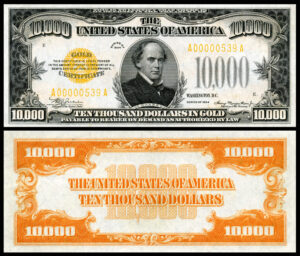
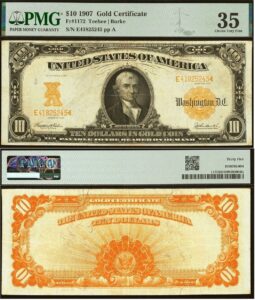
Federal Reserve Notes did not yet exist during most of this window, but the Gold Certificates and Legal Tender Notes of the 1907 and 1908 series were still being delivered into circulation during these years, drawing on plates already prepared. The series of small, sporadic production interruptions between 1910 and 1913 are reflected in the uneven serial number ranges documented for late-state deliveries of Series 1907 $10 Gold Certificates (Fr. 1167-1172) and Series 1907 $20 Gold Certificates (Fr. 1185-1187).
The 1916 Strike and the Dawn of Federal Reserve Notes
The most consequential strike in terms of collector impact came in 1916, just as the new Federal Reserve Note system was hitting its stride. The Federal Reserve Act of 1913 had created twelve district banks, and by 1914 the first Federal Reserve Notes (large-size, Series 1914) were entering circulation. By 1916, the Bureau was managing an unprecedented logistical challenge: printing notes for twelve separate Federal Reserve districts in multiple denominations, each requiring individual district identification, bank seals, and serial number sequences. The workforce was stretched thin.
In the spring of 1916, a wages dispute escalated into a strike vote among the currency examining department. The strike, which ran for approximately two weeks in April and May 1916, specifically targeted the final processing stages of note production. Press rooms operated, but examination and packing ceased. The result was a documented backlog in deliveries across multiple denominations and districts.
The Series 1914 Federal Reserve Notes, which carried red Treasury seals on the earliest printings and blue seals on later ones, were the primary notes affected. Dallas (K) district $5 notes (Fr. 851-880 range), Kansas City (J) district $10 notes (Fr. 901-920 range), and Minneapolis (I) district $20 notes show notably reduced delivery quantities for the spring 1916 period in Federal Reserve Board delivery ledgers preserved in the National Archives. These are not the rarest Federal Reserve Notes by any measure, but understanding that their reduced populations stem partly from a labor action, rather than simply low demand, reframes how collectors should evaluate them.
Series 1914 Federal Reserve Notes with blue seals from the Dallas, Kansas City, and Minneapolis districts in denominations of $5, $10, and $20 deserve a closer look from collectors focused on the large-size FRN series. These districts had smaller base populations compared to New York or Chicago, and the 1916 strike reduced deliveries further. Look for examples graded Fine-15 or better where the district letter and seal color are both sharp and unambiguous.
What Treasury Records Actually Tell Us
Tracking the impact of these strikes requires working with primary sources that most collectors never consult. The key repositories are Record Group 318 at the National Archives (BEP administrative records), the Annual Reports of the Director of the Bureau of Engraving and Printing (published each fiscal year and digitized through HathiTrust), and the Annual Reports of the Secretary of the Treasury, which include note delivery tables by type and denomination. Cross-referencing these delivery tables with the serial number ranges documented in Friedberg’s “Paper Money of the United States” and the Catalog of United States Paper Money by Arthur and Ira Friedberg reveals the gaps most clearly.
It is worth noting that the BEP’s own annual reports sometimes understate production disruptions for political reasons. Director reports to Congress tended to emphasize efficiency improvements and downplay labor friction. The raw delivery tables, however, do not lie. When you see a year where planned note deliveries significantly underperformed requests from the Treasurer’s office and no monetary policy change explains the gap, a labor disruption is usually the most parsimonious explanation.
| Series / Friedberg No. | Type and Denomination | Approx. Delivered (Strike Period) | Rarity |
|---|---|---|---|
| 1899 (Fr. 228-229), Tillman-Treat | $1 Silver Certificate “Black Eagle” | Reduced approx. 18% vs. prior year | Scarce |
| 1907 (Fr. 91) | $5 Legal Tender Note | Approx. 22% shortfall vs. FY1907 | Scarce |
| 1908 (Fr. 304) | $10 Silver Certificate “Tombstone” | Earliest deliveries delayed 6+ weeks | Rare |
| 1907 (Fr. 1167-1172) | $10 Gold Certificate | Irregular late-state serial ranges | Scarce |
| 1907 (Fr. 1185-1187) | $20 Gold Certificate | Uneven deliveries, 1910-1913 | Scarce |
| 1914 (Fr. 851-860), Dallas K | $5 Federal Reserve Note, Blue Seal | Spring 1916 deliveries sharply reduced | Rare |
| 1914 (Fr. 901-910), Kansas City J | $10 Federal Reserve Note, Blue Seal | Spring 1916 deliveries sharply reduced | Rare |
| 1914 (Fr. 961-970), Minneapolis I | $20 Federal Reserve Note, Blue Seal | Spring 1916 deliveries sharply reduced | Key Date |
Why This History Matters for Collectors Today
Labor history and numismatics rarely intersect in hobby literature, and that blind spot creates genuine opportunities. Notes whose scarcity derives from a production disruption rather than a policy decision or low denomination demand often fly beneath the collector radar precisely because the cause is less glamorous than, say, an experimental printing or a significant design change. But a $10 Silver Certificate whose low surviving population reflects a three-week strike is just as rare as one whose scarcity reflects a Treasury printing decision, and arguably more interesting from a historical standpoint.
The practical takeaway for collectors at every level is this: before assuming that a note from the 1900s or 1910s is common simply because the Friedberg guide lists it without a scarcity notation, check the delivery data. Cross-reference Annual Reports. Look at what certified populations actually exist in the major grading service registries. The gaps left by workers who put down their tools a century ago are still there, hiding in plain sight inside serial number sequences and fiscal year delivery tables, waiting for the collector curious enough to look.
Building a collection around the documented production gaps of the BEP’s labor era is a genuinely novel specialization, one that rewards archival research as much as auction floor instincts. The workers who walked out in 1907 and 1916 could not have imagined that their fight for better wages would eventually create the kind of supply interruptions that twenty-first-century numismatists would trace through Treasury ledgers. History has a way of leaving its fingerprints everywhere, including on the paper money that funded the nation that those workers were, in their own way, reshaping.