📷 Image source: Wikimedia Commons. Images are selected by AI to represent the article topic and may not depict the exact note(s) described.
Picture a $1,000 bill sitting on a poker table in 1960s Las Vegas, or stacked in the back of an armored car shuttling funds between Federal Reserve banks. These were not the stuff of legend or Hollywood imagination. They were real, circulating instruments of American commerce, and for decades they moved quietly through the financial system with little fanfare. Then, on July 14, 1969, the Federal Reserve Board and the Treasury Department issued a joint announcement that changed American currency forever: the $500, $1,000, $5,000, and $10,000 notes would be discontinued. No new printings. No replacements. The great denominations were finished.
A Brief History of High-Denomination American Currency
High-denomination notes were not a novelty invented in the twentieth century. The United States issued large-denomination currency as far back as the Civil War era, when Demand Notes and early Legal Tender issues in high face values facilitated interbank transfers and large commercial transactions. By the National Bank Note era and into the Federal Reserve Note period beginning in 1914, denominations of $500 and above were a routine part of the monetary toolkit.
The most familiar high-denomination notes to collectors today are the Series 1934 Federal Reserve Notes, issued in $500, $1,000, $5,000, and $10,000 denominations. These bear the green Treasury seal common to all Federal Reserve Notes of the period. Earlier issues included Gold Certificates in these denominations, such as the Series 1928 $500 Gold Certificate featuring William McKinley and the stunning $1,000 Gold Certificate bearing Grover Cleveland’s portrait. Gold Certificates were recalled following Executive Order 6102 in 1933, making legal surviving examples extraordinarily scarce.
There was also a $100,000 Gold Certificate, Series 1934, bearing the portrait of Woodrow Wilson. This note was never issued to the public and was used exclusively for transactions between Federal Reserve Banks and the Treasury Department. None are legally held by private collectors, and only a handful exist in institutional collections including the Smithsonian’s National Numismatic Collection.
When examining Series 1934 high-denomination Federal Reserve Notes, pay close attention to the issuing district. Notes from certain districts such as the Minneapolis (I) and Dallas (K) Federal Reserve Banks were printed in far smaller quantities than those from New York (B) or Chicago (G), and district can dramatically affect both rarity and value in today’s market.
The Nixon Administration and the Crime Connection
By the late 1960s, law enforcement agencies had accumulated substantial evidence that high-denomination currency was a preferred vehicle for criminal enterprise. The FBI, the IRS, and the newly empowered organized crime strike forces assembled under the Johnson and Nixon administrations documented how large bills facilitated everything from illegal gambling payoffs to drug trafficking settlements and Mafia money movement. A suitcase containing $1,000 bills could represent a million dollars in a package barely larger than a hardcover novel. That portability was precisely the problem.
When the Nixon administration took office in January 1969, Treasury Secretary David Kennedy and Federal Reserve Chairman William McChesney Martin were already reviewing the policy rationale for maintaining these denominations. The argument against continuation was compelling on two fronts. First, the Federal Reserve’s own data showed that legitimate inter-bank transfers had largely migrated to wire systems and Treasury checks, eliminating the operational need for physical high-denomination currency. Second, the optics of the federal government continuing to produce what critics were openly calling “gangster money” were difficult to defend in an era of Congressional scrutiny over organized crime.
The announcement on July 14, 1969 came with a clear and deliberate public message: the government was removing a tool that served criminals far more than it served ordinary commerce. Federal Reserve Banks were instructed to withdraw high-denomination notes from circulation as they were received and to ship them to the Treasury for destruction. Notes that were not deposited would remain legal tender indefinitely, but they would no longer be replaced once surrendered.
Many high-denomination notes that survived the 1969 recall did so because they were already in private hands, sitting in bank vaults as store-of-value instruments, or held by collectors who recognized their numismatic potential. Notes that were deposited in the weeks and months following the announcement were systematically destroyed, which is a key reason why uncirculated and lightly circulated survivors command such extraordinary premiums today.
The Portraits and the Paper: What These Notes Actually Look Like
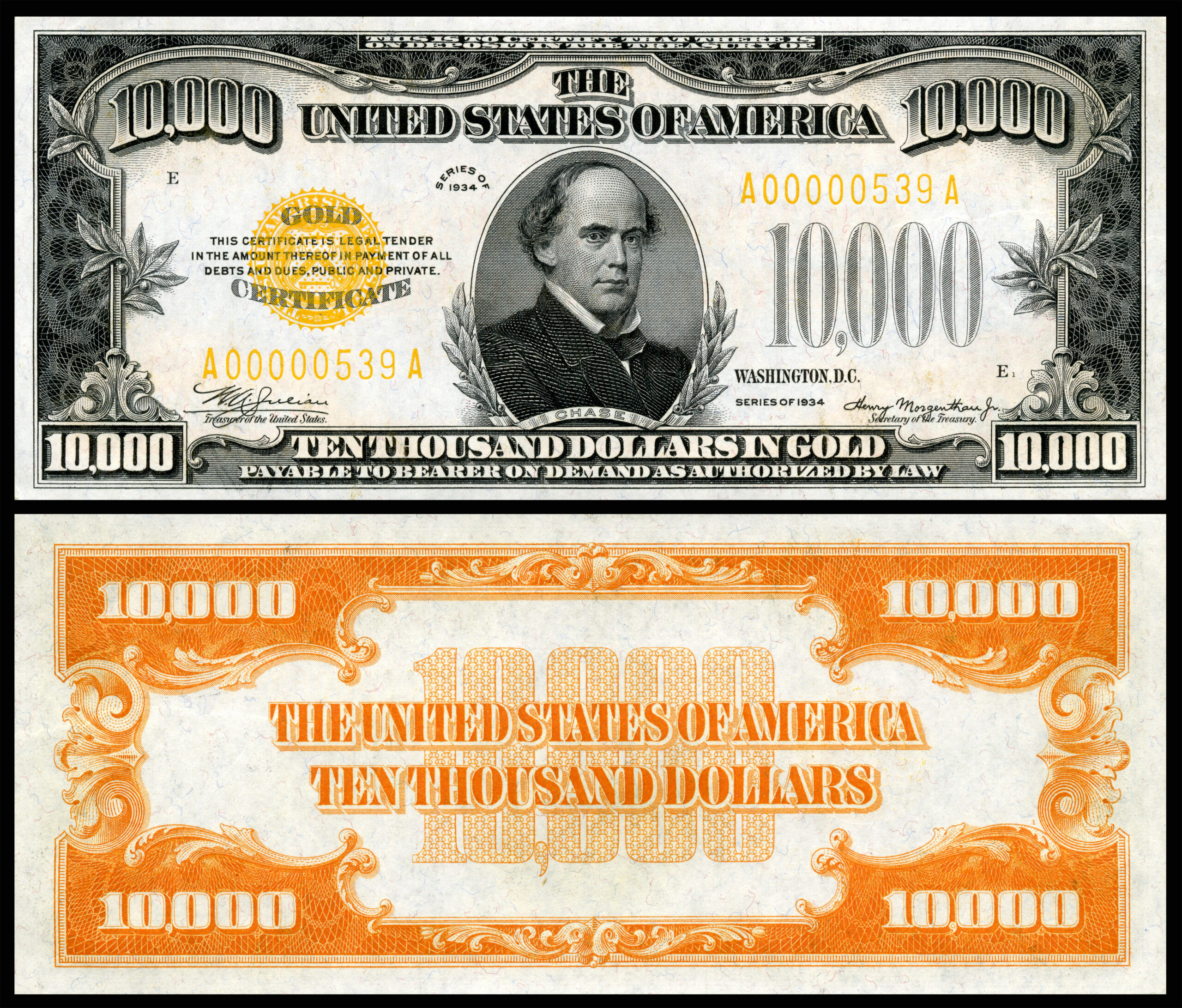
The Series 1934 high-denomination Federal Reserve Notes are striking pieces of engraving. The $500 note features William McKinley, the 25th President, centered on the face with Hernando de Soto’s Discovery of the Mississippi on the reverse. The $1,000 note carries Grover Cleveland, the only president to serve non-consecutive terms, on the face with the United States Capitol depicted on the reverse. The $5,000 note presents James Madison with the signing of the Constitution on the reverse, and the $10,000 note carries Salmon P. Chase, the Treasury Secretary who oversaw the creation of the National Banking System during the Civil War, with a vignette of the Presentation of the Constitution on the reverse.
All Series 1934 Federal Reserve Notes in these denominations carry a green Treasury seal and green serial numbers, consistent with the standard Federal Reserve Note format of the period. The signature combination found on most Series 1934 examples is Julian-Morgenthau, reflecting Secretary of the Treasury Henry Morgenthau Jr. and Treasurer of the United States William A. Julian. The Series 1934A notes, where applicable, carry the Julian-Vinson combination. Collectors should note that not all high-denomination notes were issued in all series variants, and identifying exactly which series a given note belongs to requires careful examination of the signature pair.
Surviving Populations and What They Tell Us
The Federal Reserve Bank of San Francisco publishes periodic estimates of surviving high-denomination notes, cross-referenced with destruction records. As of the most recent available figures, approximately 1,492 examples of the $1,000 Federal Reserve Note are believed to survive in all grades, while only around 336 examples of the $10,000 note are thought to exist. The $5,000 note is rarer still in terms of accessible market examples, and the $500 note, while more common than its larger siblings, remains a trophy piece in any advanced collection.
Grading matters enormously with these notes. A $1,000 note in Very Fine 20 might sell at auction for $3,500 to $5,000 depending on the issuing district. The same note in Choice Uncirculated 64 can command $15,000 or more, and a gem example that achieves PPQ (Premium Paper Quality) designation from PCGS Currency or PMG can push into five figures without difficulty. For the $10,000 note, fine examples routinely bring $100,000 or above, with exceptional specimens occasionally surpassing $200,000 at major currency auctions.
Always purchase high-denomination notes in certified holders from PCGS Currency or PMG. The market for these notes attracts sophisticated buyers and, unfortunately, sophisticated counterfeiters. Third-party grading not only confirms authenticity but documents the note’s paper quality, which is especially important for pieces that may have been stored improperly for decades. Uncertified examples, regardless of how genuine they appear, will be significantly discounted by serious buyers.
Earlier Issues: Gold Certificates and Federal Reserve Bank Notes
Before the 1934 series, collectors encounter high-denomination notes in several other types. The Series 1928 Gold Certificates represent the last gold-backed large denominations before the 1933 recall. The $500 Gold Certificate carries McKinley (consistent with later issues) while the $1,000 carries Cleveland. These notes, printed with the characteristic gold Treasury seal, were subject to the 1933 recall order and any surviving examples in private hands occupy a legal gray area that was clarified by a 1964 Treasury ruling allowing numismatic retention. Surviving 1928 Gold Certificates in high denominations are extraordinarily scarce, with many grades and districts known from fewer than a dozen examples.
The Federal Reserve Bank Notes of 1918 also included $500 and $1,000 denominations, and these bear distinctive brown Treasury seals with the issuing bank’s name prominently displayed. The 1918 $1,000 Federal Reserve Bank Note features a striking image of the Eagle on the face and is one of the most visually dramatic pieces of American paper money from any era.
| Series / Type | Denomination | Est. Survivors (All Grades) | Rarity |
|---|---|---|---|
| 1934 Federal Reserve Note | $500 | ~3,900 | Scarce |
| 1934 Federal Reserve Note | $1,000 | ~1,492 | Rare |
| 1934 Federal Reserve Note | $5,000 | ~342 | Key Date |
| 1934 Federal Reserve Note | $10,000 | ~336 | Key Date |
| 1928 Gold Certificate | $500 | ~200 known | Key Date |
| 1928 Gold Certificate | $1,000 | ~150 known | Key Date |
| 1918 FRBN | $1,000 | ~50-75 known | Key Date |
| 1934A Federal Reserve Note | $500 | ~1,200 | Rare |
| 1934 FRN (Minneapolis District I) | $1,000 | Fewer than 30 known | Key Date |
| 1934 FRN (Dallas District K) | $500 | Fewer than 40 known | Key Date |
The Legacy of the 1969 Decision
More than five decades after the Federal Reserve’s announcement, the debate over high-denomination currency has returned with new urgency. Harvard economist Kenneth Rogoff’s 2016 book The Curse of Cash argued for eliminating the $100 bill using reasoning strikingly similar to the 1969 rationale applied to $500 and $1,000 notes: that large denominations disproportionately serve tax evaders, drug dealers, and those operating in black markets. The European Central Bank discontinued its 500 euro note in 2019 for similar reasons.
For currency collectors, the 1969 decision was an inadvertent gift. By ending production and encouraging banks to destroy notes as they were deposited, the government created a fixed and slowly shrinking population of survivors. Every note that passes through a major auction today is documented, studied, and appreciated in ways that ordinary circulating currency never will be. The $10,000 bill bearing Salmon Chase’s portrait is, in a very real sense, a piece of American monetary philosophy captured in cotton and linen, a reminder that the government once trusted its citizens and its banking system with instruments of extraordinary value, before crime, policy, and modern wire transfer systems rendered them obsolete.
If your budget does not stretch to authentic high-denomination notes, consider collecting the Series 1929 National Bank Notes in $50 and $100 denominations as an entry point into large-format and high-face-value collecting. Alternatively, look for original bank references and Federal Reserve publications from 1969 documenting the discontinuation announcement itself. These paper ephemera provide important historical context and can be acquired for a fraction of the cost of the notes they describe.
Conclusion: Monuments to a Vanished Era
The decision made in the summer of 1969 was both practical and symbolic. Practical because wire transfers had already made large-denomination physical currency redundant for legitimate purposes. Symbolic because it represented the federal government drawing a line between the instruments of lawful commerce and the tools of criminal enterprise. Whether the policy actually curtailed organized crime is a question historians still debate, but its numismatic consequences are beyond dispute.
The $500 and $1,000 notes that survived that recall, that were folded into wallets as souvenirs or locked away in safe deposit boxes, now command prices that would have seemed fantastical to the bank tellers who once handled them routinely. They are monuments to a vanished era of American monetary history, and for collectors lucky enough to hold one, they represent some of the most compelling and historically resonant paper money this country has ever produced.