
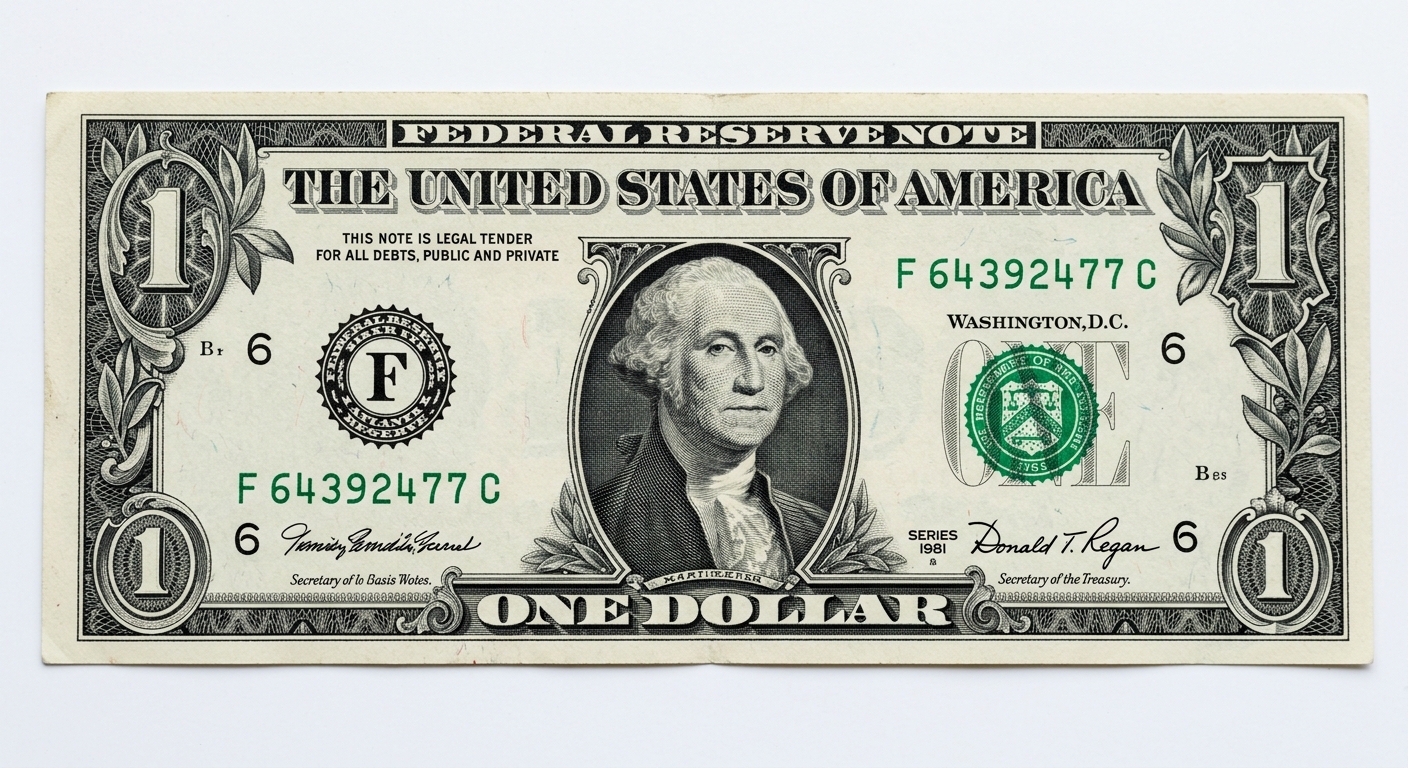
📷 Image source: Wikimedia Commons. Images are selected by AI to represent the article topic and may not depict the exact note(s) described.
Pull a Series 1981 $1 bill from a dealer’s stock box and you might dismiss it as just another modern Federal Reserve Note. Regan-Regan signature? Common. Green seal? Seen it a thousand times. But spend an hour with a loupe, a good reference guide, and a representative group of 1981 dollars, and a more nuanced story begins to emerge. The Series 1981 $1 note bridged two distinct production eras at the Bureau of Engraving and Printing, and the physical evidence of that transition is stamped directly onto the face of the notes themselves.
Setting the Stage: Why 1981 Matters in BEP History
The Series 1981 $1 note was produced during a period of genuine operational flux at the Bureau of Engraving and Printing. The BEP’s Washington, D.C. facility was the sole production site for this series, as the Fort Worth, Texas plant did not open until 1991. That Washington monopoly on production means all district varieties came from the same physical presses, making cross-district comparisons especially meaningful for attributing chronological print runs.
The Buchanan-Regan signature pairing defines the series. Angela Marie Buchanan served as the 38th Treasurer of the United States from 1981 to 1983, and her bold, angular signature appears at the lower left. Donald T. Regan, serving as Secretary of the Treasury from January 1981 through early 1985, provided the countersigning signature at lower right. This combination is shared with the subsequent Series 1981-A (where Ortega replaced Buchanan as Treasurer), so the series date printed on the note itself remains the definitive distinguishing factor.
The Treasury Seal: Small Seal vs. Large Seal Controversy
One of the most discussed variety distinctions among collectors of modern Federal Reserve Notes involves the physical size of the Treasury Department seal printed on the face. For the Series 1981 dollar, the BEP used what is catalogued as the “large seal” design, which had been standard since the Series 1963 notes. The seal measures approximately 19 to 20 millimeters in diameter and features the full Latin motto “Thesauri Americae Septentrionalis Sigillum” around its perimeter, with clearly legible individual lettering.
Collectors sometimes confuse the 1981 series with notes just before and after it in the chronological sequence. The large green Treasury seal on Series 1981 notes should be distinguished from the slightly modified renderings seen on earlier 1977-A issues, where ink saturation from aging press plates could cause the seal perimeter text to appear heavier or lighter. A crisp, well-struck 1981 seal will show clean separation between the radiating points of the outer ring and the circular text band.
When examining Series 1981 $1 notes, hold the face of the note at a low angle under a raking light source. Worn or re-lapped face plates from late production runs will show noticeably shallower ink relief in the Treasury seal and portrait area compared to early printings made from freshly engraved plates.
Face Plate Letters and the Quadrant System
Every Federal Reserve Note produced by the BEP includes small check letters and face plate serial numbers that identify exactly which engraved plate printed that specific note. On a Series 1981 $1 bill, you will find two check letters (quadrant letters) positioned in the upper left and lower right corners of the face design. These letters run A through D, corresponding to the four note positions on a standard 32-subject sheet. The face plate serial number appears just below the lower right check letter.
Early production runs of the Series 1981 dollar utilized face plates numbered in the low hundreds, generally below plate number 200 for most districts. As the series progressed through 1981 and 1982, plate numbers climbed significantly. Notes bearing face plate numbers above 300 are, statistically, later printings. While this does not by itself create major value differences, it becomes meaningful when combined with district attribution and star note identification.
Back plate numbers tell a complementary story. The back plate serial number on Series 1981 notes appears in the lower right area of the reverse. Back plates wore more slowly than face plates due to the less detailed intaglio work on the back design, so back plate numbers from this era generally run lower than contemporaneous face plate numbers.
Building a plate number “run” for a single FRB district across the Series 1981 issue is an achievable and rewarding goal for budget-conscious collectors. Look for consecutive or near-consecutive face plate numbers from the same district to document the chronological progression of the print runs.
District by District: Where the Scarcity Lives
All twelve Federal Reserve Bank districts issued Series 1981 $1 notes, identified by the familiar prefix letters A (Boston) through L (San Francisco) and corresponding district numbers 1 through 12 printed within the FRB seal at left center. However, the print quantities varied considerably by district, and those differences are the primary driver of relative scarcity among circulated and uncirculated examples today.
The Minneapolis district (I-9) and Richmond district (E-5) produced comparatively modest print runs for the Series 1981 issue relative to high-demand districts like New York (B-2) and Chicago (G-7). Federal Reserve ordering patterns in the early 1980s reflected regional currency velocity, and the agricultural Midwest and upper Plains states simply did not cycle through $1 notes at the rate of major urban financial centers. This means that high-grade Minneapolis examples, particularly those with serial numbers below 10,000,000, represent genuine collecting opportunities that have not been fully exploited by the market.
The San Francisco district (L-12) presents an interesting case. As the BEP’s primary supplier of currency to the West Coast and Pacific territories, San Francisco ordered consistently large quantities, which pushes most examples into the common category. The exception is the San Francisco star note, where replacement printing quantities for this district in the 1981 series ran substantially below some Eastern districts.
Star Notes: The Premium Replacements
Star notes, produced to replace defective notes during the printing process, carry a star symbol in place of the final letter in the serial number. For the Series 1981 $1, star notes exist for all twelve districts, but with dramatically different survival rates and original print quantities. The standard serial number format for 1981 $1 notes runs from a letter prefix identifying the district through eight digits and a suffix letter, while star notes replace that suffix with the star symbol.
Atlanta (F-6) star notes from the Series 1981 issue are particularly sought after, with relatively low confirmed print quantities. Kansas City (J-10) star notes also attract collector attention due to modest replacement runs. By contrast, New York (B-2) star notes, while still desirable, were produced in substantially larger numbers reflecting the sheer volume of regular notes printed for that district.
When attributing star note print quantities for the Series 1981 dollar, consult the Federal Reserve Bank star note print data compiled by Doug Murray and published through the Society of Paper Money Collectors. BEP production records for this era have been substantially declassified and allow for reasonably precise attribution of star note runs by delivery batch.
Grading Considerations Specific to Series 1981
Series 1981 $1 notes were produced on 75 percent cotton, 25 percent linen currency paper meeting the specifications in effect since the early 1960s. The paper stock is durable but susceptible to the characteristic folds, edge wear, and corner rounding that drag notes from the Extremely Fine grades down toward Very Fine and below. For collectors pursuing gem uncirculated examples graded MS-65 or 66 by PCGS Currency or PMG, the Series 1981 dollar is both accessible and surprisingly challenging at the top of the grade scale.
Centering is the critical variable for high-grade Series 1981 $1 notes. BEP cutting tolerances in the early 1980s, while tighter than earlier decades, still produced a notable percentage of notes with margins shifted left or right by 1 to 2 millimeters. A note that grades Choice Uncirculated 64 due to slightly unequal margins might otherwise qualify for 66 or 67. Collectors building gem sets should prioritize centering above nearly all other factors when the note shows no handling.
| Series / District | Note Type | Est. Print Run | Rarity |
|---|---|---|---|
| 1981 New York (B) | Regular Issue | 1.2 billion+ | Common |
| 1981 Chicago (G) | Regular Issue | 900 million+ | Common |
| 1981 Minneapolis (I) | Regular Issue | Approx. 160 million | Scarce |
| 1981 Kansas City (J) | Star Note | Approx. 3.2 million | Scarce |
| 1981 Atlanta (F) | Star Note | Approx. 2.56 million | Rare |
| 1981 Minneapolis (I) | Star Note | Approx. 1.28 million | Rare |
| 1981 Richmond (E) | Star Note | Approx. 2.0 million | Scarce |
| 1981 San Francisco (L) | Star Note | Approx. 3.84 million | Scarce |
| 1981 Boston (A) | Star Note | Approx. 2.56 million | Rare |
| 1981 Minneapolis (I) | Low Serial (under 100) | Fewer than 100 confirmed | Key Date |
Separating Early from Late Printings: A Practical Checklist
Attributing a Series 1981 $1 note as an early or late printing requires examining several physical features in combination. No single indicator is definitive, but the convergence of multiple data points allows a confident attribution. Work through the following checklist with any example you are examining:
First, record the face plate number. Numbers below 150 for major districts (New York, Chicago, San Francisco) and below 75 for minor districts (Minneapolis, Kansas City, Dallas) indicate early printings from the initial plate preparation runs conducted in 1981. Second, examine ink depth on the portrait of George Washington. Early printings from fresh plates show crisper hair detail in the upper right quadrant of the portrait oval and sharper collar line definition. Third, check the serial number range. While serial numbers are not strictly chronological by district in the way they were in earlier eras, very low prefix block letters combined with low eight-digit serials correlate with early delivery batches. Fourth, note the impression quality of the Federal Reserve Bank seal at left center. Early printings show sharper serrations on the outer gear ring of the FRB seal.
Cross-reference the face plate number on any Series 1981 $1 note you are attributing against the back plate number. On early printings, both numbers will be relatively low and roughly proportional. A high face plate number paired with a very low back plate number is a flag for a mid-series production note where new face plates were mated with older, still-serviceable back plates.
Conclusion: A Series Worth Studying
The Series 1981 $1 Federal Reserve Note will never command the auction prices of a Series 1928 Legal Tender or a Federal Reserve Bank Note from the 1918 era. But as a study in BEP production methodology, district printing allocation, and the measurable physical differences between early and late plate usage within a single series, it offers collectors a genuinely rewarding challenge at an affordable price point. A complete set of all twelve districts in gem uncirculated condition, augmented by star notes from the scarcer districts, represents an achievable and historically meaningful collection. The notes are out there in dealer inventories and at currency shows, often priced modestly precisely because most buyers overlook the variety story hidden within them. That oversight is your opportunity.