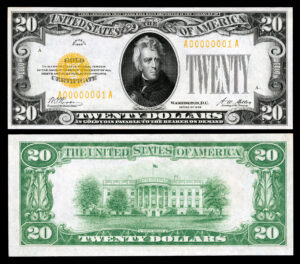
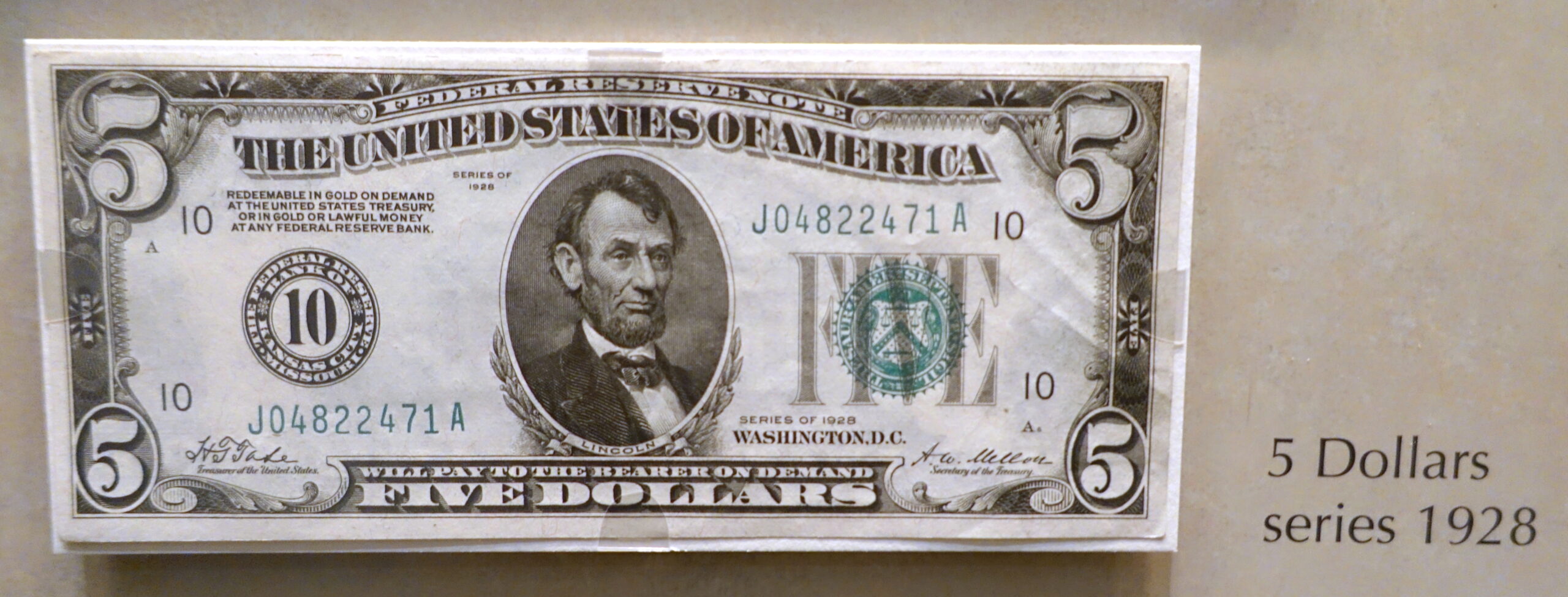
📷 Image source: Wikimedia Commons. Images are selected by AI to represent the article topic and may not depict the exact note(s) described.
The Margin Problem Nobody Talks About Enough
Pick up any well-circulated Federal Reserve Note and centering is the last thing on your mind. But the moment you start chasing high-grade, uncirculated small-size notes, those four margins become almost an obsession. A $1 Series 1995 FRN can come out of a fresh BEP strap with razor-sharp detail, original paper sheen, and zero handling, yet still land at PMG 64 EPQ instead of 67 EPQ simply because the face design printed two millimeters too far toward the left edge. That gap between a 64 and a 67 can represent hundreds of dollars on a star note or a low-print-run district.
Understanding how the two major third-party grading services, Paper Money Guaranty (PMG) and PCGS Currency, evaluate centering is not optional for serious collectors. It is the difference between overpaying for a slab and recognizing a bargain when one appears on the auction floor.
How the Bureau of Engraving and Printing Creates Centering Variation
To understand why centering varies so dramatically on small-size Federal Reserve Notes, you need to understand the BEP’s printing and cutting process. Since the adoption of the modern small-size format in 1928, notes have been printed in large sheets, then guillotined down to individual notes. For most of the twentieth century, the BEP operated with 32-subject sheets arranged in four rows of eight notes. The cutting guillotines, while remarkably precise by industrial standards, operate within a mechanical tolerance. A blade that drifts by even one millimeter affects every note in that stack simultaneously, creating systematic centering bias across an entire strap of notes.
The intaglio printing process itself introduces another variable. The face and back of each note are printed in separate passes. If the sheet feeds at a fractionally different angle or position on the second pass, the back design may be offset relative to the face. This is why you occasionally encounter notes where the face appears well-centered but the back is noticeably shifted, or vice versa. Both services evaluate both sides, and the worse of the two sides drives the centering assessment.
Sheet Position Matters
Notes cut from corner positions on a 32-subject sheet statistically show worse centering than those from interior positions, because corner cuts are affected by two blade paths simultaneously. Collectors who break open original BEP straps report consistent centering bias within a strap, with the first and last notes often showing the widest margin disparities. This is not a defect in the traditional sense, but it is very real and it costs grade points.
When buying ungraded notes from original BEP straps, examine notes from the interior of the strap first. Position 16 and 17 in a 32-note strap tend to show the most consistent centering, because they were cut on all four sides by interior blade passes with the least cumulative mechanical drift.
PMG’s Centering Standards: The Official Framework
PMG uses a descriptive centering scale that is embedded directly into its numerical grade. In practical terms, PMG evaluates centering on a continuum from “well-centered” to “poorly centered,” and the margin disparity between the widest and narrowest margins on each side determines how severely centering penalizes the final grade.
At the Gem Uncirculated level (65 EPQ), PMG expects margins that are reasonably balanced, though not necessarily perfect. A note with one margin slightly narrower than the others can still achieve a 65 EPQ if the disparity is modest, typically no more than about 50 percent variation between the widest and narrowest margin. Once you enter Superb Gem territory (66 EPQ and above), the tolerance tightens considerably. A 67 EPQ note should show four margins that are close to equal, with no single margin dramatically narrower than its opposite. For a 68 or above, centering must be essentially ideal, with margins that a reasonable numismatist would describe as perfectly balanced.
Critically, PMG’s standards acknowledge that certain series and denominations are almost never found with superb centering due to BEP production realities. Graders apply what amounts to a contextual awareness, but the numerical standard remains absolute: if a note’s margins cannot support the grade, the grade gets capped regardless of every other quality criterion being met.
The Centering Cap in Practice
Here is how the centering cap plays out in real submissions. Imagine a Series 1969-C $100 Federal Reserve Note from the San Francisco district. The note has never been folded, carries original paper brightness, shows no soiling, and has sharp corner tips. By every measure except centering, it is a 67 or 68 candidate. But the bottom margin is nearly twice the width of the top margin, and the left margin is significantly narrower than the right. PMG would likely assign this note a grade of 64 EPQ or 65 EPQ, capping it below Gem despite its otherwise superb physical condition. The EPQ (Exceptional Paper Quality) designation can still be awarded because EPQ relates to originality of paper and surface, not to centering. But the numerical grade suffers.
Never assume that an EPQ or PPQ designation means a note is well-centered. Both PMG’s EPQ and PCGS Currency’s PPQ (Premium Paper Quality) designations speak exclusively to paper originality and surface quality. A note can carry EPQ at PMG 63 specifically because centering, not paper quality, is the limiting factor.
PCGS Currency’s Approach: Similar Standards, Slightly Different Language
PCGS Currency evaluates centering using comparable standards to PMG, but its published grading criteria place slightly more explicit emphasis on the visual appeal component. At the PCGS Superb Gem (67 PPQ) level and above, PCGS graders look for what the service describes as “outstanding” centering, a term that in practice means the eye should not immediately be drawn to any margin imbalance when viewing the note at arm’s length.
One practical difference collectors notice is that PCGS Currency at times appears marginally more lenient on centering for series known to be difficult, particularly the Series 1928 through 1934 small-size notes and the higher-denomination 1950-series notes. This is not an official policy distinction, but it reflects the grader judgment inherent in any 70-point scale applied to hand-cut currency. Savvy submitters sometimes cross-grade notes specifically because of perceived service differences in centering evaluation.
Both services deduct more heavily for face centering issues than back centering issues, though both sides are evaluated. The face of a Federal Reserve Note carries the serial numbers, district seal, and Treasury seal, making centering asymmetry more immediately visible and aesthetically disruptive than equivalent displacement on the back.
Which Series and Denominations Have the Worst Centering Histories
Not all small-size FRN series are equally prone to centering problems. The following patterns emerge from decades of collector experience and population report analysis:
Series 1928 and 1934 High Denominations
The $500 and $1,000 Federal Reserve Notes from the 1928 and 1934 series are legendary for centering difficulties. These large-denomination notes were printed in smaller quantities and on different press schedules, meaning less calibration consistency. Finding a 1934-A $500 FRN in PMG 65 EPQ or better with strong centering is genuinely difficult, and population reports reflect it.
Series 1950 through 1963 Twenties and Fifties
The $20 and $50 denominations from the 1950, 1950-A, 1950-B, 1950-C, 1950-D, and 1950-E series show high rates of centering-capped grades in population reports. The 32-subject sheet format had been standardized, but cutting equipment of that era had larger mechanical tolerances than modern BEP operations. Star notes from this era with superb centering command serious premiums.
Series 1963 and 1969 Ones
Perhaps counterintuitively, the ubiquitous $1 FRNs from the early 1963 and 1969 series show worse average centering than many higher denominations from the same period. The sheer volume of production combined with high press speeds created significant cutting variability. A Series 1963-A $1 from the Richmond district (E) in PMG 68 EPQ is extraordinarily rare partly because of centering challenges at that production volume.
Before submitting a note you believe is a strong 66 or 67 candidate, hold it under a good light and measure the four margins with a millimeter ruler. If the widest margin is more than 1.5 times the width of the narrowest margin on either face or back, expect a centering deduction. This simple test can save you submission fees on notes that will cap at 64 or 65 regardless of their other qualities.
Modern Series: Has Centering Improved?
The short answer is yes, meaningfully. The BEP’s transition to fully computerized cutting equipment and modern press registration systems, accelerating through the 1990s and maturing in the 2000s, produced a measurable improvement in centering consistency. Series 1999 through the present show population reports with a higher percentage of notes achieving 66 and 67 grades on centering-related criteria compared to equivalent production runs from the 1950s and 1960s.
The Series 2004-A and 2006 redesigned $20, $50, and $100 notes in particular show excellent average centering. However, star notes and low-print-run district combinations still show centering variability, because shorter print runs sometimes involve press calibration runs that introduce the same mechanical inconsistencies that plagued earlier eras.
| Series / Denomination | Variety or Note | Est. Pop. at 66 EPQ or Better | Rarity |
|---|---|---|---|
| 1928 $500 FRN | All districts combined | Fewer than 12 known | Key Date |
| 1934-A $1,000 FRN | Chicago (G), well-centered | Fewer than 8 known | Key Date |
| 1950-E $50 FRN | Any district star note | Fewer than 20 known at 65+ | Rare |
| 1963-A $1 FRN | Richmond (E), PMG 68 EPQ | Single digits in population | Rare |
| 1969-C $100 FRN | San Francisco (L) star | Approx. 15 to 25 at 65 EPQ | Scarce |
| 1977-A $5 FRN | Minneapolis (I) star | Approx. 30 to 50 at 65 EPQ | Scarce |
| 1995 $1 FRN | Atlanta (F) star, 128,000 printed | Several hundred at 65 EPQ | Scarce |
| 2006 $100 FRN | Any district, standard note | Plentiful at 66 EPQ | Common |
| 2009 $1 FRN | Any district, standard note | Very plentiful at 66 to 67 EPQ | Common |
How to Evaluate Centering Before You Submit
Grading services charge per note, and submission fees add up quickly. Developing your own eye for centering before submitting is genuinely worth the effort. The standard approach is to lay the note face-up on a clean white surface and assess the four borders visually, then confirm with a millimeter ruler. For small-size FRNs, a well-centered note will typically show margins in the 3 to 4.5 mm range on all four sides. A margin below 2 mm on any side is a red flag for a grade cap below 65.
Also examine the back of the note separately. Flip it carefully without bending, lay it flat, and repeat the assessment. Remember that the grading services evaluate the worse of the two sides as the primary centering determinant. A note with a perfect face and a shifted back is still a centering-compromised note.
Finally, consider the district and series context. If you are working with a Series 1950-B $20, your expectations for superb centering should be calibrated to that series’ historical production standards. A note from that era that shows reasonably balanced margins, even if not perfect, may represent exceptional centering for its type and carry a corresponding collector premium regardless of what a universal centering standard might suggest.
Population reports from PMG and PCGS Currency are your most powerful research tool for centering rarity. A series with very few examples above 65 EPQ despite being commonly collected almost always has a centering problem as the culprit. Cross-reference grade distributions against print run data to identify series where centering-related grade scarcity creates undervalued opportunities at the 64 and 65 level.
Conclusion: Centering as a Collecting Advantage
Most collectors learn the basics of grading by focusing on folds, soiling, and tears. Those are the obvious defects. Centering is subtler, more technical, and frequently misunderstood, which is precisely what makes it a source of real collecting advantage. A collector who understands how PMG and PCGS Currency measure margins, which series are historically prone to centering-capped grades, and how to evaluate centering before submission will consistently make better buying and submission decisions than one who does not.
The notes that carry exceptional centering for their type and era deserve recognition and premiums. The notes that are penalized by centering despite extraordinary paper quality represent buying opportunities when the centering gap is modest and the series context is understood. Either way, those four margins around the face of every small-size Federal Reserve Note tell a story worth reading carefully before you commit to a purchase or a submission.