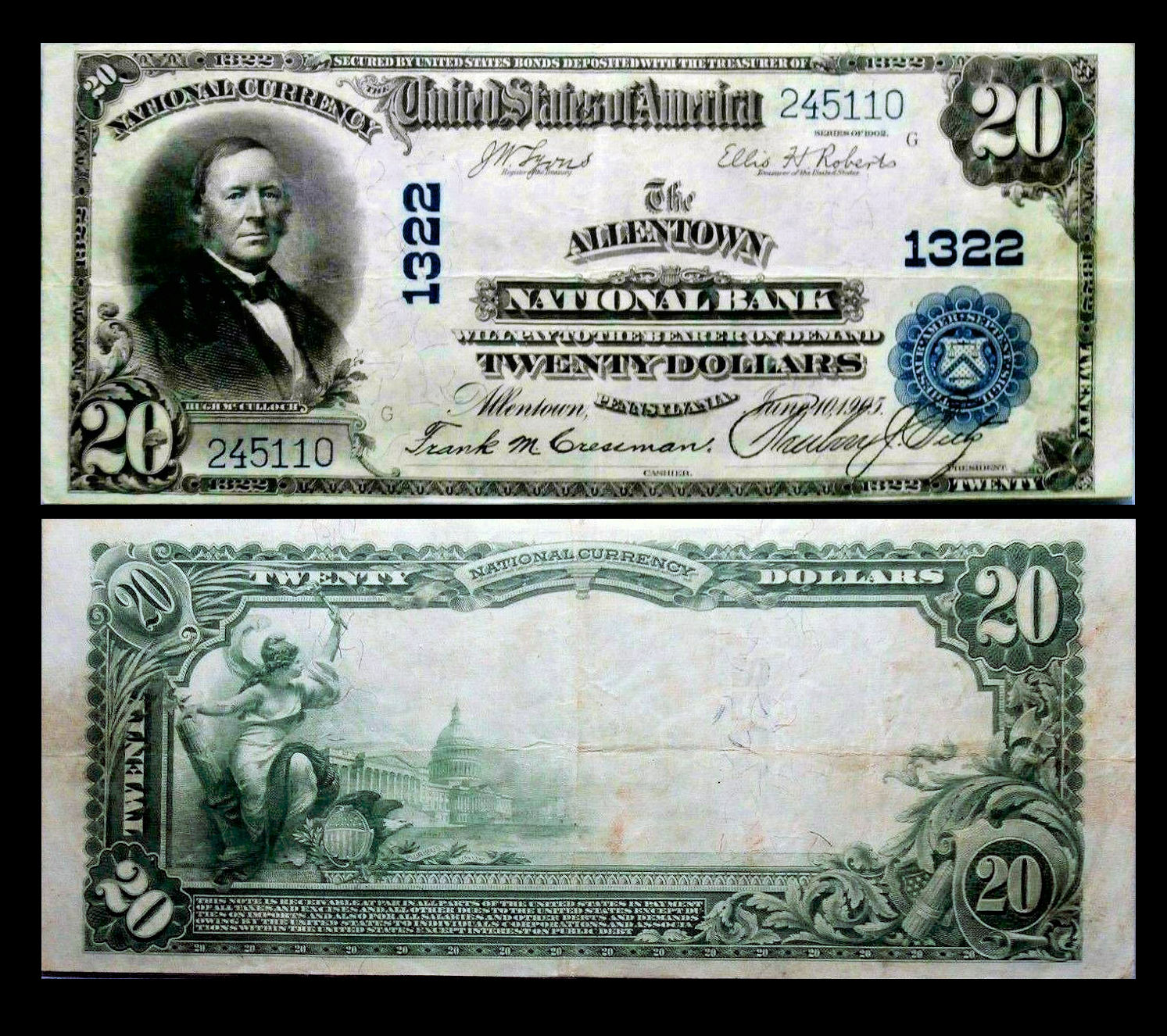
📷 Image source: Wikimedia Commons. Images are selected by AI to represent the article topic and may not depict the exact note(s) described.
Walk into any major currency auction and you will see it happen: a battered, edge-worn National Bank Note hammers for four times the price of a crisp, high-grade example from the same series. New collectors scratch their heads. Seasoned numismatists nod knowingly. The explanation lies at the heart of what makes National Bank Notes one of the most intellectually demanding, endlessly rewarding series in all of American paper money collecting. Condition matters, yes, but the identity of the issuing bank can override grade in a way that has no real parallel anywhere else in United States currency.
A Brief Framework: The Three Charter Periods
National Bank Notes were issued under federal authority beginning with the National Currency Act of 1863 and the revised National Bank Act of 1864. The system organized notes into three broadly recognized charter periods, each with distinct design characteristics that collectors use as a primary organizing framework.
Original Series and Series 1875 notes constitute the First Charter Period, running roughly from 1863 through the mid-1880s. These large-size notes featured elaborate vignettes, including the famous “Lazy Deuce” two-dollar notes and the iconic First Charter $1 with Columbus in Sight of Land. Second Charter Period notes (1882 to 1902) came in three distinct back types: Brown Backs, Date Backs, and Value Backs. The Third Charter Period (1902 to 1929) produced Red Seals, Date Backs, and Plain Backs before the transition to small-size notes in 1929. Small-size Nationals, issued as Type 1 (1929 to 1933) and Type 2 (1933 to 1935), feature a brown Treasury seal and carry the issuing bank’s name and charter number prominently on the face.
The Charter Number System and Why It Matters
Every nationally chartered bank received a unique charter number assigned sequentially by the Office of the Comptroller of the Currency. Low charter numbers generally indicate early, prominent institutions. Charter 1, for example, belonged to the First National Bank of Philadelphia, Pennsylvania. High charter numbers, extending into the 13,000s and 14,000s, represent banks chartered in the early twentieth century, many of which operated in small Midwestern or Southern towns.
The charter number appears on the face of every National Bank Note, and that number is your first clue to rarity. But the charter number alone is not enough. You must cross-reference it against known census data, surviving population reports, and historical records to understand how many notes from a given bank are estimated to still exist.
Before purchasing any National Bank Note, consult the Hickman and Oakes Standard Catalog of National Bank Notes along with the current PCGS or PMG population reports. A bank may have a known census of only one or two surviving notes across all denominations, instantly placing any surviving example in a different conversation from condition alone.
The Concept of the “One-of-a-Kind” Bank
Some national banks operated for only a brief period, issued an extremely limited quantity of notes, and left almost no surviving examples in collections today. These are the unicorns of the series. Consider a small territorial bank in Arizona or Oklahoma that held a charter for just three years around 1902 to 1905 and issued perhaps one sheet of $5 Third Charter Red Seals before closing. If only a single note is recorded from that bank in any grade, condition becomes almost secondary. A VF-20 example with a small tear along one margin may represent the only publicly known note from that issuing institution, and collectors will pay accordingly.
This dynamic creates what experienced National Bank Note collectors call a “separate value tier beyond condition.” Grading services certify the note’s physical state, but the market assigns value based on a two-axis system: the grade on the horizontal axis and bank rarity on the vertical. A note graded Fine-12 from a one-known-example bank sits higher in the market than an MS-63 from a bank that issued tens of thousands of notes over several decades.
Geographic Rarity: States and Territories
Geography intensifies this dynamic. National Bank Notes from Alaska, Hawaii (as a territory), Puerto Rico, and the Virgin Islands command extraordinary premiums in any grade. Within the continental United States, notes from Nevada are among the rarest, as the state had few national banks and most operated briefly during the mining boom years. Nevada nationals in any condition are considered significant finds. Similarly, notes from New Mexico Territory, Oklahoma Territory, and Indian Territory are highly sought regardless of grade.
By contrast, New York City, Boston, and Chicago banks issued enormous quantities of notes over long periods. A Third Charter Plain Back $10 from the First National Bank of New York City grading VF-30 is a decent collectible note but carries no extraordinary premium beyond its face characteristics.
Nevada National Bank Notes are so consistently rare that even a well-worn Good-6 example from certain Nevada charters will outperform Uncirculated notes from common-state banks at auction. If you encounter a Nevada territorial or early statehood national, secure it regardless of grade and research the census afterward.
Small-Size Nationals: The 1929 Type 1 and Type 2 Distinction
The small-size National Bank Notes issued from 1929 to 1935 deserve special attention because they offer the most accessible entry point into the series while still demonstrating the bank-rarity premium vividly. Type 1 notes (Series of 1929) carry the bank’s charter number printed twice in the black serial number area and twice in the lower margin. Type 2 notes, issued from approximately 1933 onward, have the charter number printed a total of four times on the face in a different configuration.
Many small banks that had survived the 1920s issued only a few sheets of Type 2 notes before closing during or after the Great Depression. Some of those Type 2 notes from obscure Midwestern or Southern banks have known populations of fewer than five examples across all denominations. A circulated, problem-free Very Good-10 Type 2 $10 from such a bank will routinely bring more than a Gem Uncirculated 65 Type 1 $10 from a major city bank with hundreds of recorded survivors.
The 1929 small-size series also benefits from accessibility for new collectors. Entry-level examples from common banks in grades VF to AU can be acquired for modest sums, providing an excellent learning ground for understanding how bank rarity scales upward as populations thin.
How Grading Services Handle the Dual-Value System
PCGS Currency and PMG both certify National Bank Notes using standard Sheldon-scale descriptors (1 through 70 for PMG, with similar designations from PCGS). What the plastic slab does not tell you is the bank rarity, which is why population reports and the Hickman-Oakes catalog remain essential companion resources. Some third-party graders will note “Extremely Rare” or similar language in the certification holder’s description field, but this is inconsistently applied.
Auction records from Heritage Auctions, Stack’s Bowers, and Lyn Knight Currency Auctions provide the most accurate real-world evidence of how the market values bank rarity relative to grade. Reviewing realized prices over multiple sales for the same bank is the gold standard method for calibrating your own valuation approach.
When reviewing PCGS or PMG population reports for National Bank Notes, remember that these reports only reflect certified examples submitted to those particular services. Unknown quantities of raw, uncertified notes still exist in private collections, estate sales, and regional shows. Population data is a guide, not a definitive census.
Building a National Bank Note Collection: Strategic Approaches
Collectors approach Nationals through several organizing frameworks. State collections are among the most popular: assembling one note from every national bank in a given state. Town collections focus on a specific city or county, gathering all denominations and types from local banks. Serial number collectors pursue notes with matching or low serial numbers. Some collectors focus exclusively on a single denomination across multiple banks and charter periods.
Within any of these collecting strategies, the bank-rarity premium will assert itself. A state collection of Nevada nationals, for example, may never achieve true completeness because some banks have no confirmed surviving notes at all. Collectors pursuing these “impossible” sets often substitute documentary evidence: ledger sheets, correspondence, or comptroller records confirming issuance, paired with any grade of note that can be sourced.
For budget-conscious collectors, Third Charter Plain Back notes (1902 to 1929) from Northeastern and Midwestern states represent the best value entry point. These notes can be found in grades VF-30 to AU-55 from common banks for prices ranging from roughly $150 to $500, providing genuine historical pieces at accessible costs while building knowledge of the series.
| Series / Type | Issuing Context | Est. Surviving Population | Rarity |
|---|---|---|---|
| Third Charter Red Seal (1902) | Nevada state banks, any denomination | Fewer than 20 total known | Key Date |
| 1929 Type 2 Small-Size | Oklahoma Territory heritage banks | 1 to 5 per bank in many cases | Key Date |
| First Charter Original Series | Any bank, $1 denomination | Scarce across all banks | Rare |
| Second Charter Brown Back (1882) | Arizona Territory banks | Under 50 total estimated | Rare |
| Third Charter Plain Back (1902-1929) | Small-town Midwestern banks, single-issue charters | Varies: 5 to 30 per bank | Scarce |
| 1929 Type 1 Small-Size | Major Eastern city banks (New York, Boston) | Hundreds to thousands | Common |
| Second Charter Date Back (1882) | Pacific Northwest territorial banks | 10 to 40 per bank typically | Scarce |
| 1929 Type 2 Small-Size | Large Midwestern city banks, long-running charters | 50 to 200 or more | Common |
| First Charter Series 1875 | New Mexico Territory banks | Fewer than 10 total known | Key Date |
| Third Charter Red Seal (1902) | Large New England or New York banks | Hundreds known across issues | Scarce |
The Role of Signatures in National Bank Note Valuation
Beyond the issuing bank, two sets of signatures appear on every National Bank Note: the Treasury officials (Register of the Treasury and Treasurer of the United States) and the local bank officers (typically president and cashier). Treasury signature combinations help date notes precisely and can add or subtract premium depending on their scarcity within a given type.
On large-size Nationals, the Bruce-Gilfillan combination (1882 to 1883) and the Rosecrans-Huston combination (1889 to 1891) are among the more collectible pairings for Second Charter Brown Backs. On small-size Nationals, the bank officer signatures are sometimes handwritten, sometimes printed, and occasionally rubber-stamped. Notes with handwritten signatures in strong ink carry a slight presentational premium among condition-conscious collectors, though this does not override the fundamental bank-rarity calculation.
On small-size Type 1 and Type 2 Nationals, examine the bank officer signatures carefully. Some small banks had the same president and cashier for decades, while others show multiple signature combinations reflecting officer changes. Multiple signature varieties from the same rare bank can double or triple the scope of a focused collection.
Conclusion: Grading Is the Starting Point, Not the Endpoint
The grade assigned by PMG or PCGS Currency is an essential descriptor of a National Bank Note’s physical integrity, and condition remains critically important for common-bank notes where supply is sufficient for the market to behave in conventionally grade-sensitive ways. But for notes from scarce, short-lived, or geographically isolated banks, the grade is simply the entry point into a deeper conversation.
Understanding the two-axis value system, where condition and bank rarity operate simultaneously and sometimes in opposition, is what separates collectors who consistently make smart acquisitions from those who overpay for high-grade common material and unknowingly pass on extraordinary low-grade rarities. Study the census data, track auction results, invest in the Hickman-Oakes catalog, and always ask the second question: not just “what grade is this note?” but “how many examples from this bank are known to exist?” The answer to that second question may be the most valuable information in the transaction.