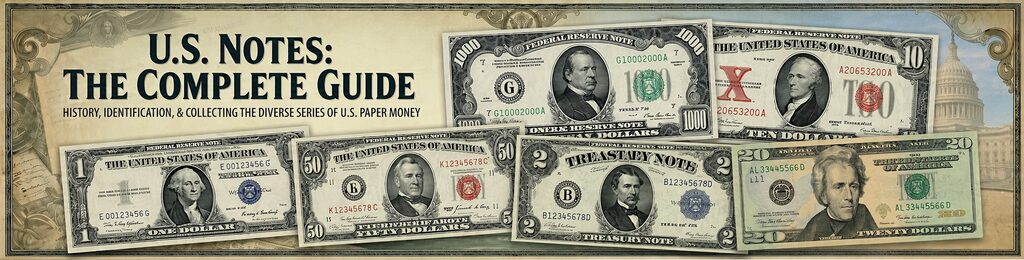
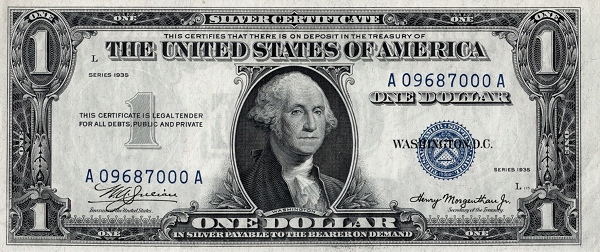
📷 Image source: U.S. Currency Education Program (uscurrency.gov). Images are selected by AI to represent the article topic and may not depict the exact note(s) described.
Pick up a raw, ungraded 1957-B Silver Certificate at any coin show and the first thing your eye goes to is that blue seal. On a crisp, uncirculated example, it punches with an almost electric cobalt intensity, clean and fully saturated from edge to edge. On a note that has passed through thousands of wallets over the decades, that same seal might look faded, washed out, or patchy. What many collectors do not immediately appreciate is just how heavily the two major third-party grading services, PMG (Paper Money Guaranty) and PCGS Currency, weight seal color when assigning numerical grades to the 1935 and 1957 series Silver Certificates. A single numerical grade difference can represent a meaningful price gulf, particularly on scarce varieties. Understanding the relationship between blue seal intensity and final grades is not optional for serious collectors. It is essential.
A Brief History of the Blue Seal on $1 Silver Certificates
Silver Certificates were authorized under the Act of February 28, 1878, but the familiar small-size $1 notes with the blue Treasury seal did not appear until the Series of 1928. The 1935 series launched in November 1935 under Secretary Henry Morgenthau Jr. and Treasurer William A. Julian. It would spawn eight sub-series, running through 1935H, before the cleaner-backed 1957 series took over. The 1957 series eliminated the mottoes and modified the back plate design slightly, and it continued through 1957A and 1957B before Silver Certificates were phased out of production entirely in 1963 under Public Law 88-36.
Throughout this entire period, the blue seal remained the visual signature of the Silver Certificate class. The ink used was a specific blue-black formulation applied by the Bureau of Engraving and Printing using intaglio printing on the seal and serial numbers. The blue of the seal is technically a separate ink layer from the black of the portrait and the green of Federal Reserve Note seals on other currency. Because the seal ink sits slightly proud of the paper surface, it is uniquely vulnerable to wear, chemical exposure, and improper storage over the decades.
What Graders Actually Look At: The PMG Approach
PMG uses a holistic grading standard based on four primary criteria: paper quality, impression sharpness, margins, and eye appeal. Seal color falls under the eye appeal category but also interacts directly with the impression sharpness standard. A faded seal can suggest one of two things to a grader: genuine wear from circulation, or chemical or environmental degradation on an otherwise uncirculated note. These two scenarios are treated quite differently on the grading scale.
For circulated grades, fading is generally understood as a byproduct of normal handling. A note graded Very Fine 25 (VF-25) or Extremely Fine 40 (EF-40) is expected to show some diminishment in color vibrancy. The grader is checking that the fading is consistent with the overall wear pattern. A note with crisp corners and sharp folds but a dramatically faded seal raises a red flag because the wear story does not add up.
When examining raw 1935 or 1957 Silver Certificates at shows or in dealer stock, hold the note at a 45-degree angle under a strong light source. A genuine intaglio-printed seal will show a very slight raised texture. If the seal appears flat and faded simultaneously, that note may have been washed or chemically treated, which both grading services will note as a qualifier or problem designation.
In the gem uncirculated range, specifically MS-63 through MS-67, seal color becomes a primary differentiating factor. PMG graders are trained to distinguish between notes where the blue seal retains full original color saturation versus those where slight toning or ink migration has occurred. A 1957-B note with brilliant white paper, perfectly square margins, and sharp serial numbers can still be held back from MS-66 or MS-67 if the seal shows any uneven color, cloudiness at the center, or peripheral fading at the saw-tooth border of the seal design.
The PCGS Currency Standard and How It Differs
PCGS Currency, operating under Collectors Universe, approaches seal color with similar rigor but applies what some veteran collectors describe as a slightly more holistic eye-appeal weighting. PCGS graders have noted in published standards that color quality on the seal, serial numbers, and Treasury signatures is evaluated as a single compositional unit. A faded seal that is accompanied by equally faded serial numbers may be penalized less than a note where the serial numbers are bright and vivid but the seal alone has lost intensity, because the latter pattern suggests selective damage rather than uniform, honest aging.
On 1935 sub-series notes, PCGS has shown a consistent tendency to grade notes with minor seal color unevenness at the PPQ (Premium Paper Quality) level rather than the standard grade if the paper itself is clean and original. PPQ designation from PCGS, like the EPQ (Exceptional Paper Quality) designation from PMG, indicates that the paper has not been pressed, cleaned, or artificially enhanced. A note with a slightly faded seal but original paper surfaces may still earn an EPQ or PPQ qualifier at a lower grade, which many advanced collectors actually prefer over a pressed note at a higher numerical grade.
Do not automatically favor the higher numerical grade when comparing two slabbed Silver Certificates. A PMG 64 EPQ with a slightly soft seal is often a better long-term investment than a PMG 65 without the EPQ designation, because the latter may have been pressed or lightly cleaned to achieve that extra grade point. Always read the full label notation before bidding at auction.
The 1935 Series: Sub-Series Variations in Seal Quality
Not all 1935 sub-series notes age the same way, and experienced collectors know to look for production-era differences in seal ink application. The 1935A notes, printed heavily during World War II to supply military payment needs through the North Africa and Hawaii overprint programs, used slightly different paper stock in some runs. Notes from the 1935A series without overprints were printed from 1942 through the late 1940s in enormous quantities, and ink consistency varied across BEP press runs. Some 1935A notes exhibit a noticeably lighter seal right out of the production run, a fact confirmed by examining BEP production records and comparing notes graded directly from original bank-wrapped bundles.
The 1935D series introduced a notable change: beginning in 1953, the BEP began incorporating a wider variety of paper pulp sources, and some 1935D and 1935E notes stored in non-climate-controlled bank vaults for decades show a characteristic blue-green migration of the seal ink into the surrounding paper fibers. Under magnification, the seal border on affected notes appears slightly blurred. Both PMG and PCGS treat this as a grading negative, typically costing the note one full grade point compared to a clean-sealed example of identical paper quality and fold pattern.
The 1957 Series: Cleaner Backs, Same Seal Vulnerability
The 1957 series is the most common Silver Certificate ever printed. The combined print runs of the 1957, 1957A, and 1957B series totaled well over two billion notes. Scarcity is not the issue here. Condition is everything, and within the condition spectrum, seal color is the single most decisive factor separating a note worth $2 in pocket change from one worth $75 or more in a PMG 66 EPQ holder.
The 1957B notes, signed by Treasurer Kathryn O’Hay Granahan and Secretary C. Douglas Dillon, are the final Silver Certificates ever issued. Star notes from the 1957B series, particularly those from the Dallas Federal Reserve district prefix range (though Silver Certificates technically carried no Federal Reserve district designation), are actively collected. The star replacement notes from the 1957B printing, identified by the star suffix on the serial number, represent smaller print runs and command premiums especially in gem grades with vivid seals.
The 1957B star notes with serial numbers in the F* block (starting with a star prefix) were printed in small batches. When evaluating these at auction, pay close attention to the PCGS or PMG population report for that specific serial range. A note grading MS-65 with a brilliant blue seal in a low-population star run can be dramatically undervalued compared to equivalent grades in common serial ranges.
Practical Grading: The Color Saturation Spectrum
Collectors who submit notes regularly develop a mental spectrum for blue seal saturation. At the top end, a fully saturated seal on a gem note is a deep royal blue, even and consistent across the entire face of the seal, with no lighter patches near the center or at the fine serrated border. Moving down the scale, the first sign of compromise is usually a very slight grayish cast to the blue, often most visible near the letters of the Treasury inscription around the seal’s interior ring. Further fading produces a dusty or powder-blue appearance. At the most degraded end, heavily circulated notes can show a seal that is more gray than blue, sometimes with the ink worn entirely away in isolated spots.
PMG’s published grading standards reference seal color implicitly within their eye appeal criteria. Their graders are instructed to assign qualifiers for notes that fall outside expected color norms for their grade level. A note that would otherwise qualify for MS-64 but shows seal color inconsistent with genuine uncirculated preservation may receive a net grade of MS-63 or even lower, or it may be placed in a problem note holder with a notation such as “faded seal” if the degradation is severe enough to affect authenticity assessment.
| Series | Variety or Signature Combination | Approx. Print Run | Rarity |
|---|---|---|---|
| 1935A Hawaii Overprint | Julian / Morgenthau, Brown Seal | 35,052,000 | Scarce |
| 1935A North Africa Overprint | Julian / Morgenthau, Yellow Seal | 26,916,000 | Scarce |
| 1935B | Julian / Vinson | 806,612,000 | Common |
| 1935D Wide Border | Clark / Snyder | ~1.6 billion combined | Common |
| 1935E | Priest / Humphrey | ~5.1 billion | Common |
| 1935G No Motto | Smith / Dillon | 31,320,000 | Rare |
| 1935H | Granahan / Dillon | 30,520,000 | Rare |
| 1957 Star Note | Priest / Anderson | ~5.7 million (star) | Scarce |
| 1957B | Granahan / Dillon | ~1.6 billion | Common |
| 1957B Star Note | Granahan / Dillon (star serial) | ~43 million (star) | Key Date |
Storage, Environment, and Prevention
Understanding why seals fade in the first place is the most useful thing a collector can do to protect existing holdings. The blue ink used by the BEP on Silver Certificate seals is vulnerable to three primary environmental threats: ultraviolet light exposure, humidity fluctuations, and acidic paper or plastic off-gassing. UV exposure is the fastest actor. A Silver Certificate left in a display frame under fluorescent lighting for several years can show measurable seal fading even if the paper itself remains bright white. Humidity cycling, common in attics and basements, causes the paper fibers to expand and contract, mechanically stressing the ink layer and promoting flaking or migration over time. Acidic storage materials, including many older coin album pages and non-archival plastic sleeves, release gases that chemically degrade the ink binders.
Proper storage in archival-quality Mylar or polyethylene terephthalate sleeves, away from light and in a stable humidity environment between 45 and 55 percent relative humidity, will preserve seal color for generations. Notes that have already been graded and slabbed by PMG or PCGS benefit from the UV-filtering properties of the polycarbonate holder, but even slabbed notes should be stored away from direct light and in stable temperatures.
Submitting for Grading: Setting Realistic Expectations
When submitting 1935 or 1957 Silver Certificates to either service, collectors should pre-screen notes under a 10x loupe and a strong daylight-balanced light source before paying submission fees. Compare the seal color to published images of graded examples in the PMG or PCGS population reports at the grade level you are targeting. If your note’s seal shows any grayish cast or peripheral softening, budget for a grade point penalty. For a note you believe would otherwise grade MS-65, a compromised seal may land it at MS-63 or MS-64, which can represent a meaningful difference in value for the rarer sub-series.
Both services offer economy, standard, and express submission tiers. For common 1957 or 1957B notes, economy tier submission makes economic sense only if you have strong reason to believe the note will grade MS-66 or higher with a vivid seal, where the premium over lower grades justifies the fee. For the scarcer sub-series such as 1935G No Motto or 1935H, standard or even express submission is warranted because the grading result meaningfully affects resale value across a broader grade range.
Conclusion: The Seal Is the Story
For Silver Certificate collectors working with the 1935 and 1957 series, the blue Treasury seal is not merely decorative. It is a condition barometer, a grading pivot point, and a historical artifact of BEP printing technology all at once. Learning to read seal color with precision, to distinguish between legitimate aging and problematic degradation, and to understand how PMG and PCGS translate that color into numerical grades will make you a more effective buyer, a smarter submitter, and ultimately a more satisfied collector. The vivid blue of a fully saturated gem-grade seal is one of the genuine pleasures of this hobby. Protecting and understanding it is worth every bit of the effort.