📷 Image source: U.S. Currency Education Program (uscurrency.gov). Images are selected by AI to represent the article topic and may not depict the exact note(s) described.
Pull a raw note from an old collection album and you may notice two small punctures sitting quietly near the top margin, easy to overlook at a glance but devastating to a grade. Staple holes are one of the most common mechanical defects encountered in circulated and even uncirculated paper money, and they carry a disproportionate weight in the grading room. Understanding why, and how the two major third-party grading services handle them differently, can save collectors real money and prevent nasty surprises when certified holders come back lower than expected.
Where Staple Holes Come From
Before diving into grading mechanics, it helps to understand why staple holes exist on paper money at all. Banks routinely bundled notes together in straps of 100 using metal staples well into the late twentieth century. Tellers and Federal Reserve district offices used staples to hold together partial bundles, count sheets, and even routing paperwork that sat on top of stacks of currency. Collectors who acquired notes directly from bank tellers during the great “star note hunting” era of the 1960s and 1970s often received notes already punctured this way. Estate collections from the same period are a common source of staple-damaged material today.
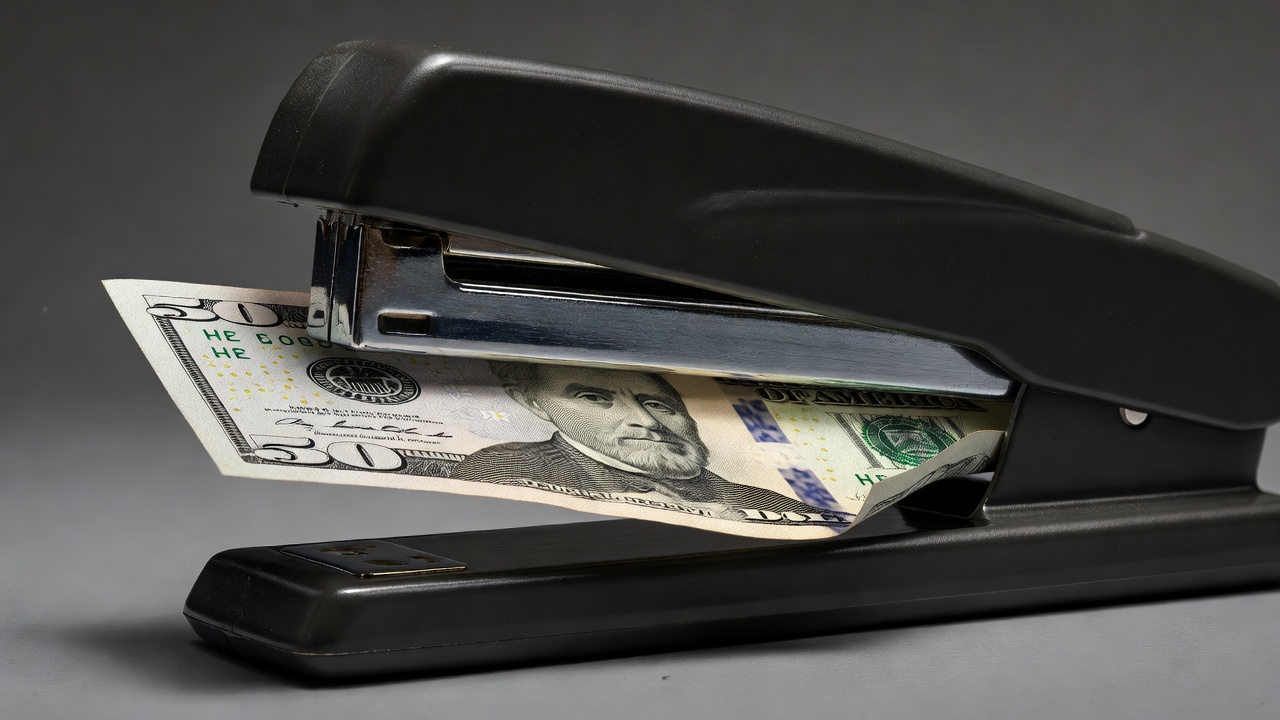
The physical result is a pair of small round or slightly elongated punctures, typically appearing 5 to 7 millimeters apart, caused by the two legs of a standard office staple. A single staple leaves two holes. Multiple staples multiply accordingly. In some cases the staple was removed but the paper fibers were pushed, torn, or displaced, creating a rougher edge around each puncture than a simple pinhole would show.
How Graders Actually Evaluate the Damage
Paper money graders assess staple holes along three separate axes: number, location, and severity of paper disturbance. These three factors combine to determine both whether a qualifier notation appears on the label and how many grade points the note effectively loses.
Number of Holes
A single staple, producing two small holes in the margin of an otherwise Extremely Fine note, may result in only a minor grade reduction or simply a qualifier notation with no numeric penalty at all. Two or three staples begin to compound the damage both visually and structurally. Five or more staple holes on a single note, which is not uncommon on notes that were bound into multi-year budget ledgers or accounting records, almost always result in a net grade well below what the paper quality and crispness would otherwise support. PMG’s published grading standards describe pinholes and staple holes as defects that can appear as a notation without affecting the numeric grade for very minor occurrences on lower circulated grades, but which carry increasing weight as the base grade rises.
Location, Location, Location
This is where many collectors are caught off guard. A staple hole in the extreme top margin of a Small Size Federal Reserve Note, well clear of the design, portraits, and serial numbers, is treated more leniently than the same hole placed through the portrait vignette, a serial number digit, or the Treasury seal. Graders at both PMG and PCGS Currency consider “design interruption” as an aggravating factor. A note with two staple holes punching directly through the center of a Lincoln portrait on a Series 1917 Legal Tender $5 will grade significantly lower than an identical note with the same holes appearing in the white border above the design.
When examining a raw note for potential submission, hold it up to a light source at an angle. Staple holes that pass completely through the note will show a pinpoint of light, while surface abrasions or counting machine marks will not. This quick test helps distinguish true punctures from superficial contact marks before you commit to grading fees.
The geographic center of a note is considered highest-priority real estate. Damage there affects the primary visual focal point and is weighted accordingly. Corners are slightly more forgiving than center, but still more penalized than margins. The very edge of the margin, particularly on notes with wide borders, is the least penalized location for staple damage, though it is never entirely ignored on high-grade material.
Severity of Paper Disturbance
Not all staple holes are created equal. A clean puncture from a fine-gauge staple leaves a relatively small, round hole with minimal surrounding fiber damage. A heavy staple forced through thick paper, or one that was yanked out sideways rather than lifted cleanly, can leave a torn, ragged opening with raised fibers, a slight crease radiating outward, or even a small missing chip of paper. This latter category is treated as meaningfully worse than a clean puncture of the same diameter. Graders will sometimes note whether holes show signs of attempted repair, including the application of clear tape or Japanese tissue from the reverse, which introduces an entirely separate set of grading considerations.
PMG vs. PCGS Currency: The Practical Differences
Both PMG (Paper Money Guaranty) and PCGS Currency use qualifier-based notation systems to flag staple holes on their labels. The holder will typically read something like “Very Fine 30, Staple Holes” or “Extremely Fine 40, Pinholes” depending on the service and the precise nature of the damage. However, the two services have historically approached the numeric impact of these qualifiers in subtly different ways, and collectors who submit to one versus the other based solely on perceived leniency may find the differences smaller than forum discussions suggest.
PMG’s Approach
PMG uses a net grading philosophy for significant defects. When staple holes are considered severe enough to affect the note’s desirability beyond a simple notation, the numeric grade itself is lowered to reflect the note’s actual market value relative to undamaged examples. A note that PMG graders assess as having the paper quality and fold characteristics of an Extremely Fine 45 but which carries four staple holes through the vignette area may be net-graded at Very Fine 35 or Very Fine 30 with a qualifier. For minor marginal staple holes on circulated notes below Very Fine 20, PMG frequently applies the qualifier notation without reducing the numeric grade, treating the holes as consistent with the note’s overall wear level.
PMG also distinguishes between “pinholes” and “staple holes” in its terminology. Pinholes, which are smaller and often associated with notes mounted in albums or records using straight pins rather than staples, tend to be treated slightly more leniently in the lower circulated grades. The distinction matters because the two types of holes are caused by different tools and carry different collector connotations.
If you are comparing two PMG-graded notes with the same numeric grade, check whether one carries a qualifier. A PMG VF35 without qualifiers is always preferable to a PMG VF35 with a “Staple Holes” notation, and the price difference on the secondary market can be substantial, sometimes 30 to 50 percent for key dates and scarce series.
PCGS Currency’s Approach
PCGS Currency similarly uses qualifier notations and net grading, but collectors have observed that PCGS graders sometimes apply qualifier notations on notes where PMG might net-grade instead, and vice versa. This is not a policy difference so much as a reflection of the inherent subjectivity in evaluating how much a given defect reduces a note’s appeal. PCGS Currency labels read clearly when qualifiers are applied, and the service’s online population reports allow collectors to track how frequently certain qualifier combinations appear for specific series and denominations, which is useful data when evaluating registry set competition.
One practical distinction worth noting: PCGS Currency has historically been somewhat more willing to straight-grade (assign a clean numeric grade without qualifier) notes with very minor, single-staple-hole damage in the far margins of heavily circulated small-size issues. This is an area where collector opinion is divided, with some viewing it as appropriate flexibility and others as inconsistency. Either way, it is worth understanding before deciding which service to use for a specific submission.
The Grade Impact by Starting Grade Level
The same staple hole damage does not cost the same number of grade points across all grade levels. The penalty is proportionally larger the higher the starting grade, because expectations for problem-free surfaces increase dramatically as notes approach Uncirculated and Gem status.
On a note grading in the Fine 12 to Very Fine 25 range, moderate staple hole damage in the margin may result in no numeric reduction at all, only a qualifier notation. On a note grading Very Fine 30 to Extremely Fine 45, the same damage typically reduces the numeric grade by 5 to 10 points while also applying a qualifier. On a note that would otherwise grade About Uncirculated 50 through Uncirculated 63, even minor marginal staple holes will almost certainly result in a net grade drop of 10 to 15 points plus a qualifier, because the presence of mechanical damage is fundamentally inconsistent with the uncirculated standard. A note that would grade Gem Uncirculated 65 or above with clean surfaces will almost never reach that tier with staple holes present regardless of their location, as the top tier standards require freedom from all significant defects.
When building a high-grade registry set, avoid purchasing raw notes described as “crisp” or “bright” without examining them under magnification and oblique light. Crisp paper does not rule out staple holes, and many problem notes have traveled from hand to hand for years with their damage overlooked by buyers who evaluated them only under direct overhead lighting.
Large Size Notes and the Staple Hole Problem
Large Size United States currency, issued from 1861 through 1928, is particularly susceptible to staple hole discoveries during grading because of how these notes were stored and used over the following decades. Many Large Size notes passed through government accounting offices, insurance company records, and bank archival files during the early twentieth century, where stapling was a standard administrative practice. Collectors pursuing high-grade examples of Series 1901 Legal Tender “Bison” $10 notes, Series 1914 Federal Reserve Notes in the higher denominations, or the large-format Gold Certificates should treat any raw example with extra scrutiny regarding staple damage before paying premium prices.
Small Size Star Notes and Scarce District Issues
Among Small Size Federal Reserve Notes, the notes most affected by the valuation gap between staple-holed and clean examples are those already carrying a premium for scarcity: low-print-run star notes, specific Federal Reserve district issues, and signature combination rarities. A 1928 $100 Federal Reserve Note with the Boston district (A) designation is scarce in any condition. A Boston $100 from that series with staple holes grades lower and sells for meaningfully less than a clean example at the same numeric grade, compressing the value of the rarity premium. Collectors building district type sets should factor this into their purchasing decisions.
| Series / Issue | Denomination and Type | Typical Grade Impact | Rarity (Clean Examples) |
|---|---|---|---|
| 1901 | $10 Legal Tender “Bison” | Net grade drops 10-15 pts in VF-EF range | Rare |
| 1914 | $50 FRN, Boston (A) or Dallas (K) | Net grade drops 5-10 pts; qualifier common | Rare |
| 1928 | $100 FRN, All Districts | Qualifier applied even for minor margin holes | Scarce |
| 1928-B | $2 Legal Tender, Star Note | Net grade drops 5-10 pts; clean examples command 40-60% premium | Key Date |
| 1934-A | $500 FRN, any district | Even single marginal hole results in qualifier; major net grade drop if central | Rare |
| 1918 | $2 FRN “Battleship,” any district | Qualifier nearly universal on estate-sourced examples | Scarce |
| 1995 | $1 FRN, Atlanta Star (F*) | Minimal impact below VF; significant in CU range | Key Date |
| 1880 | $100 Legal Tender, Large Red Seal | Net grade drops 15+ pts if holes through portrait | Key Date |
Can Staple Holes Be Professionally Conserved?
This is a question collectors ask frequently, and the answer is nuanced. Professional paper conservators can sometimes reduce the visual impact of staple holes by relaxing displaced fibers and re-adhering torn edges using archival-quality materials. In some cases this treatment is disclosed to and approved by the grading service as conservation rather than restoration, and notes that have undergone disclosed conservation can still achieve certified grades with appropriate notation. However, undisclosed alteration of staple holes, including filling them with paper pulp or covering them with adhesive, is considered restoration and will result in a “details” or “apparent” grade designation that significantly reduces the note’s market value. Collectors should never attempt home repair of staple holes and should be cautious when purchasing raw notes where holes appear to have been addressed in any way.
Before purchasing an expensive raw note described as having “minor” staple holes, ask the seller for high-resolution scans of both obverse and reverse under raking light. The reverse often reveals more about the severity of paper disturbance than the face of the note, since the staple legs entered from the front and pushed paper fibers outward on the back.
Conclusion: Know Before You Buy
Staple holes occupy a complicated position in paper money collecting. They are common enough that many collectors have learned to accept them on circulated material in affordable grades, but they are penalized sharply enough at the high end of the grading scale that a single pair of small holes can mean the difference between a $200 note and a $2,000 note. The practical takeaways are clear: examine every raw note carefully, understand that both PMG and PCGS Currency treat location and number of holes as primary variables, expect larger numeric penalties the higher the starting grade, and remember that the gap between a clean certified example and a qualified one widens considerably for scarce series and key dates. Treat staple holes not as a cosmetic nuisance but as a grading factor that demands the same careful attention you give to folds, creases, and paper quality.