
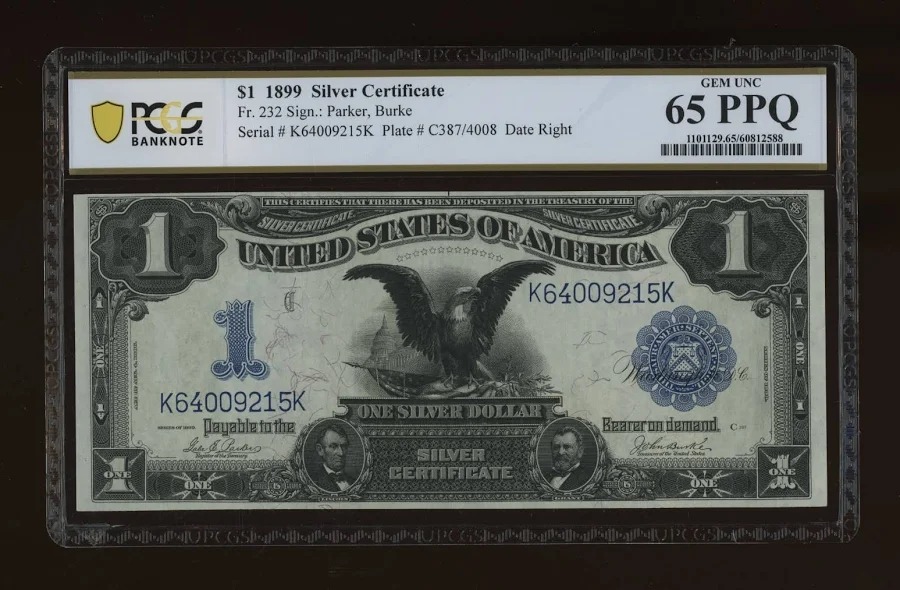
📷 Image source: Web image. Images are selected by AI to represent the article topic and may not depict the exact note(s) described.
Walk through any major currency show and you will hear the term “EPQ” dropped in conversation almost as often as the grades themselves. Dealers advertise it prominently, auction houses bold it in lot descriptions, and new collectors quickly learn that a 65 EPQ trades at a meaningful premium over a plain 65. Yet ask most collectors to define exactly what Exceptional Paper Quality means, and the answers get vague in a hurry. After years of submitting notes and studying third-party graded holders, the distinction between a note that earns EPQ and one that does not comes down to a surprisingly specific set of physical characteristics, and understanding those characteristics will change the way you evaluate every raw note you ever pick up.
The Origins of the EPQ Designation
Before third-party grading services formalized their standards in the early 2000s, currency grading was entirely subjective. A dealer might call a note “choice uncirculated” while a competing dealer looking at the same piece might say “about uncirculated due to counting smudges.” The paper itself, its original brightness, crispness, and freedom from chemical alteration, was folded into a single holistic grade with no separate notation.
Paper Money Guaranty launched its grading service in 2005 and introduced EPQ from nearly the beginning of its operations, recognizing that paper originality deserved its own notation separate from the fold and wear count that determines the numeric grade. PCGS Currency uses the term Premium Paper Quality, abbreviated PPQ, to describe the identical concept. For the purposes of this article the two terms are interchangeable; the criteria and collecting implications are the same.
The core insight behind EPQ is simple but important: two notes can have identical fold counts and identical centering, earning the same numeric grade, yet one can have paper that has been lightly pressed, cleaned with a solvent, or contaminated with a banker’s thumb grease, while the other retains every molecule of its original sizing and ink exactly as the Bureau of Engraving and Printing intended. The EPQ flag tells the buyer which note is which.
What Graders Are Actually Looking For
PMG’s published standards describe EPQ as requiring that a note display paper that is original and free from artificial enhancements. In practice, graders are evaluating several distinct physical properties simultaneously.
Original Paper Sizing and Stiffness
Currency paper produced by Crane and Company for the BEP contains a specific proportion of linen and cotton fiber with a surface sizing applied during manufacture. This sizing gives a fresh note its characteristic stiffness and that unmistakable “snap” when you flick the corner. When a note is pressed, whether with a household iron, a book press, or a professional currency press, the heat and pressure partially collapse the fiber structure and redistribute the surface sizing. The result is a note that looks flat and bright under casual inspection but feels limp or artificially stiff in a different way from original stiffness. Experienced graders detect this difference by lightly flexing the note and observing how the paper responds. A pressed note tends to lie dead flat without wanting to spring back; an original paper note has a subtle memory and resilience.
Freedom from Counting Smudges and Finger Oils
Bank tellers and Federal Reserve counting room workers handled notes in enormous quantities, and the oils from human skin transfer readily to cotton-linen paper. Under certain lighting conditions, especially raking light at a low angle, these smudges appear as subtle gray or iridescent patches, most commonly along the left and right edges where thumbs contacted the paper during counting. A note with visible counting smudges can still grade 65 for its fold characteristics but will not receive EPQ because the paper is no longer in the condition it left the BEP.
Before submitting a note, examine it under a single-bulb lamp held at a very low angle, about 10 to 15 degrees from the surface plane. Tilt and rotate the note slowly. Counting smudges, light folds, and solvent traces that are completely invisible under overhead light will jump out dramatically under raking illumination. This is precisely the technique graders use at their examination tables.
No Chemical or Solvent Treatment
The most damaging form of alteration from a collector standpoint, and one of the hardest to detect without experience, is solvent washing. Acetone, lighter fluid (naphtha), and various commercial paper cleaners have been used for decades to remove stains, lighten soiling, and improve a note’s visual appearance. These treatments can be extraordinarily subtle on casual inspection, but they typically leave telltale signs: a slightly chalky or washed-out appearance to the ink, areas where the surface sizing has been stripped leaving the paper with an oddly matte or absorbent look, and occasionally a faint chemical odor detectable when the note is inside a closed holder. PMG and PCGS Currency graders are trained specifically to identify solvent traces, and a treated note will not only be denied EPQ but may receive a “cleaned” or “altered” notation that dramatically depresses its value.
Paper Brightness and Color Originality
Federal Reserve Notes from the 1963 series through current production are printed on paper with red and blue security fibers embedded in a cream-white base. Over time, and especially with humidity exposure or storage near acidic materials, this paper can take on a yellowish or grayish cast. A note that retains its original bright white to cream color consistent with its series date demonstrates paper that has been stored properly and has not aged chemically. Graders compare the paper tone against reference examples for each series, since notes from 1928 have a naturally warmer cream tone than notes from 1988, and what is original for one series would be disqualifying for another.
Store high-grade notes in Mylar D or polyester currency sleeves, never in PVC-based plastics. PVC off-gasses plasticizers over time that deposit on paper surfaces, creating exactly the kind of chemical contamination that disqualifies notes from EPQ. Even a few years in a PVC album page can permanently damage a note’s chances of receiving the designation.
EPQ Across Different Series and Denominations
Not all series are equally easy to find with EPQ, and understanding these differences helps collectors set realistic expectations and recognize genuine finds.
Large-size notes from 1861 through 1928 present the greatest challenge. Paper from this era is more than 90 years old at minimum, and the combination of age, historical handling, and pre-modern storage conditions means that a large-size note earning EPQ at grade 64 or higher is genuinely exceptional. The 1899 Black Eagle Silver Certificate in high grade with EPQ, for example, commands prices that dwarf non-EPQ examples because the original paper quality tells buyers the note has had an unusually protected life.
Small-size notes from the 1928 through 1950 series are more commonly found in EPQ grades, but notes from this era that saw circulation through the banking system, particularly 1928 and 1934 series Federal Reserve Notes, often exhibit the counting smudges and edge handling that preclude EPQ. A 1934-A $1,000 Federal Reserve Note graded PMG 65 EPQ is a significant find precisely because most high-denomination notes of this era were handled extensively by banks before retirement.
Post-1963 series notes, with their modern paper formulations and more widespread collector awareness, appear in EPQ grades with much greater frequency. This does not make them less desirable; it simply means the premium for EPQ is proportionally smaller on common series and larger on scarcer ones.
The Marketplace Premium: How Much Does EPQ Actually Add?
The financial premium for EPQ varies considerably by series, denomination, and overall rarity. On a common 1977 $1 Federal Reserve Note graded 65, the difference between EPQ and non-EPQ might be modest, perhaps 15 to 20 percent, because the series is plentiful and many high-grade examples exist. On a 1928B $5 Legal Tender Note in grade 65, the EPQ designation can add 35 to 50 percent or more to the realized price, because original paper at that level is genuinely scarce.
Star note collectors pay particular attention to EPQ. Star replacements have smaller print runs and were often stored in BEP packaging that protected them better than circulated stock, meaning that EPQ stars in grade 65 or 66 are attainable for many series. Auction records consistently show that a 65 EPQ star note outperforms a 66 non-EPQ star note from the same series in competitive bidding, a powerful demonstration of how much the market values paper originality over a single numeric grade point.
| Series / Type | Denomination / Notes | EPQ Pop (Approx.) | Rarity |
|---|---|---|---|
| 1869 Rainbow Note | $1 Legal Tender, high-grade EPQ | Fewer than 10 known | Key Date |
| 1899 Black Eagle | $1 Silver Certificate, 65 EPQ+ | Under 30 PMG/PCGS combined | Rare |
| 1928 Series | $500 and $1,000 FRN, any EPQ | Fewer than 50 total | Rare |
| 1934-A | $100 FRN, 65 EPQ | Several hundred graded | Scarce |
| 1950 Series | $20 FRN all districts, 65 EPQ | Moderate population | Scarce |
| 1963 Series | $1 FRN, 66 EPQ | Large population | Common |
| 1976 Series | $2 FRN, 67 EPQ | Very large population | Common |
| 1995 Series | $1 FRN Star, Atlanta (F*), 65 EPQ | Under 200 graded EPQ | Rare |
| 1928-B | $5 Legal Tender, 65 EPQ | Fewer than 40 graded | Rare |
| 2003-A Series | $20 FRN, 68 EPQ | Readily available | Common |
Common Misconceptions About EPQ
One of the most persistent misconceptions is that EPQ guarantees a note is perfectly centered or free of manufacturing defects. It does not. EPQ speaks only to the originality and condition of the paper itself. A note can have a dramatic ink smear from the printing press, off-center margins, or even a small counting crease introduced at the BEP and still receive EPQ if the paper substance is original and unaltered. Conversely, a flawlessly centered note with perfect margins earns no EPQ bonus if the paper shows signs of pressing or chemical treatment.
Another misconception is that EPQ is available only on uncirculated notes. While in practice the designation appears almost exclusively on grades of 64 and above, because circulated notes by definition have handling wear that alters the paper, PMG’s standards do not categorically exclude lower grades. A circulated note with original paper and no artificial enhancement can technically earn EPQ, though such notes are rarely submitted and rarely discussed in the market.
When buying raw notes at shows with the intention of submitting them for grading, ask the dealer specifically whether the note has ever been pressed or stored in a currency album. Many dealers will answer honestly, and the ones who will not are telling you something important. A brief flex test, gently bowing the note slightly lengthwise and releasing it, can reveal the dead flatness characteristic of pressed paper before you commit to a purchase price based on EPQ expectations.
Developing Your Eye for Paper Quality
The best education available is direct comparison. If you have access to a PMG or PCGS Currency graded note with EPQ in the same series as a raw note you are evaluating, hold them side by side under identical lighting. The differences in paper resilience, ink reflectivity under raking light, and overall surface character become immediately apparent once you have a reference point.
Population reports from PMG and PCGS Currency, available on their respective websites, are invaluable research tools. Searching a specific series and denomination will show you how many notes have been graded at each level with and without EPQ, giving you a realistic sense of what to expect before you submit. A series where 90 percent of graded 65s carry EPQ is one where your raw note has good odds; a series where only 20 percent of 65s carry it demands more careful pre-submission evaluation.
Conclusion: EPQ as a Window Into a Note’s Life Story
The EPQ designation is more than a quality flag; it is a condensed biography of a banknote. A note that earns Exceptional Paper Quality at grade 65 or above has survived decades or even a century of potential mishandling, amateur cleaning attempts, and poor storage without suffering any of those insults. It came off the BEP’s printing presses, passed through Federal Reserve distribution, and arrived in a collector’s hands with its paper chemistry essentially intact. That is genuinely rare, and the market premium it commands reflects a legitimate scarcity.
For collectors building type sets or registry submissions, understanding EPQ criteria transforms the note-buying process from guesswork into informed evaluation. You are no longer just looking at a note; you are reading its paper the way an archivist reads a manuscript, looking for the signs of original condition versus intervention. Once that skill is developed, it becomes impossible to turn off, and your collection will be stronger for it.