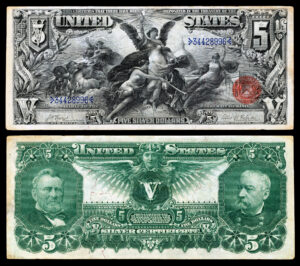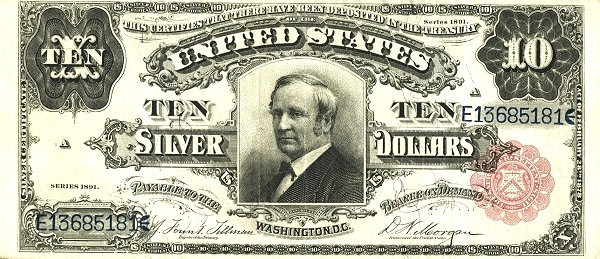
📷 Image source: banknote.ws (World Banknote Gallery). Images are selected by AI to represent the article topic and may not depict the exact note(s) described.
Few nineteenth-century notes capture the complexity of American currency design quite like the Series 1891 $1 Silver Certificate. Issued under the authority of the Sherman Silver Purchase Act of 1890, this series presents collectors with a genuinely rare situation: two completely different portrait subjects appearing on the same series designation, separated by a change in Treasurer of the United States signatures. On early printings, the stern visage of Edwin M. Stanton, Lincoln’s Secretary of War, graces the obverse. On later printings, Martha Washington takes his place, making her the only woman ever to appear on a circulated United States paper currency note at the one-dollar denomination. For collectors, this distinction transforms what might seem like a single series into two distinct collecting targets with vastly different availability and price points.
Historical Context: The Sherman Silver Purchase Act and Silver Certificate Expansion
To understand why the Bureau of Engraving and Printing was issuing freshly redesigned $1 Silver Certificates in 1891, you have to appreciate the political climate surrounding silver coinage in the post-Civil War decades. The Sherman Silver Purchase Act, signed by President Benjamin Harrison on July 14, 1890, required the Treasury to purchase 4.5 million ounces of silver per month, paying for it with Treasury notes redeemable in either gold or silver coin. This dramatically increased the volume of silver-backed currency in circulation, and the existing Series 1886 $1 Silver Certificates, featuring a portrait of Martha Washington on the face, were due for a redesign refresh aligned with the broader aesthetic reforms happening across all denominations.
The Series 1891 notes introduced a cleaner, more open reverse design compared to their 1886 predecessors. The back of the 1886 $1 Silver Certificate had featured an ornate, heavily engraved design with large numeral counters, while the 1891 reverse simplified to a more legible layout. This aesthetic shift was part of a BEP-wide campaign to reduce engraving costs and improve counterfeit detection through better contrast and clarity.
Edwin M. Stanton: The First Portrait Subject
When the Series 1891 $1 Silver Certificate first entered production, the portrait chosen was that of Edwin McMasters Stanton, who served as Abraham Lincoln’s Secretary of War from January 1862 through May 1868. Stanton’s placement on currency was not entirely surprising given his prominent role in prosecuting the Civil War and his later controversial clash with President Andrew Johnson during Reconstruction. His image appeared on the earlier Series 1890 $1 Treasury Note as well, giving him a brief but meaningful presence in late nineteenth-century American currency iconography.
The Stanton portrait on the Series 1891 $1 Silver Certificate is catalogued under Friedberg number 223 and corresponds to a single signature combination: Rosecrans-Nebeker (William S. Rosecrans as Register of the Treasury and James W. Nebeker as Treasurer of the United States). Rosecrans served as Register from 1885 to 1893, while Nebeker served as Treasurer from April 1891 to May 1892, giving this note a relatively narrow production window. The result is a note that is genuinely scarce in any grade and commands serious premiums in the marketplace.
The Fr. 223 Stanton note is among the most underappreciated key dates in the Silver Certificate series. Many collectors focus on the more recognizable Martha Washington notes, leaving the Stanton example overlooked. In grades of Very Fine 20 to Extremely Fine 40, these notes regularly trade for multiples of their published catalog values at major auction houses. Always examine the portrait carefully when evaluating any Series 1891 $1, since a misattributed Stanton note can represent a significant find.
The Transition to Martha Washington
Sometime during the printing run associated with the Rosecrans-Nebeker signatures, the BEP swapped the Stanton portrait for that of Martha Washington. The exact impetus for this change is not definitively documented in surviving BEP records, but numismatic historians generally attribute the decision to the same aesthetic and public relations considerations that had previously placed Martha Washington on the Series 1886 $1 Silver Certificate. There may also have been public sentiment favoring a return to her image, as she was broadly popular and recognized in a way that the more politically divisive Stanton was not.
Martha Washington’s portrait on these notes was engraved by Charles Burt, one of the most accomplished bank note engravers of the nineteenth century, who had also produced the image for the 1886 series. Her likeness is based on a Gilbert Stuart portrait, rendered with fine crosshatching and exceptional tonal range. The result is a portrait that holds up beautifully even in lower circulated grades, making these notes aesthetically compelling at virtually any condition level.
The Martha Washington type covers two signature combinations. The first is the continuation of Rosecrans-Nebeker (Fr. 224), representing the notes printed during the transition period when Nebeker was still serving as Treasurer. The second combination is Rosecrans-Morgan (Fr. 225), with Daniel N. Morgan serving as Treasurer from May 1892 through April 1893. Both Martha Washington varieties are considerably more available than the Stanton note, though choice and gem examples still attract competitive bidding at major sales.
When comparing Fr. 224 and Fr. 225, remember that print run estimates suggest the Rosecrans-Morgan (Fr. 225) version is slightly more common due to a longer production window. However, both notes are frequently encountered with heavy circulation wear. Original Uncirculated examples of either Martha Washington variety are the genuine prizes: look for bright paper with full margins, well-centered designs, and no evidence of pressing or cleaning. PMG and PCGS Currency holders with Original Paper quality designations add meaningful value.
Design Details Worth Knowing
Collectors who study these notes carefully will notice several consistent design elements across the Stanton and Martha Washington types. The obverse of all Series 1891 $1 Silver Certificates features the large red Treasury seal positioned to the right of the portrait, with the series designation and obligation text reading “This certifies that there have been deposited in the Treasury of the United States One Silver Dollar payable to the bearer on demand.” The serial numbers appear in red ink as well, consistent with the red-seal convention for Silver Certificates of this era.
The reverse design of the 1891 series uses a large, open ONE centered on the back, flanked by lathe work patterns and the words “Silver Certificate” in an arc above and “One Dollar” below. This reverse is considerably less ornate than the 1886 design, and collectors accustomed to the earlier series often find the 1891 back somewhat stark by comparison. However, this simplicity contributes to excellent legibility and provides a clean canvas that showcases the quality of surviving examples.
Paper quality is a persistent concern with 1891 $1 Silver Certificates. Notes from this era used a rag-based paper stock that ages well when stored properly but is extremely susceptible to heavy folds, tears, and the notorious “ink migration” effect where the red seal color can bleed into surrounding paper fibers over time. Notes with bright, unbled seals and original crispness are genuinely difficult to locate after more than 130 years.
Ink migration on the red Treasury seal is one of the most common grading deductions on Series 1891 $1 Silver Certificates. Under a loupe, examine the seal perimeter carefully: clean, sharp edges with no visible bleeding into the surrounding paper indicate a high-quality example. Third-party grading services will note seal migration in their comments, but independent examination before purchase is always worthwhile at this price level.
Grading Considerations Specific to This Series
The Series 1891 $1 Silver Certificate presents several grading challenges unique to its construction and circulation history. Because these notes were widely used in everyday commerce during the 1890s, the majority of surviving examples show significant wear. Fine 12 to Very Fine 20 represents the most commonly encountered grade range at auction and in dealer inventories. Extremely Fine examples (40 to 45) are genuinely scarce for all three Friedberg numbers, and anything grading Choice AU 55 or better is a legitimate rarity that commands strong collector interest.
Centering is another critical factor. The printing registration on 1891 $1 Silver Certificates was inconsistent by modern standards, and many notes show margins that are noticeably uneven. Top-centered notes, where the portrait sits close to the top border with wide bottom margin, are common, while perfectly centered examples with even margins on all four sides are the exception. Premium notes should have margins of at least 1.5mm on all sides to be considered acceptable by today’s competitive grading standards.
| Friedberg Number | Portrait / Signature Combination | Est. Known Examples | Rarity |
|---|---|---|---|
| Fr. 223 | Stanton / Rosecrans-Nebeker | Fewer than 60 known | Key Date |
| Fr. 224 | Martha Washington / Rosecrans-Nebeker | Several hundred estimated | Rare |
| Fr. 225 | Martha Washington / Rosecrans-Morgan | 500-800 estimated | Scarce |
| Fr. 223 (VF or better) | Stanton / Rosecrans-Nebeker, Choice Grade | Fewer than 20 known | Key Date |
| Fr. 224 (AU-UNC) | Martha Washington / Rosecrans-Nebeker, Uncirculated | Approximately 15-25 | Key Date |
| Fr. 225 (AU-UNC) | Martha Washington / Rosecrans-Morgan, Uncirculated | 30-50 estimated | Rare |
| Fr. 225 (VF-XF) | Martha Washington / Rosecrans-Morgan, Mid-Grade | Moderately available | Scarce |
Market Values and Where to Find These Notes
The Series 1891 $1 Silver Certificate market is active and well-documented through major auction records. The Fr. 223 Stanton note in Good to Fine condition typically realizes between $2,000 and $5,000, while choice Very Fine examples have brought $8,000 to $15,000 at Heritage, Stack’s Bowers, and Lyn Knight auctions over the past decade. The finest known Stanton examples, graded PMG 35 or better, are genuinely rare auction events that attract competitive bidding from advanced type collectors and specialists alike.
Martha Washington notes (Fr. 224 and Fr. 225) are far more accessible entry points for collectors building a Silver Certificate type set. Good to Fine examples of Fr. 225 can often be found in the $150 to $400 range through established dealers, while Very Fine examples trade in the $400 to $900 window depending on eye appeal, centering, and the quality of the seal color. The Fr. 224 Rosecrans-Nebeker Martha Washington commands a premium over the Fr. 225 in comparable grades, typically running 25 to 40 percent higher.
Building a complete set of all three Friedberg numbers from the Series 1891 $1 Silver Certificate is a realistic long-term goal for a serious collector with patience and a modest budget for the key date Stanton note. Start by acquiring choice examples of Fr. 224 and Fr. 225 first, as these appear regularly at auction and through currency dealers. Save your resources for the right Fr. 223 Stanton: a properly graded, problem-free example with original paper surfaces is worth waiting years to find rather than settling for a cleaned or pressed note just to fill the slot.
Conclusion: A Microcosm of Nineteenth-Century Currency History
The Series 1891 $1 Silver Certificate rewards the collector who takes the time to understand its nuances. In a span of less than two years of production, this single series designation encompassed a portrait change, two different Treasurers, three catalogued Friedberg numbers, and a range of availability from the genuinely rare to the moderately accessible. The presence of Martha Washington as the sole woman ever featured on a circulating United States currency note at the one-dollar denomination gives these notes a historical significance that extends well beyond pure numismatics. Whether you approach this series as a type collector filling an 1880s-1890s Silver Certificate album, a specialist focused exclusively on the Martha Washington portrait type, or an advanced collector hunting the elusive Stanton Fr. 223, the Series 1891 $1 Silver Certificate offers depth, history, and genuine collecting excitement at every level of the hobby.