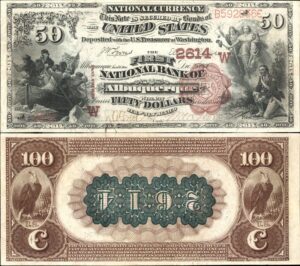
Flip a Series 1882 $100 National Bank Note Brown Back face-down on a velvet pad and you are immediately confronted with one of the most striking reverse designs ever placed on American paper money. A large, spread-winged bald eagle dominates the center field, perched above a shield and surrounded by an intricate lathe-work border. The deep brown ink that gives this series its collector nickname bleeds richly across the charter number and the Treasury seal on the face. These notes were issued between 1882 and approximately 1908, and the $100 denomination represents the high-water mark of the series in terms of both face value and scarcity. For collectors of National Bank Notes, the Brown Back $100 is a benchmark piece, one that separates the casual accumulator from the dedicated specialist.
Historical Context: Why the Brown Back Existed
The National Banking Acts of 1863 and 1864 created a framework under which federally chartered banks could issue their own currency backed by U.S. government bonds deposited with the Comptroller of the Currency. The Series 1875 notes had preceded the Brown Backs, featuring a distinctive red seal. When the Treasury Department updated the design in 1882, it introduced the brown overprint system, printing each bank’s charter number twice on the face in the same rich brown ink used for the Treasury seal. This was both an anti-counterfeiting measure and a cleaner visual approach that collectors today find immensely appealing.
The Bureau of Engraving and Printing produced these notes in sheets of four for denominations up to $50, but the $100 notes were printed in sheets of two, which immediately reduced the total number of sheets entering circulation. Combined with the high face value, which meant these notes circulated less aggressively among everyday transactions, and the passage of more than a century, surviving Brown Back $100 examples are genuinely rare across all issuing states.
The Eagle Reverse: Design Details Every Collector Should Know
The reverse vignette is the work of the Bureau of Engraving and Printing’s skilled craftsmen, based on a design that draws from the tradition of Columbian-era iconography. The eagle faces left, its wings fully extended in the heraldic display position. Beneath the eagle rests a union shield flanked by scrollwork. The border employs the fine-line geometric lathe patterns that the BEP perfected during the 1880s, patterns that were virtually impossible for counterfeiters using contemporary printing technology to replicate accurately.
The dominant color of the reverse is a warm olive-green, printed from two separate plate impressions to create depth. Collectors who examine these notes under magnification will notice that the cross-hatching on the eagle’s breast feathers shows incredible detail when the note grades Very Fine or above. In lower grades, the first areas to show wear are the eagle’s wing tips and the fine scrollwork at the upper corners of the border. A Brown Back $100 that grades Fine-12 is not a disappointment. It is a completely legitimate collector piece. Survivors in Very Fine or better condition are exceptional, and any example grading Extremely Fine-40 or above will command a premium that reflects true numismatic importance.
When examining a Brown Back $100 for grade, pay particular attention to the center fold. Most circulated examples show a single horizontal fold through the eagle’s body. Notes that avoided this fold entirely, or show only light vertical folds at the edges, will grade significantly higher and carry correspondingly stronger premiums at auction.
Face Design: The Benjamin Harrison Portrait and Signature Combinations
The face of the Series 1882 $100 National Bank Note features a portrait of Commodore William Bainbridge in some older catalog references, but current scholarship and official Bureau documentation confirm that the central vignette on the $100 Brown Back face is actually an allegorical figure representing commerce, flanked by counter numerals and the issuing bank’s title. The brown Treasury seal appears to the right of center, and the brown charter number overprint appears twice, once in the upper left field and once in the lower right. The obligation text names the issuing bank and state, making each note a unique artifact of that specific institution.
Signature combinations on Brown Back $100 notes span multiple Treasurer and Register pairings. The most commonly encountered combinations are Bruce-Gilfillan, Bruce-Wyman, Rosecrans-Jordan, Rosecrans-Hyatt, Rosecrans-Huston, Rosecrans-Nebeker, Tillman-Morgan, Tillman-Roberts, Bruce-Roberts, Lyons-Roberts, and Lyons-Treat. The Bruce-Gilfillan pairing represents the earliest production and is the scarcest signature combination on Brown Back $100 notes. Later pairings such as Lyons-Roberts are more frequently encountered simply because production volumes were higher during those years.
Signature combination scarcity on National Bank Notes is secondary to state and charter scarcity, but it is not irrelevant. A Bruce-Gilfillan signed $100 Brown Back from a common New York charter will still outperform a Lyons-Roberts example from the same bank, all else being equal. Always note the signature combination when cataloging your collection.
State Rarity Rankings: The Geographic Distribution of Survivors
National Bank Note collecting is fundamentally a geographic pursuit, and the Brown Back $100 illustrates state-level rarity more dramatically than almost any other issue. Because each note is tied to a specific chartered bank in a specific city and state, population reports from PCGS and PMG, combined with the landmark research of Don Kelly and the late John Hickman, allow us to construct reasonably accurate state rarity rankings for this series.
The eastern seaboard states, particularly New York, Pennsylvania, Massachusetts, and Ohio, issued Brown Back $100 notes through a large number of chartered banks, and surviving populations from these states, while still small in absolute terms, are the largest relative to other regions. New York alone had hundreds of nationally chartered banks active during the Brown Back period, and examples from large New York City institutions such as the First National Bank of New York occasionally appear at major auction houses.
Moving westward, the picture changes considerably. Midwestern states such as Illinois, Indiana, and Missouri have moderate surviving populations. The Great Plains states, Texas, and the mountain territories present a very different story. Many banks in these regions were chartered late in the Brown Back period, operated for only a few years, and issued small quantities of $100 notes before converting to later series or closing entirely. Notes from states such as Wyoming, Nevada, New Mexico Territory, and Arizona Territory are extraordinarily rare at the $100 denomination.
Southern states present a particularly poignant collecting challenge. The post-Civil War economic environment, combined with the devastation of Reconstruction and the financial panics of the 1890s, meant that many Southern national banks were short-lived. Brown Back $100 notes from states such as Mississippi, Arkansas, Florida, and South Carolina are among the rarest collectible large-size notes in all of American numismatics. Single-digit populations are not unusual for these states, and some issues may be unique.
Before bidding on a Brown Back $100 from a Southern or territorial state, consult the Charter Number section of Don Kelly’s “National Bank Notes: A Guide with Prices” and cross-reference the PMG and PCGS population reports. An apparently attractive price can be explained by undetected problems, questionable provenance, or simply a lack of recent comparable sales data for that specific charter.
Key Charters and Notable Examples
Within the Brown Back $100 series, certain individual charter numbers have achieved landmark status in the hobby. The First National Bank of Tombstone, Arizona Territory (Charter 4287), is one of the most famous territorial issuers, and any $100 Brown Back tied to a Tombstone charter would be a truly significant discovery. Similarly, national banks chartered in the Nevada silver mining towns of Virginia City and Carson City represent crossover appeal for both currency collectors and Western Americana enthusiasts.
On the opposite end of the accessibility spectrum, large Philadelphia and Boston charters provide more affordable entry points for collectors who want to own a genuine $100 Brown Back without spending five figures. The National Bank of Commerce of New York (Charter 733) and the Fourth National Bank of Philadelphia (Charter 1259) are examples of well-documented charters with multiple graded survivors, making comparative pricing more straightforward.
| State or Territory | Approximate Issuing Banks | Known Survivors (Est.) | Rarity |
|---|---|---|---|
| New York | 450+ | 150+ | Common (for series) |
| Pennsylvania | 380+ | 100+ | Common (for series) |
| Massachusetts | 190+ | 60+ | Scarce |
| Ohio | 310+ | 70+ | Scarce |
| Illinois | 250+ | 45+ | Scarce |
| Texas | 80+ | 12 to 18 | Rare |
| Mississippi | 25+ | 3 to 6 | Key Date |
| Arkansas | 20+ | 2 to 5 | Key Date |
| Wyoming Territory / State | 8 to 12 | 1 to 3 | Key Date |
| Arizona Territory | 5 to 8 | 0 to 2 | Key Date |
Grading Considerations and Market Values
The grading of National Bank Notes requires attention to factors not always emphasized in general currency grading guides. Paper quality is paramount because many of these notes were printed on rag-content paper that responds differently to folding and moisture than the paper used in later Federal Reserve issues. A Brown Back $100 with original paper quality, bright colors, and sharp margins will often grade higher than its fold count might suggest. Conversely, a lightly circulated example with even minor edge splits, rust stains from paper clips, or corner rounding will be penalized significantly.
In terms of market values as reflected in recent Heritage Auctions and Stack’s Bowers results, Brown Back $100 notes from common eastern states in Fine condition have realized between $1,500 and $4,000. The same notes in Very Fine can bring $6,000 to $12,000, and Extremely Fine examples have eclipsed $20,000. For rare state issues, grade is often secondary to availability: a Good-6 example from Arkansas or Wyoming may realize more than a Very Fine example from Pennsylvania simply because collector demand for the scarce state far exceeds the supply of any survivors regardless of condition.
Third-party grading through PCGS Currency or PMG is essentially mandatory for any Brown Back $100 purchase above $2,000. The holder provides not only grade verification but also confirms authenticity and protects the note from handling damage. Heritage Auctions and Stack’s Bowers both provide excellent realized price archives that are freely searchable and serve as the best real-world pricing reference for these notes.
Building a Brown Back $100 Collection: Strategies for Different Budgets
A collector with a modest budget who wants to own a genuine Brown Back $100 should target common eastern charters in grades Fine to Very Fine-20. These notes are historically significant, visually impressive, and authentically part of the series without requiring a five-figure outlay. As the collection matures and expertise grows, adding a moderately scarce state example, perhaps from Illinois or Missouri in lower circulated grades, brings the geographic diversity that makes National Bank Note collecting so rewarding.
Advanced collectors with deeper resources often approach Brown Back $100 collecting as a state set challenge, attempting to acquire at least one example from every state and organized territory that issued these notes. Completing such a set would represent one of the most ambitious achievements in large-size paper money collecting, and only a handful of collectors have ever assembled anything approaching completeness.
Conclusion: A Monument of the National Bank Note Era
The Series 1882 $100 National Bank Note Brown Back is not merely a collectible currency item. It is a tangible record of American commercial and banking history during one of the nation’s most transformative economic periods. The eagle reverse design, the brown charter number overprints, the surviving signature combinations, and above all the geographic stories embedded in each issuing bank’s charter, these elements combine to make every example a unique historical document. Whether you are drawn to the art of the engraver, the history of individual banks and their communities, or the pure challenge of assembling a geographically representative collection, the Brown Back $100 rewards serious study. Few pieces in all of American numismatics offer this depth of engagement at any price point.