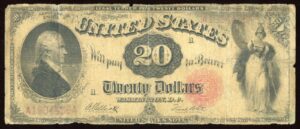
Walk into almost any major currency auction and you will see the usual suspects commanding headlines: the 1890 $1,000 Grand Watermelon, the 1869 $1 Rainbow Legal Tender, or perhaps a prized National Bank Note from a tiny territorial town. Rarely does the conversation turn to the Series 1890 $2 Treasury Note, a denomination so artistically ambitious and historically layered that its relative obscurity among collectors borders on criminal neglect. Yet those who study it closely will find a note that tells a fascinating story about post-Civil War monetary politics, Gilded Age engraving craftsmanship, and the brief, turbulent life of the Treasury Note class itself.
What Is a Treasury Note?
Before diving into the specifics of the $2 denomination, it helps to understand what Treasury Notes were and why they existed at all. Authorized by the Sherman Silver Purchase Act of July 14, 1890, Treasury Notes, also called Coin Notes, were a political compromise between hard-money advocates and the powerful silver mining lobby in the American West. The government agreed to purchase 4.5 million ounces of silver each month and to pay for that silver with these new notes, which were redeemable on demand in either gold or silver coin at the Treasury’s discretion. The Act was a partial victory for the silver advocates, who had wanted full free coinage, and it produced a distinctive and short-lived series of currency that collectors now prize.
Treasury Notes were issued in denominations of $1, $2, $5, $10, $20, $50, $100, $500, and $1,000. They were printed in two series: 1890 and 1891. The key visual distinction between the two series lies on the reverse. The 1890 backs feature intricate lacy engraving that fills nearly every inch of the design space, while the 1891 reverses were simplified considerably, reportedly because counterfeiters had an easier time reproducing the complex patterns than Treasury officials expected. This ornate 1890 reverse on the $2 is what collectors affectionately call the McPherson Back, named for the portrait subject on the obverse.
Who Was James B. McPherson?
The face on the $2 Treasury Note belongs to Major General James Birdseye McPherson, one of the Union Army’s most celebrated and mourned commanders of the Civil War. Born in 1828 in Clyde, Ohio, McPherson graduated first in his class from West Point in 1853 and rose rapidly through the ranks during the war, serving under both Ulysses S. Grant and William Tecumseh Sherman. He commanded the Army of the Tennessee during the Atlanta Campaign and was killed in action near Atlanta on July 22, 1864, becoming the only Union Army commander at army level to be killed in combat during the war. Sherman reportedly wept openly upon hearing the news.
McPherson’s appearance on currency was a tribute to his status as a national hero. His portrait on the $2 Treasury Note was engraved by the Bureau of Engraving and Printing from a photograph, rendered in the meticulous stipple-and-line technique that characterized the finest BEP work of the era. The result is a dignified, three-quarter facing portrait framed by elaborate lathe work and geometric patterns that make the note feel more like a piece of fine art than a circulating medium of exchange.
When examining a Series 1890 $2 Treasury Note, use a loupe to inspect the fine detail of McPherson’s uniform epaulettes and the cross-hatching in his coat. These areas are often where cleaning or pressing shows up first, because the intricate engraving lines are easily disturbed. A genuinely uncirculated example will show sharp, crisp lines throughout these zones.
The Design: Understanding the McPherson Back
The reverse of the Series 1890 $2 note is arguably the most complex two-dollar back design in the entire history of American large-size currency. The dominant feature is a large guilloche-style oval at center enclosing the denomination numeral “2” surrounded by lathe-work rosettes. Flanking this central cartouche are two vertical panels filled with micro-geometric engine-turned patterns, the kind of intricate mechanical engraving normally associated with bank note security printing in Europe. The overall visual effect is one of barely controlled complexity, dense but balanced, every space filled yet never chaotic.
The words “TREASURY NOTE” arc across the top of the reverse, while “TWO DOLLARS” appears in large block letters below the central oval. The phrase “RECEIVABLE FOR CUSTOMS, TAXES, AND ALL PUBLIC DUES” runs in two lines, reinforcing the note’s legal tender status for government obligations. The ink colors on genuine examples show a distinctly warm, slightly olive-tinged green that differs subtly from Silver Certificate or Legal Tender reverses of the same period, a detail that experienced collectors use as one authentication benchmark.
On the obverse, the large brown Treasury seal appears to the right of McPherson’s portrait on Series 1890 examples (Fr. 353 and Fr. 354). The seal shifted to red on the Series 1891 $2 notes, making seal color the fastest visual sorting tool when examining these notes in a dealer’s binder.
Signature Combinations and Friedberg Numbers
The Series 1890 $2 Treasury Notes were issued with two signature combinations, each assigned its own Friedberg catalog number in the standard reference work by Arthur L. and Ira S. Friedberg:
- Fr. 353: Signatures of Rosecrans (Register) and Huston (Treasurer). William S. Rosecrans, the Civil War general turned politician, served as Register of the Treasury from 1881 to 1893. Enos H. Huston served as Treasurer from 1889 to 1891. This is the more common of the two 1890 signature pairings.
- Fr. 354: Signatures of Rosecrans (Register) and Nebeker (Treasurer). Huston was replaced by James N. Nebeker in April 1891, and notes signed by Nebeker with the 1890 series date are scarcer because the transition to the simplified 1891 series happened relatively quickly thereafter.
Both Friedberg numbers share the same basic design but differ considerably in survival rates and collector demand. Fr. 354 commands a premium of roughly 25 to 40 percent over Fr. 353 in comparable grades, a spread that narrows in very fine grades and widens considerably in uncirculated condition where Fr. 354 specimens are genuinely elusive.
Always cross-reference a Series 1890 $2 Treasury Note’s serial number range against known Treasury records when evaluating a purchase. Serial numbers on Fr. 353 notes typically fall in ranges beginning with low numerals, while Fr. 354 examples appear later in the sequence. Discrepancies between the printed signatures and the serial number range can indicate a doctored or misattributed note.
Serial Numbers, Print Quantities, and Survival Estimates
Precise print run figures for Treasury Notes are harder to nail down than for some other large-size series because Treasury Department records from the 1890s are incomplete. However, numismatic researchers, most notably those compiling data for the Whitman Encyclopedia of Large-Scale United States Paper Money, have reconstructed approximate figures from appropriations records and audit reports.
Total production for Fr. 353 is estimated at approximately 2,856,000 notes. Fr. 354, issued during the much shorter window between Nebeker’s appointment in April 1891 and the retooling to Series 1891 designs, had a far smaller print run estimated at approximately 1,200,000 notes. Given that Treasury Notes of this period circulated heavily as everyday commerce notes and were frequently redeemed for coin (often worn to tatters in the process), survival rates are low. Population reports from PCGS Currency and PMG combined show fewer than 200 graded examples of Fr. 353 across all grades, and fewer than 80 for Fr. 354, though ungraded examples in private collections certainly add to those totals.
In circulated grades, say Very Good to Very Fine, Fr. 353 notes trade in the range of $400 to $900 at retail, depending on eye appeal and centering. Fr. 354 in the same grade range typically brings $700 to $1,400. Extremely Fine examples of Fr. 353 have sold at major auctions for $1,500 to $2,500, while Fr. 354 in EF has cleared $3,000 at Heritage Auctions and Stack’s Bowers. Uncirculated examples of either variety are rare enough that auction appearances make news in numismatic circles, with Fr. 353 in Choice CU (PMG 64 or PCGS 64) reaching $8,000 to $12,000, and Fr. 354 in similar grade potentially exceeding $18,000 depending on the bidding room.
Authentication and Common Problems
The Series 1890 $2 Treasury Note is not commonly counterfeited in the modern sense, but it does appear in three problematic forms that collectors should guard against. First, heavily circulated examples are sometimes cleaned with chemical solutions to brighten the paper and simulate a higher grade. Cleaned notes display an unnatural uniformity of color across the face and back, and the paper loses the slight tooth or texture that genuine, uncirculated large-size paper retains. Under ultraviolet light, cleaned notes often fluoresce irregularly.
Second, pressed notes are a persistent problem. A circulated note with folds and creases can be professionally pressed to eliminate the folds, creating what appears to be an uncirculated surface. However, pressing cannot restore the paper fibers themselves, and careful examination under raking light will reveal ghost fold lines or disturbed fiber patterns. Third, a small number of period-era counterfeits exist in collector holdings, most identifiable by slightly muddy engraving detail, incorrect paper weight, and off-color ink on the reverse. Genuine notes were printed on distinctive fiber-embedded paper supplied to the BEP under strict contract.
Submit any Series 1890 $2 Treasury Note you are considering at a price above $500 to either PMG or PCGS Currency for third-party grading before purchase, or insist that the seller provide a graded, slabbed example. The cost of grading is modest relative to the note’s value, and the peace of mind regarding authenticity and grade is well worth it at this price point.
| Friedberg Number | Signatures | Est. Print Run | Rarity |
|---|---|---|---|
| Fr. 353 | Rosecrans / Huston (1890) | ~2,856,000 | Scarce |
| Fr. 354 | Rosecrans / Nebeker (1890) | ~1,200,000 | Rare |
| Fr. 355 | Rosecrans / Nebeker (1891) | ~3,600,000 | Scarce |
| Fr. 356 | Tillman / Morgan (1891) | ~2,400,000 | Scarce |
| Fr. 357 | Bruce / Roberts (1891) | ~960,000 | Rare |
| Fr. 353 (CU) | Rosecrans / Huston, Uncirculated | Survivors est. under 15 | Key Date |
| Fr. 354 (CU) | Rosecrans / Nebeker, Uncirculated | Survivors est. under 8 | Key Date |
| Fr. 357 (Any Grade) | Bruce / Roberts (1891) | Survivors est. under 30 | Key Date |
Why Collectors Overlook the $2 Treasury Note
The neglect of the Series 1890 $2 Treasury Note is partly a function of how collectors organize their pursuits. Most type collectors building a representative set of large-size currency focus first on completing a single example of each major currency class: a Legal Tender, a Silver Certificate, a Gold Certificate, a Federal Reserve Note, and so on. Within Treasury Notes, the natural entry points are the dramatically named $1 Grand Watermelon (Fr. 347, with its distinctive large numeral zeroes on the back resembling watermelons), the imposing $1,000 notes, or the $5 with General George Thomas on the obverse. The $2 falls into an awkward middle ground: not as affordable as circulated $1 examples, not as spectacular in size or iconography as the high-denomination notes, and sharing a denomination with the more commonly discussed Series 1891 $2 Silver Certificates featuring Robert Fulton and Samuel Morse.
Additionally, the $2 denomination has historically carried a mild cultural stigma in American life, sometimes associated with bad luck or unusual transactions, which paradoxically reduced its circulation life compared to $1 and $5 notes but also reduced the number of examples saved by the general public. Treasury Notes as a class were eliminated entirely when President Grover Cleveland repealed the Sherman Silver Purchase Act in November 1893, meaning the entire series had a production window of barely three years, further limiting total populations.
Building a Treasury Note Type Set Around the $2
For collectors who want to incorporate the Series 1890 $2 into a broader display or type set, several logical frameworks work well. One appealing approach is to build a complete two-dollar denomination type set across all large-size series, which would include a Series 1869 $2 Legal Tender (Fr. 41, the beautiful Rainbow Note), a Series 1896 $2 Silver Certificate Educational Note (Fr. 247, one of the most celebrated designs in American currency), the Series 1890 $2 Treasury Note, and perhaps a Series 1918 $2 Federal Reserve Bank Note (Fr. 750 through 809, available from twelve districts). This four-note set tells the complete story of the two-dollar denomination across the large-size era and makes for a visually stunning display.
Another framework is a Treasury Note type set across denominations, collecting one circulated example each of the $1, $2, $5, $10, $20, $50, and $100 Treasury Notes, skipping the stratospheric $500 and $1,000 which are realistically beyond most collectors’ budgets. This set can be assembled patiently over several years for a total investment of $3,000 to $8,000 in mid-circulated grades, and it represents an honest cross-section of one of American currency’s most politically charged and aesthetically rich series.
When shopping for Series 1890 $2 Treasury Notes at paper money shows or through dealer networks, ask specifically about centering. Many surviving examples are noticeably off-center because the printing tolerances at the BEP in 1890 were less precise than modern standards. A well-centered example with margins roughly equal on all four sides commands a meaningful premium and will be significantly more desirable when you eventually sell or trade.
Conclusion: A Note Worth Rediscovering
The Series 1890 $2 Treasury Note with the McPherson Back deserves a far more prominent place in collector conversations than it currently occupies. It combines genuinely scarce survival numbers, historically significant portraiture, one of the most technically accomplished reverse designs in large-size American currency, and a compelling backstory rooted in the silver politics of the Gilded Age. Whether you are a new collector looking for an affordable entry point into the Treasury Note series, or a seasoned numismatist seeking to add a legitimately rare variety to a mature collection, Fr. 353 and Fr. 354 offer a rewarding pursuit.
General McPherson gave his life for his country on a Georgia battlefield and was honored with a place on American currency that has, over the years, faded from collector memory much as battlefield monuments fade under seasons of weather. Bringing one of these notes back into a well-curated collection is a small act of numismatic justice, and one that the market may yet reward handsomely as Treasury Note specialists continue to compete for the shrinking pool of quality survivors.