📷 Image source: Wikimedia Commons. Images are selected by AI to represent the article topic and may not depict the exact note(s) described.
A Window Into the Gilded Age of American Banking
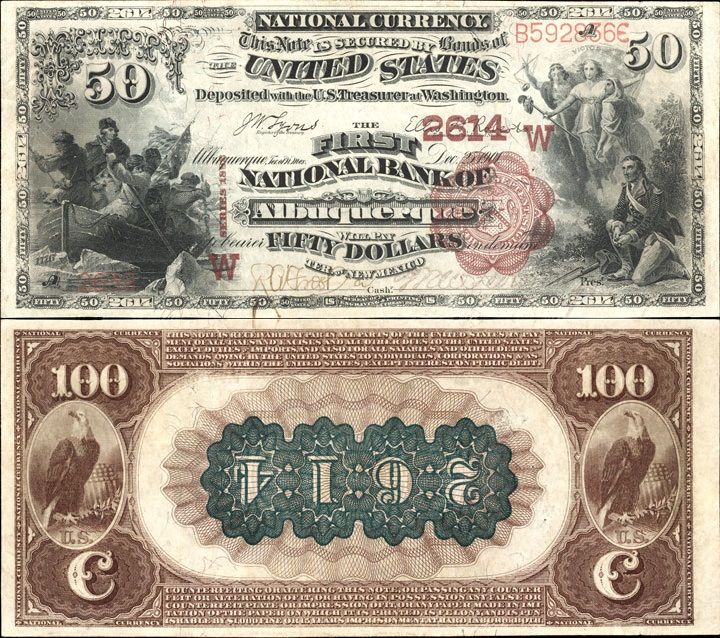
Walk into any serious currency auction today and the sight of a Series 1882 $50 Brown Back National Bank Note commands attention. These large-format beauties, measuring roughly 7.375 by 3.125 inches, represent the second charter period of National Bank Notes and carry with them the full weight of late 19th-century American commerce. Issued between 1882 and approximately 1908, the Brown Back series was printed across all twelve Federal Reserve districts before the Reserve system even existed, distributed instead through the network of nationally chartered banks that stretched from coastal cities to prairie farming towns. The $50 denomination, always a high-value note in circulation terms, survives today in smaller numbers than its $1, $2, $5, and $10 counterparts, making every known example a meaningful piece of the census.
Understanding the Brown Back Design
The defining characteristic that sets the Brown Back apart from the other two varieties of the Second Charter period (the Date Back and the Value Back) is the reverse design. The back of the note features an intricate geometric lathe-work pattern printed in rich brown ink, with the bank’s charter number prominently displayed within an ornate cartouche. This design replaced the elaborate vignettes of the First Charter period and gave the series its collector nickname. On the face, the $50 denomination carries a portrait of Edward Everett, the Massachusetts statesman and orator, centered on a green-tinted field, flanked by the issuing bank’s name, state, charter number, and the signatures of both the bank’s own officers and the Comptroller of the Currency or Treasurer of the United States.
The Treasury signatures on Brown Back National Bank Notes cycle through several combinations, and these pairings correspond to specific Friedberg catalog numbers. The earliest notes bear the Bruce-Gilfillan signatures (Fr. 567), followed by Bruce-Wyman (Fr. 568), Rosecrans-Jordan (Fr. 569), Rosecrans-Hyatt (Fr. 570), Rosecrans-Huston (Fr. 571), Rosecrans-Nebeker (Fr. 572), Rosecrans-Morgan (Fr. 573), Tillman-Morgan (Fr. 574), Tillman-Roberts (Fr. 575), Bruce-Roberts (Fr. 576), Lyons-Roberts (Fr. 577), Lyons-Treat (Fr. 578), and Vernon-Treat (Fr. 579). Among these, the Rosecrans-Jordan and Rosecrans-Hyatt pairings are the scarcest, as they correspond to the earliest transition years of 1882 through 1884, when many banks had not yet printed significant quantities in the larger denominations.
When examining a Brown Back $50, always verify the Treasury signature combination against the Friedberg number listed in the auction catalog. Early Bruce-Gilfillan examples (Fr. 567) from small-town banks in the South or Midwest can sell for double or triple the price of more common Lyons-Roberts examples from the same region, simply due to the signature scarcity.
How Many Survive? A State-by-State Perspective
The Comptroller of the Currency’s records and decades of census-building by organizations like the Society of Paper Money Collectors (SPMC) and the National Bank Note Census project have given modern collectors a reasonably clear picture of survival rates. However, the numbers are humbling. Across all states and territories, fewer than 1,500 Series 1882 $50 Brown Back National Bank Notes are believed to be documented in collector hands today. That figure includes every grade from Good-4 to the rare Gem Uncirculated example.
New York dominates the census as expected, with large metropolitan banks like the National Park Bank of New York (Charter 891) and the Merchants National Bank of New York (Charter 1370) having issued substantial quantities. Approximately 180 to 220 known examples trace back to New York state issuers, with a meaningful portion of those coming from New York City charters. Pennsylvania follows, driven by Philadelphia banking giants and a dense network of smaller interior charters in cities like Pittsburgh, Harrisburg, and Lancaster. Ohio, Illinois, and Massachusetts round out the top five, each contributing between 80 and 130 known survivors across all grades.
The more compelling collecting stories, however, come from the lower-population states. A $50 Brown Back issued by a bank in Wyoming Territory, Dakota Territory, or New Mexico Territory represents an extraordinary rarity. The Territory of Arizona produced only a handful of National Bank Note $50 denominations in Brown Back form across all issuing banks combined, and verified examples in Fine or better condition have appeared at public auction fewer than ten times in the past two decades. Similarly, Nevada, with its sparse banking infrastructure during the 1880s and 1890s, contributes only a handful of known $50 Brown Backs to the census, many of which survive only in heavily circulated Good to Very Good grades.
State-collector specialists should prioritize networking through the SPMC and regional currency clubs. Many privately held Brown Back $50 notes from rare states have never appeared at major auction and surface only through private treaty sales or estate dispersals. Building relationships in these communities can give you first access to notes that never hit the public market.
Regional Survival Patterns and Why They Matter
The geography of survival is not random. Several factors concentrate known examples in specific areas. First, large cities produced more notes simply because their banks had higher capitalization requirements and circulated more currency. Second, urban areas also had more sophisticated note-collecting communities in the early 20th century, meaning that when these notes were withdrawn from circulation after the National Bank Note era ended in 1935, local collectors were more likely to preserve them. Third, some regions experienced bank failures and consolidations that destroyed records and returned notes to the Treasury for destruction, while others saw their notes quietly accumulate in family files and local archives.
The Southern states present a particularly interesting case. Post-Civil War economic disruption limited the number of nationally chartered banks in states like Mississippi, Alabama, and Arkansas during the 1880s, meaning fewer banks issued $50 Brown Backs in the first place. When those banks did issue them, high face value relative to average wages meant the notes circulated hard before wearing out, leaving few in collectible grade. A Fine-15 example from a Mississippi issuer is genuinely more impressive numismatically than an Extremely Fine $50 from a New York bank, even though the market often prices the condition premium first.
New England offers a contrasting picture. Connecticut, Massachusetts, and Rhode Island each had dozens of well-capitalized national banks, and the cultural tradition of careful record-keeping and attic preservation in older New England homes has contributed disproportionately to the available census. Boston-area bank notes in particular appear regularly in Fine and Very Fine grades at major currency sales.
What Does Fine Grade Mean for This Issue?
For a Series 1882 $50 Brown Back, a Fine-12 grade from PMG or PCGS Currency means the note has seen honest circulation but retains clear, readable detail throughout. The portrait of Edward Everett will show slight wear on the high points. Folds will be visible, typically three to five vertical or horizontal folds, and the paper may show minor soiling at the margins. Critically, for Brown Backs, the brown charter number on the reverse must still be legible and not faded to illegibility. A Fine note should also retain most of its original crispness in the paper body, without the limpness or heavy handling associated with Very Good grades.
Fine-15, the upper boundary of the Fine range, is the sweet spot many intermediate collectors target. At Fine-15, the note has just enough detail retention to appreciate the full design while remaining comfortably accessible in price compared to Very Fine or Extremely Fine examples. For most state issues other than the absolute rarest territories, Fine-15 is the realistic floor for a presentable collection piece.
Always examine the brown ink on the reverse charter number before purchasing an unholdered Brown Back $50. This ink is chemically distinct from the rest of the note and is susceptible to fading from water exposure or improper storage. A note that appears Fine on the face may have a severely faded reverse that dramatically reduces desirability. PMG and PCGS notes with comments like “ink fading” or “edge splits” can trade at 30 to 50 percent below clean examples of the same grade.
Price Expectations in Fine Grade: Current Market Reality
Pricing a Series 1882 $50 Brown Back in Fine grade is not a one-size-fits-all exercise. The issuing bank, its state, the charter number, the signature combination, and the specific condition within the Fine range all feed into realized prices. That said, patterns have emerged across auction results from Heritage Auctions, Stack’s Bowers, Lyn Knight, and Spink in recent years.
For common-state issuers from New York, Pennsylvania, Ohio, Illinois, and Massachusetts with the prevalent Lyons-Roberts (Fr. 577) or Tillman-Morgan (Fr. 574) signatures, Fine-12 examples have been selling in the range of $800 to $1,400. Fine-15 examples from the same tier push to $1,200 to $2,000, with attractive looking notes from recognized larger city banks commanding the upper end. These prices reflect the period from 2021 through early 2024 and represent a modest appreciation from the 2015 to 2018 range of $600 to $1,200.
Mid-tier states like Minnesota, Missouri, Iowa, Wisconsin, and Virginia see Fine-grade $50 Brown Backs selling in the $1,500 to $3,500 range, with attractive examples from smaller chartered banks occasionally pushing higher. A Fine-15 from a one-note-known issuer in rural Iowa or upstate Virginia can realistically achieve $4,000 to $6,000 at a well-attended sale even in grades that might fetch $1,800 for a common bank.
For genuine rarities from states like Nevada, Montana, Wyoming, the Indian Territory, and the various organized territories, Fine examples are exceptional events. A Fine-12 Brown Back $50 from a Wyoming territory bank sold at Heritage in 2022 for slightly over $14,000. A similar note from an Arizona Territory issuer achieved $18,500 in a specialized currency session the following year. These are not annual events, but they illustrate the dramatic premium the market places on territorial and low-population-state issuances regardless of grade.
| State or Territory | Approx. Known in All Grades | Fine-Grade Price Range | Rarity |
|---|---|---|---|
| New York | 180 to 220 | $800 to $2,000 | Common |
| Pennsylvania | 140 to 170 | $900 to $2,200 | Common |
| Massachusetts | 90 to 130 | $1,000 to $2,500 | Common |
| Ohio | 85 to 120 | $1,000 to $2,800 | Common |
| Minnesota | 40 to 65 | $1,500 to $3,500 | Scarce |
| Virginia | 35 to 55 | $1,800 to $4,500 | Scarce |
| Montana | 12 to 20 | $5,000 to $10,000 | Rare |
| Nevada | 8 to 14 | $8,000 to $16,000 | Rare |
| Wyoming Territory | 5 to 9 | $12,000 to $20,000 | Key Date |
| Arizona Territory | 4 to 7 | $15,000 to $25,000+ | Key Date |
Signature Combinations and Their Relative Scarcity
Beyond geography, the Treasury signature combination printed at the lower left and lower right of the face represents a secondary scarcity driver that sophisticated collectors study carefully. As noted above, the Fr. 567 Bruce-Gilfillan pairing represents the earliest Brown Back $50 notes and survives in the smallest quantities. Population reports from PMG and PCGS Currency show that fewer than 60 examples with Bruce-Gilfillan signatures have been certified across all issuing states, compared to over 400 certified examples with the more common Lyons-Roberts pairing (Fr. 577).
The Rosecrans-Jordan (Fr. 569) and Rosecrans-Hyatt (Fr. 570) combinations are also rare enough to command meaningful premiums. A common-state issuer with an uncommon signature combination in Fine grade can easily out-price a rare-state issuer with common signatures, and savvy collectors play this dynamic to their advantage when budgets are constrained.
Conclusion: Building a Position in These Notes
The Series 1882 $50 Brown Back National Bank Note sits at a fascinating intersection of affordability and genuine rarity. For collectors entering at the Fine grade level, common-state examples remain accessible at under $2,000, providing a meaningful foothold in a historically significant issue. Mid-tier state examples in Fine offer excellent long-term collecting satisfaction and reasonable appreciation potential as census populations are well-defined and new discoveries rare. And for those with the patience and budget to pursue territorial and low-population-state examples, even a single Fine-grade note from Arizona Territory or Wyoming Territory represents a collection centerpiece that could anchor a specialized National Bank Note holding for decades. The Brown Back $50 rewards research, patience, and an appreciation for the dense web of American banking history embedded in every surviving example.