📷 Image source: banknote.ws (World Banknote Gallery). Images are selected by AI to represent the article topic and may not depict the exact note(s) described.
Walk into any serious currency auction and you will find at least one lot featuring Benjamin Franklin. He has graced the $100 denomination in virtually every major series since the Civil War era, making him the most continuously represented non-president in American paper money history. Yet most collectors, even experienced ones, treat “the Franklin” as a monolithic image. The truth is that the Bureau of Engraving and Printing produced at least six distinct engraved portraits of Franklin over roughly 140 years, each reflecting the artistic conventions, security priorities, and printing technologies of its time. Understanding those differences transforms a simple denomination collection into a rich study in American engraving history.
The Source Image: Why Duplessis Matters to Collectors
Before comparing individual notes, every collector should understand the artistic foundation. The primary source for virtually every BEP engraving of Franklin is the 1778 oil portrait by French court painter Joseph-Siffred Duplessis, now held at the Metropolitan Museum of Art. Franklin sat for Duplessis in Paris while serving as American minister to France, and the resulting image, showing Franklin at roughly age 72 in a plain brown coat with his characteristic long hair and calm gaze, became the definitive representation of the Founding Father.
The BEP did not slavishly copy Duplessis across every issue, however. Engravers interpreted the source through their own hands, adjusting the angle of the head, the depth of the fur-collar detail on certain large-size notes, the sharpness of the eyes, and the treatment of background shading. These subtle differences are exactly what make portrait comparison so rewarding, and occasionally so important for authentication.
Portrait Era One: Large-Size Legal Tender and Treasury Notes, 1869 to 1880
Franklin first appeared on United States currency in the Series of 1869 $100 Legal Tender Note (Friedberg 168), known affectionately to collectors as the “Rainbow” note for its multi-colored reverse. The obverse portrait is positioned at the left, engraved in a relatively small oval vignette. The engraving style is characteristic of the post-Civil War American Bank Note Company influence that the BEP was absorbing into its own production: fine, almost delicate line work, a slightly three-quarter facing angle, and considerable detail in Franklin’s hair flowing behind his collar. In high grades, XF-45 and above on the PMG or PCGS scale, the face shows strong definition; in circulated grades below VF-20, the portrait often wears first at the cheekbone highlight and the hair curl above the left ear.
The 1874 through 1880 Legal Tender issues (Friedberg 169 through 171) used a refined version of the same basic die, with the portrait remaining at left but the surrounding lathe work becoming more elaborate. Collectors should note that Friedberg 169 carries a distinctive red seal and is considerably scarcer than the 1880 issues with their large brown seals; auction records in PMG VF-30 show Friedberg 169 regularly bringing $4,000 to $6,500, while Friedberg 171 in similar grades trades around $1,800 to $2,800.
When examining large-size Franklin portraits from the 1869 to 1880 Legal Tender series, use a 5x loupe to inspect the hair strands above Franklin’s right temple. On genuine notes, individual engraved lines are distinct and slightly irregular. On early-era counterfeits and on photographically reproduced fakes, those lines appear even and mechanically uniform under magnification.
Portrait Era Two: Large-Size Gold Certificates, 1882 to 1922
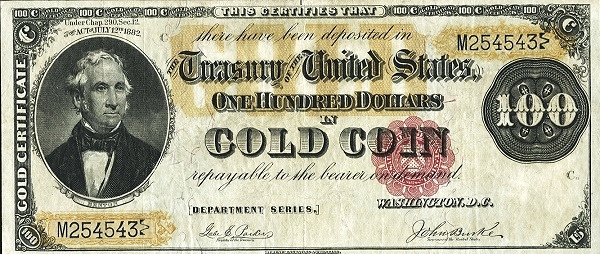
The large-size Gold Certificate series gave Franklin his most dramatic 19th-century portrait treatment. The Series of 1882 $100 Gold Certificate (Friedberg 1200 through 1215, depending on signature combination) features a new engraving that places Franklin’s portrait centrally on the obverse, larger than any previous rendition, against a bright yellow-orange tinted background. The BEP’s engravers introduced a fur or heavy-cloth collar detail not prominent in the Legal Tender issues, likely drawing on an engraving tradition that softened the stark simplicity of the Duplessis pose.
The 1882 Gold Certificates are among the most visually striking of all American large-size notes. The portrait’s eyes carry an intensity that collectors and dealers often call “piercing,” a result of careful cross-hatching in the iris area. Signature combinations significantly affect value: the Bruce-Gilfillan pairing (Friedberg 1200) is the rarest of the 1882 issues, with PMG VF-25 examples selling for $18,000 to $30,000 at major auctions. The later Teehee-Burke combination on the Series of 1922 (Friedberg 1215) is far more accessible at $2,500 to $4,500 in VF-20.
The Series of 1906 Gold Certificates introduced yet another subtle engraving refinement. The portrait appears slightly repositioned, with Franklin’s gaze oriented just fractionally more toward the viewer. Hair shading was deepened, and the background screen behind the portrait was updated. These are not differences you will notice without placing a 1882 and 1906 note side by side, but they are real and documented in BEP production records. The 1906 series also introduced a red-orange seal color that collectors find particularly attractive, contrasting with the golden field of the note.
Gold Certificate notes from the 1882 to 1922 period were not legal for private ownership until the Gold Reserve Act of 1934 was effectively superseded and the Treasury clarified collection status in later decades. Today they are fully legal to own, but always purchase examples with a PMG or PCGS holder for the 1882 series specifically, as several convincing high-quality counterfeits of the scarcer signature varieties entered the market between 2005 and 2015.
Portrait Era Three: Large-Size Federal Reserve Notes and the Transition, 1914 to 1918
The Federal Reserve Act of 1913 created a new $100 note series beginning with the Series of 1914. The large-size Federal Reserve Notes (Friedberg 1083 through 1108) returned Franklin to the left-facing portrait position but used a noticeably more formal engraving than the Gold Certificate era. The fur-collar flourish was toned down; the background became a solid fine-line engine-turned pattern rather than the warm tinted field of Gold Certificates. This portrait has a slightly cooler, more austere character that many collectors associate with the institutional seriousness of the new Federal Reserve System.
Red-seal 1914 Federal Reserve Notes (Friedberg 1083 through 1090) are considerably scarcer than the blue-seal issues that followed from the same year. The red-seal notes were produced in smaller quantities before the Treasury adjusted the seal color policy. A red-seal 1914 $100 from the Atlanta district in PMG VF-20 can bring $3,500 to $5,000; the same note from the more commonly available New York district is $2,500 to $3,800 in comparable grade.
Portrait Era Four: The Small-Size Standard Portrait, 1928 to 1990
The currency reform of 1928 reduced all Federal Reserve Notes, United States Notes, and Silver Certificates to the standard small size (6.14 by 2.61 inches) still used today. For the $100 denomination, the BEP commissioned a new master portrait engraving attributed to G.F.C. Smillie, one of the bureau’s most celebrated engravers of the early 20th century. This is the Franklin portrait that most collectors mean when they say “the classic Franklin”: forward-facing, slightly to the right, with dense hair shading, strong cheekbone definition, and that calm, slightly amused expression rooted in the Duplessis original.
The Smillie-era portrait served on every small-size $100 note from Series 1928 through Series 1990 with only minor touch-up work along the way. Series 1928 notes (Friedberg 2150 through 2155) used the Woods-Mellon and subsequent signature combinations. The Series 1928 with the Woods-Mellon signature pair (Friedberg 2150) is the key date of the small-size run in uncirculated grades; PMG 65 EPQ examples have brought $4,500 to $7,000. However, even circulated Series 1928 examples in VF-30 are valued at $200 to $450, making them accessible entry points for type collectors.
The green Treasury seal, introduced on Federal Reserve Notes, remained constant through this era. Star notes, denoted by a star suffix on the serial number, carry substantial premiums across all series in this period. A Series 1934 star note in PMG 64 EPQ, for example, is worth multiples of the regular issue. Collectors should also note that the 1934A through 1934D Hawaii overprint notes (Friedberg 2303) are emergency wartime issues that used the same Franklin portrait on brown-seal notes overprinted “HAWAII” on both sides; these are among the most collected 20th-century small-size varieties, with PMG 63 examples at $600 to $1,100.
For small-size $100 Federal Reserve Notes from Series 1928 through 1950E, always check the Federal Reserve district letter and number in all four corners of the face. Notes from the San Francisco district (L-12) tend to be more available in high grades from this era because West Coast banking institutions held larger reserve stockpiles. If you are building a 12-district type set of a single series, budget significantly more for Cleveland (D-4) and Minneapolis (I-9) notes, which are consistently the scarcest in gem uncirculated grades.
Portrait Era Five: The 1996 Redesign and the “Big Head” Franklin
The Series 1996 $100 Federal Reserve Note (Friedberg 2175) introduced the most dramatic change to the Franklin portrait since 1928. In response to sophisticated counterfeiting threats, the BEP and Federal Reserve completely redesigned the $100 note, moving the portrait off-center to the left, enlarging it dramatically (collectors and the public called it the “big head” note), adding fine-line engraving details, a watermark, color-shifting ink on the numeral 100, and a security strip. The portrait engraving was created by Thomas Hipschen of the BEP and marked a clear departure: Franklin now faces slightly more to his left, the oval portrait frame is gone, and the engraving uses a denser, more complex dot-and-line structure suited to high-resolution digital scanning counterfeit detection.
The 1996 redesign also introduced a subtle but important facial detail change: the line weight on Franklin’s jawline is heavier than in the Smillie portrait, giving him a slightly more defined, almost sculptural presence. The hair treatment became more stylized, with bold curved lines replacing the fine cross-hatching of the classic portrait. Purists who prefer the earlier naturalistic engraving often find the 1996 portrait less nuanced, but security-feature collectors appreciate the technical achievement it represents.
Low serial number examples of Series 1996 are popular with paper money investors. A note with serial number 00000001 from any Federal Reserve district in PMG 65 EPQ would be a significant find; even notes below 100 in serial number within a district are collected as “low serial” premiums at $200 to $600 over face value depending on grade.
Portrait Era Six: The 2013 Security Redesign
The Series 2009A and then the definitive Series 2013 $100 Federal Reserve Note (Friedberg 2186) brought the most recent Franklin portrait update. The 2013 redesign added a blue 3-D security ribbon with shifting bells and numerals, a bell in an inkwell printed in color-shifting ink on the lower right, and additional microprinting. The portrait itself was updated by BEP engravers to improve compatibility with high-speed currency authentication equipment. Subtle adjustments were made to the shading density around Franklin’s collar and in the background screen behind the portrait, but the overall composition of the 1996 enlarged portrait was retained.
The 2013 notes entered circulation in October 2013 and are the current issue. From a collecting standpoint, the most interesting modern varieties are the star notes from low-print-run Federal Reserve districts. The Kansas City (J-10) star notes for Series 2013 had a reported print run of only 640,000, making them significantly scarcer in gem condition than New York or Atlanta stars from the same series.
| Series / Date | Type or Variety | Approx. Print Run or Survivors | Rarity |
|---|---|---|---|
| 1882 Gold Cert. (Fr. 1200) | Bruce-Gilfillan Signatures | Est. fewer than 200 known | Key Date |
| 1869 Legal Tender (Fr. 168) | Rainbow Note, Colby-Spinner | Est. 100 to 150 known | Key Date |
| 1914 Red Seal FRN (Fr. 1083-90) | All Districts, Red Seal | Est. 300 to 500 total survivors | Rare |
| 1928 FRN (Fr. 2150) | Woods-Mellon, Any District | Est. 3.2 million printed, few UNC | Scarce |
| 1934 Hawaii (Fr. 2303) | Brown Seal, HAWAII Overprint | Est. 11.5 million, few gem | Scarce |
| 1950 FRN Star Notes | Minneapolis District (I-9) | Est. under 250,000 per series | Scarce |
| 1996 FRN (Fr. 2175) | Low Serial Numbers (under 100) | 96 per district | Rare |
| 2013 FRN Star Note | Kansas City (J-10) District | 640,000 printed | Scarce |
| 1906 Gold Cert. (Fr. 1207) | Vernon-Treat Signatures | Est. 400 to 600 known | Rare |
| 1934A-1934D FRN (Fr. 2152-55) | Standard Issue, Any District | Common in circulated grades | Common |
How to Compare Portraits Side by Side: A Practical Method
Assembling a study collection of Franklin portraits does not require spending tens of thousands of dollars. A practical approach is to target one representative note from each portrait era in a grade that shows full portrait detail without paying gem premiums. For Era One (1869 to 1880), a Friedberg 171 in VF-20 at around $1,800 to $2,500 gives excellent portrait visibility. For Era Two (Gold Certificates), the Series 1922 Friedberg 1215 in VF-20 at $2,500 to $4,000 is the most affordable entry. Era Three is best represented by a blue-seal 1914 FRN in Fine-15, available for $600 to $1,200 from major dealers. Era Four is accessible with any Series 1934 or 1950 note in AU-55, typically $150 to $300. Eras Five and Six can be filled with high-grade current or near-current circulation notes for face value plus a small premium.
When comparing across eras, focus on four specific areas: the treatment of Franklin’s right eye (his left as depicted), the hair shading above the right ear, the definition of the chin and jawline, and the sharpness of the coat or collar detail. These four zones are where engravers made the most individual choices, and where the evolution from 19th-century naturalism to 21st-century security-focused stylization is most visible.
The Engravers Behind the Faces
Credit for these portraits belongs to a succession of largely anonymous craftsmen. The 1869 Legal Tender portrait is believed to derive from a composite die originally prepared by the American Bank Note Company before BEP took full control of currency printing. The Gold Certificate portraits of 1882 and 1906 show characteristics associated with the hand of Charles Burt and his contemporaries at the BEP, men trained in the 19th-century tradition of portrait engraving that prized subtlety of tone above all else. G.F.C. Smillie’s influence on the 1928 small-size portrait is well documented in BEP archival records; Smillie was also responsible for the classic Liberty portraits on several denominations and was considered the bureau’s finest portrait engraver of the early 20th century. Thomas Hipschen’s work on the 1996 portrait represents the modern era, where engravers must simultaneously satisfy aesthetic standards and the technical requirements of automated currency verification systems.
Authentication Notes for Collectors
Portrait quality is one of the most reliable quick authentication checks for pre-1950 $100 notes. On genuine BEP-engraved notes, examine Franklin’s right eye under 10x magnification: the iris should show distinct, slightly curved parallel lines that do not intersect mechanically. The white highlight in the eye, a tiny unprinted area that gives the portrait its lifelike quality, should be irregular in shape, not a perfect oval or circle. Photocopied or digitally reproduced counterfeits consistently fail this test, showing either a solid dark mass or a too-perfect highlight. On genuinely altered notes (genuine paper with fraudulently upgraded serial numbers or seals), the portrait itself will pass scrutiny, which is why seal color, serial number font, and paper fiber analysis are necessary secondary checks.
Building a Franklin Portrait Study Collection
Whether you are a large-size specialist or a modern note collector, the Franklin portrait sequence offers a uniquely coherent collecting theme with a natural narrative arc. No other single portrait image has tracked the full development of American currency production technology from hand-finished intaglio engraving through modern multicolor offset and intaglio security printing. A complete six-era portrait collection, assembled over time with patience and research, represents not just American paper money history but the history of the engraver’s art in service of public trust.
Start with what you can afford, study the details carefully, use certified holders from PCGS Currency or PMG for any note above $500 in value, and never stop comparing those eyes, that jaw, and that quietly confident expression that Duplessis captured in Paris more than two centuries ago and that BEP engravers have been reinterpreting ever since.