📷 Image source: banknote.ws (World Banknote Gallery). Images are selected by AI to represent the article topic and may not depict the exact note(s) described.
When Rarity Meets Obscurity: The 1891 $50 Silver Certificate
Most collectors who have spent years pursuing large-size type sets can name the legendary rarities without hesitation: the 1890 $1,000 Treasury Note, the 1878 $1,000 Silver Certificate, the 1863 Legal Tender notes in high grade. But mention the Series 1891 $50 Silver Certificate with the portrait of Edward Everett, and even seasoned numismatists sometimes pause. This is not because the note is unimportant. Quite the opposite. It is because surviving examples are so few, and auction appearances so infrequent, that most collectors have simply never had a meaningful chance to study one in hand. That obscurity is precisely what makes it so fascinating.
Edward Everett: The Man on the Note
Before diving into the note itself, it is worth pausing on the portrait subject. Edward Everett is almost entirely unknown to modern Americans, yet in the mid-nineteenth century he was among the most celebrated figures in the country. Born in Dorchester, Massachusetts in 1794, Everett served as a U.S. Representative, Governor of Massachusetts, U.S. Senator, President of Harvard University, Secretary of State under Millard Fillmore, and even ran for Vice President on the Constitutional Union ticket in 1860 alongside John Bell. He was regarded as the greatest orator of his era, a distinction most vividly illustrated by the fact that he delivered a two-hour address at Gettysburg on November 19, 1863, immediately before Abraham Lincoln gave the 272-word speech history remembers as the Gettysburg Address.
Everett died in January 1865, just months before the Civil War ended. His appearance on U.S. currency during the 1880s and 1890s reflected the Treasury’s practice of honoring statesmen who had shaped the nation but had never held the presidency. Other non-presidents appearing on large-size notes from this era include Daniel Webster, DeWitt Clinton, and William Seward. Everett’s placement on the $50 Silver Certificate, however, proved short-lived, and he never appeared on another circulating U.S. note series after 1891.
The Silver Certificate Series of 1891: Context and Design
The Silver Certificate program had its roots in the Bland-Allison Act of 1878, which required the Treasury to purchase silver and issue certificates redeemable in silver coin. By 1891, the program was well established across multiple denominations. The Series 1891 redesign introduced a cleaner, more refined aesthetic compared to the ornate Series 1880 and Series 1886 issues. On the $50 denomination specifically, the Bureau of Engraving and Printing produced a note measuring the standard large-size format of approximately 7.375 by 3.125 inches.
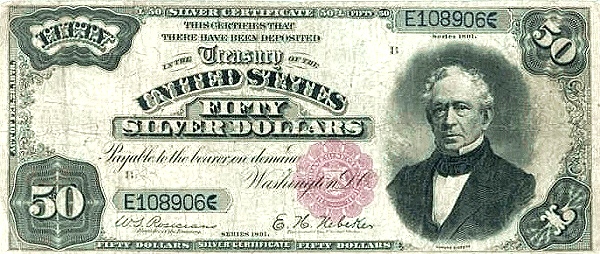
The face of the Series 1891 $50 Silver Certificate features a central portrait of Edward Everett engraved with the exceptional detail characteristic of BEP workmanship of the period. The red Treasury seal appears to the right of the portrait, and the bold “SILVER CERTIFICATE” obligation runs across the top. The reverse is printed in a distinctive silver-gray ink, a design choice that gave Silver Certificates their characteristic back appearance and reinforced the silver backing concept visually as well as legally.
When examining a Series 1891 $50 Silver Certificate, pay close attention to the engraved portrait of Everett. Genuine examples show extraordinary hair and facial detail visible under 5x magnification. Flat, uniform printing in these areas can indicate a cleaned, repaired, or altered note and should prompt immediate third-party grading submission before purchase.
Signature Combinations: Only One Known Pairing
Unlike some large-size types that span multiple signature combinations across different officers of the Treasury, the Series 1891 $50 Silver Certificate is known with only a single signature pairing: Rosecrans-Nebeker. William S. Rosecrans served as Register of the Treasury from 1881 to 1893, while James W. Nebeker served as Treasurer of the United States from April 1891 to May 1892. This narrow window of Nebeker’s service essentially defines the entire production run of this note. No examples with Rosecrans-Tillman or any other combination have been confirmed, which makes the type both simple to attribute and brutally scarce in absolute terms.
The Friedberg catalog assigns this note the number Fr. 336, and it stands alone within the 1891 Silver Certificate $50 series. There is no companion note with a different signature combination to offer collectors a consolation prize at a lower price point. Either you acquire the Rosecrans-Nebeker example, or you do not have the type at all.
Print Run and Survival Rate: Numbers That Explain Everything
The Bureau of Engraving and Printing delivered relatively modest quantities of $50 Silver Certificates during the early 1890s. Archival records suggest the production of Series 1891 $50 notes fell well below 100,000 pieces, a modest figure even by the standards of high-denomination currency of the era. When one considers the natural attrition of large-denomination notes, which were returned to the Treasury at higher rates than lower-denomination issues as banks settled accounts, and further factors in deliberate destruction during currency reforms of the late 1890s and early twentieth century, the survival pool contracts dramatically.
Population data from the major grading services, primarily PCGS Currency and PMG, reveals that certified examples number somewhere between 25 and 40 individual notes across all grades at the time of writing. Some of these may represent the same note graded at different times or crossed between services, meaning the true population of distinct surviving specimens is likely lower still. By any reasonable measure, this is a note with fewer surviving examples than many colonial-era documents.
Because so few examples exist, certified population reports for the Fr. 336 should be treated as minimum counts rather than definitive totals. A meaningful number of high-denomination Silver Certificates from this era remain in private collections and estates without ever having been submitted for grading. If you encounter a raw example at a show or in a collection purchase, do not hesitate to send it to PMG or PCGS Currency before making valuation decisions.
Grades Known and Collector Values
The grade distribution of known Fr. 336 examples skews heavily toward the lower end of the spectrum. Large-denomination notes of this era typically circulated through banking channels for years before retirement, and the $50 face value meant that even minor handling produced visible wear quickly. Very Good and Fine examples account for the majority of certified specimens. Extremely Fine survivors are exceptional, and Uncirculated examples are essentially legendary within the series.
Auction records provide the clearest picture of market values, though the infrequency of appearances makes price-guide figures somewhat abstract. A Fine-15 or Fine-20 example has brought between $15,000 and $25,000 at major auction houses including Heritage Auctions and Stack’s Bowers in recent years. Extremely Fine examples, when they surface, have reached $40,000 to $60,000 or more. A single Uncirculated or near-Uncirculated example would almost certainly test six figures at auction, though no confirmed public sale at that grade level has appeared in the modern certified-currency era. These figures should be understood as approximate guideposts, as individual eye appeal, margins, and paper quality dramatically affect realized prices on notes this rare.
Distinguishing Genuine Examples: What to Look For
Because of its high value, the Fr. 336 deserves careful authentication scrutiny. Collectors should be alert to the following characteristics on genuine examples. The paper should display the distinctive fiber content of period BEP stock, with randomly distributed red and blue silk fibers visible without magnification. The serial numbers on genuine notes appear in a style consistent with BEP numbering conventions of 1891 to 1892, with consistent character spacing and ink absorption. The red Treasury seal should show crisp, sharp sawtooth points around its circumference, as the seal on altered or repaired notes frequently shows blurred or redrawn toothing.
The back design in silver-gray ink is particularly diagnostic. Genuine reverse printing shows a three-dimensional quality from the intaglio process, with ink standing slightly proud of the paper surface when examined obliquely under raking light. Any note with a flat, lithographed-looking reverse warrants immediate suspicion. As always, third-party grading and authentication by PMG or PCGS Currency is the definitive safeguard for a note of this value.
Never purchase a raw Series 1891 $50 Silver Certificate at a significant price without first consulting the auction archives at Heritage Auctions or Stack’s Bowers. Because appearances are so infrequent, cross-referencing the serial number against previously sold examples can sometimes reveal whether a note has changed hands multiple times, been conserved, or was previously graded under a different holder.
How the 1891 $50 Fits Into a Large-Size Type Set
For collectors assembling a complete large-size type set by Friedberg number, the Fr. 336 represents one of the most difficult boxes to check in the entire Silver Certificate section. To put it in perspective, the 1886 $5 Silver Certificate with the Morgan dollar reverse (Fr. 259-265 range) is considered scarce, yet certified populations run into the hundreds. The Fr. 336 population is an order of magnitude smaller. Only a handful of type-set pursuits at the absolute highest levels of the hobby have ever included a genuine example.
This reality leads many advanced collectors to make a deliberate decision: either accept a placeholder in the type set and pursue the note opportunistically over years of collecting, or redirect resources toward the note as a priority acquisition. For collectors who have achieved most of the more accessible large-size types and are looking for the next frontier, the 1891 $50 Silver Certificate is exactly the kind of note that defines a collection and distinguishes a serious accumulation from a truly elite one.
| Friedberg No. | Series / Type | Signature Combination | Rarity |
|---|---|---|---|
| Fr. 336 | 1891 $50 Silver Certificate | Rosecrans-Nebeker | Key Date |
| Fr. 331 | 1880 $50 Silver Certificate | Scofield-Gilfillan | Key Date |
| Fr. 332 | 1880 $50 Silver Certificate | Bruce-Gilfillan | Rare |
| Fr. 333 | 1880 $50 Silver Certificate | Bruce-Wyman | Rare |
| Fr. 334 | 1880 $50 Silver Certificate | Rosecrans-Huston | Scarce |
| Fr. 335 | 1880 $50 Silver Certificate | Rosecrans-Nebeker | Scarce |
| Fr. 148 | 1891 $50 Treasury Note | Rosecrans-Nebeker | Rare |
| Fr. 151 | 1891 $50 Legal Tender | Rosecrans-Nebeker | Scarce |
| Fr. 337 | 1891 $50 Silver Cert. (if applicable variety) | Rosecrans-Tillman (unconfirmed) | Key Date |
A Note on Provenance and Auction History
One of the pleasures of researching extreme rarities like the Fr. 336 is tracing provenance through auction archives. Several examples with documented histories have passed through the major numismatic auction houses over the past three decades. Notable appearances include examples in the Friedberg Collection sale and various Donlon and Grinnell estate dispositions in earlier eras. The emergence of online auction archives at Heritage has made it possible for modern collectors to trace serial numbers across decades of auction activity, providing a uniquely transparent window into the market history of individual notes.
If you are fortunate enough to be offered an example with solid provenance, that documentation adds both historical interest and a degree of authentication confidence. Provenance alone does not substitute for third-party certification, but a note with a Heritage or Stack’s Bowers auction sticker from a 1990s or 2000s sale at minimum confirms the note was examined by professional numismatists at that time.
Conclusion: Why This Note Deserves Far More Attention
The Series 1891 $50 Silver Certificate with the portrait of Edward Everett occupies a peculiar space in American numismatics: genuinely rare by any objective measure, historically significant both in terms of its subject and its role in the Silver Certificate program, and yet persistently underappreciated simply because so few collectors have ever held one. It does not benefit from the marketing energy that surrounds, say, a 1928 $500 Federal Reserve Note or an inverted-back error. Its rarity is quiet and patient, waiting for collectors sophisticated enough to recognize it.
For those building serious large-size collections, for those who find the intersection of political history and currency design compelling, or for those who simply want to own something genuinely exceptional, the Fr. 336 represents one of the most rewarding targets in the entire landscape of United States paper money. The challenge of finding one is real. The reward, in terms of historical depth and numismatic significance, is equally real. Edward Everett spent his life in the shadow of more famous contemporaries. His note, it seems, has shared that fate. It deserves a second look.
Set up auction alerts for “Fr. 336,” “1891 $50 Silver Certificate,” and “Edward Everett note” on Heritage Auctions and Stack’s Bowers. Given the infrequency of appearances, you may wait two to four years between auction opportunities at any grade level. Having alerts in place ensures you will not miss the window when an example does come to market.