Picture a sourdough miner in Dawson City, his fingers so frostbitten he can barely peel apart two sheets of paper. He is trying to separate a worn $10 National Bank Note from a $5 Silver Certificate, both damp and stiff with cold, both smelling of tallow candles and woodsmoke. He needs to pay the outfitter before the next supply boat freezes in place for the winter. This was everyday currency life during the Klondike Gold Rush, a period stretching roughly from the summer of 1897 through about 1906, when tens of thousands of prospectors flooded into the most remote corners of the continent and carried American paper money with them into conditions it was never designed to survive.
The Paper Money Landscape of 1897
When George Carmack, Skookum Jim Mason, and Dawson Charlie discovered placer gold on Rabbit Creek in August 1896 and word reached the outside world the following summer, the United States monetary system was in one of its most visually spectacular eras. The notes a prospector carried north in 1897 would have come from several distinct types, each with its own issuing authority, design lineage, and survival quirks.
National Bank Notes were the workhorses of everyday commerce in the Pacific Northwest gateway cities. The Series 1882 Brown Back notes, bearing the distinctive brown Treasury seal and issued by hundreds of state-chartered national banks, were ubiquitous. A prospector outfitting in Seattle in July 1897 almost certainly passed through the hands of notes from the First National Bank of Seattle (Charter 4229) or the Seattle National Bank (Charter 3408). The Series 1882 Value Back notes, transitioning through 1908 to 1916, and the Date Back variety fill out the picture for slightly later arrivals to the goldfields.
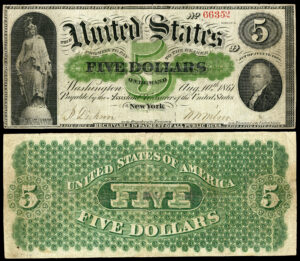
Silver Certificates were equally common. The stunning Educational Series of 1896, with its allegorical figures engraved by Charles Schlecht and Thomas F. Morris, was in active circulation during the height of the rush. The $1 Educational note (Fr. 224 through Fr. 226 depending on signature combination) featured History instructing Youth, while the $2 and $5 denominations carried equally ambitious designs. These were not notes miners treasured for their beauty. They were folded, dampened, and worn without ceremony.
When examining Series 1882 National Bank Notes from Seattle, Portland, or San Francisco charter banks, look carefully at the paper itself. Notes that circulated in extreme cold sometimes show distinctive crackling or fiber separation along fold lines that differs from normal wear. While this typically means a VG or Fine grade, documented Pacific Northwest provenance on a note from a gateway city bank can still attract significant collector interest at specialized auctions.
Gateway City Banks: The Last Stop Before the Wilderness
Understanding which banks issued the notes that actually went north is central to collecting this niche. Seattle, Portland, and San Francisco served as the primary outfitting and departure points. Seattle in particular exploded commercially because of the rush. The First National Bank of Seattle (Charter 4229) and the Dexter Horton National Bank (Charter 11280, chartered 1918 and thus post-rush) represent two ends of the charter timeline for that city. For rush-era notes proper, collectors focus on the earlier charters active between 1897 and 1906.
Portland offered notes from institutions like the United States National Bank of Portland (Charter 9983) and the First National Bank of Portland (Charter 1553, one of Oregon’s earliest charters dating to 1865). A Series 1882 Brown Back $10 from Charter 1553 in circulated condition represents exactly the type of note a merchant or prospector in the Willamette Valley gateway would have carried.
San Francisco’s contributions were substantial given California’s own gold heritage and its role as the financial hub of the West Coast. The Anglo-California Bank, the Nevada National Bank (Charter 5105), and the London and San Francisco Bank all issued notes in the late nineteenth century. It is worth noting that California state law had long discouraged branch banking and the issuance of local currency, meaning some San Francisco national bank notes are surprisingly scarce for the era despite the city’s enormous commercial importance.
Treasury Notes of 1890 and the Coin Note Connection
One category of note deserves special attention for the Klondike context: the Treasury Notes of 1890 and 1891, also called Coin Notes because they were redeemable in coin at the Treasury’s discretion. These large-size notes, authorized under the Sherman Silver Purchase Act of 1890, were issued in denominations from $1 through $1,000. The $1 Treasury Note of 1890 (Fr. 347, Rosecrans-Huston signatures) and the $2 (Fr. 353 through Fr. 358) circulated actively in 1897 when the rush was igniting.
The higher denominations, particularly the $100 (Fr. 377 and Fr. 378) and $500 (Fr. 379), were the preferred vehicle for serious capitalists funding mining operations. A Seattle provisioner outfitting a twelve-man mining syndicate might receive payment in $100 Coin Notes, which were large, impressive documents printed by the Bureau of Engraving and Printing with a red Treasury seal on the 1890 series and a smaller, rounder red seal on the 1891 series. These notes are rare in any condition today. The 1890 $100 (Fr. 377) has a known population in fine or better that numbers in the low dozens.
Treasury Notes of 1890 with the large “COIN” overprint (visible especially on the $1 and $2 denominations) are sometimes confused with Silver Certificates by newer collectors. The key distinction is the issuing authority line: Treasury Notes read “This certifies that there have been deposited with the Treasurer of the United States” language tied to coin redemption, whereas Silver Certificates reference silver dollars on deposit. Know your redemption clauses and you will never misidentify these notes.
Alaska Territory: A Banking Vacuum
Here is the extraordinary paradox at the heart of Klondike currency history. Despite the billions of dollars in gold extracted from the Yukon watershed between 1896 and 1910, the Alaska Territory had no nationally chartered bank until 1905, when Congress finally passed legislation permitting national bank charters in territories. The First National Bank of Juneau was organized under Charter 10705 in 1905, and several others followed quickly: the First National Bank of Skagway (Charter 10727), and the Washington-Alaska Bank in various iterations.
This means that for the entire peak period of the gold rush, from 1897 through roughly 1904, prospectors in Alaska and the adjacent Yukon Territory operated in a currency environment almost entirely dependent on notes issued elsewhere. Gold dust was the true medium of exchange on the creeks, weighed on small scales and traded at a standard of roughly $16 per troy ounce, the federally mandated gold price. But paper money, when it appeared, traveled enormous distances and passed through many hands before arriving in a Dawson saloon or a Nome supply store.
The notes that reached Dawson City, technically in Canadian territory, present their own complications. Canadian Dominion Notes and chartered bank issues (from the Bank of British North America, the Canadian Bank of Commerce, and others) circulated alongside American currency with fluctuating exchange rates depending on whether gold or greenbacks were the pricing benchmark that week. American collectors occasionally encounter Canadian notes with Alaska or Yukon store stamps from this era, which is a whole separate but related collecting specialty.
How Extreme Conditions Degraded Paper Money
The physical abuse that currency suffered in the Klondike context is worth understanding for grading purposes. The standard Sheldon-derived grading scale used for paper money by PCGS Currency and PMG does not have a specific category for “environmentally damaged by arctic conditions,” but examiners at both services are well aware of the patterns.
Moisture damage from repeated freezing and thawing produces distinctive rippling in the paper substrate that differs from simple humidity exposure. Notes stored in leather pokes or pouches alongside gold dust sometimes show microscopic gold particles embedded in paper fibers, visible under magnification. Grease and tallow contamination from food storage or lamp fuel creates translucent spots that are often misread as water damage. Notes stored in shirt pockets against the skin through months of wilderness travel show sweat-induced chemical changes to the ink, sometimes causing the distinctive blue-black of Bureau engraving to shift toward olive or gray.
All of these factors mean that genuinely rush-era circulated notes tend to grade in the VG-8 to F-15 range at best, with most examples falling into the Good-4 to VG-8 window. Uncirculated examples of Series 1882 and 1891 notes from Pacific Northwest charter banks exist primarily because banks maintained vault stocks that never reached the trail.
When building a Gold Rush-era currency collection, do not overlook the value of accompanying ephemera. A Series 1882 Brown Back $5 from the First National Bank of Seattle in Good condition becomes significantly more interesting when paired with a period outfitter’s receipt or a contemporary photograph of Skagway’s main street. Provenance documentation, even circumstantial, elevates a common circulated note into a genuine historical artifact for exhibit purposes and can strengthen a case for a specialized PCGS or PMG holder designation.
The First Alaska National Bank Notes: Charters 10705 and 10727
For collectors specifically focused on Alaska territorial paper money, the notes issued by the First National Bank of Juneau (Charter 10705) and the First National Bank of Skagway (Charter 10727) after 1905 are the holy grail. Both banks issued Series 1902 Red Seal, Plain Back, Date Back, and Blue Seal notes across denominations from $5 through $100.
The First National Bank of Juneau is documented to have issued $5, $10, and $20 notes under Charter 10705. Total circulation figures were modest by continental standards. Fewer than a dozen examples of the Juneau $5 Red Seal (Series 1902) are confirmed in collector hands today, making it one of the rarest territorial national bank notes in the entire census. The $10 denomination from the same bank in the Date Back variety has appeared at major auction houses including Heritage Auctions and Stack’s Bowers with realized prices ranging from $8,500 in VG to over $22,000 in Fine-15.
The First National Bank of Skagway (Charter 10727) issued notes during a period when Skagway itself was transitioning from a boomtown to a quieter railroad terminus. Series 1902 Plain Back notes from this charter in $10 denomination have sold in the $12,000 to $18,000 range at major auction, depending on grade and eye appeal. Both charters are listed in the Friedberg Paper Money of the United States reference and in Don Kelly’s National Bank Notes price guide, where they carry notations as among the rarest Alaskan issues.
| Series / Type | Issuer or Charter | Approx. Print Run or Known Pop. | Rarity |
|---|---|---|---|
| 1882 Brown Back $10 | First NB of Seattle (Ch. 4229) | Moderate, est. 2,000+ sheets | Scarce |
| 1882 Brown Back $5 | First NB of Portland (Ch. 1553) | Moderate, est. 1,500+ sheets | Scarce |
| 1890 Treasury Note $100 (Fr. 377) | U.S. Treasury | Under 100 known survivors | Key Date |
| 1896 Silver Certificate $5 (Fr. 270) | U.S. Treasury, Educational Series | Several thousand surviving | Scarce |
| 1902 Red Seal $5 | First NB of Juneau (Ch. 10705) | Fewer than 12 confirmed | Key Date |
| 1902 Date Back $10 | First NB of Juneau (Ch. 10705) | Under 20 confirmed | Rare |
| 1902 Plain Back $10 | First NB of Skagway (Ch. 10727) | Under 30 confirmed | Rare |
| 1902 Blue Seal $20 | First NB of Skagway (Ch. 10727) | Under 15 confirmed | Key Date |
| 1899 Silver Certificate $1 (Fr. 226) | U.S. Treasury, Black Eagle | Abundant, common in lower grades | Common |
| 1882 Date Back $10 | Nevada NB San Francisco (Ch. 5105) | Fewer than 40 known | Rare |
Building a Gold Rush Currency Collection Today
There are several practical approaches to assembling a meaningful collection around this theme, depending on budget and focus. The most accessible entry point is Series 1882 and 1902 National Bank Notes from the gateway cities: Seattle, Portland, Tacoma, and San Francisco. Notes from these cities in VG to Fine condition can often be found in the $150 to $600 range depending on denomination and specific charter. The First National Bank of Tacoma (Charter 3417) and the Puget Sound National Bank (Charter 4043) both issued notes that predate the rush and were actively circulating when the stampede began.
A mid-range collector might focus on Educational Series Silver Certificates (1896) in the $50 to $2,500 range depending on denomination and grade, pairing them with period maps or photographs of Seattle’s waterfront circa 1897 to 1899 for display context. The $1 Educational (Fr. 224 in VG sells for roughly $200 to $300; Fr. 226 in the same grade fetches $250 to $400 depending on eye appeal).
For the advanced collector with serious capital, the Alaskan territorial notes from Charters 10705 and 10727 represent one of the most historically potent and genuinely rare collecting fields in American numismatics. Competition for these notes is intense at major auction, and examples rarely appear more than once every few years for some varieties. Consulting the Standard Catalog of United States Paper Money by Krause Publications and Chet Krause alongside Friedberg is essential before bidding, as population data shifts and catalog values in this tier can be volatile.
Conclusion: Paper Money as Historical Witness
The currency that traveled north in sweat-stained pockets and leather pouches during the Klondike Gold Rush carries a different weight than the same series note that sat in a bank vault in Ohio. Paper money is often discussed purely in terms of condition, catalog number, and market value. But the notes that circulated through the gold rush remind us that these were working documents, instruments of commerce and survival used by real people in extraordinary circumstances. The wear on a Series 1882 Brown Back from a Seattle bank is not just a grading deduction; it is evidence. The stain, the fold, the fiber separation: they are the material record of one of American history’s great migrations. Collecting this niche means collecting history at its most tactile, and that is a privilege worth the research.