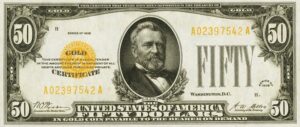
On January 17, 1980, the spot price of silver hit an intraday high of $49.45 per troy ounce on the COMEX exchange in New York. For most Americans, this was a news story about commodity speculation gone wild. For currency collectors, it was a watershed moment that permanently altered the landscape of Silver Certificate collecting, drove a short-lived but intense redemption frenzy, and paradoxically created some of the most interesting collector dynamics in modern numismatic history. To understand why, we need to go back to the certificates themselves, trace the Hunt brothers’ audacious scheme, and follow the money all the way to today’s grading tables and auction records.
Silver Certificates: A Brief but Essential Background
Silver Certificates were issued by the United States Treasury from 1878 through 1964, with circulation continuing until the redemption deadline of June 24, 1968. These notes were, in the strictest legal sense, warehouse receipts for actual silver held in Treasury vaults. The classic blue seal on the obverse, combined with the legend “This Certifies That There Is On Deposit In The Treasury Of The United States Of America [X] Dollar(s) In Silver Payable To The Bearer On Demand,” made their commodity backing explicit and enforceable.
The denominations issued ranged from $1 through $1,000 in various historical series, though the later small-size issues familiar to most collectors ran $1, $5, and $10. The final series produced were the Series 1957-B $1 notes (signed by Granahan and Dillon), the Series 1953-C $5 notes, and the Series 1953-B $10 notes. By the time the Coinage Act of 1965 began the demonetization process and Public Law 90-29 formally ended silver redemption on June 24, 1968, hundreds of millions of these certificates remained in circulation or private hands.
After the June 1968 deadline passed, Silver Certificates became legal tender (they still are today), but they could no longer be redeemed directly for silver bullion at the Treasury. A $1 Silver Certificate was simply worth $1 as currency. Or so it seemed, until two Texas oil billionaires decided to corner the silver market.
Even though silver redemption ended in 1968, Silver Certificates remain legal tender and can be spent at face value or deposited at banks today. Never spend a circulated note without first checking its catalog value. A worn Series 1923 $1 Silver Certificate (Friedberg 237) in VG condition catalogs around $30 to $40, far above face value.
The Hunt Brothers and Their Silver Gamble
Nelson Bunker Hunt and William Herbert Hunt, sons of Texas oil tycoon H.L. Hunt, began accumulating silver futures and physical silver in earnest around 1973, initially motivated by fears of dollar inflation following the Nixon administration’s closure of the gold window in August 1971. By 1979, in partnership with Saudi Arabian interests, the Hunts had amassed an estimated 100 million troy ounces of silver through futures contracts and direct bullion holdings, effectively controlling somewhere between one-quarter and one-third of the world’s privately held silver supply.
As their buying pressure pushed prices relentlessly upward through late 1979, silver climbed from roughly $6 per troy ounce in early 1979 to above $20 by December. By January 1980, the market was in a full speculative frenzy. The peak of $49.45 on January 17, 1980, represented a gain of over 700 percent in barely twelve months. The COMEX exchange, recognizing systemic risk, changed its rules on January 7, 1980, to allow only liquidation trades in silver futures, effectively pulling the chair out from under the Hunts. Silver began its collapse almost immediately. By March 27, 1980, a date that became known in commodity trading circles as “Silver Thursday,” the price had fallen to $10.80 per ounce, and the Hunt brothers faced margin calls that threatened to topple several major brokerage houses. A consortium of banks ultimately extended a $1.1 billion loan to prevent broader financial contagion.
The Numismatic Shockwave: Certificates Back in the Spotlight
Here is where the story becomes genuinely fascinating for currency collectors. As silver prices rocketed upward through late 1979 and into January 1980, a curious thing happened in American attics, desk drawers, and mattresses: people began hunting for Silver Certificates. News coverage of soaring silver prices invariably prompted questions about whether those old blue-seal dollars grandma kept in a coffee can had suddenly become valuable again.
The mathematical reality was tantalizing but slightly misleading. A $1 Silver Certificate had historically been backed by 0.7734 troy ounces of silver (the amount contained in a standard silver dollar), but post-1968, there was no longer any mechanism to redeem the paper for metal. However, the psychological association was powerful. At $49.45 per ounce, 0.7734 ounces would theoretically be worth over $38. Newspaper articles across the country, many of them poorly researched, suggested that old Silver Certificates might be worth dozens of times face value in silver content.
The reality was more nuanced. Redemption had legally ended in 1968. The Treasury was not going to reopen its vaults. But what the silver spike did accomplish was to drive massive public interest in Silver Certificates as collectibles, pushing circulated examples into coin shops and currency dealers in volumes not seen since the 1960s. Dealers reported customers arriving with shoeboxes of Series 1957, 1957-A, and 1957-B notes, along with earlier series ranging back to the large-size 1899 “Black Eagle” issues.
The Series 1957, 1957-A, and 1957-B $1 Silver Certificates (Friedberg numbers 1619, 1620, and 1621 respectively) are among the most common small-size notes ever printed. In circulated grades (Fine to Extremely Fine), they typically catalog between $3.50 and $8. Focus your budget on star notes from these series or on the scarcer earlier series such as 1928, 1928-A, and 1928-B for better long-term collector value.
How the Spike Reshaped Collector Pricing: Then and Now
The 1980 silver spike created several lasting effects on the Silver Certificate collector market that are still visible in pricing guides and auction results today.
The Culling of Circulated Common Notes
During and immediately after the spike, vast quantities of circulated Series 1957 and earlier common notes entered the market. Dealers, unable to sell them as collectibles at meaningful premiums, often purchased them at or near face value and held them in bulk. This created a durable floor under the pricing of common circulated Silver Certificates but also suppressed premiums for worn examples for years afterward. A heavily circulated Series 1957 $1 note in Good condition still struggles to bring more than $2 to $3 in today’s market, a direct legacy of the oversupply created in 1980.
Premium Notes Found New Homes
The public frenzy also shook loose genuine rarities. Dealers sorting through the 1980-era accumulations discovered high-grade uncirculated examples of the Series 1928-C, 1928-D, and 1928-E $1 Silver Certificates (Friedberg 1603, 1604, and 1605), notes that had been set aside as novelties decades earlier. The 1928-E, in particular, is a condition rarity in grades above MS-64, and several exceptional examples that surfaced during the 1980 to 1982 period later achieved record prices at auction. PCGS Currency and PMG population reports for the 1928-C and 1928-D in MS-65 Gem Uncirculated remain extremely thin, partly because so few truly high-grade examples survived.
Star Note Awareness Exploded
Perhaps the most lasting collector legacy of the 1980 period was a surge in public awareness of star notes, the replacement notes printed with a star prefix in the serial number. Before 1980, star notes were primarily known to serious numismatists. The wave of public interest in Silver Certificates brought star note rarity to a wider audience. Dealers began actively sorting and advertising star notes from all Silver Certificate series, and premiums for scarce star note runs, particularly for the Series 1934, 1934-A, 1934-B, 1934-C, and 1934-D $1 Silver Certificates, began climbing steeply. A Series 1934 $1 Silver Certificate star note (Friedberg 1606 star) in Choice Uncirculated (MS-63) that might have brought $150 in 1978 was regularly achieving $400 to $600 by 1982 in the aftermath of the silver excitement.
Large-Size Silver Certificates: The Unexpected Beneficiaries
While most of the public focus fell on the familiar small-size notes, the 1980 frenzy also drew new collectors into large-size Silver Certificates, a far more specialized and expensive field. The iconic Series 1899 $1 “Black Eagle” (Friedberg 226 through 236, depending on signature combination) and the stunning Series 1896 “Educational” $1, $2, and $5 notes (Friedberg 224, 247, and 268) saw significant auction price appreciation between 1980 and 1985 as newly minted Silver Certificate enthusiasts discovered the deep history behind the series.
The Educational $5 Silver Certificate of 1896, featuring allegorical figures of Electricity and America on the face and portraits of General Grant and General Sheridan on the back, is among the most artistically accomplished pieces of American currency ever produced. In Very Fine condition, it catalogs in the $2,500 to $3,500 range today. In 1979, comparable examples were bringing $600 to $900. The Hunt brothers’ silver corner, by generating mainstream media coverage of silver and Silver Certificates, contributed meaningfully to this long-term price appreciation.
When evaluating large-size Silver Certificates from the 1890s and early 1900s, pay close attention to the signature combinations, which determine the Friedberg catalog number and thus the rarity. The Series 1899 $1 “Black Eagle” with Speelman-White signatures (Friedberg 236) is significantly more common than the earlier Vernon-McClung combination (Friedberg 231). A misidentified signature pair can mean a $200 difference in catalog value on a mid-grade example.
The $5 and $10 Silver Certificates: Often Overlooked, Still Undervalued
Most collector and public attention during the 1980 silver frenzy focused on $1 Silver Certificates simply because they were the most familiar and widely saved denomination. The small-size $5 Silver Certificates (Series 1934 through 1953-C) and $10 Silver Certificates (Series 1933 through 1953-B) received comparatively less attention but represent exceptional collecting value today.
The Series 1933 $10 Silver Certificate (Friedberg 1700) signed by Julian and Woodin is a genuine key date with a very limited issue, and examples in Fine to Very Fine condition catalog around $2,000 to $3,500. The Series 1934-C $5 Silver Certificate with a mule plate combination (using mismatched micro and macro plate numbers) is a sought-after variety among advanced collectors. These nuances were not well understood by the 1980-era general public, meaning the $5 and $10 series were somewhat insulated from the oversupply problem that hit common $1 notes.
| Series / Friedberg No. | Denomination and Variety | Approx. Print Run or Notes Known | Rarity |
|---|---|---|---|
| 1928-E / Fr. 1605 | $1 Small-Size, Julian-Morgenthau | 3,519,324 | Scarce |
| 1928-C / Fr. 1603 | $1 Small-Size, Woods-Mills | 5,364,348 | Scarce |
| 1933 / Fr. 1700 | $10 Small-Size, Julian-Woodin | 216,000 | Key Date |
| 1896 / Fr. 268 | $5 Educational, Tillman-Morgan | Est. few thousand in all grades | Rare |
| 1899 / Fr. 228 | $1 Black Eagle, Lyons-Roberts | Large but heavily circulated | Scarce |
| 1957-B / Fr. 1621 (star) | $1 Star Note, Granahan-Dillon | Approx. 35.8 million all stars | Common |
| 1934 / Fr. 1606 (star) | $1 Star Note, Julian-Morgenthau | Est. under 500,000 | Rare |
| 1953-C / Fr. 1657 | $5 Small-Size, Granahan-Dillon | 31,320,000 | Common |
| 1928-D / Fr. 1604 | $1 Small-Size, Woods-Woodin | 7,370,220 | Scarce |
| 1934-B / Fr. 1608 | $1 Small-Size, Julian-Vinson (star) | Est. under 200,000 | Key Date |
The Lasting Legacy for Today’s Collectors
More than four decades after Silver Thursday, the Hunt brothers’ spectacular failure continues to echo through the Silver Certificate market in ways both subtle and significant. The most important lesson is one of intrinsic value versus numismatic value. During the height of the silver frenzy, ordinary people evaluated Silver Certificates almost entirely through the lens of their theoretical silver content, ignoring rarity, grade, and historical significance entirely. The collectors who prospered in the years following 1980 were those who understood that a Series 1957-B in Fine condition was never going to be worth $38 regardless of the silver price, but that a gem uncirculated Series 1928-C star note was a legitimately scarce object with a collector audience that only grows over time.
Today, the Certified Coin Exchange (CCE) and major auction houses including Heritage Auctions and Stack’s Bowers regularly feature Silver Certificates in their paper money sales, and price realization data shows steady, if unspectacular, appreciation for high-grade certified examples of key dates. A PMG-graded 65 Gem Uncirculated Series 1928-C $1 Silver Certificate realized $3,840 at a 2022 Heritage auction, reflecting genuine scarcity and collector demand rather than any commodity speculation. The $5 and $10 denominations continue to be undervalued relative to their rarity, making them attractive targets for patient collectors building sets.
The Hunt brothers set out to corner the silver market and nearly destroyed themselves in the process. What they left behind for currency collectors was a more educated and curious public, a generation of new enthusiasts introduced to paper money through the drama of commodity markets, and a market that learned, sometimes painfully, the difference between metal value and numismatic value. For collectors willing to do their homework with Friedberg catalog in hand and a loupe at the ready, Silver Certificates remain one of the most rewarding and historically rich areas of United States paper money collecting.