📷 Image source: banknote.ws (World Banknote Gallery). Images are selected by AI to represent the article topic and may not depict the exact note(s) described.
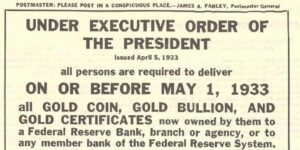
Picture this: it is April 6, 1933, and you are an ordinary American waking up to news that the federal government has just ordered you to surrender your gold coins, gold bullion, and gold certificates to the nearest Federal Reserve Bank by May 1. The penalty for non-compliance is up to ten years in prison and a $10,000 fine. For most Americans, compliance was not optional. It was terrifying. And for the history of United States paper money, it was transformative in ways that still ripple through the collector market nearly a century later.
The Economic Crisis That Made the Order Possible
To understand why Executive Order 6102 happened, you have to understand the financial chaos of early 1933. Bank runs were epidemic. Between December 1932 and March 1933, Americans hoarded gold at a staggering rate, withdrawing it from the banking system and threatening the federal gold reserve that underpinned the entire currency. When FDR took office on March 4, 1933, the country was days away from a complete banking system collapse. He declared a national bank holiday on March 6, shuttering every bank in the nation for four days.
The legal foundation for the gold recall was the Trading with the Enemy Act of 1917, which had been dormant in peacetime application. Roosevelt’s team argued the banking crisis constituted a national emergency equivalent to wartime, giving the executive branch sweeping authority over monetary matters. Congress ratified this interpretation with the Emergency Banking Act of March 9, 1933, and less than a month later, EO 6102 was signed.
The order required all persons to deliver gold coins, gold bullion, and gold certificates to a Federal Reserve Bank by May 1, 1933, receiving Federal Reserve Notes or other lawful currency in exchange. Exemptions existed for jewelry, industrial use, and amounts under $100 in gold coin. But Gold Certificates, the paper currency directly backed by and redeemable in gold, were finished as a circulating medium.
A Brief History of Gold Certificates in American Currency
Gold Certificates had been issued since 1865, serving as paper representatives of gold on deposit with the United States Treasury. Their distinctive golden-yellow Treasury seal and serial numbers made them immediately recognizable and broadly trusted. By the 1920s and early 1930s, Gold Certificates circulated alongside Federal Reserve Notes, Silver Certificates, and United States Notes in everyday commerce.
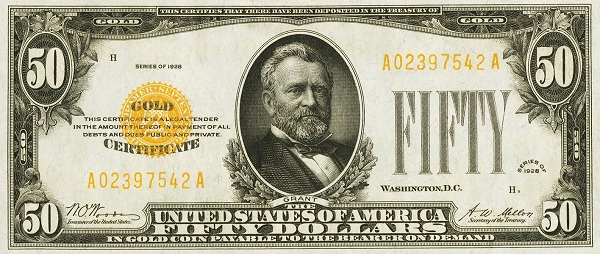
The final series of Gold Certificates issued for general circulation was the Series 1928, printed between 1928 and 1933 in denominations of $10, $20, $50, $100, $500, $1,000, $5,000, and $10,000. These notes carried the signatures of Treasurer Walter O. Woods and Secretary Andrew W. Mellon, or, for some later printings, Treasurer Walter O. Woods and Secretary Ogden L. Mills. The characteristic gold seal and gold serial numbers appeared on all denominations, making them some of the most visually striking currency ever issued by the United States.
When examining a Series 1928 Gold Certificate, the Treasury seal color is a rich amber-gold, distinctly different from the yellow-gold used on some earlier issues. Under ultraviolet light, genuine notes show specific paper fibers and ink reactions that are useful authentication tools, especially for high-denomination examples that have been heavily counterfeited or altered.
What Happened to the Notes: Surrender, Survival, and Legal Limbo
The vast majority of circulating Gold Certificates were surrendered exactly as the government demanded. The Federal Reserve Banks collected them by the millions, and most were eventually destroyed. The question that has fascinated collectors ever since is: how many survived, and what is their legal status?
The legal status of Gold Certificates remained murky for decades. Technically, the Joint Resolution of June 5, 1933, abrogated the gold clause in public and private contracts, and subsequent regulations made it illegal to hold Gold Certificates. The Gold Reserve Act of January 30, 1934, formally nationalized gold and set the official price at $35 per ounce. The prohibition on private gold ownership lasted until December 31, 1974, when President Gerald Ford signed legislation restoring the right of Americans to own gold.
For currency collectors, the pivotal date was October 14, 1964. On that date, the Treasury Department officially announced that Gold Certificates could be legally held as collectors’ items. This was a watershed moment, as it confirmed that numismatists could own these notes without legal jeopardy. The announcement spurred significant collector interest and helped establish the current secondary market.
The Series 1928 Gold Certificates: A Collector’s Breakdown
The Series 1928 Gold Certificates represent the most collectible and accessible of all Gold Certificate issues for modern collectors. Understanding the individual denominations, their print runs, and their relative scarcity is essential before pursuing any of these notes.
The $10 Gold Certificate (Fr. 2400) had the largest print run of the series at approximately 130 million notes, making it the most frequently encountered in today’s market, though even common examples in Choice Fine (VF-35 to EF-40) condition bring $125 to $300. Uncirculated (MS-63 or better) examples certified by PCGS Currency or PMG can reach $1,500 or more.
The $20 Gold Certificate (Fr. 2402) is similarly common in circulated grades but jumps sharply in value in gem uncirculated condition. The $50 (Fr. 2404) and $100 (Fr. 2405) denominations saw smaller print runs and are considerably scarcer in high grade. The $500 (Fr. 2407) and $1,000 (Fr. 2408) denominations are genuinely rare in any grade, as relatively few were ever printed and even fewer survived the recall.
The $10 and $20 Series 1928 Gold Certificates are the best entry points for new collectors. Focus on problem-free examples certified by PMG or PCGS Currency in grades of Fine-12 or better. Avoid notes with pinholes, tape repairs, or washed appearance, as these issues dramatically suppress value and resale potential. An honest Fine-15 example will always outperform a cleaned VF on the resale market.
The High Denomination Notes: $500 Through $10,000
If the $10 and $20 Gold Certificates are the workhorses of the series, the high denominations are the crown jewels. The $5,000 Gold Certificate (Fr. 2411) and $10,000 Gold Certificate (Fr. 2412) exist in such small numbers that they effectively trade outside the normal collector market, appearing at major auction houses and commanding six-figure prices. The $10,000 note, bearing a portrait of Salmon P. Chase, is believed to exist in fewer than a dozen specimens known to collectors, with most examples residing in institutional collections or the Federal Reserve’s own archives.
The $500 and $1,000 denominations are more attainable but still require a serious budget. A $500 Gold Certificate in Very Fine condition has sold at auction for $7,500 to $12,000 in recent years. The $1,000 note in similar grade can bring $15,000 to $25,000. These are notes for advanced collectors, and authentication by a recognized third-party grading service is non-negotiable at this level.
Earlier Gold Certificate Series: The 1922 and Before
While the Series 1928 notes are the ones most directly impacted by EO 6102, collectors also pursue the earlier large-size Gold Certificates issued before the transition to small-size currency in 1929. The Series 1922 $10 Gold Certificate (Fr. 1173), for example, features a dramatically different design with a large-size format and carries a premium for its visual appeal. The Series 1907 $10 (Fr. 1167-1172) and the earlier Series 1882 issues represent a rich collecting area unto themselves.
Large-size Gold Certificates from the 19th and early 20th centuries are generally rarer than their Series 1928 small-size counterparts, though the enormous visual impact of the large-format notes makes them perennial favorites at shows and auction previews. The 1882 $20 Gold Certificate (Fr. 1178) in Very Fine condition is a legitimate trophy note, with auction realizations frequently exceeding $3,000.
Large-size Gold Certificates are frequently encountered with pressed or ironed folds, making them appear to grade higher than they actually are. Before purchasing a raw (uncertified) large-size note, examine fold lines under raking light and look for unnatural stiffness in the paper. Submission to PMG or PCGS Currency for authentication and grading is strongly recommended for any note priced above $500.
| Series / Friedberg No. | Denomination | Approx. Print Run | Rarity |
|---|---|---|---|
| 1928 / Fr. 2400 | $10 Gold Certificate | 130,000,000+ | Common |
| 1928 / Fr. 2402 | $20 Gold Certificate | 66,000,000+ | Common |
| 1928 / Fr. 2404 | $50 Gold Certificate | 5,500,000 | Scarce |
| 1928 / Fr. 2405 | $100 Gold Certificate | 3,240,000 | Scarce |
| 1928 / Fr. 2407 | $500 Gold Certificate | 420,000 | Rare |
| 1928 / Fr. 2408 | $1,000 Gold Certificate | 288,000 | Rare |
| 1928 / Fr. 2411 | $5,000 Gold Certificate | 24,000 | Key Date |
| 1928 / Fr. 2412 | $10,000 Gold Certificate | 48,000 | Key Date |
| 1922 / Fr. 1173 | $10 Large-Size Gold Cert. | Approx. 8,000,000 | Scarce |
| 1882 / Fr. 1178 | $20 Large-Size Gold Cert. | Under 1,000,000 | Rare |
Authentication and Grading Considerations
Because Gold Certificates carry substantial premiums, they have been targets for alteration and outright counterfeiting. The most common fraud involves taking a common Federal Reserve Note of the same period and altering the seal color or serial numbers to mimic a Gold Certificate. Sophisticated counterfeiters have also washed genuine low-denomination notes and attempted to raise the denomination.
Genuine Series 1928 Gold Certificates use specific paper stock with red and blue silk fibers embedded throughout. The gold-colored seal is printed with an ink that has a specific luster under direct light, distinct from standard black or blue seals. Serial numbers on genuine notes are also gold-colored ink, and the typography of the Treasury seal inscription should match known certified examples precisely.
Third-party grading from PMG (Paper Money Guaranty) or PCGS Currency is the industry standard for Gold Certificates. Their holders provide tamper-evident encapsulation, assigned numerical grades on the Sheldon-derived 70-point scale, and, crucially, authentication. For any Gold Certificate above circulated grades, or any high-denomination example regardless of grade, a certified holder is the baseline expectation in today’s market.
Building a Gold Certificate Collection on a Budget
The good news for collectors working within reasonable budgets is that Series 1928 $10 and $20 Gold Certificates in circulated grades remain genuinely accessible. A crisp Very Fine $10 note can be purchased from reputable dealers or at major currency shows for under $200. The $20 in the same grade typically runs $150 to $350. These are handsome, historically significant notes that anyone can display with pride.
A focused thematic collection might include one example each of the $10 and $20 in mid-circulated grades, perhaps a $50 or $100 as a centerpiece, and a large-size 1922 $10 for contrast. Such a collection assembled thoughtfully over one or two years would represent both the aesthetic evolution of Gold Certificates and the critical historical moment of their demise, at a total cost well under $2,000 for a patient buyer.
The Lasting Legacy of Executive Order 6102
Executive Order 6102 was not merely a policy change. It represented the federal government’s decisive assertion of control over the monetary system, severing the link between paper currency and a tangible commodity that Americans could hold, trade, and trust independently of government policy. The Gold Certificates it rendered illegal overnight became, in time, some of the most sought-after artifacts of American financial history.
For currency collectors, every Series 1928 Gold Certificate is a survivor, a note that somehow escaped the government’s dragnet and the passage of ninety years. Whether tucked in a forgotten drawer, hidden in a wall, or carried secretly across borders by immigrants who distrusted government edicts, each example tells a story of the most dramatic monetary transformation in American history. That story, embodied in gold ink on cream paper, is precisely what makes these notes worth collecting.