Pull open any serious error currency reference and you will find ink smear errors occupying a peculiar middle ground: dramatic enough to stop a bidder cold at a Heritage or Stack’s Bowers sale, yet misunderstood often enough that fakes, post-issue alterations, and simple handling damage regularly get misrepresented as genuine manufacturing errors. Serial number ink smear errors, specifically the type caused when wet overprint ink drags across the face of a note during the printing process, are a distinct and collectible subset of the broader smear error family. Understanding exactly how they happen, what they look like, and how to authenticate them is essential knowledge for anyone pursuing error currency.
How Serial Number Smear Errors Are Born on the Press
To appreciate why these errors happen, you need a basic picture of how small-size Federal Reserve Notes are produced at the Bureau of Engraving and Printing. Since the introduction of small-size currency in 1929, production has been divided into distinct printing stages. The face of a note receives its intaglio-printed green or black background design in the first pass, the portrait and surrounding engraved detail in the second intaglio pass, and then the overprint elements, including Federal Reserve district numbers and letters, Treasury seals, and serial numbers, are applied in a final letterpress or offset overprint pass.
The ink used for serial numbers is a specially formulated numerically coded green (or occasionally brown on some pre-1950 Federal Reserve Bank Notes) that must adhere cleanly to a surface already bearing two layers of dried intaglio ink. When conditions deviate from ideal, wet serial number ink can smear. The most common mechanical cause is a sheet that shifts or hesitates as it exits the impression cylinder, allowing a trailing portion of the overprint impression to drag laterally across digits that were just laid down a fraction of a second earlier. The result is a streak, a smudge, or a ghost trail of ink that extends outward from one or more digit positions, sometimes obliterating the numeral entirely and sometimes leaving it legible beneath a translucent green haze.
A second, less common cause is ink-train contamination: excess ink builds up on the type or numbering wheel, deposits onto the sheet, and then smears as the press cycle completes. This type tends to produce heavier, more irregular blobs rather than clean lateral streaks, and affects a smaller percentage of the serial string.
Always examine a suspected smear error under raking (oblique) light rather than direct overhead illumination. Genuine overprint smears sit slightly above the paper surface and will cast a faint shadow along their trailing edge under raking light, confirming the ink was deposited wet from the press rather than applied after the fact with a pen or stamp.
Anatomy of a Genuine Drag Smear: What to Look For
Authentication is the first challenge any collector faces. A genuine drag smear produced during the overprint stage has several consistent characteristics:
- Directional consistency: The smear travels in the same direction across all affected digits, generally horizontal on portrait-orientation notes because the sheet moves horizontally through the overprint press. A smear that changes direction mid-string is almost certainly post-issue tampering.
- Fiber embedment: When ink smears during printing, it is forced into the cotton-linen fiber matrix of the currency paper. Under 10x magnification, genuine smear ink will show fiber penetration along the smear trail. Post-printing ink applied externally sits on top of the fibers.
- Relief profile: Intaglio-printed elements on a note have a characteristic raised feel. Overprint serial numbers are not intaglio, but they do sit in slight relief. A genuine smear will show a tapered relief profile: thicker at the point of origin and thinning as it trails away.
- Companion sheet position: Because the BEP prints sheets of 32 subjects (or historically 12, 18, or 36 depending on era), a smear error on one position often has a corresponding, sometimes less severe, smear on an adjacent position on the same sheet. If you encounter a smear note with a documented companion, its authenticity is significantly reinforced.
Series and Denominations Most Commonly Encountered
Serial number smear errors appear across nearly all denominations and series of small-size Federal Reserve Notes, but collector experience and auction records point to some concentrations. One-dollar notes from the Series 1969 through Series 1995 represent the largest share of known examples, largely because one-dollar notes are printed in vastly greater quantities than any other denomination, providing more opportunities for press-related errors to survive into circulation and eventually reach collector hands. Series 1977 and Series 1981 one-dollar notes with significant serial smears are encountered with moderate frequency at major auction houses.
Five-dollar Federal Reserve Notes from the Series 1950 through Series 1969-C period offer some of the most visually striking examples because the overprint ink on those series was applied in a slightly more viscous formulation, making drag smears longer and more colorful when they occur. A Series 1950-B $5 note (Fr. 1963-B in Friedberg notation) with a severe serial number drag smear sold at a Heritage Currency Signature Sale in 2019 for $840 in PMG Very Fine 25.
Twenty-dollar notes present a different dynamic. Because twenties are the workhorse denomination for commercial transactions, heavily circulated examples with genuine press smears are often difficult to grade above Fine or Very Fine, which depresses values somewhat. However, an uncirculated or near-uncirculated $20 smear error, such as a Series 1988-A $20 Federal Reserve Note with a significant trailing smear across the last four digits of the serial number that realized $1,450 at Stack’s Bowers in 2021, demonstrates how condition dramatically affects value in this error category.
When budgeting for a serial number smear purchase, factor in third-party grading costs immediately. PMG charges roughly $30 to $65 per note depending on service tier (as of 2024), and an ungraded smear error will sell for 30 to 50 percent less than an identical example in a PMG or PCGS Currency holder at major auction venues. The grading holder is not just about authenticity, it is also about realizing full market value.
Star Note Smear Errors: A Premium Subset
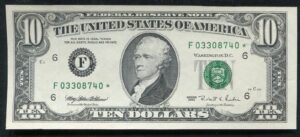
When a serial number smear error appears on a star note, the replacement note printed to substitute for a defective sheet, collector interest intensifies considerably. Star notes already carry a premium because of their lower print runs. A smear error on a star note represents two independent rarity factors combining in a single piece. Series 1993 $1 Federal Reserve Notes from the Atlanta district (prefix F, star suffix) are known with minor serial smears from a print run of approximately 3,200,000 notes, a relatively modest run that makes any surviving error from that batch desirable. A PMG-graded Extremely Fine 40 example of a star note smear from the Chicago district (Series 1985, prefix G) realized $2,100 at Heritage in March 2022.
Grading Considerations Specific to Smear Errors
Standard paper money grading criteria apply to the note itself, but PMG and PCGS Currency both annotate smear errors with a brief qualifier on the holder label, typically reading “Serial Number Ink Smear” or “Overprint Ink Smear.” The grade assigned reflects the physical condition of the paper, not the severity of the error. This creates an interesting valuation dynamic: a Fine 15 example with a truly dramatic, full-serial smear may be worth more to an error specialist than a Very Fine 30 example with a minor one-digit smear, even though the latter grades higher. Severity of the error, not just paper grade, drives premium pricing in this category.
Collectors should also be aware that PMG distinguishes between overprint smears (ink applied wet by the press) and what the service calls “printing smears” caused by mechanical contact with already-dry ink. These are cataloged differently and carry different market values. The former is generally considered more desirable because it represents a failure in the overprint process itself rather than incidental contact during sheet handling.
Post-Issue Alterations and How to Spot Them
The relative simplicity of smearing green ink on a serial number has unfortunately attracted a small number of fraudulent alterations. The most common involves applying a commercially available green ink or fine-tipped marker to a circulated note, attempting to simulate a press smear. These fakes almost always fail the raking-light test described earlier. They also tend to show a uniform ink density across the smear trail, whereas a genuine press smear thins and lightens as the drag force dissipates. A third red flag is edge sharpness: genuine smear ink at the outer edge of the trail shows a feathered, fiber-following boundary. Pen or marker ink typically shows a sharper, more defined boundary, even when the forger attempts to feather it manually.
Submitting any significant smear error purchase to PMG or PCGS Currency for authentication and encapsulation before paying premium money is strongly recommended. Both services have decades of experience with overprint anomalies and will identify post-issue alterations reliably.
Before submitting a smear note for grading, photograph it under both direct light and raking light using a smartphone macro lens or a dedicated numismatic USB microscope. Keep these images on file. If PMG or PCGS grades the note and returns it in a holder, those pre-submission images document the error’s original appearance and can serve as provenance support if you ever resell the note.
| Series / Denomination | Variety or District | Approx. Notes Surviving | Rarity |
|---|---|---|---|
| 1928-B $1 Silver Certificate | Full serial drag smear, any block | Fewer than 10 confirmed | Key Date |
| 1950-B $5 FRN | Severe smear, New York or Chicago (Fr. 1963-B/G) | 20 to 35 estimated | Rare |
| 1963-A $1 FRN | Partial serial smear, any district | 75 to 100 estimated | Scarce |
| 1969-C $1 FRN Star Note | Serial smear, Boston or Richmond star | 15 to 25 estimated | Rare |
| 1977 $1 FRN | Minor one to two digit smear, various districts | 200+ estimated | Common |
| 1985 $1 FRN Star Note | Serial smear, Chicago (G*) | 30 to 50 estimated | Scarce |
| 1988-A $20 FRN | Severe four-digit trailing smear, any district | 40 to 60 estimated | Scarce |
| 1993 $1 FRN Star Note | Serial smear, Atlanta (F*) | 50 to 80 estimated | Scarce |
| 1995 $1 FRN | Minor smear, high-run districts (B, G, K) | 300+ estimated | Common |
| 2003-A $100 FRN | Serial smear affecting prefix letters and first two digits | Fewer than 20 confirmed | Rare |
Building a Collection Around This Error Type
For collectors entering the smear error category, a tiered approach works well. Start with common Series 1977 or Series 1995 one-dollar smear errors in Fine to Very Fine grades. These can often be found in the $150 to $350 range at major auction venues or from established error currency dealers, and they allow you to handle genuine examples and develop authentication confidence. The Paper Money Guaranty population reports (available on the PMG website) list graded smear error notes by series and denomination, giving you a rough sense of relative availability before you commit to a purchase.
The mid-tier consists of scarce examples from the 1950s through 1969 period, or star note smears from any era. Budget $400 to $1,200 for meaningful examples in the VF to EF range. The top tier, full-serial drag smears on large denominations, pre-1950 examples, or star notes with severe smearing, can exceed $3,000 in auction and should be pursued only in certified holders from PMG or PCGS Currency.
The Friedberg reference, “Paper Money of the United States” by Arthur L. and Ira S. Friedberg (currently in its 22nd edition), does not specifically catalog individual error varieties, but its serial number prefix and district tables are indispensable for contextualizing where a smear note fits within the larger production history of its series. The “Standard Guide to Small-Size U.S. Paper Money” by Dean Oakes and John Schwartz provides additional detail on overprint characteristics by series and is worth having on your reference shelf.
Conclusion: Why These Errors Deserve a Place in Any Serious Collection
Serial number ink smear errors are, at their core, documentary evidence that the mechanical process of manufacturing American currency was imperfect, that presses hesitated, ink ran too wet, and sheets shifted at the wrong moment. Each genuine example that survived quality control at the BEP, entered circulation or was found by a sharp-eyed collector before being spent, and eventually made its way into a certified holder represents a small miracle of survival. The combination of visual drama, authentication complexity, and genuine rarity across certain series and denominations makes this error category both intellectually engaging and financially rewarding for collectors willing to learn it thoroughly. Whether you are examining your first $150 one-dollar smear or bidding on a four-figure star note example at auction, the analytical skills and historical context outlined here will serve you well every step of the way.