📷 Image source: banknote.ws (World Banknote Gallery). Images are selected by AI to represent the article topic and may not depict the exact note(s) described.
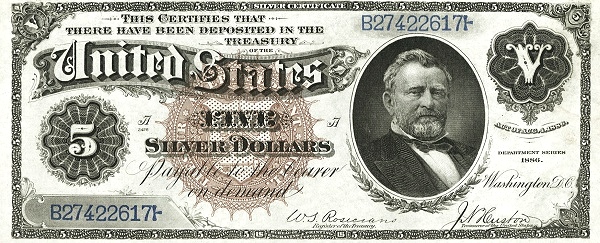
Pick up a 1902 Plain Back National Bank Note and hold it to a strong light source. Before you look at the design, before you assess the margins, before you count the folds, feel the note between your fingers. Does it have that crisp, almost cardboard-like resistance that serious collectors call “body”? Or does it feel limp, tired, or dangerously fragile? That tactile first impression tells an experienced grader an enormous amount, because paper strength sits at the very foundation of large-size note evaluation. A spectacular 1899 $5 Silver Certificate with a bold Black Eagle vignette can be derailed from a PMG 35 Choice Very Fine all the way down to a 25 Very Fine, or worse, simply because the paper has lost its integrity over the past 110-plus years.
Why Large-Size Paper Is Different from Small-Size Paper
Before diving into specific defects, it helps to understand what large-size currency paper actually is. Bureau of Engraving and Printing records and historical analyses confirm that the cotton-linen blend used throughout the large-size era (roughly 1861 to 1928) was produced by several contracted mills, most notably Crane and Company of Dalton, Massachusetts, which has supplied currency paper since 1879. This fiber composition gives genuine large-size notes a characteristic feel, a slight texture from the embedded red and blue silk fibers, and, when properly preserved, a resilience that can survive more than a century in remarkable shape.
However, large-size notes are more susceptible to environmental degradation than their small-size successors for one practical reason: size. A 7.375 by 3.125 inch large-size note has significantly more surface area exposed to humidity fluctuations, acidic envelopes, rubber band chemicals, and the mechanical stress of folding than a modern 6.14 by 2.61 inch note. The edges, corners, and fold intersections are the first places paper fiber breakdown becomes visible to graders.
The Three Core Paper Strength Defects Graders Identify
1. Soft Paper: The Subtle Grade Killer
Soft paper is arguably the most common paper-strength defect encountered in large-size notes, and it is also the most frequently overlooked by newer collectors. A note with soft paper has not necessarily been washed or pressed, though those practices certainly contribute to softness. More often, soft paper is simply the result of decades of high humidity exposure, which breaks down the inter-fiber hydrogen bonds in the cotton-linen matrix. The note does not look damaged at first glance. The ink may be bold, the margins generous, and the overall appearance appealing. But when held between thumb and forefinger and gently flexed, it offers little resistance. It flops rather than snaps.
PMG’s grading standards explicitly note that paper quality, including body and crispness, factors into the final numeric grade. A 1901 $10 Legal Tender (Fr. 114 to Fr. 122, the famous Bison or Buffalo Note series) in apparent VF condition with soft paper will typically grade PMG 25 rather than 30, because the evaluator recognizes that the paper no longer reflects the note’s original manufactured state. On the collector market, a PMG 25 Bison Note in a popular Speelman-White signature combination (Fr. 121) might trade for $800 to $1,200, while an equivalent PMG 30 with normal paper body commands $1,600 to $2,200, illustrating the very real financial consequence of soft paper.
When evaluating a large-size note for purchase, ask the seller to hold the note by one corner and let the body hang freely. A note with healthy paper body will hold relatively flat or show only slight droop. A note with soft paper will bow significantly, almost folding under its own weight. This simple test, performed carefully, tells you more about paper strength than almost any visual inspection.
2. Brittle Paper: The Structural Time Bomb
Where soft paper has lost elasticity through moisture, brittle paper has undergone acid hydrolysis, a chemical process in which the cellulose fibers themselves degrade and shorten. Brittle paper most commonly develops when notes have been stored in acidic environments such as old newspaper wrappings, ungummed glassine envelopes with residual sulfur compounds, or wooden boxes with high tannin content. Civil War-era Demand Notes (1861, Fr. 1 through Fr. 7) and First Issue Fractional Currency pieces are among the most frequently encountered brittle large-size pieces, simply because of their age and the storage conditions prevalent in the 1860s through early 1900s.
A brittle note feels stiff, but not in the desirable way of a crisp uncirculated piece. The stiffness is crystalline and unforgiving. When a brittle note is flexed even slightly, you can sometimes hear a faint crackling sound, and the fiber surface may show a network of micro-cracks, visible under 5x to 10x magnification. In severe cases, the paper begins to flake at the edges or along old fold lines, a condition graders describe as “paper loss” when the flaking has already removed design elements.
Grading services handle brittle notes with significant caution. PMG and PCGS Currency both assign qualifier language such as “Brittle Paper” or “Paper Issues” on the certification label when the condition is notable but has not yet caused structural failure. A 1862 $1 Legal Tender (Fr. 16 to Fr. 17, the first dollar bill issued by the federal government) with brittle paper and no splits or losses might grade PMG 15 Choice Fine, but the qualifier label communicates the risk to future handlers and suppresses auction realized values by 30 to 50 percent compared to a clean example at the same numeric grade.
Never attempt to flatten or remove folds from a brittle large-size note. What looks like a simple crease could be the last intact fiber connection across a fold line. Professional conservators at institutions like the Library of Congress use controlled humidity chambers and Japanese tissue reinforcement for brittle currency consolidation. Home humidification attempts with brittle paper almost always cause irreversible splits.
3. Split Paper: When Integrity Is Compromised
A split occurs when the paper fibers at a fold line or along an edge have separated completely, creating a visible gap or tear in the note’s surface. Splits range from a hairline separation of 1 to 2 millimeters at a corner to a complete edge split that runs a centimeter or more into the design field. Graders categorize splits by location (margin versus design field), length, and whether they have been previously repaired with tape or adhesive, a discovery that significantly complicates both grading and value.
For a practical example, consider the 1886 and 1891 $1 Silver Certificate series (Fr. 215 through Fr. 224), which are extremely popular with type collectors. These notes circulated heavily and are frequently encountered with fold splits at the intersection of horizontal and vertical folds in the note’s center. A PMG VF 20 example of the Fr. 223, the 1891 $1 Silver Certificate with Martha Washington portrait, might show two small margin splits that do not enter the design. That same note, if the splits were to enter the portrait vignette even 3 to 4 millimeters, would typically fall to a PMG F 15 with the “Split” qualifier, dropping realized auction values from the $300 to $400 range into the $150 to $200 range.
Tape repairs on splits create the most complex grading scenarios. Both PMG and PCGS Currency note tape repairs explicitly on their labels. A tape-repaired split on a common series note like the 1917 $1 Legal Tender (Fr. 36 to Fr. 39, printed in quantities exceeding 1 billion notes across the series) is essentially fatal to collectible value. But on a genuinely rare note, a tape-repaired split is simply part of the survival story. A Fine-details 1861 $5 Demand Note (Fr. 2, the Boston issue with print runs estimated at only 40,000 notes) with a tape-repaired split at a fold might still realize $4,000 to $6,000 at a major auction precisely because original survivors in any condition are so scarce.
When examining ungraded large-size notes under a UV (ultraviolet) light, old tape repairs become immediately visible as rectangular fluorescent areas, even after the tape has been physically removed. Many dealers remove deteriorated tape from notes before selling them, but UV examination reveals the repair history. Always UV-check any significant large-size purchase before committing to a price.
How Graders Quantify Paper Strength: The Evaluation Process
Professional currency graders at PMG and PCGS Currency evaluate paper strength through a combination of tactile assessment, transmitted light examination (backlighting), and magnification. Transmitted light is particularly revealing: a note placed on a light box shows areas of fiber thinning as brighter regions, often invisible under normal reflected light. A note that appears VF 30 under reflected light might reveal thinning across the entire central fold area under transmitted light, pushing the grade to F 15 with a qualifier.
The grading community generally recognizes the following grade impacts for paper strength defects, though every note is evaluated individually:
- Minor softness with retained body: 0 to 1 grade point deduction, typically no qualifier label
- Significant softness or paper lacking body: 1 to 2 grade point deduction, may receive “Apparent” designation
- Brittle paper without splits: 1 to 2 grade point deduction plus qualifier label
- Brittle paper with minor edge splits: 2 to 3 grade point deduction plus qualifier label
- Split entering design field: 2 to 3 grade point deduction plus qualifier label
- Tape-repaired split: Graded on a net grade basis with “Apparent” or “Details” designation
Series-Specific Vulnerabilities Worth Knowing
Not all large-size series are equally prone to paper issues. The 1902 Date Back and Plain Back National Bank Notes, issued through thousands of individual bank charters, vary enormously in paper quality based on storage conditions maintained by individual bank archivists and subsequent collectors. High-denomination notes like the 1902 $50 and $100 National Bank Notes (Fr. 664 through Fr. 717) saw limited circulation and are often found with better paper body than their lower-denomination counterparts, which passed through more hands.
Gold Certificate issues from 1882 through 1922 tend to exhibit slightly better average paper strength than contemporary Legal Tender or Silver Certificate issues, possibly due to their treatment as store-of-value instruments rather than everyday transaction currency. A 1922 $10 Gold Certificate (Fr. 1173) in Very Fine condition with solid paper body is a realistic and affordable acquisition for a collector on a moderate budget, typically realized at $150 to $250 in PMG VF 25 to 30 holders with clean paper notes.
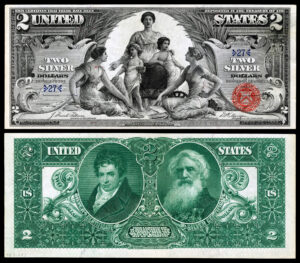
The Educational Series Silver Certificates of 1896, specifically the $1 Fr. 224 (History Instructing Youth), $2 Fr. 247 (Science Presenting Steam and Electricity), and $5 Fr. 270 (America), are among the most visually stunning large-size notes ever produced, but they are also among the most challenging from a paper strength perspective. The extremely complex intaglio printing on both faces required multiple press passes, creating slightly stiffer paper initially, but the interaction of multiple ink layers with the paper substrate over 125-plus years has made marginal splits and paper thinning common in circulated grades.
When building a type set of large-size notes, budget for the paper quality premium. A PMG 30 Very Fine note with solid paper and no qualifiers is often a better long-term investment than a PMG 35 Choice Very Fine with a “Soft Paper” or “Paper Issues” qualifier, even if the apparent visual grade of the 35 looks better in hand. The market increasingly recognizes and prices paper quality as a separate dimension of value, and that trend is likely to continue as the collector base becomes more sophisticated.
| Series / Type | Friedberg Numbers | Paper Survival Challenge | Rarity |
|---|---|---|---|
| 1861 Demand Notes | Fr. 1 to Fr. 7 | Extreme: brittle and split paper near-universal in circulated grades | Key Date |
| 1862-1863 Legal Tenders ($1 and $2) | Fr. 16 to Fr. 41 | High: acid degradation from 19th-century storage very common | Rare |
| 1896 Educational Series Silver Certs | Fr. 224, Fr. 247, Fr. 270 | Moderate to high: edge splits and thinning common in VF and below | Rare |
| 1886 and 1891 $1 Silver Certificates | Fr. 215 to Fr. 224 | Moderate: center fold splits frequent due to heavy circulation | Scarce |
| 1901 $10 Legal Tender (Bison Note) | Fr. 114 to Fr. 122 | Moderate: soft paper common, strong paper commands large premium | Scarce |
| 1902 National Bank Notes (Date Back) | Fr. 626 to Fr. 663 | Variable: quality depends heavily on individual bank storage history | Scarce |
| 1922 $10 Gold Certificate | Fr. 1173 | Low to moderate: high-denomination treatment preserved many examples | Common |
| 1917 $1 Legal Tender | Fr. 36 to Fr. 39 | Low: massive print runs mean healthy survivors are readily available | Common |
| 1899 $5 Silver Certificate (Black Eagle) | Fr. 270 to Fr. 282 | Moderate: popular series with wide quality range; verify paper carefully | Scarce |
Conclusion: Paper Strength as a Collecting Discipline
Evaluating paper strength in large-size notes is not a skill that develops overnight. It requires handling hundreds of notes across multiple series, calibrating your sense of what normal body feels like for a given type, and developing the habit of backlighting every note before purchase. The collectors who consistently find value in the large-size market are those who understand that a visually appealing note with compromised paper is not the bargain it appears to be, and conversely, that a note with exceptional paper body can justify a premium even if its aesthetic grade seems modest.
The grading services have done the hobby a genuine service by codifying paper quality into their labeling systems. Qualifier language like “Brittle Paper,” “Soft Paper,” and “Split” on a PMG or PCGS Currency holder communicates critical structural information that protects buyers and creates a more transparent market. As you build your large-size collection, let paper strength guide your acquisitions as much as series completeness or visual appeal. A 1901 Bison Note that cracks when flexed will never be a great note regardless of its grade. One that snaps like the day it left the Bureau of Engraving and Printing is a treasure, whatever grade it carries.