📷 Image source: banknote.ws (World Banknote Gallery). Images are selected by AI to represent the article topic and may not depict the exact note(s) described.
Imagine reaching into your pocket in 1863 and pulling out a note smaller than a playing card, bearing the stern, helmeted profile of the Roman goddess of wisdom and war. This was everyday reality for millions of Americans during and after the Civil War, when coin hoarding stripped the nation of small change and the Treasury Department scrambled to fill the void with Fractional Currency. Among the most visually compelling of these miniature notes are those featuring the helmeted head of Minerva, a design choice that was anything but accidental. The goddess embodied wisdom, craft, and martial strength, qualities the beleaguered Union government was eager to project onto even its most humble monetary instruments.
The Emergency That Created Fractional Currency
The story of Minerva on small-change paper begins not in a design studio but in a panic. When the Civil War erupted in April 1861, citizens across the North began hoarding gold and silver coins, anticipating prolonged conflict and economic instability. By the summer of 1862, even copper cents had virtually vanished from circulation. Merchants resorted to postage stamps, privately issued scrip, and tokens to make change. The chaos was so severe that Congress authorized the use of postage stamps as currency in July 1862, creating the short-lived Postage Currency series (the First Issue of Fractional Currency).
Those first issues, authorized by the Act of July 17, 1862, featured reproductions of actual postage stamp designs and were never meant to be permanent. Congress quickly moved to formalize the program. The Act of March 3, 1863, authorized a true Fractional Currency system managed by the Treasury, with denominations of 3, 5, 10, 25, and 50 cents issued through five separate series between 1862 and 1876. It is in the Third Issue (1864-1869) and the Fifth Issue (1874-1876) that Minerva makes her most prominent appearances.
Minerva in the Third Issue: 1864 to 1869
The Third Issue of Fractional Currency represents the most artistically ambitious phase of the program. Treasury officials, working with the Bureau of Engraving and Printing’s predecessors, commissioned designs that moved decisively away from the postage-stamp aesthetic toward proper allegorical portraiture. Minerva, the Roman goddess identified with the Greek Athena, was a natural choice. She symbolized wisdom, the arts, and strategic warfare, all qualities associated with republican virtue and, by implication, the Union cause.
The most celebrated Minerva note from the Third Issue is the 25-cent note, Friedberg 1290 through 1297. The obverse displays a finely engraved right-facing portrait of Minerva wearing a crested helmet, rendered with extraordinary detail given the tiny 68mm x 38mm format. The reverse varies by variety, with red or fiber paper treatments accounting for several catalog numbers. A particularly important variety is the Fr. 1291, which features a red surcharge on the face. In VF-20 condition these trade in the $40-$80 range, while Gem Uncirculated (65 EPQ) examples certified by PMG or PCGS Currency can reach $300 to $500.
Third Issue 25-cent Minerva notes with fiber paper (security threads embedded in the paper itself) carry a premium over plain paper examples. Check catalog numbers carefully: Fr. 1294 (fiber paper, no surcharge) is noticeably scarcer than Fr. 1290 in high grades, yet many dealers list them at similar prices. A sharp eye on paper type can reveal undervalued inventory.
The Third Issue 50-cent denomination also features Minerva, cataloged as Fr. 1331 through 1342. These larger notes, measuring approximately 84mm x 47mm, allowed engravers more canvas to render the goddess in greater detail. The helmeted portrait on the 50-cent obverse is widely considered the finest Minerva engraving in the entire Fractional Currency series. Key varieties include the Fr. 1336 with a red fiber paper reverse and the scarcer Fr. 1339 with green back. The Fr. 1339 in Fine-15 can command $150 or more, with Uncirculated examples reaching into four figures at major auction.
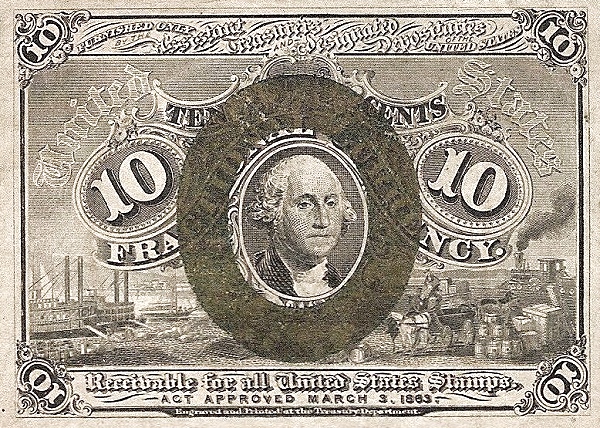
A small-denomination Minerva also appears on the Third Issue 10-cent note, Fr. 1251 through 1258. Here the goddess is depicted in a smaller oval vignette, still helmeted but rendered more compactly. These 10-cent notes are among the most affordable entry points into Minerva collecting, with circulated examples available for $20 to $60 depending on variety and grade.
Why Classical Allegory? The Politics of Design
The decision to place Minerva and other classical figures on Fractional Currency was deliberate statecraft in miniature. Treasury Secretary Salmon P. Chase and his successors understood that paper money functioned as a form of government propaganda, visible to virtually every citizen regardless of literacy level. Portraits of living politicians were occasionally used (Chase himself appeared on the First Issue 1-cent Demand Note era notes), but allegory offered a timeless authority that transcended partisan controversy.
Minerva specifically invoked the great republics of antiquity. Rome and Greece had employed her image on coinage for centuries, and American neoclassicism, then at its peak in architecture, sculpture, and public art, made her immediately recognizable as a symbol of enlightened governance. Placing her on emergency scrip was a subtle but powerful statement: even in crisis, the United States remained a republic guided by wisdom and reason, not desperation.
When building a Minerva-themed Fractional Currency set, consider acquiring one example of each denomination (10 cents, 25 cents, 50 cents) in the same grade tier to display as a matched set. A Fine-15 to VF-20 set of the three primary Third Issue Minerva notes can typically be assembled for under $250, making this an exceptional value compared to analogous sets in large-size currency.
Proof and Specimen Notes: The Collector’s Holy Grail
No discussion of Minerva Fractional Currency is complete without addressing the proof and specimen notes produced for display and archival purposes. The Treasury Department and the private security printing firms it contracted, including the American Bank Note Company and the National Currency Bureau (precursor to the Bureau of Engraving and Printing), routinely struck proof impressions on card stock or India paper for record-keeping and presentation purposes.
These proof notes feature the Minerva design printed with exceptional sharpness and often mounted on presentation cards. They were not intended for circulation and survive in genuinely small numbers. A proof impression of the Third Issue 50-cent Minerva note (Fr. 1331 proof) can command $1,500 to $3,500 at major auction houses including Heritage Auctions and Stack’s Bowers, depending on condition and provenance. The 2023 Heritage FUN Currency sale featured a PMG-graded 64 EPQ proof example of the Fr. 1336 50-cent Minerva that realized $2,160.
Specimen notes with “SPECIMEN” overprints or punch cancellations are similarly prized. Collectors should be aware that some spurious overprints exist in the marketplace; authentication by PMG or PCGS Currency is strongly recommended for any proof or specimen purchase above $500.
The Fifth Issue: Minerva’s Farewell Appearance
The Fifth and final Issue of Fractional Currency, authorized by the Resumption Act of 1875 and issued through 1876, features a simplified Minerva design on the 10-cent note (Fr. 1264 through 1266). By this point the nation was preparing to return to specie payments, and the artistic ambitions of the Third Issue had given way to more economical designs. The Fifth Issue Minerva is a smaller, somewhat less detailed portrait, but the helmeted goddess remains recognizable and charming in her diminutive format.
These Fifth Issue 10-cent notes are among the most common Minerva Fractional notes in circulated grades, with Fr. 1264 readily available in VG to Fine condition for $15 to $35. However, Gem Uncirculated examples are surprisingly elusive: the notes circulated heavily right up until silver coin redemption resumed in January 1879, and most surviving examples show significant wear. A PMG 65 EPQ Fifth Issue 10-cent Minerva is a legitimately difficult note to locate and can bring $200 or more when certified.
The Fifth Issue 10-cent Minerva notes (Fr. 1264-1266) are often overlooked by advanced collectors who focus on the more dramatic Third Issue designs. This creates an opportunity: high-grade Fifth Issue examples are genuinely scarce in certified populations but priced modestly because demand is lower. Check PCGS CoinFacts and PMG’s population reports before purchasing, as the certified population in grades above MS-63 is often in the single digits.
Condition Grading Challenges Specific to Fractional Notes
Grading Fractional Currency presents unique challenges that collectors must understand before buying. These notes are tiny, and the paper used in the 1860s and 1870s was not archival quality. Common problems include:
- Toning and oxidation: The fiber security threads in some varieties oxidize over time, creating dark streaks visible through the paper.
- Trimming: Many Fractional notes were cut from printed sheets with scissors rather than guillotine cutters, leaving uneven margins. Notes with full, even margins command significant premiums.
- Staining: Small size made these notes prone to pocket moisture and food staining.
- Folds: Even a single vertical fold drops a note from Gem to Fine territory in many cases, given the small dimensions.
The EPQ (Exceptional Paper Quality) and PPQ (Premium Paper Quality) designations from PMG and PCGS Currency respectively are especially meaningful for Fractional Currency. An EPQ designation on a high-grade Minerva note confirms that no cleaning, pressing, or artificial enhancement has occurred, and it typically adds 20 to 40 percent to realized prices at auction.
Building a Minerva Fractional Currency Collection
There are several logical approaches to collecting Minerva Fractional Currency, suited to different budgets and interests. A denomination set targets one example of each Minerva-bearing denomination across all issues, requiring three to four notes in the $50 to $300 range depending on grade. A variety set attempts to complete every Friedberg-cataloged Minerva variety, a more ambitious project requiring perhaps 15 to 20 notes and a budget of $500 to $2,000 for mid-grade examples. At the pinnacle, a registry-quality set pursuing certified Gem examples across all varieties and including at least one proof note represents a multi-year project with a budget in the $5,000 to $15,000 range.
For new collectors, the best starting point is a circulated Third Issue 25-cent Minerva (Fr. 1290 or 1291) purchased from a reputable dealer or PCGS/PMG-certified at auction. These are available, affordable, and immediately convey the artistic achievement of these remarkable little notes.
| Friedberg No. | Denomination / Issue | Variety Detail | Rarity |
|---|---|---|---|
| Fr. 1290 | 25 cents, Third Issue | No surcharge, plain paper | Common |
| Fr. 1291 | 25 cents, Third Issue | Red surcharge, plain paper | Common |
| Fr. 1294 | 25 cents, Third Issue | Fiber paper, no surcharge | Scarce |
| Fr. 1297 | 25 cents, Third Issue | Fiber paper, red surcharge | Scarce |
| Fr. 1336 | 50 cents, Third Issue | Red fiber, Spinner autograph | Rare |
| Fr. 1339 | 50 cents, Third Issue | Green back, fiber paper | Rare |
| Fr. 1331 (Proof) | 50 cents, Third Issue | Proof on India paper | Key Date |
| Fr. 1251 | 10 cents, Third Issue | No surcharge, plain paper | Common |
| Fr. 1258 | 10 cents, Third Issue | Fiber paper, autographed | Scarce |
| Fr. 1264 | 10 cents, Fifth Issue | Green seal, standard | Common |
| Fr. 1266 | 10 cents, Fifth Issue | Gem Unc. (65 EPQ or higher) | Key Date |
The Lasting Legacy of Minerva in American Currency
The helmeted Minerva on Fractional Currency represents a brief but brilliant chapter in American numismatic art. For roughly twelve years, from 1864 to 1876, the goddess of wisdom gazed out from the nation’s smallest denomination notes, a daily reminder that even in the chaos of war and economic reconstruction, the United States aspired to the ideals of classical republican civilization. When specie payments resumed in 1879 and Fractional Currency was retired, Minerva’s tenure on American paper money effectively ended. She would appear again on certain revenue stamps and bond vignettes, but never again on circulating currency.
Today, collecting these tiny monuments to classical allegory is one of the most intellectually rewarding specialties in American paper money. The notes are affordable at most grade levels, richly varied in their catalog numbers, and steeped in historical context that connects numismatics to art history, political history, and the economic story of the Civil War era. Whether you acquire a single circulated 25-cent Minerva for $30 or spend years assembling a complete proof set, the helmeted goddess rewards careful study and genuine appreciation.
The standard reference for Fractional Currency collectors remains Robert Friedberg’s “Paper Money of the United States,” but serious specialists should also consult Milton R. Friedberg and Jack Friedberg’s updated editions alongside Neil Shafer and Tom Bain’s “Standard Guide to Small-Size U.S. Paper Money.” For Fractional Currency specifically, the Fractional Currency Collectors Board (FCCB) maintains an active community with a dedicated newsletter and census data that supplements the commercial grading services’ population reports.